The Heart of Giving (Luke 20:45-21:4)

As all the people were listening, Jesus said to his disciples, “Beware of the experts in the law. They like walking around in long robes, and they love elaborate greetings in the marketplaces and the best seats in the synagogues and the places of honor at banquets. They devour widows’ property, and as a show make long prayers. They will receive a more severe punishment.”

Jesus looked up and saw the rich putting their gifts into the offering box. He also saw a poor widow put in two small copper coins. He said, “I tell you the truth, this poor widow has put in more than all of them.For they all offered their gifts out of their wealth. But she, out of her poverty, put in everything she had to live on.” (New English Translation)

Holy Scripture is replete with contrasting characters. A common teaching device of the ancient world, as well as Jesus, was to make clear narrative contrasts between different persons or groups. In the telling of the story, it would be evident that one is virtuous and the other not. In contemporary terms, we refer to such characters in a story as the protagonist and the antagonist.

It is abundantly clear, in today’s Gospel lesson, who is the godly virtuous person and who is not. Jesus is the one who illumined the contrast because it was not evident to the crowd of people.

You often cannot tell a fake by the external appearance. 

A pious religious person on the outside may not necessarily be a genuine Christ follower on the inside. And, conversely, a poor, old, bedraggled person may seem unimpressive on the outside, yet has a lush garden for a soul on the inside.

The religious experts in Christ’s day liked to do things for a show, for the attention. They were important and respected people, desiring and enjoying the accolades of others. They lived to be noticed. 

In reality, however, it was all a façade, a carnival sideshow. The outside and the inside were incongruent to each other. Their very selves were fragmented, not integrated; disparate, not synced together. The false self, displayed for others, hid a darkened true self underneath.

But Jesus saw them inside-and-out. He named the hypocrisy and condemned it.

There is a marked contrast between the rich and respected religious experts and the poor overlooked widow. Whereas the rich men put a wad of money in the temple offering for everyone to see, the impoverished widow put barely anything in. Yet, it was everything she had to give. 

The widow’s outward giving and inward disposition were perfectly matched. She gave everything out of the abundance of her heart. There was integrity, congruence, and a complete synthesis of the inner and outer person.

And Jesus saw her, inside-and-out. He named the genuineness and affirmed it.

The kingdom of God is not a matter of outward eating and drinking and ostentatious displays of spirituality; it is rather a matter of inner righteousness, peace, and joy in the Holy Spirit. (Romans 14:17)

We are to beware of those who do things for a show – who try and appear pious, while on the inside, they only have self-serving agendas. For the hypocrite, giving is more like a business transaction; I give money – you give respect and attention.

Remember that the person who plants few seeds will have a small crop; the one who plants many seeds will have a large crop. You should each give, then, as you have decided, not with regret or out of a sense of duty; for God loves the one who gives gladly. (2 Corinthians 9:6-7, GNT)

But giving is not designed by God to be done so people will admire and see what wonderful Christians we are, or so that others will know that we have done our proper duty. 

If our motive for giving is for others to admire us, then we will likely receive exactly what we want – and nothing more. There will be no reward from God because God isn’t even in the picture.

“Be careful not to practice your righteousness in front of others to be seen by them. If you do, you will have no reward from your Father in heaven.

“So, when you give to the needy, do not announce it with trumpets, as the hypocrites do in the synagogues and on the streets, to be honored by others. Truly I tell you, they have received their reward in full. But when you give to the needy, do not let your left hand know what your right hand is doing, so that your giving may be in secret. Then your Father, who sees what is done in secret, will reward you. (Matthew 6:1-4, NIV)

Giving is important and, I believe, needs to happen much more than it does. And there is also much more to the act of giving than placing money in an offering plate, supporting humanitarian causes, or donating resources; it involves the heart and the motives behind it. 

If I give because I want people to see how generous and benevolent I am; or to gain attention and approval; or to let people know how they need to act or change; then I have ceased to truly give. 

If I give away everything that I have and hand over my own body to feel good about what I’ve done but I don’t have love, I receive no benefit whatsoever.

1 Corinthians 13:3, CEB

Let’s call it something else: “The Me Show.” Tuning into “The Me Show” is not good. Giving is not supposed to be a circus with me in the center ring of the big top. Instead, giving is to be a heartfelt, genuine connection with both God and our fellow humanity. If it isn’t this, then we are spiritual clowns who think we need to perform more than we need to steward our God-given resources.

Yet, if we will but aim for the heart, the hands will follow with sincere generosity and grace.

Loving God, my heart longs to worship you with everything I possess. Transform me from the inside-out so that all my thoughts and motives may humbly express my words and actions, to the glory of Jesus Christ your Son, our Lord, who with you and the Holy Spirit are One God, now and forever. Amen.

What Will It Take to Reach Others? (1 Corinthians 9:19-23)

Even though I am free of the demands and expectations of everyone, I have voluntarily become a servant to any and all in order to reach a wide range of people: religious, nonreligious, meticulous moralists, loose-living immoralists, the defeated, the demoralized—whoever. I didn’t take on their way of life. I kept my bearings in Christ—but I entered their world and tried to experience things from their point of view. I’ve become just about every sort of servant there is in my attempts to lead those I meet into a God-saved life. I did all this because of the Message. I didn’t just want to talk about it; I wanted to be in on it! (The Message)

What will it take? 

What will it take to impact the world with the gospel of grace? 

What will it take to reach your neighbor with the love of God in Christ? 

What will it take to positively influence your relative, co-worker, or friend in grace and truth? 

The answer? It will take becoming a servant to them all. 

Reaching others with the glorious and incredible good news of forgiveness and new life in Jesus requires us to relinquish our rights and freedoms in order to have a ministry of presence. 

Somehow, far too many Churches and Christians have adopted the wrongheaded notion that they can reach people without interacting with them. They wing-it with a few tepid prayers, wishing that people will magically show up their church or event in order to experience their friendliness.

But it takes going to where people are and engaging in real human relationship to reach another person. It ought to be obvious, yet it isn’t for a lot of folks:

We have to be around other people in order to reach them. 

That’s why reaching the party-crowd takes going to the bar. 

It’s why reaching young moms takes sitting with them at the park while the kids play. 

It’s why reaching kids requires getting on the floor with them and playing what they want to play.

This is why it takes being present among the various people, businesses, and institutions in the community in order to reach them.

The goal is not to get other people to show up on our turf and become just like us. The goal is not for us to remain in comfortable surroundings while we expect others to get over their uncomfortableness to be with us.

Rather, the goal is to show up on their turf and relate to them, to become like them.

If it weren’t in the Bible we might think it blasphemous to say such a thing. But there it is, and we must wrestle with its implications for our lives. So, what needs to change?

My wife and I have a lot of experience working with dementia and Alzheimer’s patients – which means we also end up working a lot with their adult children and grandchildren. It’s difficult watching a person who raised you becoming a different person, living in a different world.

Many relatives try their darndest to get mom or dad back into “reality,” to return to their original selves and their surroundings. So, they correct, cajole, and criticize, in order to reach them and pull them back from their supposed mental abyss.

And it doesn’t work. More than that, it’s not only unhelpful, but it’s also often hurtful.

Instead of expecting a dementia patient to come into my world, I must go into their world.

Just the other day, my wife was talking with a self-described “Ninja Priestess.” And this dear woman was refusing to wear her socks on a hospital floor – which cannot happen in a healthcare setting. She didn’t want to wear them because “it diminishes my power and my connection to the ground.”

If we insist on remaining in our world, this immediately becomes a fight. Ultimatums are issued. Policies are pronounced. Security is called because everything escalates out of control.

Yet, if we enter the dear woman’s world, we choose to see things from her perspective and not ours.

My wife’s response? “It’s okay. The socks are cotton. All natural. They won’t hinder your power, at all.” And off they went together down the hall without incident and the patient feeling cared for and empowered.

When it comes to reaching people – anyone, no matter who they are – we must be willing to enter their world and be a part of it, seeing things as they see it, understanding where they’re coming from, without judgment and with plenty of empathy and compassion.

But if we insist on colonizing others in order to harvest their souls for our own spiritual benefit, then we have failed to understand the spirit and intent of the Apostle Paul’s teaching to us.

Being a servant means exactly that – serving others by listening, washing their feet, giving them time, and making compassionate connections.

God has cut us into the action of divine purposes in this world. This is privileged work. So, let’s do it with all the care and concern given us by the Spirit.

Merciful God, help us, your people, to live wisely among those who don’t yet know you, so that they can see the light of Christ in us, hear the words of Christ from us, and experience the salvation of Christ which is in us. Amen.

The Motivation of a Christian (Acts 4:1-12)

The Great Sanhedrin (Jewish ruling council) by Edouard Moyse, 1868

The priests and the captain of the temple guard and the Sadducees came up to Peter and John while they were speaking to the people. They were greatly disturbed because the apostles were teaching the people, proclaiming in Jesus the resurrection of the dead. They seized Peter and John and, because it was evening, they put them in jail until the next day. But many who heard the message believed; so, the number of men who believed grew to about five thousand.

The next day the rulers, the elders and the teachers of the law met in Jerusalem. Annas the high priest was there, and so were Caiaphas, John, Alexander and others of the high priest’s family. They had Peter and John brought before them and began to question them: “By what power or what name did you do this?”

Then Peter, filled with the Holy Spirit, said to them: “Rulers and elders of the people! If we are being called to account today for an act of kindness shown to a man who was lame and are being asked how he was healed, then know this, you and all the people of Israel: It is by the name of Jesus Christ of Nazareth, whom you crucified but whom God raised from the dead, that this man stands before you healed. Jesus is

“‘the stone you builders rejected,
    which has become the cornerstone.’

Salvation is found in no one else, for there is no other name under heaven given to mankind by which we must be saved.” (New International Version)

What motivates you? What is it that moves you to speak and act? What is your motivation in life? 

The answer to the question of motivation says a lot about the person. 

People are motivated by all sorts of things: to prove someone else wrong; to make a lot of money; to become famous; to help underprivileged kids in the inner city; to take on the problem of the world’s sex trade; to quietly make God known in everything. 

As you well know, our motivations can be rather selfish, or quite altruistic. Or both.

In today’s New Testament lesson, the Apostle Peter offered to the nation’s leaders his motivation. Peter was moved to have a dedicated ministry of proclaiming Jesus and healing in his name. 

Whereas the ruling religious authorities thought Jesus just another man, Peter’s conviction was that Jesus has the power to save. The name of Jesus Christ is the one which saves.

Our words and actions – what we actually say and do in life – comes from our deepest motivations. 

Peter’s proclamation the gospel through both word and deed came from his deep wellspring of knowing Christ. Peter believed that Jesus could deliver on life’s most pressing problems of guilt, shame, and sin.

For Christians everywhere, motivation comes from knowing Christ Jesus as Lord and him crucified, died, risen from death, ascended, and coming again. This, ideally, is an intrinsic motivation – and not simply something we feel we “have to” believe.

Intrinsic motivation is an internal desire, inspiring us to perform particular tasks. When we are intrinsically motivated, we start enjoying even those tasks that we never thought of as bringing joy.

I’m not particularly fond of housework. I don’t get an internal kick out of pushing a vacuum, doing laundry, or cleaning the house. But because my dear wife is limited in what she can do, I find that I actually enjoy these tasks. You see, I clearly link what I’m doing with my love for her – which, for me, makes all the difference. My intrinsic motivation to love my wife works it’s way out in the loving service of doing the necessary mundane tasks around the house.

An intrinsic motivation allows me to connect the task at hand as the good and beautiful thing to do.

Extrinsic motivation, on the other hand, comes from external factors exerting themselves on our lives. This isn’t necessarily a bad thing. When someone holds us accountable for following through on expectations, this is a good thing. Laws exist, ideally, as positive extrinsic motivations to do the right thing.

Being motivated to get good grades, a better job, or a trophy can be a powerful means of acting and speaking for good in the world. It’s just that sometimes we lose sight of why we do what we do, In those times, we then fail to connect with our original intrinsic desires to make a difference.

Unfortunately, a lot of churches get stuck here – simply doing the same things over and over and forgetting why they’re doing it – maybe acting a lot like the religious leaders of Peter’s day. Churches can too easily stray from making disciples of Christ to making followers of tradition. And then they wonder why they aren’t reaching anyone.

If we lack motivation, then we need to run to Jesus. When the believer’s deepest needs are met in Christ, the supernatural by-product is being moved to make Jesus known in every sphere of life. 

May it be so, to the glory of God.

Saving God, you have made your glory and grace known to me through your Son, the Lord Jesus.  May I know him better and better so that the motivations that impel me in life are pure, holy, righteous, and, above all, gracious. Amen.

Dealing with Grinding Pain (Psalm 79:1-9)

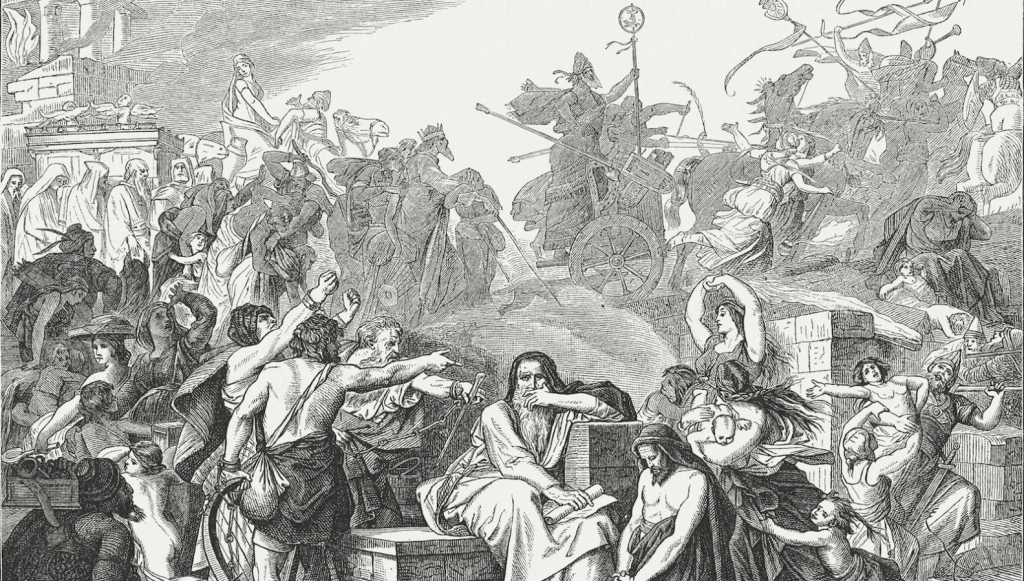
The Babylonian conquest of Jerusalem, by William Hole (1846-1917)

God, nations have come against your chosen people.
    They have ruined your holy Temple.
    They have turned Jerusalem into ruins.
They have given the bodies of your servants as food to the wild birds.
They have given the bodies of those who worship you to the wild animals.
They have spilled blood like water all around Jerusalem.
    No one was left to bury the dead.
We are a joke to the other nations;
    they laugh and make fun of us.

Lord, how long will this last?
    Will you be angry forever?
    How long will your jealousy burn like a fire?
Be angry with the nations that do not know you
    and with the kingdoms that do not honor you.
They have gobbled up the people of Jacob
    and destroyed their land.
Don’t punish us for our past sins.
    Show your mercy to us soon,
    because we are helpless!
God our Savior, help us
    so people will praise you.
Save us and forgive our sins
    so people will honor you. (New Century Version)

I don’t like evil. And I really don’t like arrogant people who want what they want and leave a path of destruction behind them.

The setting behind today’s Psalm is the destruction of the temple. It was razed by a conquering army who proudly gloated over their victory. This psalm, as all psalms, is a prayer. It’s a bitter and angry cry for God to step in and act on behalf of the humiliated people.

The psalm is more than a simple plea for help; it is a deeply passionate appeal. As a child of the 1960’s, my phrase for the psalmist’s entreaty is, “God, stick it to the man!”

There is no polite knock at the side door of God’s house in the face of such evil. This is a pounding on the front door with the demand for God to do something about this terrible trouble. For the psalmist, the incongruence between who God is and what has happened to God’s people is inconceivable and unacceptable.

To profane God’s temple is to profane God; and to kill and maim God’s people is to flip the middle finger at God. The psalmist is beside himself and overwhelmed with emotion.

There is something very instructive here that we ought not miss. When we have been brutalized, victimized, and/or demoralized, we just want someone, especially the Lord we serve, to take notice and feel what we are feeling.

Never underestimate the power of empathy and solidarity. To feel alone and bereft of help is an awful feeling.

Perhaps the psalmist’s prayer offends some sensibilities. I wonder, for those who find the language difficult, have ever had a daughter raped or a house destroyed by fire or seen a person killed without mercy in front of their own eyes. Methinks they have not. The feelings of helpless despair and sheer anger defy human words. These are not casual affronts but malicious destructions of property and people.

We need someone to affirm the raw ruthlessness of it all, to have some understanding of the impossible place we are in with such wanton cruelty. When our very support is ripped from our lives, the madness within is too much to bear.

Who will rescue us from this body of death?

God is big enough to handle our rage and our hurt. The Lord is available and hears our desperate voice of prayer. Yet, God is not always going to directly and immediately answer on the terms we stipulate. God acts out of God’s own providence and justice, and not from our expectations. And that is a good thing, not a bad thing.

God sees, knows, and feels with us. This realization enables us to recenter and reorient ourselves around faith, hope, and love. New life is never a gift in a vacuum; it comes out of agonizing struggle in reckoning with existing evil.

So, when someone goes through a hellish experience, we are to exercise our capacity to listen and witness their horrible spiritual pain. Healing hurts: it is not a pleasant affair. We are to hang in there and walk alongside another in their hour of need, even when their vitriol seems over the top to us.

For only in telling our story to another will any of us find relief and renewed hope.

The psalms permit us to use language appropriate to what has happened to us. They also allow us to move beyond the venom to the God who restores broken lives.

Lord Jesus Christ, by your patience in suffering you hallowed earthly pain and gave us the example of obedience to your Father’ will.

Be near me in my time of weakness and pain; sustain me by your grace, that my strength and courage may not fail; heal me according to you will; and help me always to believe that what happens to me here is of little account if you hold me in eternal life, my Lord and my God.

As the Lord Jesus cried out on the cross, I cry out to you in pain, O God my Creator. Do not forsake me. Grant me relief from this suffering and preserve me in peace, through the power of the Holy Spirit. Amen.