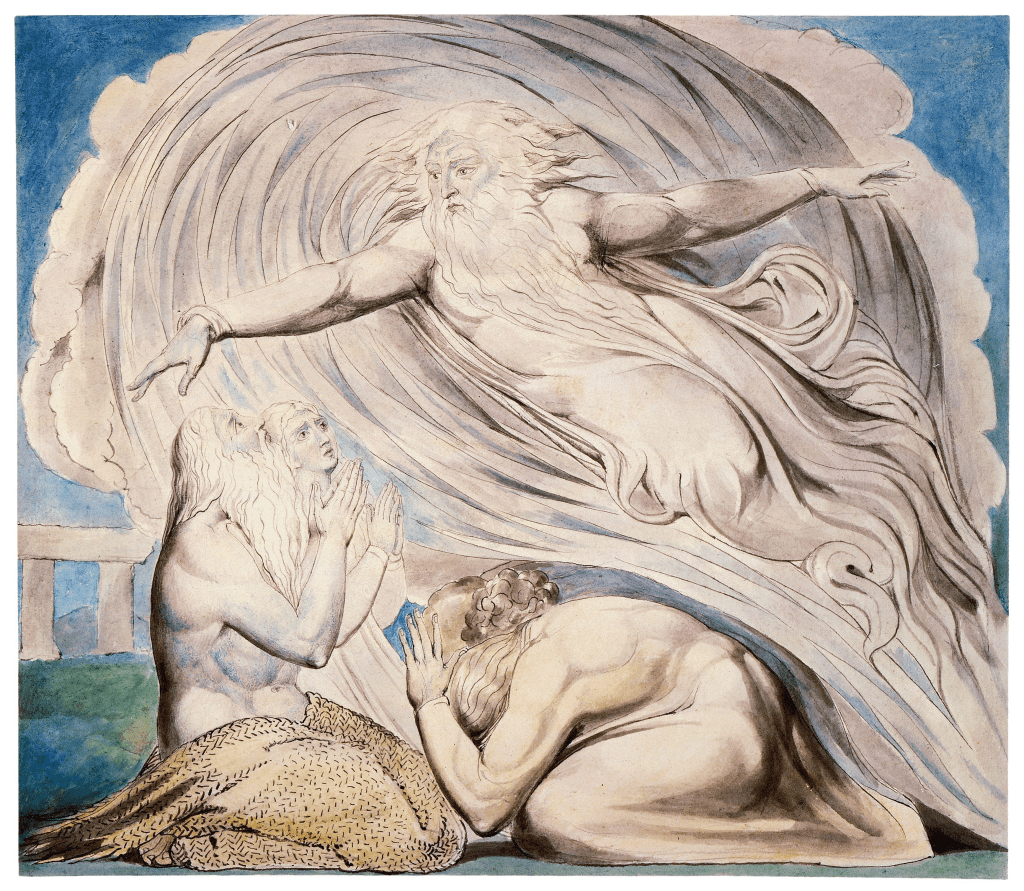
The Steadfast Love of God (Psalm 33:12-22)

Happy is the nation whose God is the Lord,
    the people whom he has chosen as his heritage.

The Lord looks down from heaven;
    he sees all humankind.
From where he sits enthroned he watches
    all the inhabitants of the earth—
he who fashions the hearts of them all
    and observes all their deeds.
A king is not saved by his great army;
    a warrior is not delivered by his great strength.
The war horse is a vain hope for victory,
    and by its great might, it cannot save.

Truly the eye of the Lord is on those who fear him,
    on those who hope in his steadfast love,
to deliver their soul from death
    and to keep them alive in famine.

Our soul waits for the Lord;
    he is our help and shield.
Our heart is glad in him
    because we trust in his holy name.
Let your steadfast love, O Lord, be upon us,
    even as we hope in you. (New Revised Standard Version)

God is in control of the world. I am not. Neither are you.

Although the myth of self-sufficiency and self-reliance completely permeates individualist societies, this in no way lessens the immense transcendence and sovereignty of a hugely big God.

In today’s psalm, the scene of God looking down from heaven portrays the Lord as above all, firmly in control, clearly seeing the big picture of the entire world. And yet, the Lord is also attentive to all that is happening on the earth.

Individual human creatures subscribing to a narrative of personal independence will inevitably run into the Creator God with a story as big as history itself.

Success may give us the illusion that our own strength, intelligence, and/or ingenuity has brought us the good things we possess – not God. “I worked hard for my money and I will do whatever I want with it!” and the even more crass, “It wasn’t God who put food on my table!” are just a few of the power delusions I have heard from others, as if personal accomplishments are unconnected to any other force in the universe.

What’s more, looking at individualism from the converse angle, our lack of success may cause us to pause and wonder if God is really observing all our deeds, or not. Perhaps the Lord is reclining in his La-z-God chair and watching old baseball game replays of the Angels.

More likely, we have become so expectant of satisfactory service and immediate results as consumers in a capitalist culture that we fail to discern the virtue of patience – that God is not slow in keeping divine promises as some would understand it.

The sheer fact of the matter is that we need God. And God feels no compulsion from us to be hurried along with divine purposes for humanity. Since God is the ever-present gravity in this world, the way of realizing the good life on this earth is to conform ourselves to the Lord’s purposes, and not the other way around.

When we learn to exercise the inherent gifts of hope and patience which a gracious God has fashioned in our hearts, then we begin to discover persevering trust, enduring happiness, a settled sense of gladness, and steadfast love. We awaken to the true passion of God for us. Rather than a capricious or indifferent deity, the Lord God looks upon us with endearing faithfulness.

God’s heart is forever drawn to us. Therefore, there’s no need to take every matter into our own hands, as if we are alone in the world. If we can see a vision of God high and lifted-up, observing us with a gaze of delight, then our spirits open to mercy and we find grace to help us in our time of need.

The Lord your God is in your midst—a warrior bringing victory. He will create calm with his love; he will rejoice over you with singing.

Zephaniah 3:17

God labors on our behalf. God has our back. God establishes a safe environment for us. And never forget: God delights in you. And so much so, that, this very minute, the Lord is singing songs of joy over you.

Trust and hope cannot be coerced by another or willed into being by the mind; it can only be generated through the deep conviction of God’s broad love for you and me.

The best self-help program I know of is not self-help at all – it is the self-care of opening to a loving God and allowing God’s joy and delight to fill us. God is watching us, and it is the gaze of adoration, not condemnation.

Dear God, the One who watches all, love comes from you. Anyone who loves is your child and knows you. And anyone who does not love does not know you, for God is love. Thank you for showing me love by sending your one and only Son into the world so that I might have eternal life through him. 

Precious Lord, since you loved me that much, I surely ought to love others. May you live in me and may the love of Jesus be brought to full expression in me through the power of the Spirit. Amen.

The Spirit of Faith, Not Fear (Romans 8:14-17)

Come Holy Spirit, by Ed de Guzman, 2014

For those who are led by the Spirit of God are the children of God. The Spirit you received does not make you slaves, so that you live in fear again; rather, the Spirit you received brought about your adoption to sonship. And by him we cry, “Abba, Father.” The Spirit himself testifies with our spirit that we are God’s children. Now if we are children, then we are heirs—heirs of God and co-heirs with Christ, if indeed we share in his sufferings in order that we may also share in his glory. (New International Version)

The distinguishing mark of the believer in Jesus Christ is the presence and power of the Holy Spirit. The Spirit is the sine qua non – the indispensable and most essential element – of the Christian life.

Christians are spiritual people, that is, people of the Spirit. Christianity is a religion dependent upon spiritual resources for life and godliness.

There is nothing more practical, beneficial, and enjoyable than the application of biblical truth to our lives each and every day.  

The Spirit’s work is to point us to Christ. The application of biblical truth is an experience of getting to know Jesus Christ better, and becoming ever more aware and involved with God. This involvement, characterized by faith, hope, and love, increasingly transforms every area of the Christian’s character and life. And it is the Spirit who helps us do it.

It is not God’s will that we fail in living the Christian life by succumbing to fear.  

Rather, it is God’s intention that believers have a robust faith which sings with gusto, connects meaningfully and vulnerably with other Christians, and a boldness to embody the good news of grace and forgiveness in Christ. To love God, and love the world, is to have a life of faith, not fear.

The successful Christian life is characterized by:

  • Experiencing inner transformation through suffering
  • Enjoying ministry and worship with others
  • Progressive deliverance from the power of sin
  • Continual enablement to live a holy life
  • Being an effective witness to the person and work of Jesus

Living this kind of life keeps believers from yielding to temptation. Life in the Spirit motivates us to read the Bible and pray; and to live above criticism and pretense.

The spiritual life helps others discern and understand what Christianity is all about. And, perhaps most importantly, life in the Spirit glorifies God, because we are then reflecting the joy and beauty of the Lord in all we do and say.

So, why don’t more Christians experience this kind of life-giving knowledge and joy? 

It is possible, even with the best of intentions in living a faithful and spiritually rich life, to be stonewalled or crippled with fear and anxiety. And in our fearful state, we almost always produce incorrect actions. These mistakes end up becoming barriers to living an enjoyable and productive Christian life. 

Here are just a few of the fearful and/or erroneous statements I have heard as a pastor over the years:

  1. It’s the pastor’s job to do all that stuff (as if parishioners can live vicariously through their pastor and not have to face their fears of failure)
  2. I don’t need to be a part of a church (as if it’s optional for Christians; and as if I can do it myself)
  3. I don’t like reading (as if this gets us off the hook to personally learn Holy Scripture)
  4. I think (or feel) _____ (as if my thoughts and opinions are the final authority concerning what I should do or not do).
  5. That’s nice advice (as if what is heard in a sermon or read in the Bible does not really need to be followed)
  6. God will lead people to Jesus (as if I have no responsibility for involvement with unbelievers)
  7. I sincerely believe ______ (as if sincerity makes something true)
  8. If I can’t do it 100% I won’t do it at all (as if service depends on my effort, and not on the Spirit’s power)
  9. I might screw it up; others can do it better than me (as if the word “grace” doesn’t exist in Christianity)
  10. That might work for you, but it doesn’t work for me (as if certain people are exceptions to the a spiritually successful life)

      What might you add to this list? 

      What are some of the hindrances which keep you from enjoying the Lord and living in faith?  

Fear disconnects us from the God of grace, that is, unless we acknowledge we are afraid and drink deeply from the fount of Scripture, letting the Holy Spirit be our divine mentor in leading us to Jesus, who is the way, the truth, and the life.

I sought the Lord, and he answered me
    and delivered me from all my fears.
Look to him, and be radiant,
    so your faces shall never be ashamed. (Psalm 34:4-5, NRSV)

Mighty and merciful God, I humble myself before you, trusting that you shall exalt me in due time. Therefore, I cast all my anxiety on you because you care for me. May the grace of the Lord Jesus be with all your people, along with the presence and power of the Holy Spirit. And may you conspire within yourself – Father, Son, and Spirit – to alleviate our fears and bolster our faith. Amen.

Living with Purpose (Exodus 19:1-9a)

Moses, by Marc Chagall, 1956

On the first day of the third month after the Israelites left Egypt—on that very day—they came to the Desert of Sinai. After they set out from Rephidim, they entered the Desert of Sinai, and Israel camped there in the desert in front of the mountain.

Then Moses went up to God, and the Lord called to him from the mountain and said, “This is what you are to say to the descendants of Jacob and what you are to tell the people of Israel: ‘You yourselves have seen what I did to Egypt, and how I carried you on eagles’ wings and brought you to myself. Now if you obey me fully and keep my covenant, then out of all nations you will be my treasured possession. Although the whole earth is mine, you will be for me a kingdom of priests and a holy nation.’ These are the words you are to speak to the Israelites.”

So Moses went back and summoned the elders of the people and set before them all the words the Lord had commanded him to speak. The people all responded together, “We will do everything the Lord has said.” So Moses brought their answer back to the Lord.

The Lord said to Moses, “I am going to come to you in a dense cloud, so that the people will hear me speaking with you and will always put their trust in you.” (New International Version)

If I were to list every job I’ve ever had in my life, it would be a long list. I’m sure, at this point in my life, that I wouldn’t immediately recall some of them. Some workplaces were run well. Others, especially in the factories I worked, were characterized by inattention to working conditions and expected employees to be more like extensions of their machines than like people. And I typically never knew why we were doing what we were doing.

I’ve also been in many churches and pastored a wide array of congregations. Some of the churches were run well and were attentive to their mission and service to the world. Others left a lot to be desired. Without trying to be simplistic, today’s Old Testament lesson gives the clue to what makes the difference: a clear sense of purpose. 

God made it clear that Israel was given the mandate “to be a kingdom of priests and a holy nation.”

Although there was always a remnant of Israelites who held to this original purpose, we know the end of the story. Israel largely failed to fulfill their God-given reason for existence and did not follow through with their missionary goal. They ended up in exile, mostly because of straying from their intended purpose, which then also led to a lack of holiness.

When Christians, Churches, and faith communities of all kinds lose sight of why they exist, they degenerate into a bunch of finicky cats who want ever richer food and a lusher bed to sleep on. 

So, let’s be clear about the reason for our existence as an institutional Body of believers: We exist not to be catered to, but to be people who do the priestly work of interceding for others so that the nations might come to know the God of all the earth. 

“Intercessory prayer might be defined as loving our neighbor on our knees.”

Charles Bent

We exist for holiness, set apart to be the conduit between heaven and earth so that others might come to embrace the life that is truly life. 

Christianity recognizes that it was Christ who fulfilled the great promises of God as the ultimate Prophet, Priest, and King. Through his holy life, Christ became the priest who made the once for all sacrifice to end all sacrifices. He reigns over a moral kingdom which is a light to the nations. And the Church, as Christ’s Body, is to continue this purpose of kingdom ethics by letting the light of Jesus shine into the shadowy dark places of this world.

Wherever you find complaining, backbiting, gossip, and slander, there you will find a profound lack of purpose. Because without a “why,” people fill the vacuum with endless squabbling about petty affairs which amount to nothing, in the scope of eternity.

And wherever there is only talk of how others can meet personal needs and satisfy pet desires, in that place there is a lost mandate to be a priest bringing others to God. 

The gracious and priestly work of intercession is the purpose many are lacking. Believers everywhere must return to this holy and sacred vocation.

Jesus modeled for us the work of intercession when he prayed:

“Father, I want those you have given me to be with me where I am, and to see my glory, the glory you have given me because you loved me before the creation of the world. Righteous Father, though the world does not know you, I know you, and they know that you have sent me. I have made you known to them, and will continue to make you known in order that the love you have for me may be in them and that I myself may be in them.” (John 17:24-26, NIV)

The Lord has said what the divine purpose is. It is our task, therefore, to do everything God has spoken.

O sovereign and majestic God, you are holy. So, I choose to be holy in all I do. I intercede for those around me who either cannot or will not come to you on their own. Draw them to yourself so that they might experience the grace and mercy of Jesus Christ, through the power of the Holy Spirit. Amen.

A Prayer of Blessing (1 Kings 8:54-65)

Solomon, by Marc Chagall (1887-1985)

As soon as Solomon finished praying and making these requests to the Lord, he got up from before the Lord’s altar, where he had been kneeling with his hands spread out to heaven. He stood up and blessed the whole Israelite assembly in a loud voice: 

“May the Lord be blessed! He has given rest to his people Israel just as he promised. He hasn’t neglected any part of the good promise he made through his servant Moses. 

May the Lord our God be with us, just as he was with our ancestors.

May he never leave us or abandon us. 

May he draw our hearts to him to walk in all his ways and observe his commands, his laws, and his judgments that he gave our ancestors. 

And may these words of mine that I have cried out before the Lord remain near to the Lord our God day and night so that he may do right by his servant and his people Israel for each day’s need, and so that all the earth’s peoples may know that the Lord is God.

There is no other God! Now may you be committed to the Lord our God with all your heart by following his laws and observing his commands, just as you are doing right now.”

Then the king and all Israel with him sacrificed to the Lord. Solomon offered well-being sacrifices to the Lord: twenty-two thousand oxen and one hundred twenty thousand sheep when the king and all Israel dedicated the Lord’s temple. 

On that day the king made holy the middle of the courtyard in front of the Lord’s temple. He had to offer the entirely burned offerings, grain offerings, and the fat of well-being sacrifices there, because the bronze altar that was in the Lord’s presence was too small to contain the entirely burned offerings, the grain offerings, and the fat of the well-being sacrifices. 

At that time Solomon, together with all Israel, held a celebration. It was a large assembly from Lebo-hamath to the border of Egypt. They celebrated for seven days and then for another seven days in the presence of the Lord our God: fourteen days in all. (Common English Bible)

Prayer is arguably one of the most significant works a spiritual person could ever do.

Why do I say that?

Because we, as people (especially Americans!) tend to be focused on solutions, fixes, and getting things done. We work hard; and if it doesn’t work out, then we pray.

Yet prayer is a needed activity from the get-go. Prayer is to be infused from the beginning to the end. Prayer is to be our very breath.

Relying solely on our strength, smarts, and stamina – on self – may yield some results; but the human touch cannot provide like the divine touch. Trusting in all else, besides God, shall eventually fail.

Now this I know:
    The Lord gives victory to his anointed.
He answers him from his heavenly sanctuary
    with the victorious power of his right hand.
Some trust in chariots and some in horses,
    but we trust in the name of the Lord our God.
They are brought to their knees and fall,
    but we rise up and stand firm. (Psalm 20:6-8, NIV)

King Solomon prayed. He prayed before building a temple to the Lord. He prayed during construction. He offered prayers after its erection and provided prayers of dedication to it.

And, in today’s Old Testament lesson, Solomon was faithful to pray and bless the people who participated in the building, as well as all the people who would worship at the temple.

Biblical prayers are solid theological models for us in our own prayers. They give us some needed form and function, directing us in how to pray and what the content of those prayers ought to be.

So, I offer this prayer of blessing for you, based in Solomon’s to the people:

Blessed be the Lord our God, who has given peace to people, just as he said he’d do. Since we have been justified through faith, we have peace with God through our Lord Jesus Christ. Not a one of all those good and wonderful promises that God spoke has failed.

May the God and Father of our Lord Jesus Christ, our very own God, continue to be with us just as he was with all of our spiritual ancestors.

May God never give up and walk out on us.

May God keep us Christo-centric, revolving our entire lives around him, devoted to him, following the life path he has cleared, being attentive to the words and ways of Jesus, walking at the pace and the rhythms he laid down for us to follow and observe.

May these words that I pray in the presence of God be always before the divine throne, day and night, so that the Lord will do what is right, just, and fair for us and for all people everywhere.

May mercy and justice reign day after day after day. Then all the people on earth will know God is the true God; there is no other God.

And may your lives be totally obedient to God, following the path of righteousness the Lord has cleared, alert and attentive to avoid the path of temptation, through Jesus Christ our Lord, in the strength of the Holy Spirit. Amen.