Day of Pentecost (John 14:8-17, 25-27)

Philip said to him, “Lord, show us the Father, and we will be satisfied.” Jesus said to him, “Have I been with you all this time, Philip, and you still do not know me? Whoever has seen me has seen the Father. How can you say, ‘Show us the Father’? Do you not believe that I am in the Father and the Father is in me? The words that I say to you I do not speak on my own, but the Father who dwells in me does his works. 

“Believe me that I am in the Father and the Father is in me, but if you do not, then believe because of the works themselves. Very truly, I tell you, the one who believes in me will also do the works that I do and, in fact, will do greater works than these, because I am going to the Father. I will do whatever you ask in my name, so that the Father may be glorified in the Son. If in my name you ask me for anything, I will do it.

“If you love me, you will keep my commandments. And I will ask the Father, and he will give you another Advocate, to be with you forever. This is the Spirit of truth, whom the world cannot receive because it neither sees him nor knows him. You know him because he abides with you, and he will be in you….

“I have said these things to you while I am still with you. But the Advocate, the Holy Spirit, whom the Father will send in my name, will teach you everything and remind you of all that I have said to you. Peace I leave with you; my peace I give to you. I do not give to you as the world gives. Do not let your hearts be troubled, and do not let them be afraid.” (New Revised Standard Version)

The Christian observance of Pentecost is much more than a date on the calendar or a cognitive belief about the Holy Spirit. Pentecost is a powerful reality for believers to be aware of and to live into.

The symbols used to communicate this reality are the elements of wind and fire. They each have incredible potential for both help and harm, life and death. Tornadoes and wildfires bring awful destruction, whereas flame and wind power are necessary elements for life.

There is power in the Spirit. The Spirit of God dismantles and rearranges our lives to make something different or new altogether.

When the Spirit gets involved, nothing is the same again.

The Spirit upsets the status quo, brings energy and ability, heals broken lives, and establishes a truly egalitarian society. The New Testament knows the Christian as one given wholly to the Spirit in order to accomplish the will of God on this earth.

Therefore, this time of the year is hugely significant. Christians attune themselves to Holy Time because it is the age of the Spirit, the blessed opportunity of Pentecostal life and power. 

Jesus promised us an Advocate, the Spirit, and the era of the Spirit is here. We enjoy the very same Holy Spirit as our spiritual ancestors in the faith. This gives us great confidence and security knowing that the Spirit’s enablement, guidance, and power is available to us.

Pentecost flings every single believer into a congregational whole, the church, and lets us know that we are not to be rugged individualists acting alone, but are part of the Body of Christ.   

The Spirit uses us to forge spiritual bonds of kinship, fellowship, and solidarity.  Pentecost throws disparate people together in a unified whole, made up of every kind of language, nationality, ethnicity, gender, and race. We all use the gifts of the Spirit given to us for the benefit of building up one another.

Pentecost and the presence of the Spirit opens up the greatest of possibility in seeing our true selves emerge, and experiencing what is false melt away.

For most of us, we eventually discover that our egos are much thicker and predominant than we realized. And that ego gets in the way of bringing our authentic selves to the world. The Spirit comes along with fire to purify us, and then blows a mighty wind to drive the false self away.

Such true spiritual power helps us discern that issues of power in this world are difficult to deal with because things are not as they appear to be. Operating in the ego, far too many of us puff up ourselves to try and merely appear strong. People who present themselves as large and in charge end up hiding their vulnerabilities and insecurities in favor of keeping up appearances.

Jesus openly talked of real spiritual power, and promised to give the Spirit for our benefit. And Christ laid bear himself, stretching his arms out on a cross in a display of humiliation and degradation – all for us and our deliverance from false power and pesky egos.

If we go looking for earthly power and rely upon worldly power structures, we will likely be as confused as Philip and the other disciples of Jesus. But if we adopt the inner spiritual power provided for us, we find real effective strength which brings us the peace of Christ in any and all circumstances.

Life in the Spirit – spiritual life – happens within the depths of the soul. And it happens when we give up all pretense to alternative power sources, and participate with the Holy Spirit in allowing God to melt all that is false with spiritual fire and blow it all away with spiritual wind.

Pentecost was and is a watershed event. It’s effects are lasting, right up to the present time. Rather than settling for power-substitutes, we can imbibe ourselves of real spiritual power.

Living God, you have created all that is. Send forth your Spirit to renew and restore us, so that we may proclaim your good news in ways and words that everyone will understand and believe. Amen.

The Illness of Our Era: What Is It?

Anxiety, by James Callaghan

Our contemporary society focuses primarily on a functional existence. In our pragmatism, we care a great deal about production, the things we can do and produce; and we are attentive of how we appear to others. Western culture is enamored with all things of the outer person that others can see, touch, hear, smell, and taste with physical senses.

The outer person is important. The way in which we present ourselves to the world does have meaning and significance. Yet, so does the inner person.

The Inner Person

I believe the inner person, the true self, the soul, is just as vital, if not more, than the outward displays we give to others. On the inside is where our motives and intents come from. The core of self is of utmost importance; it is the place where our inherent worth is found.

Being aware of this inner person (which I use interchangeably with “soul” and “true self”) gives us a guide for ordering our outer self – our activities, work, and relationships.

If we are unaware of what’s happening deep within us, or pay little to no attention to the soul, our outer person becomes a false self. A gross disconnect then occurs between how we think and feel within, and what we choose to display for everyone.

In paying attention to the inner person, we will likely find that there is a lot of anxiety within us. Anxiety may even transform itself into a despair of self and/or the world.

The Anxiety Within

This anxiety, however, is not all bad. It certainly can lead us to a struggle with life, an experience of strained relationships, and a crippling fear of what will happen. Yet it can also help us become in touch with the soul, and enable us to gain an awareness of what is happening within and what to do about it.

It is my firm understanding and unshakable conviction that if we are to learn anything at all about healthy functioning in this world, it must begin with learning about one’s self – the true self, the inner person, the soul.

Knowing Ourselves

“Without knowledge of self, there is no knowledge of God.”

John Calvin, Institutes of the Christian Religion, Vol.1

As we commit ourselves to the journey within, we come to discover our place in the cosmos, and the image of God that is inherent in us. We come to know ourselves as integral to creation.

If we never gain this sense of humanity and of the divine, then we lose our special perspective on reality, and of the vital interconnectedness we have with God and others. Separateness then replaces the unity and oneness which exists. As a result, the person lives without a sense of their true place or function in this world.

Feelings of isolation and estrangement take over. This profound experience of disconnection with God, people, and even self creates a powerful sense of anxiety. Fear becomes a dominant theme. Unconscious emotions and desires drive the anxious person. A belief that my conscious self is all there is to me is a path of denial that leads to abject misery.

Knowing ourselves – before we know anything else – must be our pursuit. Failure to do this is perhaps why we live in such an era of worry, pessimism, and fear.

Addressing Our Fears

Have you ever felt that there is no one to whom you could turn to in your time of loneliness and despair?

Is there a time when you felt as if you were in a deep dark hole of quiet anxiety?

Did you ever brood over your situation in life so much that all of your courage melted like ice cream on a 100 degree day?

Was there a season in your life where you felt the world could not understand your grief?

Has God ever felt aloof to you, with your prayers seeming as if they were bouncing off the ceiling?

Depending upon who we are, the self believes that if I am right enough, help enough, achieve enough, unique enough, know enough, plan enough, party enough, lead enough, or withdraw enough, then I will relieve this bothersome anxiety and fear within me and can get on with life.

Others may seek solace in the finite things of this world. But that approach only exacerbates the existing problem. Believing that freedom from an ethereal illness can come by having more of something you can see only increases the despairing feelings.

Any sickness of the soul must be addressed by means of infinite resources.

The Need For Integration

If we lose ourselves, we are fragmented and in need of integration. The work needed is to bring our spiritual internal parts into a unified whole. This then puts us in a position to experience the grace and peace of God. Indeed, the process itself becomes the divine mercy and settled rest.

We tend to hold onto what we are afraid of experiencing. This very problem often becomes the solution. Our anxiety has the potential to lead us toward the grace of God, or away from it by self-conjured solutions and/or coping mechanisms.

Rather than holding our anxieties and fears close so that we can keep an eye on them, we need to let go of them. This is accomplished by actually feeling our feelings. By holding our emotions loosely, they can express themselves and then fly away.

If we never experience anxiety, worry, discouragement, fear, depression, or despair, then we internally see no reason whatsoever to pursue transformation of life – to go after that which is immortal and invisible.

The Apostle Paul’s Struggle

At the end of a frustrating litany of anxiety over his inability to control the trajectory of his inner self, the Apostle Paul concluded:

So I find it to be a law that, when I want to do what is good, evil lies close at hand. For I delight in the law of God in my inmost self, but I see in my members another law at war with the law of my mind, making me captive to the law of sin that dwells in my members. Wretched person that I am! Who will rescue me from this body of death? Thanks be to God through Jesus Christ our Lord! (Romans 7:21-25, NRSV)

Sin presupposes itself through anxiety. And anxiety awakens the awareness of needing freedom and deliverance. Worry is not our master. Anxiety has no authority over us. Fear merely exists for us to pay attention to something.

In Christianity, that something is a someone: Jesus. Christ is the Deliverer from sin, death, and hell. The oblivious and lonely darkness we find ourselves trapped within has a way out, or rather, up. A divine hand reaches from above to snatch us from our inky hole.

If humanity never had a need of God, people would not know themselves. They would fail to realize that there is immortality in their very souls.

Taking the Journey Within

It takes bravery to engage in a journey within, down into the core of one’s being. It’s neither a vacation nor a weekend adventure. The path unfolds slowly over time; it is circuitous, and often frustrating. Yet, when we find the incredibly bright blue diamond at the center, we immediately know every part of the journey was worth it.

The illness of our era is that we are soul-sick with anxiety, even despair, and most of us don’t know it. But why?

Like a cancer lurking unaware within the body, the years of ego construction has smothered the image and likeness of God within.

Anxiety becomes the initial symptom that something is askew with us. We’d better get checked out and find what the root problem is.

Are you up for the discovery of yourself, and thus, of God?

Anti-Intellectualism

Everyone with good sense
    wants to learn. (Proverbs 18:15, CEV)

Anti-intellectualism:

  1. opposition to or hostility toward intellectuals and the modern academic, artistic, social, religious, and other theories associated with them
  2. the belief or doctrine that intellect and reason are less important than actions and emotions in solving practical problems and understanding reality

Holy Scripture encourages knowledge, understanding, and wisdom. In order to be a truly wise and understanding person, there must be a combination of knowledge and experience. When these two elements come together, and are practiced over a long period of time, then spiritual maturity is realized.

In every church I’ve ever served across the decades there have been individuals and groups of people in my congregations who are anti-intellectual. They were not big fans of seminaries. They often mistrusted highly educated persons with multiple degrees. And they had a hard time submitting to any authority structure that smacked to them of being elitist.

Unfortunately, the majority of those persons, in my experience, refused to learn in any other way other than their own personal experience. I don’t think I need to tell you the many pitfalls such a stance creates: constant misinterpretation of situations; prejudice toward others whom they don’t understand; and chronic disobedience to every authority in their life.

It likely wouldn’t surprise you to know that these sorts of parishioners rarely, if ever, read their Bibles, or even seek to learn other than hearing Sunday sermons. They reek of spiritual immaturity and pride, being puffed-up with themselves that they aren’t like the elites in power.

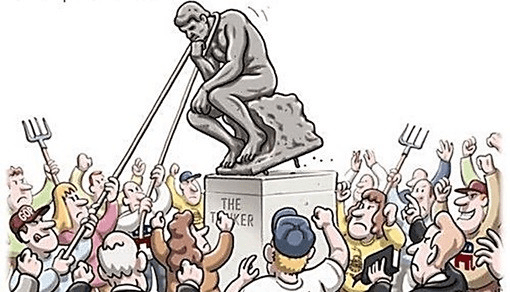
Now imagine what a group of people like this would be like if they were in the highest levels of government… But we need not imagine; the reality is in front of us every day.

To understand the current political climate in the United States, it seems to me we need to see that the present governmental administration, at its heart, is an anti-intellectual movement.

Now please know that I am not saying that everyone in the administration is stupid. What I am saying is that many if not most Republicans have a deep seated problem with educational elites – hence the sustained attention on American universities, especially Harvard.

They believe themselves to be practical, no nonsense people who can get things done without umpteen committees and eggheaded reports. The problem, however, is that in their belief of experiential superiority, they’ve refused to listen. They end up making snap judgments of situations and other people. In other words, they can quickly make a disaster of things whenever they’re in charge.

Furthermore, what the anti-intellectuals end up doing most is grasping for as much worldly power as they can gain.

For Protestant Evangelicals, their desire for power stems from their perceived loss of a golden age of Christendom. Back then they were in power – prayer in schools, no abortion, the Ten Commandments in every court house, riding your bike in the neighborhood with safety, etc.

Yet, because there is such a paucity of listening and seeking to understand, the anti-intellectuals fail to understand that their own golden age was a bronze age of Jim Crow laws, failed reservation promises, and the need to operate in the shadows for all sorts of other persons.

Holy Scripture’s Book of Proverbs – which is a combination of accumulated knowledge and lived experience – has something to say about those who refuse to listen and learn from others:

With wisdom you will learn
what is right
    and honest and fair.
    with knowledge. (Proverbs 2:9-10, CEV)

Fools think they know
    what is best,
but a sensible person
    listens to advice. (Proverbs 12:15-16, CEV)


Stupidity leads to foolishness;
    be smart and learn. (Proverbs 14:18, CEV)

Fools have no desire to learn,
instead they would rather
    give their own opinion. (Proverbs 18:2, CEV)

Pride leads to destruction;
    humility leads to honor.
It’s stupid and embarrassing
to give an answer
    before you listen. (Proverbs 18:12-14, CEV)

An ignorant fool learns
    by seeing others punished;
a sensible person learns
    by being instructed. (Proverbs 21:11, CEV)

If we apply our hearts to wisdom, we will learn:

  • the pursuit of power at all costs creates stupidity
  • the disdain and/or ignorance of others has adverse consequences for all
  • there has always been an anti-intellectual strain throughout the history of the world (including U.S. history)
  • the act of placing blame on others (such as the so-called “elites”) will come back to bite us

It does no good to reason with an anti-intellectual, namely because they will not avail themselves of logic nor learning.

Instead, it is wise to treat an anti-intellectual like we ourselves would want to be treated: to have another listen to us and be curious about why we hold to what we hold, without judgment; and to have another respect our ability to choose for ourselves.

Can you imagine a world where we would all commit ourselves to listening and learning, acquiring knowledge, understanding, and wisdom? We would likely live in a very different world than the one we are in today.

May the course of this world be peaceably governed by divine providence. And may the church everywhere joyfully serve God in confidence and serenity. Amen.

Spiritually and Emotionally Overwhelmed

Gethsemane – His Will, by Lucy Dickens

I lift up my eyes to the hills—
    from where will my help come?
My help comes from the Lord,
    who made heaven and earth. (Psalm 121:1-2, NRSV)

“You can’t calm the storm, so stop trying. What you can do is calm yourself. The storm will pass.” – Timber Hawkeye

Even Jesus got overwhelmed.

He took Peter and the two sons of Zebedee along with him, and he began to be sorrowful and troubled. Then he said to them, “My soul is overwhelmed with sorrow to the point of death. Stay here and keep watch with me.”

Going a little farther, he fell with his face to the ground and prayed, “My Father, if it is possible, may this cup be taken from me. Yet not as I will, but as you will.” (Matthew 26:37-39, New International Version)

Jesus was so spiritually and emotionally overwhelmed, he felt so bad, that depression and grief were a powerful part of his experience in the garden as he anticipated facing his horrendous death.

Yes, Jesus became grieved and depressed. Not only did he express such emotions in prayer, but he also told his feelings to his disciples. I personally don’t know of any leader – either in the world or in the church – that would ever admit such a thing to his/her parishioners, employees, or constituents.

Christ confessed that his very soul was encircled with grief-stricken depression. The weight of the emotion was so heavy that Jesus felt as though he was being crushed to death.

“It is one thing for Jesus to feel this way; but should a leader tell his followers he feels this way? Isn’t a part of effective leadership keeping fears from followers? But if Jesus having depression has already taught us it is acceptable, at times, to be depressed, then Jesus talking about his depression teaches that it is acceptable, at times, for leaders to tell followers the bad state of their souls.” – Frederick Dale Bruner, The Church Book: Matthew 13-28

If Jesus needed human companionship and the ability to bear his soul, then how much more do his followers need to do so? And especially the clerics who are ordained to his ministry?

Becoming overwhelmed is a universal human experience:

May my prayer come before you;
    turn your ear to my cry.

I am overwhelmed with troubles
    and my life draws near to death.
I am counted among those who go down to the pit;
    I am like one without strength. (Psalm 88:2-4, New International Version)

We may become overwhelmed by being devastated or feeling overpowered by a confluence of circumstances all at once. To be overwhelmed is to experience several big emotions all at once – including an awful feeling of estrangement from God and/or others.

Whenever complicated grief, relational distance, traumatic experiences, and too many responsibilities come together, they create a perfect storm which can leave us stuck, lonely, and chronically tired.

There are times when it seems as if every time we turn around, there’s another big shoe that drops. We might end up dealing with so many large circumstances and important situations happening at the same time, that we become spiritually and emotionally overwhelmed with it all.

Although it’s easy to become overwhelmed, it’s hard to get over those big, troubled feelings. Yet, we can do it. We can initially calm ourselves enough to function.

Yet, we also need to understand that the emotional array surrounding our difficult circumstances will take more than a few minutes and a few breathing exercises to overcome; it could take weeks, months, even longer.

What’s more, going forward, there will always be a need to listen to our bodies, be attentive to our feelings, and remain in touch with our gut instincts.

We could use some helpful habits to serve us well, whenever we sense the tug toward that sinking feeling of becoming spiritually and emotionally overwhelmed:

  • Sit with your emotions, especially the grief. That is, acknowledge your feelings, and actually let yourself feel them, and express them in positive ways that don’t damage others or their property.
  • Identify and list your current stressors. Then, prioritize them as to which you will work on first. Avoid multi-tasking. Breaking down your life into manageable pieces, done over time with patience, is a healthy way of approaching the behemoth in front of you.
  • Write out your experiences. Keep a daily journal. Focus on expressing both your emotions and your gratitude. The act of writing in and of itself is a powerful means of bringing health, wholeness, and some sort of sense to your situations.
  • Create art. Learn a musical instrument, write your own poetry, sculpt, or paint. Let any anger and frustration come out through your art, rather than coming out sideways onto others through verbal violence.
  • Discover new or alternative spiritual practices, i.e. mindfulness, meditation, Reiki, aromatherapy, breath prayers, etc. Crazy new circumstances you’ve never experienced before may require some seemingly new or strange practices you’ve never tried before.
  • Change the story you are telling yourself. Look for parts of your experience within your control. Learn from the past. Consider what you might do differently in the future in similar situations. In other words, let your story not be one big nasty carbuncle on your soul; allow it to be a companion that teaches you.
  • Consider having a comfort animal. Caring for a pet fosters emotional healing. This one addition to your life could change it immeasurably for good.
  • Engage your inner critic. Face the judgment you may be giving yourself and replace it with grace. Work on dropping the ego and becoming your true self. And there is perhaps no better way of this happening than facing your inner critic.
  • Exercise. Pay attention to where you carry stress in your body. Find an enjoyable way of moving your body.
  • Connect with others. Join a group of like-minded people, such as a faith community or a volunteer organization. Tell your story to another trusted person, such as a friend, therapist, or pastor.
  • Find your identity. Most spiritual traditions take a high view of humanity as having intrinsic worth. As for me, I know to whom I belong: God. Having my identity firmly in Christ – and not in my abilities, or the lack of them – makes all the difference.

Our limitations, screw-ups, diseases, disorders, and disasters need not define our lives. There is no shame in admitting when we are full of sorrow, in the throes of grief, experiencing depression, or living in an awful situation.

Taking Jesus as an example, we have the courage to face stressful adversity and become the people we were always meant to become.

May the places of darkness within you be turned towards the light. And may you know divine shelter and healing blessing when you are called to stand in the place of pain. Amen.