1 Corinthians 2:6-16 – Do You Know?

We do, however, speak a message of wisdom among the mature, but not the wisdom of this age or of the rulers of this age, who are coming to nothing. No, we declare God’s wisdom, a mystery that has been hidden and that God destined for our glory before time began. None of the rulers of this age understood it, for if they had, they would not have crucified the Lord of glory. However, as it is written:

“What no eye has seen,
    what no ear has heard,
and what no human mind has conceived”—
    the things God has prepared for those who love him—

these are the things God has revealed to us by his Spirit.

The Spirit searches all things, even the deep things of God. For who knows a person’s thoughts except their own spirit within them? In the same way no one knows the thoughts of God except the Spirit of God. What we have received is not the spirit of the world, but the Spirit who is from God, so that we may understand what God has freely given us. This is what we speak, not in words taught us by human wisdom but in words taught by the Spirit, explaining spiritual realities with Spirit-taught words. The person without the Spirit does not accept the things that come from the Spirit of God but considers them foolishness and cannot understand them because they are discerned only through the Spirit.The person with the Spirit makes judgments about all things, but such a person is not subject to merely human judgments, for,

“Who has known the mind of the Lord
    so as to instruct him?”

But we have the mind of Christ. (New International Version)

Knowledge can be a tricky thing. There is so much to the topic of knowing that we have an entire branch of philosophy, epistemology, which theorizes on how we know ourselves and our world.

The Enlightenment era (18th-century) focused on empirical data, that is, what can be known becomes knowable through the verification of our senses and a scientific process of systematic observation, measurement, and experimentation. In other words, knowledge has to do with the natural, not supernatural, because knowing involves our five senses of sight, hearing, smell, taste and touch.

The Enlightenment project, I believe, severely truncated our personhood. It left us as mere brains on a stick – valuing dispassionate empiricism to the point of devaluing the heart and the gut. For, when all is said and done, there is an immaterial way of knowing, a kind of sixth sense, which can discern truth and reality in a manner that sheer natural evidence cannot.

If we are unaware of this other sense, the spirit, then there is an entire dimension of ourselves and our world that we are unable to discern and know. Grounding our ideas and theories in evidence-based practices is quite important. We need rigorous processes of going beyond opinions and hypotheses to actual tangible evidence. Our world has benefited immensely from the scientific process. And yet, all this is insufficient.

Without a focus on the spiritual, we limit our knowledge and our perceptions of others and the world. And if we ignore our internal epistemic assumptions which are coming from other places than our brain, we can talk and act without knowing why we say and do some things. We can be unsure why we react in particular ways or cannot quite make sense of why we keep overeating or drinking too much or avoiding certain people and places.

In many ways, a major task our earthly life is to keep knowing ourselves better and better. There is a vast inner world that needs exploration, just as much as we need to explore the vastness of our earth and the immense space of the universe.

In science fiction, Star Trek has a way of knowing the seemingly unknowable within us. Vulcans (ironically the most empirical and dispassionate beings in the universe) have a unique ability to perform a “mind meld” which is a technique for the psychic fusion of two minds, permitting unrestricted communication or deep understanding. It is a way of accessing and sharing thoughts and feelings which are obscured or hidden. It is an epistemology that, in actuality, isn’t far from reality.

Nothing is as wonderful as knowing Christ Jesus my Lord. I have given up everything else and count it all as garbage. All I want is Christ and to know that I belong to him. I could not make myself acceptable to God by obeying the Law of Moses. God accepted me simply because of my faith in Christ. All I want is to know Christ and the power that raised him to life. I want to suffer and die as he did, so that somehow I also may be raised to life.

Philippians 3:8-11, CEV

That’s because the people of God, believers and followers of Jesus, have been given the Spirit of God. An unusual, unscientific, and mystical union has taken place in which God’s Spirit joins with our spirit and opens a whole new world to us.

There are some things which can only be known, understood, and verified by the spiritual. Incredibly, Christians are given the very mind of Christ. We enjoy an amazing melding, enabling us to become the people we were always meant to be – forgiving, loving, encouraging people who live and love just like Christ – who is in both our hearts and our heads. This supernatural epistemic way of knowing allows us to see beyond the five senses to a multiverse of senses within ourselves and others.

We can only know what God has freely given us if we have God’s Spirit within us and the mind of Jesus Christ testifying what is good, just, and true. This is a knowing beyond language and explanation. It is knowledge requiring a mind meld between the individual and Christ.

Rather than crucifying and putting to death things (and, God forbid, people) we don’t understand, there is a better way. Explore a different way of knowing. Discover the spirit within. Seek to understand the invisible God. Experience a fuller and richer way of life in Jesus Christ through the enlightening of the Holy Spirit.

Soli Deo Gloria

1 Corinthians 13:1-13 – Will Our Ministry Have More Love?…

Love is enduringly patient with the quirkiness of others. Love is infinitely kind and generous to everyone it encounters. Love does not envy or resent another person’s gifts or abilities; it does not place oneself on a pedestal as a braggart. Love is not puffed-up like a peacock looking for constant attention and believing that life is all about my-way-or-the-highway. Love is never snarky toward others and does not seek a selfish conniving agenda at all costs.

Love does not fly-off the handle with limited information, and it absolutely never keeps a scorecard of other people’s offenses. Love does not cheer when other people screw-up, but, instead, throws a party when someone embraces gospel truth. Love always looks out for others, always gives the other person the benefit of the doubt, always sees the potential in others, and always believes what God can do in the most stubborn of hearts. (1 Corinthians 13:4-7, My own translation)

Love Is Eternal

Love will forever endure. There is never a time when being un-loving is required or acceptable – that somehow we need to withhold love from someone so that they will get the clue they are doing something we don’t like.  In other words, love does not hate people who are different from us. Hate is temporary. Love is permanent and ageless.

As humans, we simply do not have the full picture to everything happening in the world. We don’t see all the angles or have a complete understanding of everything. Because of our limitations, we are to avoid being so quick to evaluate and judge. 

Love makes God’s interests in other people our interests. Love is to be our guiding and overarching principle for living. Love is to be our way of life. Love cannot be manufactured or synthesized. That’s because God is love, and God cannot be reproduced into our own image of how we think life ought to operate.

Many people are unloving and unkind in this often cruel and calloused world because they don’t know God loves them. If we don’t believe God loves us, then our words and our actions will reflect more of hate than love.  God really truly does love you and me. This is crucial. Do not forget this. Believe it. Live it. Enjoy it. Know it in your heart and deep in your gut. Tell it to yourselves until you are thoroughly bathed in it because it is more wonderful than any 70’s love song could ever describe it.

The Lord your God is with you.
    He is like a powerful soldier.
    He will save you.
He will show how much he loves you
    and how happy he is with you.
He will laugh and be happy about you. (Zephaniah 3:17, ERV)

Christianity does not simply happen by knowing some belief statements about God and Jesus. Christianity happens when people experience the white hot burning love of God in Jesus Christ for them. 

Jesus came not only for those who skip church and only occasionally read their Bibles, but also came for the hard-hearted thief, prostitute, adulterer, addict, terrorist, murderer, and for all those caught up in bad choices and failed relationships.

God’s love is never based on our performance, or how good we look to others; it is never conditioned by our moods. The love of God only looks longingly at you and me with the potential of what we can become in Christ, loving us as we are. This is a world-altering revolutionary reality:

God loves me as I am and not as I should be. 

Mit Tdrahrhe

But Christ died for us while we were still sinners, and by this God showed how much he loves us. (Romans 5:8, ERV)

Despite the decline of institutional religion in the Western world, the vast majority of people still believe God exists. Conversely, however, the majority of people do not believe God truly loves them. We are in a crisis of love. People need to know the God who is Love. 

Christianity never begins with what we do for God so as to make ourselves lovely and presentable to the Divine.  No! Christianity always starts with what God has done for us, the great and wonderful Love that exists for us in Christ Jesus.

God our Savior showed us
    how good and kind he is.
He saved us because
    of his mercy,
and not because
of any good things
    that we have done.

God washed us by the power
    of the Holy Spirit.
He gave us new birth
    and a fresh beginning. (Titus 3:4-5, CEV)

All the wrong turns in the past, the mistakes, the moral lapses, everything that is ugly or painful, it all melts in the light of God’s acceptance and love for us. Amen.

1 Corinthians 13:1-13 – Will Our Ministry Have Love?

If I speak in the tongues of men or of angels, but do not have love, I am only a resounding gong or a clanging cymbal. If I have the gift of prophecy and can fathom all mysteries and all knowledge, and if I have a faith that can move mountains, but do not have love, I am nothing. If I give all I possess to the poor and give over my body to hardship that I may boast, but do not have love, I gain nothing.

Love is patient, love is kind. It does not envy, it does not boast, it is not proud. It does not dishonor others, it is not self-seeking, it is not easily angered, it keeps no record of wrongs. Love does not delight in evil but rejoices with the truth. It always protects, always trusts, always hopes, always perseveres.

Love never fails. But where there are prophecies, they will cease; where there are tongues, they will be stilled; where there is knowledge, it will pass away. For we know in part, and we prophesy in part, but when completeness comes, what is in part disappears. When I was a child, I talked like a child, I thought like a child, I reasoned like a child. When I became a man, I put the ways of childhood behind me. For now, we see only a reflection as in a mirror; then we shall see face to face. Now I know in part; then I shall know fully, even as I am fully known.

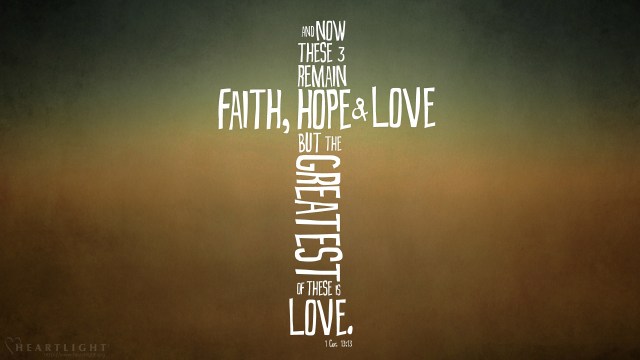
And now these three remain: faith, hope and love. But the greatest of these is love. (New International Version)

Love almost defies definition. It is so large and so deep that we can only try and describe it. That’s because love cannot be contained within puny human definitions. Every person in the world knows love exists. We have felt it, experienced it, longed for it, need it, and given it.

Throughout history, music has explored the dimensions of love. It seems that the 1970’s were especially smitten with singing about love. The ‘70’s give us a taste of how big love is in life and what it does in the human experience.

Just by looking at the song titles, we see there are all kinds of love: “Mighty Love,” “Lotta Love,” “Back in Love,” “Sweet Love,” “Radar Love,” “Hot Love,” “Puppy Love,” “Young Love,” “Sugar Baby Love,” “Easy Love,” “Burning Love,” “Our Love,” apparently “Chuck E’s in Love,” there’s even a thing called “Muskrat Love,” and, it seems, a person can have a “Love Hangover.”

Maybe the song titles give us an idea of what love is and does: “Love Will Keep Us Together,” “Love Takes Time,” “Fallin’ in Love,” “Love is the Answer,” “Love is Thicker Than Water,” “Love Will Find a Way,” “Turn Your Love Around,” “Love Grows,” “I Think I Love You,” “Don’t Pull Your Love,” “Give a Little Love,” “I’ll Never Fall in Love Again,” “Don’t Knock My Love,” and “Walk Away From Love.” 

It could be that love has something to do with attaching the word “baby” to it: “Love to Love You, Baby,” “Baby I Love Your Way,” “Lay a Little Lovin’ on Me, Baby,” “My Baby Loves Lovin’,” and Barry White is “Gonna Love You Just a Little More, Baby.”

Or perhaps love happens in certain places, such as: “Love’s Train,” “Love Rollercoaster,” “Love on a Two Way Street,” or maybe we need to slip into the ‘80’s to the “Love Shack.” Could be we just have to be a “Love Machine” (ooo-yeah!).

Indeed, when we think of love within our culture, it is something that we hope just happens to us, like the song, “I Woke Up in Love This Morning.” But when we think of biblical love, a real genuine godly love, it’s something we both give and receive. Turns out that love really is a two-way street; we all need love, to receive it and to give it. 

Without love, we die. Fish need water to swim; and we need love to survive. However, love doesn’t simply fall into our laps. Rather:

Love is a deliberate and intentional decision to meet the need of another person without showing favoritism or discrimination.

Mit Tdrahrhe

Love begins with God. God is love. Love is not only something God does; love is God’s true self and identity.  This is why love dominates so much of the Bible, as well as why our culture is so enamored with love.

Since, biblically, people are made in the image and likeness of God, there is an innate power, permanence, and presence of love deep within our souls. Even if people fail to know exactly where love comes from, we all have the collective human experience of understanding that love is supremely important.

The Apostle Paul’s beautiful description of love was penned because within the Corinthian church, there was a profound lack of love. The church was characterized by all kinds of unloving attitudes and actions, which is why they were so deeply divided among themselves. 

The Corinthian believers abused their freedom in Christ, refused to share with everyone, scorned their neighbors’ spiritual gifts, boasted about their accomplishments, sought power and recognition for themselves, and jockeyed for position in the church. So, the Corinthians needed to learn how important love is, as well as how and why to do it. Today’s New Testament lesson lets us know that love is essential, effective, and eternal. 

Love Is Essential

Love is of primary importance. Without love we might do great and impactful things, yet they will mean nothing. 

Once I decided to make a homemade pizza for my family. I spent a lot of time making my own crust, creating my own sauce, and carefully selecting the toppings. After it finally came out of the oven, it was a masterpiece!  As the chef, of course, I eagerly watched the family as they took their first bites, anticipating the rave reviews I would receive over my work of culinary art. 

But what I saw was the looks of people who were trying to be nice enough not to gag. My wise wife simply said to me, “Go ahead and have a bite.” I took one bite and spit it out of my mouth. I immediately knew what had happened. I accidentally used powdered sugar instead of flour to make my pizza crust. Even though everything else in the pizza was perfect, the one missing ingredient of flour ruined the entire meal and its experience.

Without love, it does not matter how many good works we do, how many people we help, or how much we understand the Bible and Christianity. Without love, life is just a schedule of activity with no heart to it. Apart from love, no one will ever be able to savor the good news of Jesus Christ. Religious activity in and of itself means nothing unless it is thoroughly infused with love.

Love is so large that it most certainly cannot be limited to a blog post. So we’ll pick it up in another post!….

John 1:43-51 – Follow Me

“Follow Me” by Greg Dampier. Jesus calls Peter and Andrew.

The next day Jesus decided to leave for Galilee. Finding Philip, he said to him, “Follow me.”

Philip, like Andrew and Peter, was from the town of Bethsaida. Philip found Nathanael and told him, “We have found the one Moses wrote about in the Law, and about whom the prophets also wrote—Jesus of Nazareth, the son of Joseph.”

“Nazareth! Can anything good come from there?” Nathanael asked.

“Come and see,” said Philip.

When Jesus saw Nathanael approaching, he said of him, “Here truly is an Israelite in whom there is no deceit.”

“How do you know me?” Nathanael asked.

Jesus answered, “I saw you while you were still under the fig tree before Philip called you.”

Then Nathanael declared, “Rabbi, you are the Son of God; you are the king of Israel.”

Jesus said, “You believe because I told you I saw you under the fig tree. You will see greater things than that.” He then added, “Very truly I tell you, you will see ‘heaven open, and the angels of God ascending and descending on’the Son of Man.” (New International Version)

I am a follower of Jesus. I have been for decades. I found, and continue to find, in Jesus Christ a compelling person full of grace, truth, and love.

But my early life was not characterized with knowing Christ. I certainly learned about Jesus, that this ancient guy lived an altruistic life, got tortured and killed on a cross, and that Christians believe in his resurrection from death. However, back then it was more like some strange history lesson. That information made no difference to me.

That is, until I heard a voice – not an audible one that others could hear. Yet, it was just a real as any daily conversation with another person. I heard the call of Jesus. The Ancient of Days showed up. I know with every epistemic fiber in my being that it wasn’t an undigested bit of beef, a blot of mustard, a crumb of cheese, a fragment of an underdone potato. I am sure beyond sure that there was more of an empty grave than gravy about my experience of the risen Christ.

I experienced the call of Jesus to “follow me.” And that is really, at its simplest, the call which continually goes out to all humanity. It is a gracious and merciful call. It isn’t a summons to experience a cataclysmic event of total belief in one fell swoop. Rather, it’s a call to belief that is much more an unfolding awareness of the deep spirituality and connection with the divine within.

“I am the light of the world. If you follow me, you won’t have to walk in darkness, because you will have the light that leads to life.”

Jesus (John 8:12, NLT)

Important to that faith process is another call to “come and see.” Whereas there are some Christian traditions which focus solely on a singular one-time experience of saving faith in Christ, the Gospel of John displays a drama of faith with multiple layers which people move through.

There is no egalitarian zap in which God grants total and immediate understanding. Instead, faith is an ever-increasing process. It is appropriate and biblical to say that our salvation has happened, is happening, and will happen. We follow, we come and see, and we keep following, keep coming, keep seeing more and more.

Like a muscle, our faith grows, develops, stretches, and strengthens over time. To use another metaphor, we ascend a stairway to heaven, one step at a time, day after day, following Jesus.

Methinks this is likely part of what Jesus was getting at with Nathaniel in today’s Gospel lesson. Nathaniel would have quickly picked up on the reference Jesus was making, way back to the first book of Genesis. The Jewish patriarch, Jacob, had an experience of seeing the angels of God on some celestial stairway, ascending and descending. It was an encounter of God’s presence with Jacob, assuring him of divine intervention into the muck of humanity. (Genesis 28:10-17)

Jesus connected that ancient portrait to himself so that Nathaniel would understand, would believe, that God has again broken into this world with a special divine presence. To look at Jesus and follow him, is to see and follow God.

Christ Jesus is the ultimate example and embodiment of God with us. Throughout John’s Gospel, Jesus presents himself as:

  • Living water – connecting to Jacob’s well (John 4:5-14)
  • The Temple of God – the place where the Lord dwells in all divine fullness (John 2:18-22)
  • Bread from heaven – linking the giving of manna to the Israelites in the desert (Exodus 16:4-7; John 6:1-59)
  • The good shepherd – fulfilling divine Old Testament imperatives of caring for people (Ezekiel 34:11-16; John 10:1-30)

In all these ways, and more, Jesus intentionally connects himself as fulfilling God’s ancient promises to people.

In whichever way we need to hear the call to follow, Jesus accommodates to us. For some, Christ comes knocking on the front door. For others, he enters the side door, or slips into the backdoor of our lives.

And, if we will come and see, Jesus will also accommodate us by being the authority over us, the teacher to us, or the friend beside us. The Lord Jesus shall shepherd us and woo us to the flock for guidance and protection.

However, Jesus comes to you, it most likely will be in ways we aren’t expecting. Surely, nothing good can come from Nazareth! Yet, it did. Can anything good come from Calcutta, India, or Juarez, Mexico, or Hoboken, New Jersey, or Milwaukee, Wisconsin, or even from a small rural area that doesn’t show up on a map? Yes, it can. Because with Jesus, God has entered this world, and, as it turns out, the Lord’s presence is everywhere.

Follow me. Come and see. Two of the simplest exhortations ever uttered. Yet, two of the most gracious phrases ever said, with profound implications for us beyond what we can fathom or imagine.

Guide us waking O Lord, and guard us sleeping; that awake we may watch with Christ and asleep we may rest in peace. May the shape of each day be formed by the pedantic following of my Lord; and may I come and see the wonders you have done, are doing, and will do. Almighty and merciful God – Father, Son and Holy Spirit – bless us and keep us. Amen.