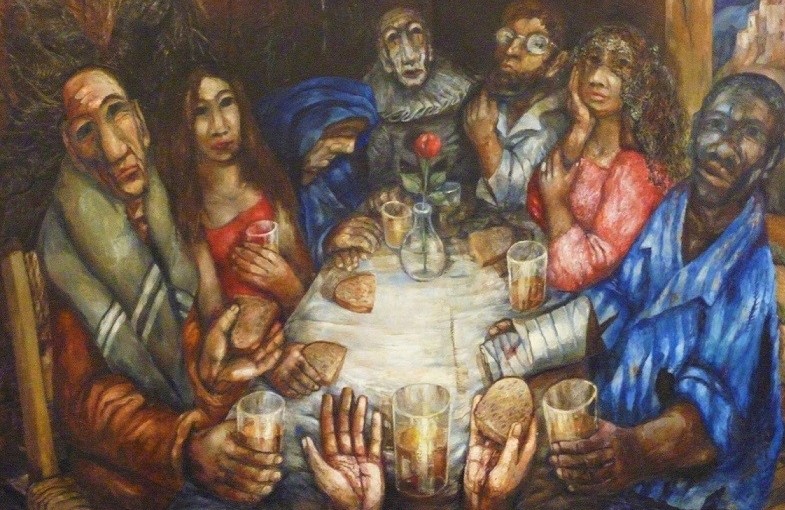
Luke 5:27-32 – Included Through Hospitality

Jesus Eats with Tax Collectors and Sinners by Sieger Köder (1925-2013)

After this, Jesus went out and saw a tax collector by the name of Levi sitting at his tax booth. “Follow me,” Jesus said to him, and Levi got up, left everything and followed him.

Then Levi held a great banquet for Jesus at his house, and a large crowd of tax collectors and others were eating with them. But the Pharisees and the teachers of the law who belonged to their sect complained to his disciples, “Why do you eat and drink with tax collectors and sinners?”

Jesus answered them, “It is not the healthy who need a doctor, but the sick. I have not come to call the righteous, but sinners to repentance.” (New International Version)

Eating meals together in the Ancient Near East was much more than simply taking in sustenance and having some social interaction. It was also a deeply religious affair of spiritual connection and sharing.

So, it was rather surprising for a lot of people, not just the religious leaders, that Jesus freely ate and drank with people of dubious reputation.

Tax collectors were a hated lot by the Jewish people. Most were Jewish themselves, and so, were understandably seen as traitors and turncoats, colluding with the Romans to squeeze as much tax money out of their compatriots as they could.

Jesus actually calls one of these despised persons into his group. Then, even eats with him and his Mafia friends. This is a radical and unheard of inclusion, completely reversing the exclusion tax collectors had from the Jewish community and synagogue.

The religious leaders, of course, want an explanation for such unacceptable behavior by Jesus. He gave them a simple answer, short and sweet: It’s unhealthy people who need help, not healthy ones. I came to help.

For the malady of sin with all its guilt, shame, and exclusion, a powerful remedy is the act of hospitality.

“Hospitality is not to change people, but to offer them space where change can take place.”

Henri Nouwen

The word “hospitality” literally means “love of the stranger.” It is an invitation to accept another into our home that we do not know very well and befriend them. 

Hospitality is what Jesus did. Because of our sin and disobedience, humanity we were estranged from God – we were on the outside. But because of God’s great love, the Son was sent, the Lord Jesus, to come and dwell among us. 

Jesus invited us into the life of God. He is now standing at the door and knocking, and we are to invite Jesus in (Revelation 3:20). Christ has so closely identified with his people that when we invite others into our homes and lives, we are inviting Jesus in. 

Keep in mind that for Matthew to invite Jesus into his life and home cost him time, effort, and negative attention from those not around the table. There was no grumbling or belligerence by neither the tax collectors nor Jesus. 

In an ideal world, we always receive something back for our own work of hospitality – an invitation from the other person, or, at least, a simple thank you. But that does not always happen, and it cannot be the driving reason why we practice hospitality. 

Hospitality must be a work of love that comes from a heart that has been touched by the hospitality of God. Our earthly hospitality is to be a form of saying “thank you” to God for his great grace to us. And that is precisely what I believe Matthew was doing with his own hospitality. 

Complaining comes when we expect to receive and don’t get it. Yet, if you truly receive another person as though she were Christ himself, you will not complain but will rejoice in your service. Jesus has said, “Whoever receives you, receives me.” (Matthew 10:40)

In ancient Christianity, a concrete expression of love to other believers was providing food and shelter for Christians traveling throughout the Roman Empire. Many times, the traveling strangers were itinerant evangelists spreading the message of the gospel from place to place (3 John). 

At other times, believers were deprived of some basic necessities due to the occasional waves of persecution that broke out. They were often poor and needy because of their situation, and of being different; and the townspeople were not typically hospitable.  So, Christians had to rely on the love and hospitality of those believers they could connect with who had the means to help.

Hospitality is an important means of showing and providing love. 

Contribute to the needs of God’s people, and welcome strangers into your home. (Romans 12:13, CEB)

One of the qualifications for church leadership is that they are hospitable.

An elder… must be respected by others. He must be ready to help people by welcoming them into his home. (1 Timothy 3:2, ERV) 

There is a great need for hospitality in our world. Many people are lonely, isolated, and withdrawn, sometimes even excluded because of their mental illness or struggles with addiction. Being in a pandemic certainly doesn’t help that situation whatsoever. They have no one to talk to about important matters.

Hospitality cuts both ways for us. We are to invite the lonely into our hearts and homes; and the lonely are to invite others into their hearts and homes, instead of waiting for somebody to just show up.

Jesus fully understood that eating a meal together with Matthew and the other tax collectors was a sacred affair – communicating mutual acceptance, care, and friendship. This is why the religious leaders had such difficulty seeing Jesus eat with “sinners.” By eating with outsiders and those excluded from the community, Jesus was broadcasting his love and acceptance of such persons.

Our dining room tables are little mission stations. 

When my wife and I were new believers, there was a Christian couple who often had us into their home. Both of us had learned some unhealthy relations through our families of origin.  Here we were, not really knowing what a Christian family should look like. 

Through hospitality, eating together and sharing around the table, we began to learn how a family dedicated to Christ lives. We learned life lessons that we probably could not have learned in any other way.

Jesus, on the cusp of his Passion, enjoyed a meal with his disciples. He said…

While they were eating, Jesus took a loaf of bread, and after blessing it he broke it, gave it to the disciples, and said, “Take, eat; this is my body.” Then he took a cup, and after giving thanks he gave it to them, saying, “Drink from it, all of you; for this is my blood of the covenant, which is poured out for many for the forgiveness of sins.” (Matthew 26:26-28, NRSV)

One thing Jesus meant by those words is that, eating and ingesting the elements of bread and wine, serve as a very tangible way of understanding what life is to be like. 

We are to take Jesus into the depths of our lives. We are to ingest him, that is, to engage in a very close and intimate relationship with him to the degree that the two of us cannot ever be separated. 

The same is to be true of our relationship with one another in the Body of Christ, the Church.  We are to do life together. We are to enjoy eating and drinking together. 

We are to share with others, in a radical act of hospitality which emulates our Lord, not only our food, but our hearts.

Let your heart and your home be open today.

Soli Deo Gloria

1 Timothy 3:1-9 – Be, Not Just Do

Photo by Krivec Ales on Pexels.com

Here is a trustworthy saying: Whoever aspires to be an overseer desires a noble task. Now the overseer is to be above reproach, faithful to his wife, temperate, self-controlled, respectable, hospitable, able to teach, not given to drunkenness, not violent but gentle, not quarrelsome, not a lover of money. He must manage his own family well and see that his children obey him, and he must do so in a manner worthy of full respect. (If anyone does not know how to manage his own family, how can he take care of God’s church?) He must not be a recent convert, or he may become conceited and fall under the same judgment as the devil. He must also have a good reputation with outsiders, so that he will not fall into disgrace and into the devil’s trap.

In the same way, deacons are to be worthy of respect, sincere, not indulging in much wine, and not pursuing dishonest gain. They must keep hold of the deep truths of the faith with a clear conscience. (New International Version)

For the Church everywhere, Jesus Christ is to form and inform everything we do – including leadership.

This is why character formation is at the core of being an elder and a deacon in Christ’s Church – because the elder’s ministry of oversight, shepherding, and discernment of God’s will comes from the inner resources of knowing Christ; and a deacon’s ministry of outreach and service comes from a close walk of faith with Jesus, who desires to work through those individuals. 

Church leaders are to be the light of Jesus to their congregations. It is a high calling. The Apostle Paul gave to the Church seven requirements of Christian morality and seven requirements of a daily walk for leaders. Together, these fourteen requirements are the basis for Christian leaders so that the responsibility of the Church’s mission might be kept on track of bringing people to Jesus and bringing those who know Jesus to know him better.

The first set of seven requirements have to do with the morals of the person. A church leader is to:

1) Be trustworthy. Have a good reputation in both the church and the world

2) Be devoted in the marriage relationship (This doesn’t mean that a church leader must be married, because then even Jesus wouldn’t qualify as a church leader!)

3) Be clear-minded, even-keeled, and consistent

4) Be self-controlled (and not controlling others)

5) Be brave, possessing moral courage, through speaking truth with grace and not being a complainer

6) Be a friend of strangers through practicing hospitality

7) Be an able teacher, gently and carefully instructing others in a way that builds them up and does not tear them down 

The second set of seven requirements have to do with the ethical conduct of the person in everyday life. A church leader is to: 

1) Be sober and not a drunkard, conducting oneself in all moderation

2) Be respectable and not given to anger outbursts and constantly carrying a chip on their shoulder about something

3) Be gentle with everyone and in all situations

4) Be cordial and foster healthy relations, and not always picking a fight about something

5) Be generous and not thinking about the all-mighty dollar in every decision

6) Be caring in the family and give rules with relationship, so as to curb rebellion in a child

7) Be mature and not a novice in the faith so that those outside the church can see there is something wonderfully different about the way things are handled and done among those who profess Jesus Christ.

In addition to this, we have seven related requirements for deacons: 

1) Be dignified in every kind of relation, a person worthy of respect

2) Be sincere and not double-tongued, saying one thing to one person and something different to another

3) Be moderate in all things, especially when it comes to drink

4) Be benevolent and altruistic, and not greedy for either stuff or attention

5) Be holy and pure, keeping very close to faith in Christ with a good heart

6) Be a servant who is able to handle attention without falling apart

7) Be faithful, keeping promises and vows, especially in marriage and with family

God calls and sets apart individuals for service so that the Divine presence might be manifested among the people. Jesus Christ wants the church to be built up through faithful service. Notice what today’s New Testament lesson does not say about church leaders:

  • Be a listener to complaints.

Do everything without complaining or arguing (Philippians 2:14, ERV)

  • Be a representative of the people. Nowhere in Scripture do we find church leaders are supposed to operate like an American form of democracy. Instead of being representatives of the people to do their will, church leaders are rather representatives of God to the people so that God’s will is done in all things. 

Guard yourselves and God’s people. Feed and shepherd God’s flock—his church, purchased with his own blood—over which the Holy Spirit has appointed you as leaders. (Acts 20:28, NLT)

  • Be ingenious. Church leaders are not called to be the smartest, most creative, and best idea people in the room. They are to be servants, leading others in prayer, outreach, and acts of mercy.

I have a special concern for you church leaders. I know what it’s like to be a leader, in on Christ’s sufferings as well as the coming glory. Here’s my concern: that you care for God’s flock with all the diligence of a shepherd. Not because you have to, but because you want to please God. Not calculating what you can get out of it but acting spontaneously. Not bossily telling others what to do, but tenderly showing them the way. (1 Peter 5:1-3, MSG)

These requirements of Holy Scripture are not just for leaders; they are to be sought after by every member of God’s holy Church. We are all together to aspire to the highest of ideals of Christ in the way we operate in the church and in the world. 

Let no debt remain outstanding except the continuing debt to love one another (Romans 13:8). Godly leaders help us to maintain that biblical mandate.

Now may the God of peace, who through the blood of the eternal covenant brought back from the dead our Lord Jesus, that great Shepherd of the sheep, equip you with everything good for doing his will, and may he work in us what is pleasing to him, through Jesus Christ, to whom be glory for ever and ever. Amen. (Hebrews 13:20-21, NIV)

Judges 5:1-11 – A Woman in the Middle

Illustration of Deborah in “Woman in Sacred History” by Harriet Beecher Stowe, 1888

On that day Deborah and Barak son of Abinoam sang this song:

Praise the Lord!
    The Israelites were determined to fight;
    the people gladly volunteered.
Listen, you kings!
    Pay attention, you rulers!
I will sing and play music
    to Israel’s God, the Lord.
Lord, when you left the mountains of Seir,
    when you came out of the region of Edom,
    the earth shook, and rain fell from the sky.
    Yes, water poured down from the clouds.
The mountains quaked before the Lord of Sinai,
    before the Lord, the God of Israel.

In the days of Shamgar son of Anath,
    in the days of Jael,
caravans no longer went through the land,
    and travelers used the back roads.
The towns of Israel stood abandoned, Deborah;
    they stood empty until you came,
    came like a mother for Israel.
Then there was war in the land
    when the Israelites chose new gods.
Of the forty thousand men in Israel,
    did anyone carry shield or spear?
My heart is with the commanders of Israel,
    with the people who gladly volunteered.
    Praise the Lord!
Tell of it, you that ride on white donkeys,
    sitting on saddles,
    and you that must walk wherever you go.
Listen! The noisy crowds around the wells
    are telling of the Lord’s victories,
    the victories of Israel’s people!

Then the Lord’s people marched down from their cities. (Good News Translation)

In the Middle

At the center of the celebration – of Israel’s victory over their oppressors – was a woman.

Today’s Old Testament lesson is a classic Hebrew poem and song of celebration. Yet, there is something a bit different with this poem. The structure of Hebrew poetry points to the middle of the poem as the central idea and focus, with verses before pointing forward to it, and the verses after pointing back to it.

In many poems, God is at the center. The poet’s aim is typically to highlight the Lord as the ballast or resolution to some situation. But today’s poem has Deborah, a woman, smack in the middle. Israel was in a bad way, that is, until Deborah became the leader and judge in Israel. And this was no weird aberration.

Women in the Middle

Women are central to Holy Scripture. God called the people of Israel and labored to shape them into a community built on love, mercy, and justice, reflecting God’s image. Through the Israelites, God continued the work begun in creation, commanding them to love God and serve their neighbors–the orphan, the widow, the stranger, and the alien. Women and men, together, served God in Israel.

The women filled their primary roles in Israel as wives, mothers, and grandmothers. In bearing and caring for children, they patterned their lives on the life of the One who in the beginning labored to bring forth the world, and who later brought forth the nation of Israel and patiently taught it to walk.

Whenever freedom and liberation were needed, women played a central role. The Hebrew midwives Shiphrah and Puah trusted God and refused to obey Pharaoh’s orders. When instructed by Pharaoh to kill the male children, but to let the daughters live, these daughters of Israel preserved the lives of all the newborn. They risked their own lives in order to serve God’s purpose in setting the Israelites free from their slavery in Egypt. (Exodus 1:6-22)

Women were at the heart of hospitality, loving the stranger, as God instructed all the people to do. God empowered the widow of Zarephath to offer lodging and food to the prophet Elijah. Her ministry came at a critical time for Elijah, and this poor widow placed herself and her child at risk by offering her only morsel of food to the prophet. Through her acts of service, the widow advanced God’s work in the world and was sustained by God because of her ministry. (1 Kings 17:7-16)

Miriam and Huldah were prophets, revealing God’s will to the people. (Exodus 15:1-21; 2 Kings 22:11-20). And, along with them, Deborah was both a prophet and a judge, the leader of all the people. She gave wisdom, discernment, and justice to Israel. Deborah even had her hand in the military affairs of the nation. She directed Barak, the general, in a battle against the Canaanites. Although men usually filled such roles, God uses whomever God wants to use in accomplishing the divine will here on this earth, as it is always done in heaven.

God in the Middle

God is the Lord of the past, present, and future. God reigns over both the old and the new, utilizing each for good purposes in the world. In other words, God is not boxed-in. The Lord didn’t start wringing his hands in heaven saying, “Oh, my, I can’t find a man for the job. I guess I’ll have to use a woman!” No, instead, a woman was the Lord’s first and only choice for each situation in which females were used to accomplish God’s will. The Lord is not a victim of circumstances. Rather, God is sovereign and reigns supreme over all situations.

Let’s keep in mind that God is not limited to using men. In fact, God is always doing a new thing in the world. Women and men, equally created in the image and likeness of God, are equally able to be partners with God in the never-ending work of bringing life and redemption to all. Women fulfilling roles of ministry and leadership are not exceptions to God’s order and purpose in creation. Instead, they illustrate God’s true intent for women and men in the world.

We need to hear the stories of women’s leadership and service in Israel as testimony to God’s intent that women and men should be co-laborers with God in God’s work. The Lord isn’t laboring in this world with one hand tied between his back. He is using both hands, both men and women, to establish a benevolent rule and ethical reign.

So, loose the bonds and let the women serve!

Soli Deo Gloria

Luke 4:42-44 – Holding onto Jesus

Journey with Jesus by He Qi

At daybreak, Jesus went out to a solitary place. The people were looking for him and when they came to where he was, they tried to keep him from leaving them. But he said, “I must proclaim the good news of the kingdom of God to the other towns also, because that is why I was sent.” And he kept on preaching in the synagogues of Judea. (New International Version)

A domesticated Jesus is nothing more than a fictional character, part of the panoply of old classic literature, and just another person in the Christian writings of the New Testament.

Many so called Christians want to control Jesus, to have him serve their purposes. Like some magical entertainer, they want to hold onto him, keep him around, trotting him out occasionally to impress friends and family.

Such persons have not yet come to terms with the spiritual reality that Jesus belongs to others, to everyone, not just me or people I like.

Whenever we grab hold of Jesus to keep him from going to others, we play the role of Mary Magdalene, who did not recognize her Lord when he was standing in front of her face. Then, when realizing who he was, did not want Jesus going anywhere. Yet, the Lord responded:

“Do not hold on to me, because I have not yet ascended to the Father. But go to my brothers and say to them, ‘I am ascending to my Father and your Father, to my God and your God.’” (John 20:17, NRSV)

Mosaic of Jesus and Mary Magdalene, Washington National Cathedral

Jesus did more than proclaim good news; he was the good news itself, embodied, for the life of the world – and not only for the life of a particular race or ethnicity or gender, or even religion. As the Lord of Life, there is enough Jesus for everyone.

Maybe the true mark of a Christian is not having bumper sticker messages or a bobblehead Christ or an impressive Bible on the living room coffee table or erudite theological ideas. Maybe its in telling others about Jesus from our own mouth, from a heart that overflows with the gospel of grace.

We must let God be God. Yes, there is a very important place for us to ask, seek, and knock on the door of heaven. And there is also an equal necessity for solitude, silence, and patience, in waiting for the Lord to say, “Come here to me.”

The wisdom to know when to practice solitude, and when to actively seek, arises by purposely engaging in both. We must have an action/reflection model in which we seek to do the will of God, then step back and reflect upon the experience and learn from it. And, at the same time, we are to practice a contemplation/response model that communes in solitude with God, then responds with active involvement of just and merciful acts toward others.

Our Gospel lesson today highlights the need for solitude as a Christian spiritual practice because our Lord practiced it. The solitude, however, is not to be unending. At some point, we must descend from the mountain peak and enter the valley, just as we ascended it from the activity below.

Good news needs proclamation. And for that to happen, it must be proclaimed from both the top of the mountain, as well as the lowest valley. The gospel cannot be chained so that it is tethered for only my group of cronies. No, Jesus is for all, and so, good news is meant to spread to every corner of the earth.

Perhaps we need to sit still long enough, without allowing our inner anxiety to rule the day, to let Jesus call to us and invite us to come. Then, maybe we will be able to hear the gracious words of the Lord:

“Come to me, all you who are struggling hard and carrying heavy loads, and I will give you rest. Put on my yoke and learn from me. I’m gentle and humble. And you will find rest for yourselves. My yoke is easy to bear, and my burden is light.” (Matthew 11:28-30, CEB)

Come Unto Me by Wayne Pascall

There’s no need to break down doors, trying to squeeze ourselves into the kingdom of God. We need only respond to the gracious invitation of Jesus and let him invite others. Truly receiving amazing grace changes us, and we then do not seek to keep Jesus from leaving.

“How amazing, amazing that the one who has help to bring is the one who says: Come here! What love! It is already loving, when one is able to help, to help the one who asks for help, but to offer the help oneself! And to offer it to all! Yes, and to the very ones who are unable to help in return! To offer it, no, to shout it out, as if the helper himself were the one who needed help, as if he who can and wants to help everyone were nevertheless in one respect himself a needy one, that he feels need, and thus needs to help, needs those who suffer in order to help them!”

Søren Kierkegaard, Practice in Christianity

Coming and going, silencing and proclaiming, holding and letting go. We allow Jesus to do it all. And we simply follow in his footsteps.

Lord Jesus Christ, Son of God, Son of Humanity, your presence here on earth never becomes a thing of the past – thus never becoming distant. Our faith and experience of you is very present and very much real in the here and now.

Might all people see you in your true form and in the way you walked this earth – not in an empty or meaningless way of mere thoughts or distortions. May all people see you as you are, a lowly man, yet the Savior and Redeemer of humanity – who out of love came to earth to seek the lost, to suffer and die, to call the straying soul, and to absorb the opposition of others without raising a hand in defense.

Would that we might see you in this way, and not be offended at you and your gracious gathering of all kinds of people into your glorious kingdom. Amen.