Have mercy on me, God, according to your faithful love! Wipe away my wrongdoings according to your great compassion! Wash me completely clean of my guilt; purify me from my sin! Because I know my wrongdoings, my sin is always right in front of me. I’ve sinned against you—you alone. I’ve committed evil in your sight. That’s why you are justified when you render your verdict, completely correct when you issue your judgment. Yes, I was born in guilt, in sin, from the moment my mother conceived me. And yes, you want truth in the most hidden places; you teach me wisdom in the most secret space.
Purify me with hyssop and I will be clean; wash me and I will be whiter than snow. Let me hear joy and celebration again; let the bones you crushed rejoice once more. Hide your face from my sins; wipe away all my guilty deeds! Create a clean heart for me, God; put a new, faithful spirit deep inside me! Please don’t throw me out of your presence; please don’t take your holy spirit away from me. Return the joy of your salvation to me and sustain me with a willing spirit. Then I will teach wrongdoers your ways, and sinners will come back to you.
Deliver me from violence, God, God of my salvation, so that my tongue can sing of your righteousness. Lord, open my lips, and my mouth shall proclaim your praise. You don’t want sacrifices. If I gave an entirely burned offering, you wouldn’t be pleased. A broken spirit is my sacrifice, God. You won’t despise a heart, God, that is broken and crushed. (Common English Bible)
Ash Wednesday is an ancient holy day on the Church Calendar. It marks the beginning of the season of Lent—a time of penitence, discipline, and renewal.
We are reminded of our mortality, we confess our sins, and we experience forgiveness through Christ’s death and resurrection. The “imposition of ashes” is a central part of Ash Wednesday observances, whereby the penitent worshiper receives ashes on the forehead in the sign of the cross.
In Holy Scripture, ashes serve both as a symbol of mortality and as a sign of mourning and repentance. But neither sin nor death is the final word. So, we also have confidence and gratitude that Christ has conquered death, and nothing can separate us from the love of God, which is in Jesus, our Lord.
Today, on this Ash Wednesday, the appropriate posture of the devout Christian is prayer. Specifically, prayers of confession of our great and many sins, shortcomings, and moral failures.
This might sound negative and a major downer. Yet, to not look evil square in the face and call it out for what it is, is at best denial, and at the worst allowing a bitter seed of unforgiveness to gestate in the depths of your soul.
It seems to me there is no better way to confront the darkness within than with using the ancient prayer book of the Old Testament Psalms. I encourage you to pray Psalm 51 out loud and slowly, with a generous amount of emotional flavor – even, and especially, if you don’t feel like it.
Pray the ancient psalm over more than once, and perhaps several times punctuated throughout the day today. In doing so, you will be joining the faithful across this entire big world who today offer to God a prayer of subversion against the blackness on this earth.
Holy God, as the season now turns to Lent, we pray that you will guide us in the days ahead. As we journey with Jesus, give us an abiding sense of your presence, an unguarded sense of ourselves, and an awareness of the needs of this world.
Loving God, as we are marked with the ashes of earth, we bring before you the frailty of our very human lives: our fragile health; the uncertainty of our plans; the changing nature of our relationships. Grant us patience in suffering and healing from our ills. Give us, in equal measure, humility and hope in our pursuits. Bind us in love that is constant, yet able to change according to the needs and circumstances before us.
Just God, you call us to action; to bring freedom to the oppressed; to care for those in need; to lift the burdens of others. We ask you to increase our courage and our will to work for the peace you envision and desire. We pray for an end to warfare and conflict, accepting our call to be peacemakers. We pray for an end to hunger and homelessness, knowing we are called to share with others and show hospitality. We pray for an end to false righteousness, evil speech, and shallow faith in our lives, in the church, in our public life, and among all the nations.
Eternal God, we pray your kingdom will come in fullness; that what is perishable will be raised imperishable; that death itself will be swallowed up in victory; through Jesus Christ, our Savior and Lord. Amen.
In the thirtieth year, in the fourth month, on the fifth day of the month, as I was among the exiles by the river Chebar, the heavens were opened, and I saw visions of God. On the fifth day of the month (it was the fifth year of the exile of King Jehoiachin), the word of the Lord came to the priest Ezekiel son of Buzi, in the land of the Chaldeans by the river Chebar; and the hand of the Lord was on him there.
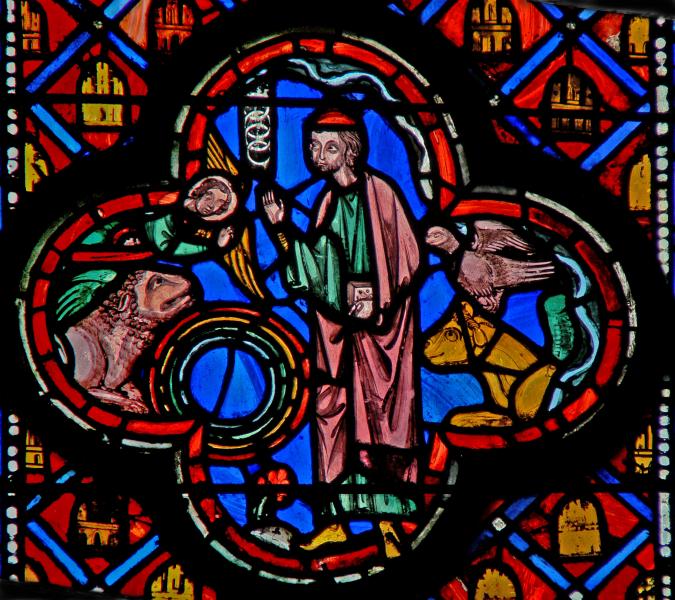
As I looked, a stormy wind came out of the north: a great cloud with brightness around it and fire flashing forth continually, and in the middle of the fire, something like gleaming amber. In the middle of it was something like four living creatures. This was their appearance: they were of human form. Each had four faces, and each of them had four wings. Their legs were straight, and the soles of their feet were like the sole of a calf’s foot; and they sparkled like burnished bronze. Under their wings, on their four sides, they had human hands. And the four had their faces and their wings thus: their wings touched one another; each of them moved straight ahead, without turning as they moved. As for the appearance of their faces: the four had the face of a human being, the face of a lion on the right side, the face of an ox on the left side, and the face of an eagle;such were their faces. Their wings were spread out above; each creature had two wings, each of which touched the wing of another, while two covered their bodies. Each moved straight ahead; wherever the spirit would go, they went, without turning as they went. In the middle of the living creatures there was something that looked like burning coals of fire, like torches moving to and fro among the living creatures; the fire was bright, and lightning issued from the fire. The living creatures darted to and fro, like a flash of lightning.
As I looked at the living creatures, I saw a wheel on the earth beside the living creatures, one for each of the four of them. As for the appearance of the wheels and their construction: their appearance was like the gleaming of beryl; and the four had the same form, their construction being something like a wheel within a wheel.When they moved, they moved in any of the four directions without veering as they moved. Their rims were tall and awesome, for the rims of all four were full of eyes all around. When the living creatures moved, the wheels moved beside them; and when the living creatures rose from the earth, the wheels rose. Wherever the spirit would go, they went, and the wheels rose along with them; for the spirit of the living creatures was in the wheels. When they moved, the others moved; when they stopped, the others stopped; and when they rose from the earth, the wheels rose along with them; for the spirit of the living creatures was in the wheels.
Over the heads of the living creatures there was something like a dome, shining like crystal, spread out above their heads. Under the dome their wings were stretched out straight, one toward another; and each of the creatures had two wings covering its body. When they moved, I heard the sound of their wings like the sound of mighty waters, like the thunder of the Almighty, a sound of tumult like the sound of an army; when they stopped, they let down their wings. And there came a voice from above the dome over their heads; when they stopped, they let down their wings.
And above the dome over their heads there was something like a throne, in appearance like sapphire; and seated above the likeness of a throne was something that seemed like a human form. Upward from what appeared like the loins I saw something like gleaming amber, something that looked like fire enclosed all around; and downward from what looked like the loins I saw something that looked like fire, and there was a splendor all around. Like the bow in a cloud on a rainy day, such was the appearance of the splendor all around. This was the appearance of the likeness of the glory of the Lord.
When I saw it, I fell on my face, and I heard the voice of someone speaking.
He said to me: O mortal, stand up on your feet, and I will speak with you. (New Revised Standard Version)
Stained glass window of Ezekiel’s vision, c.1246–48, Sainte-Chapelle, Paris (Bridgeman Images)
If anyone ever spouted these words on the behavioral health unit on which I work, they’d likely get diagnosed with psychosis. But the prophet Ezekiel was far from psychotic. Patients experiencing a psychotic break rarely talk about visions resembling Ezekiel’s. They’re more inclined to speak about their past trauma in very detached ways, or say things like, “Please pass the ketchup. I’d like to fly a kite and catch some of those butterflies.”
Ezekiel’s vision is also not some contrived experience due to imbibing hallucinogenic substances. The entire prophecy of Ezekiel, spanning a hefty forty-eight chapters, certainly evidences a unique person – yet one that is in control of his full faculties and has keen self-awareness.
If anyone ever tells you they are certain about everything in the book of Ezekiel, don’t believe them. Today’s Old Testament lesson of Ezekiel’s vision of God is an incredible view. It almost defies description. In fact, it does. It’s as if Ezekiel was trying to somehow to communicate with the limitation of words of what he saw.
Even though we might not understand or comprehend everything in this vision, does not mean we can lose sight of the big picture of what was happening.
Ezekiel got a glimpse of God’s glory. That, in and of itself, would explain why it is such a mysterious and incredible vision.
Slowly reading Ezekiel’s vision, one gains the sense of immensity, hugeness, grandeur, and awesome glory. The Hebrew word “glory” literally means “heavy.” In other words, God is large, bright, holy, carrying a great deal of weight. As we used to say back in the ‘70’s, “Heavy, man, heavy!”
This was much more than a unique experience for Ezekiel. It completely had him undone. Ezekiel fell on his face because that is about all one can do when encountering such an incredible appearance. Sneaking a peek of God in glorious heavenly splendor is an awesome sight. So, when God speaks from the place of such awsome glory, there is nothing to do but listen and obey.
Meeting God, this same God whom Ezekiel encountered, is no small thing. Whenever we truly catch a glimpse of this holy God, it will forever change us – and this is a good thing, even if it seems to others that we must be smoking something.
If we want to hear the call of God upon our lives, we need to see God’s glory. Otherwise, we can too quickly forget and neglect the Lord.
May God be gracious in allowing you a glimpse into the Divine throne room – and may you never be the same again because of it.
Glorious God, you carry such great weight that all creation bows to your every word and each move. I, too, bow before you, and I will stand up so that I might hear what you have to say to me. Speak, Lord, for I am listening to you. Amen.
Moses gathered together the whole Israelite community and said to them: These are the things that the Lord has commanded you to do:
Do your work for six days, but the seventh day should be holy to you, a Sabbath of complete rest for the Lord. Whoever does any work on the Sabbath will be put to death. Don’t start a fire in any of your homes on the Sabbath day.
Moses said to the whole Israelite community, This is what the Lord has commanded: Collect gift offerings for the Lord from all of you. Whoever freely wants to give should bring the Lord’s gift offerings: gold, silver, and copper; blue, purple, and deep red yarns; fine linen; goats’ hair; rams’ skins dyed red; beaded leather; acacia wood; the oil for the light; spices for the anointing oil and for the sweet-smelling incense; gemstones; and gems for setting in the priest’s vest and in the priest’s chest pendant.
All of you who are skilled in crafts should come forward and make everything that the Lord has commanded: the dwelling, its tent and its covering, its clasps, its boards, its bars, its posts, and its bases, the chest with its poles and its cover, the veil for a screen, the table with its poles and all its equipment, the bread of the presence, the lampstand for light with its equipment and its lamps, the oil for the light, the incense altar with its poles, the anointing oil and the sweet-smelling incense, the entrance screen for the dwelling’s entrance, the altar for entirely burned offerings with its copper grate, its poles, and all its equipment, the washbasin with its stand, the courtyard’s drapes, its posts, and its bases, and the screen for the courtyard gate, the dwelling’s tent pegs and the courtyard’s tent pegs, and their cords, the woven clothing for ministering in the sanctuary, and the holy clothes for Aaron the priest and his sons for their service as priests.
The whole Israelite community left Moses. Everyone who was excited and eager to participate brought the Lord’s gift offerings to be used for building the meeting tent and all its furnishings and for the holy clothes. Both men and women came forward. Everyone who was eager to participate brought pins, earrings, rings, and necklaces, all sorts of gold objects. Everyone raised an uplifted offering of gold to the Lord. And everyone who had blue or purple or deep red yarn or fine linen or goats’ hair or rams’ skins dyed red or beaded leather brought them. Everyone who could make a gift offering of silver or copper brought it as the Lord’s gift offering. Everyone who had acacia wood that could be used in any kind of building work brought it. All the skilled women spun cloth with their hands and brought what they had spun in blue and purple and deep red yarns and fine linen. All the women who were eager to use their skill spun the goats’ hair. The chiefs brought gemstones and gems to be set in the priest’s vest and the chest pendant, spices and oil for light and for the anointing oil, and for the sweet-smelling incense. All the Israelite men and women who were eager to contribute something for the work that the Lord had commanded Moses to do brought it as a spontaneous gift to the Lord. (Common English Bible)
At first glance, today’s Old Testament lesson might seem a bit tedious, perhaps even boring. After all, being informed of all the details on the furnishings for building the tabernacle (the Ark of the Covenant, the utensils for worship and sacrifice, and the tent that houses it all) appears like some ancient engineer wrote it. It’s just downright laborious.
But that’s the point. It took a great deal of planning, effort, and commitment to realize it all. Although Moses received the instructions and revelation from God on the mountain, he still had to communicate it to the people and solicit their help.
There is a wonderful synergy here, between God and the people, a kind of divine/human cooperative, a spiritual rhythm of revelation and response.
The contributions and the work were done by people whose hearts were stirred to give of their resources and their labor. The people freely offered their things and themselves in order to realize the tabernacle’s construction.
The epicenter of worship is a divine dialogue between us and God. That is, God speaks, and the people respond. God reveals the divine will, and the people’s hearts are stirred.
Whenever worship becomes a mere duty and drudgery, it is cheapened. Worship that degenerates into mere obligation becomes dull and flat. Duty without delight is boring. Such worship has no impact or effect on us.
Contemporary problems of Christian worship are typically viewed as liturgical issues. Many modern worshipers disparage particular prayers, Scriptures, or readings said every week as being vain repetition. The Lord’s Table may be celebrated only occasionally, so as to not lose something of it’s specialness.
Yet, none of us looks down at eating every day, praying multiple times in a day, and using the same daily phrases of greeting and saying good-bye to others. We don’t create new shoe stores which have no shoelaces because tying our shoes every day is so boring and pedantic.
The real issue is us – not the form of worship. It’s about our own hearts. The ancient Israelites gave of their time and resources in worship because they wanted to, not because they had to. They weren’t looking to be highly entertained, emotionally captivated, or mentally stimulated. The people simply wanted to please their God and to truly connect with the Lord.
Worship isn’t a monologue. It’s not a one-way communication in which we, the people, passively sit and soak-in what’s in front of us. Worship is work. It’s active. It’s participative. And it’s a process which involves some tedious and sometimes slow patient effort.
Moses and God’s people were genuinely enthused to participate in what God was calling them to do. Worship that comes from willing hearts is a beautiful thing, because encountering God and being stirred within by a Divine call is a wonderful and mystical thing – and it isn’t boring.
Gracious God, just as you laid it upon the hearts of people long ago to participate in the work of worship, so impress my heart with your mission in this world. I give you my life along with my possessions so that my entire self will be dedicated to the worship of Jesus Christ. Amen.
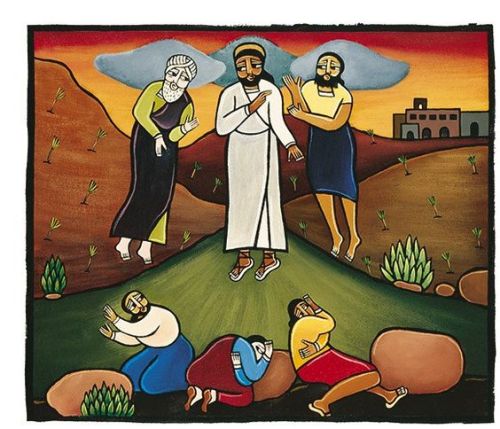
Jesus took Peter, John and James with him and went up onto a mountain to pray. As he was praying, the appearance of his face changed, and his clothes became as bright as a flash of lightning. Two men, Moses and Elijah, appeared in glorious splendor, talking with Jesus. They spoke about his departure, which he was about to bring to fulfillment at Jerusalem. Peter and his companions were very sleepy, but when they became fully awake, they saw his glory and the two men standing with him. As the men were leaving Jesus, Peter said to him, “Master, it is good for us to be here. Let us put up three shelters—one for you, one for Moses and one for Elijah.” (He did not know what he was saying.)
While he was speaking, a cloud appeared and covered them, and they were afraid as they entered the cloud. A voice came from the cloud, saying, “This is my Son, whom I have chosen; listen to him.” When the voice had spoken, they found that Jesus was alone. The disciples kept this to themselves and did not tell anyone at that time what they had seen.
The next day, when they came down from the mountain, a large crowd met him. A man in the crowd called out, “Teacher, I beg you to look at my son, for he is my only child. A spirit seizes him, and he suddenly screams; it throws him into convulsions so that he foams at the mouth. It scarcely ever leaves him and is destroying him. I begged your disciples to drive it out, but they could not.”
“You unbelieving and perverse generation,” Jesus replied, “how long shall I stay with you and put up with you? Bring your son here.”
Even while the boy was coming, the demon threw him to the ground in a convulsion. But Jesus rebuked the impure spirit, healed the boy and gave him back to his father. And they were all amazed at the greatness of God.(New International Version)
When Jesus is around, extraordinary things happen. And yet, sometimes we just don’t perceive it. The three disciples of Jesus – Peter, James, and John – experienced something incredible, yet they were not really aware of what it meant, at the time. The Transfiguration of Jesus on the mountain was unimaginable and awesome. The disciples, however, were confused, sleepy, and walked away silent about the whole affair.
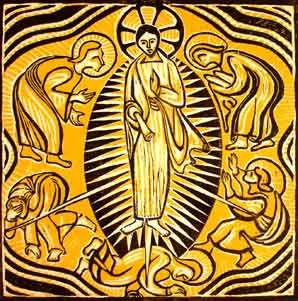
Woodcut of the Transfiguration by Sister Mary Grace Thul
Coming down from the mountain, the other disciples were found scratching their heads about a boy in need of healing. Jesus seemed rather perturbed about the all-around lack of faith. After curing the boy, everyone was amazed, as if they did not expect such a thing to occur.
We are not always told in the Gospels why Christ’s disciples often did not understand or perceive the significance of the miraculous, supernatural, or extraordinary events that took place right in front of them. Maybe their minds were somewhere else.
It could be that Peter had ADD (Attention Deficit Disorder) and was having trouble focusing.
Perhaps James trying to do some sort of ancient multi-tasking.
Maybe John had some road rage on his way to the meeting on the mountain and was having a hard time thinking straight.
It could be that the three disciples were caught up in the anxiety of wondering where their next shekel was coming from.
Perhaps they were just up too late the night before binge watching the fishermen on the lake. But whatever was going on with the disciples, they were distracted.
So, we actually have God the Father step into the scene at the Transfiguration of Jesus on the mountain and speak. God isn’t typically in the business of exhorting people to listen unless they are not paying attention. The heavenly Father is clear, succinct, and to the point:
“This is my Son, whom I have chosen; listen to him.”
We are to listen to Jesus because he is God’s Son. Everything centers round him.
Jesus is the full bodily and human representation of God on earth. Jesus is Savior, Lord and Master, Teacher and Healer.
Jesus is the complete fulfillment of all the Old Testament promises, and the one who will come again to judge the living and the dead.
Jesus is the mid-point of history, the hinge upon which all the universe swings. Jesus is the one whom we must listen to when he speaks and acts.
Therefore, our identity is to be fully bent, molded, and shaped in Jesus Christ. This spiritual formation of our lives happens as we intentionally seek to be with Jesus, listen to him, and do what he says.
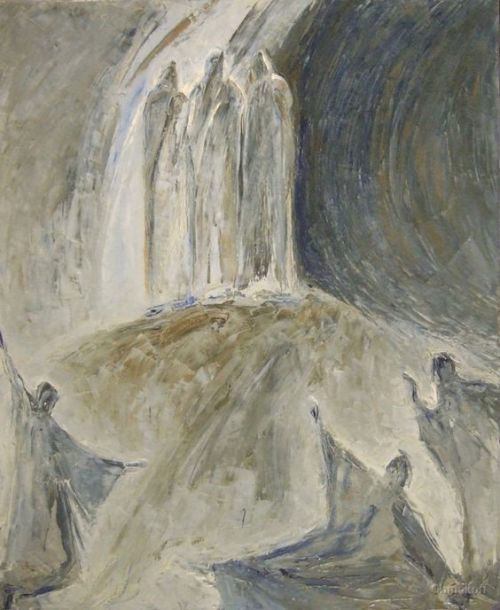
Transfiguration by Macha Chmakoff
Jesus took Peter, James, and John up the mountain to experience his Transfiguration in a prayer meeting. Extraordinary things happen in prayer meetings. The early church gathered often in prayer meetings, following the example of their Lord Jesus. As the church listened to God and responded (in a rhythm of revelation and response) they saw Peter miraculously delivered from jail; ordinary people delivered from empty lives and demonic influence; and guidance in how to proceed as followers of Christ.
Prayer is as much or more about listening to God as it is talking to him. It is in listening to God that we are filled with God’s Spirit and empowered to come down from the mountain and engage in God’s mission.
Jesus wanted the disciples to learn and discern something on the mountain. Jesus was changed in front of them. Moses and Elijah showed up and talked with him about his “departure,” that is, his “exodus.”
Moses was the one who listened to God and led the people in a mass exodus from slavery in Egypt to the freedom of the Promised Land.
Elijah was a prophet who listened to God and led the people out of centuries of idol worship and dead religion into the freedom of spiritual and national revival in Israel.
And Jesus came to lead people in an exodus out of sin, death, and hell so that they can experience a new life of freedom, hope, peace, and joy.
Changed lives are God’s goal for us. And a changed life will occur when we listen to God’s Son, Jesus, learn from him, and lean into faith in him – all of which takes humility.
Eventually, Jesus and his disciples came down from the mountain. Prayer meetings are great, but there is a time to descend the mountain and engage in God’s mission.
We are to participate with God in seeing changed lives through the work of Jesus.
We must bear witness to the redemptive saving events of Jesus to a world which desperately needs him – his healing work of both body and spirit.
The glory of God is presently here among us. We need to perceive it and be aware of it. But to do so, we must listen well.
Erik Weihenmayer is blind, yet on May 25, 2001, he reached the peak of Mount Everest. Suffering from a degenerative eye disease, he lost his sight when he was thirteen years old. But that did not stop him from mountain climbing. On a mountain where 90% of climbers never make it to the top—and 165 have died trying since 1953—Erik succeeded in large measure because he listened well.
He listened to the little bell tied to the back of the climber in front of him, so he would know what direction to go. He listened to the voice of teammates who would shout back to him, “Death-fall two feet to your right!” so he would know what direction not to go. He listened to the sound of his pick jabbing the ice, so he would know whether the ice was safe to cross.
When we journey through this life, listening well makes all the difference. So, how might we listen well to Jesus? Here are some basic principles of active listening:
Stop talking. It was Mark Twain who said: “If we were supposed to talk more than we listen, we would have two tongues and one ear.” Proverbs 12:15 says, “The way of a fool seems right to him (therefore he has no need to listen) but a wise person listens to advice.”
Prepare yourself to listen to God. One of the ways I do this is by sitting in a quiet spot, free of distraction, and repeat several times to God, “Speak Lord, for your servant is listening” (1 Samuel 3:10). Then, I am quiet… and listen…. If this practice is way off your radar then I would recommend, at first, being quiet for only a few minutes. Then, after a few weeks, be quiet in longer stretches so that you can go 20-30 minutes or even an hour. We might even consider a silent retreat in which the sole purpose is to listen to what God is saying to us.
Slowly and carefully read God’s Word. Scripture is meant to be digested in small bites and thoroughly savored. Slow down and be quiet enough to hear God speak through the Word. A contemplative and meditative readings of Holy Scripture will always yield spiritual health and vitality.
Pray back to God what you hear him saying to you. This is active listening – a genuine dialogue between us and God. “Come, now, let us reason together,” the Lord has said (Isaiah 1:18). God wants a conversation with us.
God speaks, if we have ears to hear, through so much more than an audible voice.
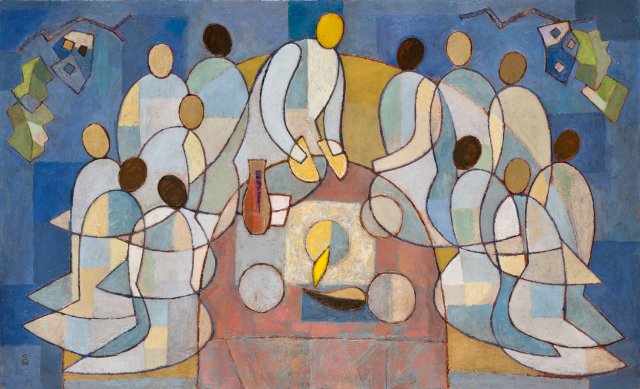
The Lord’s Supper is a tangible proclamation of the person and work of Jesus Christ. It speaks to us, and, so, we must listen well. The Table proclaims Christ’s identity as God’s Son, the one who came to live a holy life, teaches us the way to live, and how Jesus died a cruel death so that we might be born again and experience new life.
We Are All One in Jesus Christ by Soichi Watanabe, 2009
The Table proclaims our mission, that as often as we share in communion, we proclaim the Lord’s death until he comes again. That is, we witness to the reality of Christ’s redemption in our own lives. We share our own changed lives with others. We pray for them so that they will experience new life, as well.
The Table proclaims our spiritual formation in Christ. At the Table, we are lifted and joined with Christ through the Holy Spirit. It is a mysterious joining that defies description, just as the disciples had a mysterious encounter that they could not fully explain. Yet they experienced it, nonetheless.
May we listen well, without distraction, to God’s Son. May we know God’s purpose for our life. And may we encounter Jesus at the Table, and in all of life, so that we experience new life.
O God, teach us to listen to those nearest to us, our family, our friends, our co-workers. Caring God, teach us to listen to those far from us – the whisper of the hopeless, the plea of the forgotten, and the cry of the anguished. Holy Spirit of God, teach us to listen for your voice — in busyness and in boredom, in certainty and doubt, in noise and in silence. Gracious God, teach us to listen well to the message of your Table. May you change and transform us to be like Jesus. Teach us, Lord, to listen. Amen.









 Rev. Tim Ehrhardt