Luke 15:1-10 – The Parable of the Lost Sheep and the Lost Coin

Parable of the Lost Sheep by Sieger Köder (1925-2015)

Now all the tax collectors and sinners were coming to hear him. But the Pharisees and the experts in the law were complaining, “This man welcomes sinners and eats with them.”

So, Jesus told them this parable: “Which one of you, if he has a hundred sheep and loses one of them, would not leave the ninety-nine in the open pasture and go look for the one that is lost until he finds it? Then when he has found it, he places it on his shoulders, rejoicing. Returning home, he calls together his friends and neighbors, telling them, ‘Rejoice with me, because I have found my sheep that was lost.’ I tell you, in the same way there will be more joy in heaven over one sinner who repents than over ninety-nine righteous people who have no need to repent.

“Or what woman, if she has ten silver coins and loses one of them, does not light a lamp, sweep the house, and search thoroughly until she finds it? Then when she has found it, she calls together her friends and neighbors, saying, ‘Rejoice with me, for I have found the coin that I had lost.’ In the same way, I tell you, there is joy in the presence of God’s angels over one sinner who repents.” (New English Translation)

Lost people matter to God… a lot. They matter so much to the Lord that one lost soul who is found is the grounds for a big celestial party. 

Please note this simple observation of today’s Gospel lesson: If there is rejoicing in the presence of angels over one sinner who repents, then it is God who is doing the rejoicing. The Lord is absolutely giddy with joy over a lost person being found.

Jesus told two short stories, each teaching the same thing, so that we will be absolutely sure to get it: A loving God has unbounded joy over lost people being found. These parables of Jesus give us a glimpse of God’s own heart. The Lord would do anything to find a lost person, to restore and reconcile that person to right relationships. 

God would go dumpster diving and wade through stinky nasty garbage to find just one lost valuable person.

Restoring lost people is such a high priority to God that the Father sent the Son to this earth. Jesus paid the ultimate price of a cruel death on a cross to reconcile a broken lost relationship between people and God.

I have not always been a devoted follower of Christ. I still remember what it felt like to be separated from God and estranged from the church – it was lonely and awful, like being in a deep black hole with no way of getting out and no one around to help. 

But God mercifully sent people into my life to share good news with me and help me out of my prodigal way of life. I once was lost. But now I am found. When I turned from my path of destruction and embraced Jesus Christ, there was a big party in heaven.
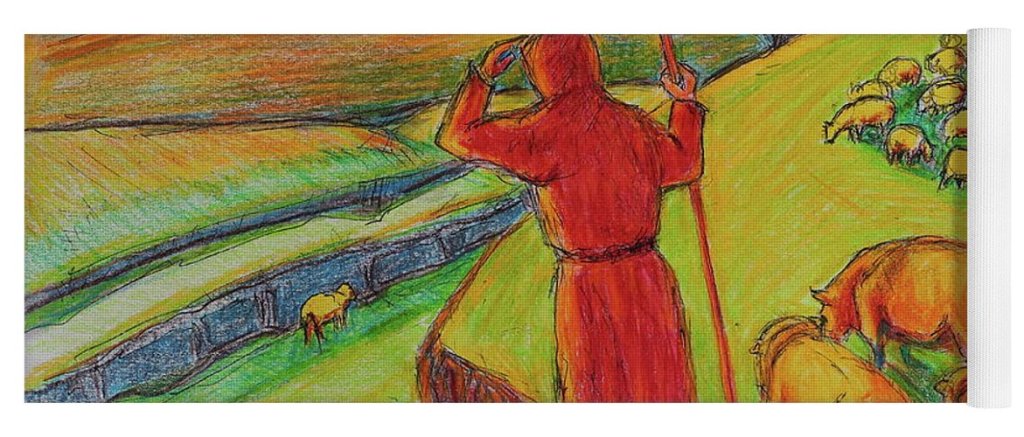
Lost Sheep Parable by Thomas Bertram Poole

God gathering wayward and lost persons is a gracious activity, seemingly free from criticism. But there was. And because there were complaints leveled at Jesus for purposely going after the lost, it therefore needs to be asked: 

Where do we locate ourselves in these parables? 

The two stories were downright offensive to many of Christ’s original hearers. Those upset with Jesus were so inwardly focused that they believed ministry ought to revolve around them and their needs.

And, what’s more, the religious leaders were offended because they thought all the fuss about sinners would only highlight their sin. In other words, there ought to be no party and no rejoicing for people who have lived an ethically and morally dubious life.

Preaching grace is always offensive to people who work for their salvation. It is scandalous to such persons to hear that Jesus did not come to call the righteous, but sinners to repentance. 

If we hear Christ’s parables and the concern for lost sinners who don’t know Jesus and say, “Well, all this talk about outreach is well and good, but what about us?  What about me? After all, I never went down a path of immorality or hurt anyone. I’m a good person. Where’s my party?” Then, we must locate ourselves as the lost persons in need of being found by God’s grace.

Consider for a moment the worst sinner you can think of – a person for whom you would label as being akin to the devil…. Now picture that person being found by God and becoming a follower of Christ….

Would you attend the party to celebrate that person’s repentance, reconciliation, and recovery? 

If any of us feels justified in our hate, then we are the lost one in need of turning from our sin.

In leaving the ninety-nine sheep in the flock and going after the one sheep, God gave preferential attention to the lost…. Can you live with that? 

These parables of Jesus have significant meaning for church programs, budgets, and committees. By most estimations, only one-in-five lost people in America even knows one Christian. Statistics like that are what keep me up at night; it deeply saddens me. It drives me to prayer.

God’s unconditional mercy and amazing grace is what makes all the difference. 

If we lose the sense of awe and appreciation for what God has done for us in Christ, then there will be no outreach. Finding lost people is not dependent on completing a class on evangelism or getting training in how to answer every question.

Outreach is fueled by passion and desire. Healthy Christians reproduce themselves. I assume you didn’t take a class on how to procreate – you just had the desire and the willingness; and then, you celebrated nine-months later, the birth of new life.

New life always needs to be celebrated because that’s what God does. Yet, the party cannot commence until the lost are found….

O God – blessed Father, Son, and Spirit – sanctify all believers everywhere with your abiding presence. Enlighten the minds of your people more and more with the light of the Gospel. Bring lost people to the knowledge of our Savior Jesus Christ; and those who are walking in the way of life, keep steadfast to the end. Guard those who are strong and prosperous from forgetting you and straying from the flock. Increase in us your grace and love so that we may participate with you in finding the lost. Amen.

Joshua 4:14-24 – The Importance of Visual Reminders

That day the Lord brought honor to Joshua before all Israel. They respected him all his life, just as they had respected Moses.

The Lord told Joshua, “Instruct the priests carrying the ark of the covenantal laws to come up from the Jordan.” So, Joshua instructed the priests, “Come up from the Jordan!” The priests carrying the ark of the covenant of the Lord came up from the middle of the Jordan, and as soon as they set foot on dry land, the water of the Jordan flowed again and returned to flood stage.

The people went up from the Jordan on the tenth day of the first month and camped in Gilgal on the eastern border of Jericho. Now Joshua set up in Gilgal the twelve stones they had taken from the Jordan. He told the Israelites, “When your children someday ask their fathers, ‘What do these stones represent?’explain to your children, ‘Israel crossed the Jordan River on dry ground.’ For the Lord your God dried up the water of the Jordan before you while you crossed over. It was just like when the Lord your God dried up the Red Sea before us while we crossed it.He has done this so all the nations of the earth might recognize the Lord’s power and so you might always obey the Lord your God.” (New English Translation)

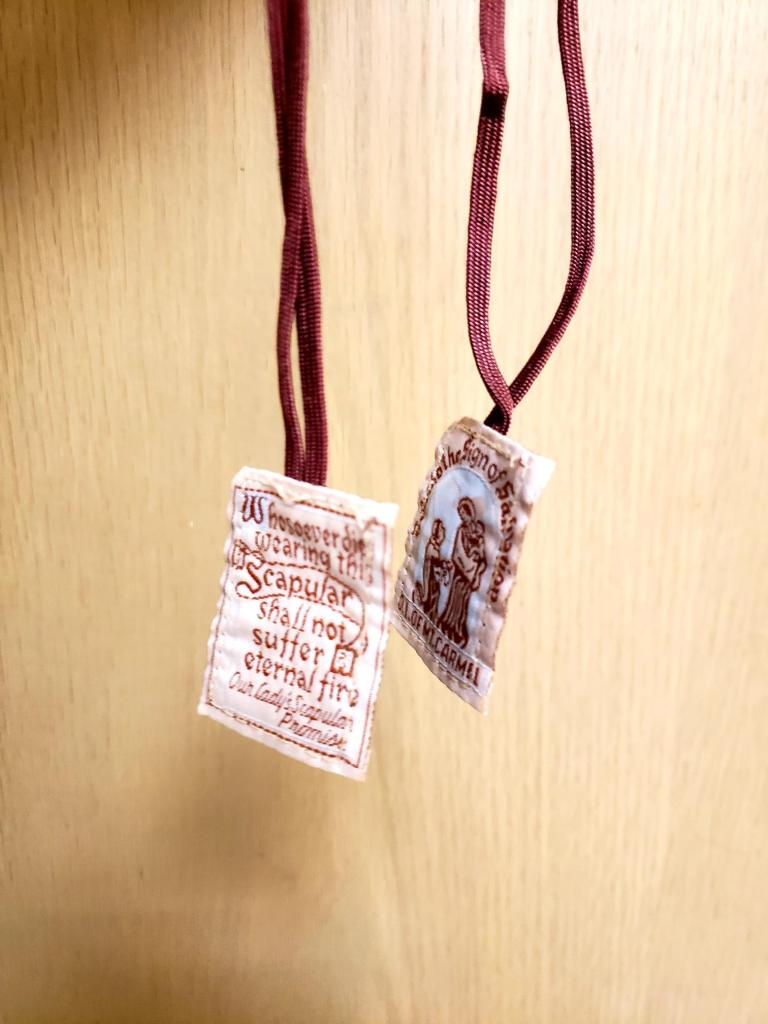
On my hospital office desk, where I can see it every day, is a scapular. “Scapular” is the Latin word for “shoulders.” A scapular typically consists of two small pieces of cloth, a few inches in size, which has a religious image on one, and a message on the other. There are two bands of cloth connecting the message or image.

The wearer places one square on the chest, rests the bands on each shoulder and lets the second square drop down the back. Worn by some Catholic faithful, the scapular serves to remind the believer of their commitment to live a Christian life.

The particular scapular I have in my possession was given to me by a patient when I was first starting out as a hospital chaplain. I was called to the room of a dying patient. He was afraid of death. So, we conversed together for an hour about his life, his fears, and his devotion to faith. At the end of the conversation, the patient took off the scapular he was wearing, which states, “Whosoever dies wearing this Scapular shall not suffer eternal fire.”

Regardless of what you think about scapulars and the particular message on this one, most important to me is what the patient said next with tears in his eyes: “I’ve worn this scapular every day for the past forty years. Here, I want you to have it. I don’t need it anymore. I am no longer afraid of death.”

The patient died. But he died at peace with God and without fear. I keep his scapular on my desk as a constant reminder of why I am a hospital chaplain, and how important the work I do is. Anytime I get discouraged or have a hard day, when I return to my office, the scapular reminds and reorients me that the spiritual care of patients is a privileged and sacred responsibility.

The ancient Israelites were finally ready to enter the Promised Land. The twelve tribes miraculously crossed the Jordan River on dry ground. God had stopped the water from flowing. After everyone crossed over, the river went back to flowing again.

Joshua, their leader, instructed people from each tribe to take a large stone from the river and place them in a heap for two didactic reasons:

1) To educate future generations inside Israel that God kept the promise to bring them into a land of abundance; and

2) To educate those outside Israel that God is mighty.

It’s important that we all have a continual awareness of why we are here on this earth and what our purpose is. Our history is significant and needs to be remembered.

Yet, there are many families and faith communities in which the children know little about how God worked in their parents’ lives, not to mention the many previous generations. Having tangible reminders of God’s past actions helps everyone remember. 

Just as people ask me about why I have a scapular on my desk, so having reminders of God’s grace in prominent visible places serves to aid all ages of folks to ask why those mementos are there.

It is good to have visual reminders of faith and the faithful people who influenced us around our homes, places of work, and communities so that others may discover and know the redemptive acts of God, that the Lord keeps promises.

Almighty God, we praise and magnify your holy Name for all your servants who have finished their course in faith and patience. May we remember them and their service well. We humbly pray that, at the day of resurrection, we and all who are members of the mystical body of your Son may be set on his right hand, and hear his most joyful voice: “Come, you who are blessed by my Father, inherit the kingdom prepared for you from the foundation of the world.” Grant this, O merciful Father, for the sake of Jesus Christ, our only Mediator and Advocate. Amen

Psalm 32 – Don’t Waste Away

Blessed is the one
    whose transgressions are forgiven,
    whose sins are covered.
Blessed is the one
    whose sin the Lord does not count against them
    and in whose spirit is no deceit.

When I kept silent,
    my bones wasted away
    through my groaning all day long.
For day and night
    your hand was heavy on me;
my strength was sapped
    as in the heat of summer.

Then I acknowledged my sin to you
    and did not cover up my iniquity.
I said, “I will confess
    my transgressions to the Lord.”
And you forgave
    the guilt of my sin.

Therefore, let all the faithful pray to you
    while you may be found;
surely the rising of the mighty waters
    will not reach them.
You are my hiding place;
    you will protect me from trouble
    and surround me with songs of deliverance.

I will instruct you and teach you in the way you should go;
    I will counsel you with my loving eye on you.
Do not be like the horse or the mule,
    which have no understanding
but must be controlled by bit and bridle
    or they will not come to you.
Many are the woes of the wicked,
    but the Lord’s unfailing love
    surrounds the one who trusts in him.

Rejoice in the Lord and be glad, you righteous;
    sing, all you who are upright in heart! (New International Version)

Depression is downright awful. It is the leading cause of disability in the Unites States among people ages 15-45. More sobering is the fact that two-thirds of all persons with depression have not yet sought help.

The psalmist was once one of those persons. When he kept silent, it was as if his bones went limp and wasted away inside him. The emotional pain of such an experience transcends our language.

David, the psalmist, had every reason to feel deeply about the circumstances of his life. He had been both the victim and even the perpetrator in all kinds of very troubling situations. Yet, as the king of Israel and Judah, he kept the stiff-upper-lip of stubbornly holding everything inside. 

The very word “depression” literally means to depress or stuff the emotions down inside and keep them tightly held within, not allowing them to see the light of day. Deep inside, those feelings don’t just go away. Instead, they sit, not going anywhere, and eventually rot the soul.

“It’s so difficult to describe depression to someone who’s never been there, because it’s not sadness. I know sadness. Sadness is to cry and to feel. But it’s that cold absence of feeling — that really hollowed-out feeling.”

J. K. Rowling

There was a time in my past in which I was so good at stuffing my feelings that one night when my neighbor had a blow-out of a party at two o’clock in the morning, I actually felt no anger. Just so you know: That’s not healthy. I had an anger problem. Not the kind where you explode, but just the opposite – the kind where you stuff every unwanted feeling in the book.

Recovery, for me, meant first recognizing that I was depressed and had a lot to be angry about. Next, I began to let myself feel the past situations of my life. And I need to tell you that what was inside me wasn’t at all pretty. 

Like a wound that needs peroxide, dealing with depression hurt like hell. But I couldn’t heal without it. I couldn’t go around it or avoid it; I had to go through it. 

Finally, I learned to not only identify my feelings, but take charge of them. I discovered I could choose to say how I feel without apology, and I could say it all in a way that helped others, as well as myself. Like David of old, I had to get what was inside on the outside.

The Christian season of Lent is an appropriate time to do this sort of internal work. This is no time to sit on neglected feelings or stuff emotions. It may seem as if opening up will cause internal shame, outward regret, or judgment from others.

But that would be a lie.

Shame cannot survive the light of day; regret typically happens when we fail to do something; and millions of others are struggling with the very same sort of things you are.

What’s more, God is patiently awaiting for us to break our silence and tell what’s troubling us. With the Lord, there is bountiful grace, unconditional forgiveness, and emotional healing.

I don’t believe depression is a sin which needs to be confessed but rather a terrible condition of the spirit that must be named and dealt with. So, if you are experiencing:

  • Feelings of sadness or a depressed mood that lingers for weeks, even months
  • A loss of interest or pleasure in activities once enjoyed
  • Changes in appetite — weight loss or gain unrelated to dieting
  • Trouble sleeping or sleeping too much
  • A loss of energy or increased fatigue
  • An increase in useless activity (e.g., hand-wringing or pacing) or slowed movements and speech
  • Feelings of worthlessness, shame, or guilt
  • Difficulty thinking, concentrating, or making decisions
  • Thoughts of death or suicide

Then, it is high time to get help. A place to start can be with the Substance Abuse and Mental Health Services Administration’s National hotline at 1-800-662-HELP (4357) or online at findtreatment.samhsa.gov

It is also wise to speak with a trusted family member or friend about the need for help and support, as well as a safe faith leader, pastor, or chaplain. There is no reason for anyone to have to live with crushing emotional and/or spiritual pain day after day.

Gracious God, your stamp of approval is on the penitent – those who are brutally honest with the inner self and receive your mercy. I will not keep silent. I will declare to you the current state of my life and not run away from the ugliness within. Through the gracious Name of Jesus, I pray with thanksgiving. Amen.

Luke 13:18-21 – What is the Kingdom of God Like?

A mustard seed

Jesus asked, “What is God’s kingdom like? What can I compare it to? It’s like a mustard seed that someone planted in a garden. It grew and became a tree, and the birds nested in its branches.”

He asked again, “What can I compare God’s kingdom to? It’s like yeast that a woman mixed into a large amount of flour until the yeast worked its way through all the dough.” (God’s Word Translation)

I grew up on a rural Mid-West America farm. Working with seeds was our livelihood. And making bread was second nature to us. Even though my parents worried incessantly about the weather and the price of groceries, there were two things they were never anxious about: seeds and yeast.

My dad knew that when we planted seeds in the Spring, there would be a harvest in the Fall. That’s because he knew the seed already has within itself everything it needs to germinate, take root, grow, and produce a harvest. His role was simply to tend to it all by keeping the fields free of weeds, worms, and critters.

My mom knew that when she put the bread in the oven, it would bake and rise into a glorious loaf. That’s because she had full confidence that the little bit of yeast she worked into the dough would do it’s job. Her role was simply to ensure the proper amount of ingredients and oversee the time and temperature of baking.

Since I was the youngest, I typically got the grunt work of our massive garden. I was always excited when we planted things because I knew what was coming in a few months: some delicious veggies on my dinner plate which were fresh from the garden I tended. I never wondered whether there would be food on the table, or not.

Seeds are, of course, small. If you think about it, they appear quite unimpressive. Yet, we know better. We understand that when planted, watered, and cultivated, those seeds turn into amazing plants. 

But it takes time. Even as dumb little kid, I clearly knew that my planting seeds would not result in seeing anything above ground the next day. I understood it would take a few weeks before new growth would break the ground.

The kingdom of God, Jesus told us, is like a mustard seed – a very small seed which can grow into a tree big enough for birds to nest. Unlike the mighty Roman Empire, or contemporary powerful national governments, the kingdom of God had humble beginnings. It grows, over a long period of time, to become a force greater than anything the world can produce.

While our world races forcefully on with the speed of the hare, Jesus is carefully and patiently building his church at the pace of a tortoise. In the end, the kingdom of God will rule over all creation, while the kingdoms of this world shall no longer exist. 

Even though many of us now live in a society where the quick, the fast, and the strong dominate everything, still the best things in life come as a result of tedious perseverance over an extended period of time. 

We are in such a hurry to accomplish our goals, make as much money as we can, and keep constant vigilance over our work. And for what purpose?

“What an unspeakable comfort it is to know that in the midst of humanity’s mischief, in the midst of their scheming and bad speculations, their shaping and misshaping, their activism and their failures, there is still another stream of events flowing silently on, that God is letting divine seeds grow and achieving divine ends.” 

Helmut Theilicke

Quiet, humble submission to King Jesus is at the heart of the kingdom. God is working-out good purposes in and through us with all the care of the farmer expecting to eventually reap a harvest. To get ourselves into the groove of God’s unforced rhythms of grace, we must learn to slow down, so as to not miss Christ’s benevolent kingdom. So, how do we do that?

  • Listen to yourself. Our bodies send us signals all the time, telling us what we need. There is a time for work and a time for rest, a time to hurry and a time to slow down. If we continually stressed, it could be that we are trying to force God’s kingdom into our lives or the lives of others.

But if you listen to me,
you will be safe and secure
    without fear of disaster. (Proverbs 1:33, CEV)

  • Practice gratitude. Count your blessings. Keep things in proper perspective. Sit with joy and happiness. Whenever something really good happens, slow down and savor the moment – don’t just quickly move on to the next thing. The kingdom of heaven revolves on thankfulness, not criticism.

O give thanks to the Lord, for he is good,
    for his steadfast love endures forever.
O give thanks to the God of gods,
    for his steadfast love endures forever.
O give thanks to the Lord of lords,
    for his steadfast love endures forever. (Psalm 136:1-3, NRSV)

  • Use breath prayers. Take some deep breaths. While inhaling, pray, “More of you, Lord.” And exhale saying, “Less of me.” Or inhale, praying, “Fill me with your Spirit,” then exhaling, “So that I may be a blessing.” Go ahead and develop your own prayers, as well.

“Speak, Lord, for your servant is listening.” (1 Samuel 3:10, NRSV)

  • Say, “no.” If we are in the habit of helping others, it can be hard to say “no.” But if we are working to understand how to slow down, learning to say “no” is a skill we need to develop. We must set boundaries and manage our time responsibility. That means leaving plenty of time to slow down, rest, observe, and relax.

Just say ‘yes’ and ‘no.’ When you manipulate words to get your own way, you go wrong. (Matthew 5:37, MSG)

  • Walk outdoors. Nature walks are an opportunity to stroll through God’s creation and notice the wonder that is all around us.

The heavens proclaim the glory of God.
    The skies display his craftsmanship.
Day after day they continue to speak;
    night after night they make him known.
They speak without a sound or word;
    their voice is never heard.
Yet their message has gone throughout the earth,
    and their words to all the world. (Psalm 19:1-4, NLT)

  • Ask for help. To ask for what we need and want is neither selfish nor a sign of weakness. Rather, piling on responsibilities only causes us to run ragged and never get around to slowing down. Asking for help requires humility, which is the very thing needed to enter the kingdom of heaven.

Jesus said, “Ask and it will be given to you; seek and you will find; knock and the door will be opened to you. For everyone who asks receives; the one who seeks finds; and to the one who knocks, the door will be opened.” (Matthew 7:7-8, NIV)

Spiritual formation and development are dependent upon slow growth over a long period of time. Don’t short circuit the process through accumulating more and more responsibility and constant busyness. Let God’s grace do its work and sense the kingdom of God near you.

Lord God, everlasting Father, you have brought me to this point in time.  Preserve me according to your unassuming power so that I might not be seduced by worldly might, nor be overcome by the rantings of politicians, but in all things daily direct me to the fulfilling of your purpose, through Jesus Christ, my Lord.  Amen.