Isaiah 43:16-21 – God Is Doing a New Thing

This is what the Lord says—
    he who made a way through the sea,
    a path through the mighty waters,
who drew out the chariots and horses,
    the army and reinforcements together,
and they lay there, never to rise again,
    extinguished, snuffed out like a wick:
“Forget the former things;
    do not dwell on the past.
See, I am doing a new thing!
    Now it springs up; do you not perceive it?
I am making a way in the wilderness
    and streams in the wasteland.
The wild animals honor me,

    the jackals and the owls,
because I provide water in the wilderness
    and streams in the wasteland,
to give drink to my people, my chosen,
    the people I formed for myself
    that they may proclaim my praise. (New International Version)

Judgment and Ruin

The prophecy of Isaiah spans sixty-six chapters; it is a large book portraying a large God who is in control of the nations and holds them accountable for their decisions and actions. Chapters 1-39 of Isaiah contain a lot of scathing judgments. God is pictured as the one true Judge who is not only grieved over the sins of the pagan nations, but especially over the sin of God’s people, Israel. 

As a result of Israel’s refusal to recognize their errant ways and turn to the Lord, God sent the Babylonians to Jerusalem. King Nebuchadnezzar tore down the city wall, took all the implements from the temple, and carried off the youngest and brightest people into exile to Babylon. 

Grace and Mercy

Israel was ruined. But that is not the end of the story. In chapters 40-66 of Isaiah, rather than judgment dominating the prophecy, grace and mercy are liberally spoken. Although Israel deserved their exile, God would step in and return them back to the land.

The Lord will bring them back to Jerusalem, yet it will not be easy. The long journey home will be full of obstacles to overcome and deserts to cross. They will need to walk in a caravan stretching over five-hundred miles (like walking from Milwaukee, Wisconsin to Lincoln, Nebraska). That’s about four months of walking over harsh terrain, desert, and dangers from thieves and wild animals. 

Yet, God will care for them, making a way through the desert, providing water, commanding animals to keep away, and causing growth to spring up from the desert for their pack animals to eat.

God Was Doing Something New

No longer could Israel only rely on looking back to the exodus out of Egypt. They had been doing that for a thousand years. Now, they have to deal with God in the present moment and take a walk of faith filled with uncertainty and hazards. 

The Israelites would be vulnerable in their walk to Jerusalem. It was a scary prospect for them. God was telling his people to forget the “good old days” of the exodus because he is doing a work right now in the present that requires their faith and action.

Isaiah insisted that the people must commit their ways to the God who is calling them to a new journey. They are to be present and mindful to what God is doing now. God is doing a new thing, so forget clinging to the familiar past and strive to live in the here and now.

If we believe there is a better tomorrow, we can bear a hardship today.

It’s easy for people to get stuck in the past. One of the reasons we get stuck is that we do not lament our losses. Being present to God does not mean refusing to deal with what happened in the past; it means lamenting our losses in the present so that the past does not control us. 

You and I are not the same people we were twenty years ago. The institutions we care about are not the same. Some of the people we have cared the most about in our lives are not here anymore. Only you and I are here, now, in this present moment. There is no alternate reality or some multiverse in which things are different. That means we must deal with today.

The Good Old Days

The Israelites did not grieve well. They kept looking back to a golden age when they came out of Egypt and entered the Promised Land.  And when things began to break down in Israel and in Judah, they kept looking back instead of dealing with God in the present. 

Rather than lamenting their losses, they just wished things were different. Whenever anyone or any group fails to grieve a significant loss or change, then the ghosts of the past roam everywhere. No one can effectively move into the future unless they confront the stark reality that things have changed; we cannot turn the clock back to halcyon days.

Things can be better. But that will not happen apart from doing the hard work of identifying denial of the way things presently are, confronting the anger, stopping the bargaining with God, addressing the depression, and coming out the other side coping in a healthy way with the new reality. 

The Israelites were in exile. It was not their new normal. It was their present station of history. God was ready to take them back to Jerusalem. Yet, they were stuck in depression.  Jerusalem would never be the same city again. The people had to resolve their inner spiritual tension in order to accept it. Acceptance is not cheap; it takes a difficult journey to get to that point.

A healthy way of viewing the past is to see ancient miracles, like the exodus, re-enacted in fresh ways for the present. I know a guy who asked his newlywed wife a question after they got married, “What are we going to talk about for the rest of our lives?”  The thought of living together for decades had him curious and a bit scared. 

The man’s wife wisely replied, “I think we will talk about whatever happens each day.”  Ah, there is the truth about relationships: They happen in the present. Good relationships are built on daily experiences. The newness of each day keeps the relationship alive and exciting.  Couples that don’t continue to experience each other in fresh new ways lose the joy and enthusiasm of their relationship.

When folk no longer experience God in creative, new, and fresh ways in the present, they are limited by their memories of what God once did, back there, in the past. 

God Is Alive Today

A God who is hermetically sealed in the past becomes an interesting person to be theologically studied and learned about, like any character from history. However, today, God is alive! Now, in the present, God wants to do a new thing! We need present-tense stories of God so that others know the relevance of the Lord in the here and now.

God is most definitely changeless in character and attributes. Yet, that does not mean God is averse to change and new things. In fact, God’s work is to effect transformation in the lives of people who need redemption and new life. The God I serve is anything but boring, lifeless, careless, or uninteresting. 

The proof that something is alive is that it grows, develops, changes, and matures. The new plants in our gardens and fields are undergoing astonishing growth and development.  What they are like now is quite different than what they will look like in August and even different than October.

New, different, creative, and exciting things need to happen in the church and in the world today, in the present. Whenever those things do not happen, people will believe that God is dead, does not care, or does not exist. Because God is alive and works in the present, the Church is to be alive with spiritual momentum, biblical drive, and Christian proactive love.

Showing Others What God Is Like

People everywhere need an accurate picture of God portrayed for them. That is why the church exists – to show people what God is really like, what he looks like here in the present.  Here is a question I often ask people, both Christian and non-Christian: “What is your picture of God?  What is God like?” 

I have gotten all kinds of answers to those questions. And I have discovered that many people picture God as a harsh Judge who is stern and always unhappy about something.  I have found that many picture God as distant, boring, and unsympathetic with the problems of this world.

Many people generally disdain any organized religion, viewing the church as distorting God, and caring more about buildings, budgets, and butts in the pew, rather than the poor, the disadvantaged, and the pressing issues of our day.

Jesus As the Picture of God

            If people are continually underwhelmed by Church, they will not be overwhelmed by God. Looking at Jesus, we get a picture of God. We see a Savior who walks on water, raises the dead, and amazes the crowds. Christ’s unpredictability led many to have a new and more accurate picture of God.

Philip said, “Lord, show us the Father and that will be enough for us.”

Jesus answered: “Don’t you know me, Philip, even after I have been among you such a long time? Anyone who has seen me has seen the Father…. Believe me when I say that I am in the Father and the Father is in me; or at least believe on the evidence of the works themselves. Very truly I tell you, whoever believes in me will do the works I have been doing, and they will do even greater things than these, because I am going to the Father. And I will do whatever you ask in my name, so that the Father may be glorified in the Son. You may ask me for anything in my name, and I will do it.” (John 14:8-14, NIV)

            Jesus revealed to us a God who is compelling, powerful, relevant, passionate, unpredictable, exciting, personal and present to people right now, this very day. The Church everywhere has been given the assignment to reveal God to the world. 

The Church is supposed to be a place of change and reform that wakes the dead and raises them to new life, right now, in the mighty Name of Jesus. 

God is the Creator of the universe. God is creative. We are in his image. We are creative.  God is fresh, does new things, and wants people to do the same without always getting stuck.

A problem which happens over and over again is called a pattern. Avoidance of conflict, or being impulsive, or allergic to risk, or distracted and bored, or overcommitted, or afraid of authority, or a people-pleaser, or resistant to making hard decisions, or a fear of failure, are not just problems, but patterns that prevent us from allowing God to be present to us today. 

And today, we need to embrace the new life God is trying to accomplish in us. God will make a way where there seems to be no way.

Help us, Lord, to have hope for the future. In the face of change, help us to set fear aside and recognize our potential for problem-solving. Help us develop a reasonable optimism when confronted by new things and to guard against our own defensiveness. Be with us as we remember and celebrate former times and keep us from unreasonable yearning for them. Work your will in us, through Jesus Christ our Lord. Amen.


John 11:45-57 – Gripped by Worry and Fear

Many of the Jews who had come to visit Mary [the sister of Lazarus] and had seen what Jesus did [raised Lazarus from death] believed in him. But some of them went to the Pharisees and told them what Jesus had done. Then the chief priests and the Pharisees called a meeting of the Sanhedrin.

“What are we accomplishing?” they asked. “Here is this man performing many signs. If we let him go on like this, everyone will believe in him, and then the Romans will come and take away both our temple and our nation.”

Then one of them, named Caiaphas, who was high priest that year, spoke up, “You know nothing at all! You do not realize that it is better for you that one man die for the people than that the whole nation perish.”

He did not say this on his own, but as high priest that year he prophesied that Jesus would die for the Jewish nation, and not only for that nation but also for the scattered children of God, to bring them together and make them one. So, from that day on they plotted to take his life.

Therefore, Jesus no longer moved about publicly among the people of Judea. Instead, he withdrew to a region near the wilderness, to a village called Ephraim, where he stayed with his disciples.

When it was almost time for the Jewish Passover, many went up from the country to Jerusalem for their ceremonial cleansing before the Passover. They kept looking for Jesus, and as they stood in the temple courts they asked one another, “What do you think? Isn’t he coming to the festival at all?” But the chief priests and the Pharisees had given orders that anyone who found out where Jesus was should report it so that they might arrest him. (New International Version)

Helping others, Christian ministry, and compassionate service can be risky business. Just ask Jesus.

The Jewish ruling council (Sanhedrin) was deeply disturbed by all the hubbub Jesus was stirring. Rather than celebrating the healing of many people in both body and soul, the rulers were anxious, worried, and afraid. They feared the worst: All the attention might rile the Roman occupation of the land. Then, they will obliterate both temple and nation.

“Fear is the path to the Dark Side. Fear leads to anger, anger leads to hate, hate leads to suffering.”

Yoda

Wherever you find a group of folks living in continual fear that something awful is going to happen, there you will find a strict code of conformity and no allowances for difference. After all, rocking the boat only draws attention. Fear dictates that if anything, or anyone, deviates from established protocol, the entire religious system and even its people will be destroyed.

Jesus was anything but a conformist to the status quo. He frequently operated outside of established religious norms. Thus, Christ was viewed by many religious leaders as a loose cannon that was making too much noise and needed to be silenced before something terrible happened.

One of the problems with living in the fearful worry of what horrible thing may occur is that we play an ignorant game of prognostication. We simply do not know the future. We can predict. We can become full-time pundits, opining about what’s going to happen. Yet, when all is said and done, the future is not ours to see. Only God is privy to standing above time and space.

Any institution whose chief focus is keeping everyone in line out of a fear of losing influence, power, privilege, money, devotion, buildings, or people will likely experience a self-fulfilled prophecy of doom. Therefore, it is necessary we define our ministries, services, and actions by who we are and not by what we don’t do.

“The enemy is fear. We think it is hate; but it is fear.”

Gandhi

Today’s Gospel lesson chronicles the forward progress of Jesus to his ultimate suffering and death. Within the Gospel of John, there are two streams running parallel to one another. There is a group who observes Jesus, listens to his teaching, sees his miraculous works, and believes in him.  Alongside them is another group who experiences all the same events and hears all the same words of Jesus – yet responds in a different manner by plotting how Jesus might be arrested and killed.

Fear can take such a tight hold within an organization that premeditated murder is executed without any moral misgivings.

Worry can worm its way so deeply into a group that verbal assassinations seem both justified and necessary.

Anxiety can overwhelm an institution to such a degree that rationalizations for unethical behavior are rife. People cease to be looked at as people. They are referred to as threats, demonized as monsters who are trying to take away a way of life.

Caiaphas, the high priest, spoke to his fellow religious leaders, perhaps without even knowing the truth and deep import of his prophetic words: “You know nothing at all.  Nor do you understand that it is better for you that one man should die for the people, not that the whole nation should perish.” Indeed, not only did Jesus die for the nation of Israel, but on behalf of all nations, and all people. 

The implications of Christ’s death are magnanimous. The extent of his atonement for the people includes redemption from the bondage of sin; reconciliation between us and God; satisfaction of God’s wrath against the sin of the world; and victory over demons, death, and hell.

With all this incredible work of restoration and renewal, fear and worry take a back seat. Courage and confidence take the wheel.

Merciful Jesus, you are my guide, the joy of my heart, the author of my hope, and the object of my love. I come seeking refreshment and peace. Show me your mercy, relieve my fears and anxieties, and grant me a quiet mind and an expectant heart, that by the assurance of your presence, I may learn to abide in you, my Lord and my God. Amen.

Isaiah 43:8-15 – The Supremacy of God Matters

Bring out the people who have eyes but are blind,
    who have ears but are deaf.
Gather the nations together!
    Assemble the peoples of the world!
Which of their idols has ever foretold such things?
    Which can predict what will happen tomorrow?
Where are the witnesses of such predictions?
    Who can verify that they spoke the truth?

“But you are my witnesses, O Israel!” says the Lord.
    “You are my servant.
You have been chosen to know me, believe in me,
    and understand that I alone am God.
There is no other God—
    there never has been, and there never will be.
I, yes I, am the Lord,
    and there is no other Savior.
First I predicted your rescue,
    then I saved you and proclaimed it to the world.
No foreign god has ever done this.
    You are witnesses that I am the only God,”
    says the Lord.
“From eternity to eternity I am God.
    No one can snatch anyone out of my hand.
    No one can undo what I have done.”

This is what the Lord says—your Redeemer, the Holy One of Israel:

“For your sakes I will send an army against Babylon,
    forcing the Babylonians to flee in those ships they are so proud of.
I am the Lord, your Holy One,
    Israel’s Creator and King. (New Living Translation)

I am an ordained Minister in a smallish denomination, the Reformed Church in America. This particular Christian tradition has its roots in the magisterial reformer, John Calvin (1509-1564). Calvin placed a strong emphasis on the sovereignty of God. In other words, all things hinge on God as the supreme Being of the universe. As Creator of all things, God’s actions and inactions are in no way dependent upon us creatures.

I believe in God’s unconditional election of persons to salvation and new life. Maybe that means nothing to you, and to others it means everything. For many folks, it’s just some churchy mumbo-jumbo which is rather irrelevant to the real stuff of the Christian life. 

I do not agree. It seems to me to be quite important. The heart of Reformation faith is a focus on God’s sovereignty, majesty, power, and grace. It is God who justifies, and not any human. That means there are no conditions to which God is beholden to act. That is, God works in the world according to divine free will and is not reliant upon anyone or anything to accomplish good purposes and fulfill good promises.

“We should therefore learn that the only good we have is what the Lord has given us gratuitously; that the only good we do is what He does in us; that it is not that we do nothing ourselves, but that we act only when we have been acted upon, in other words under the direction and influence of the Holy Spirit.”

John Calvin

Today’s Old Testament lesson is a soaring view of God’s grace and powerful control. Throughout all eternity God is God. There is none who can thwart the Lord’s plans. God acts freely and mercifully and nothing can cancel out those actions. Nothing can separate us from the love of God. We might jump from finger to finger in our puny attempts at autonomy, but we are not getting out of God’s hand! 

For me, this is a balm and a comfort to my soul. Not everything is up to me, as if my action or inaction has cosmic repercussions. As a guy who easily tends toward carrying the world on his shoulders, it is good for me to know that the earth spinning on it’s axis isn’t my job.

It seems to me, the assurance of God’s sovereignty in the world really ought to be a comfort to every believer. God’s decrees will be fulfilled, and there is not one thing any wicked person can do to subvert divine initiatives.

Furthermore, there is absolutely no way we can screw-up God’s purposes. We simply do not have such power. Our great task as believers is to rest secure in God’s will and to therefore place our trust in the One who knows exactly what he is doing in the world.

So, take a few minutes, draw in a few deep breaths, and think on the wonderful truth that God is sovereign. To help you, here is the great opening to the Reformed confession, The Heidelberg Catechism, giving us a glimpse into the majesty of God:

Q: What is your only comfort in life and in death?

A: That I am not my own,

but belong with body and soul,

both in life and in death,

to my faithful Savior Jesus Christ.

He has fully paid for all my sins

with his precious blood,

and has set me free

from all the power of the devil.

He also preserves me in such a way

that without the will of my heavenly Father

not a hair can fall from my head;

indeed, all things must work together

for my salvation.

Therefore, by his Holy Spirit

he also assures me

of eternal life

and makes me wholeheartedly willing and ready

from now on to live for him. Amen.

Psalm 126 – Planting in Tears and Harvesting with Joy

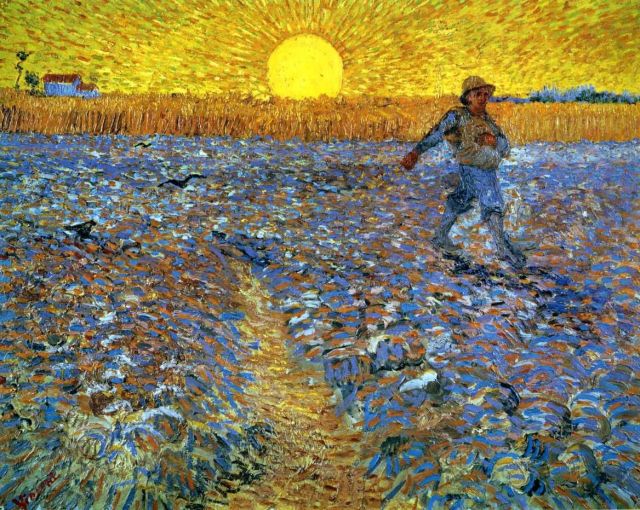
The Sower, by Vincent Van Gogh, 1881

When the Lord brought back his exiles to Jerusalem,
    it was like a dream!
We were filled with laughter,
    and we sang for joy.
And the other nations said,
    “What amazing things the Lord has done for them.”
Yes, the Lord has done amazing things for us!
    What joy!

Restore our fortunes, Lord,
    as streams renew the desert.
Those who plant in tears
    will harvest with shouts of joy.
They weep as they go to plant their seed,
    but they sing as they return with the harvest. (New Living Translation)

Many people are familiar with the phrase, “You reap what you sow.” Although the saying is typically referred to in the context of avoiding poor decisions (Galatians 6:7) the principle is woven throughout Holy Scripture in other scenarios, as well, as it is in today’s psalm.  

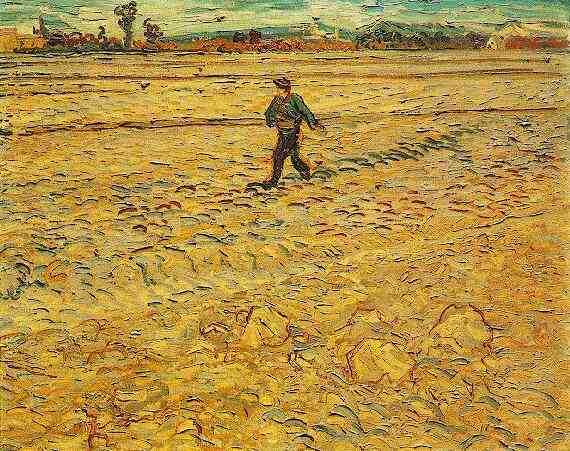
Sowing and reaping are, of course, agricultural terms. Farmers and gardeners tend to the soil through tilling, planting, cultivating, weeding, and eventually harvesting. The images of farming and the growth of plants serve as fitting metaphors for the spiritual life. Growth does not occur quickly. Instead, constant and vigilant attention to one’s spirit eventually brings a harvest of good works and godly attitudes. 

Jesus said, “My food is to do what the one who sent me wants me to do. My food is to finish the work that he gave me to do.” (John 4:34, ERV)

In a culture which values immediacy and having things now, the slow growth of the spiritual life can be a difficult principle to grasp. We may think that whenever we sin – with no immediate lightning to zap us – that therefore what we did must not have been so bad. 

Eventually, however, our implanted seeds will sprout and become visible to all. Conversely, we might believe whenever we dedicate ourselves to altruistic service, and then see no immediate results, that we must be doing something wrong. So, we may easily become discouraged and give up.

Sow for yourselves righteousness; reap steadfast love. Break up your fallow ground; for it is time to seek the Lord, that he may come and rain righteousness upon you. (Hosea 10:12, NRSV)

The psalmist reminds us of the need for patience. Just as it takes continual watering to reap a harvest in the field, so the Christian’s life of weeping and tears, of tilling deeply into the things of God, is the necessary work to eventually spot a sprout, see growth, and finally bear fruit. 

The tedious cultivating and weeding of our souls is the task before us. If we are patient and consistent, we will realize a harvest of righteousness. 

The Sower, by Vincent Van Gogh, 1888

Jesus taught his Beatitudes to help us understand that righteousness, peace, and joy come through connecting with our poverty of spirit; mourning over personal and corporate sin; embracing humility and meekness; hungering and thirsting after righteousness.

Only through the blood, sweat, and tears of spiritual agony will we come through to the deep happiness of seeing the Lord accomplish great things in our lives. In other words, joy is neither cheap nor easy. It is the fruit of many tears.

Spiritual farming involves sound practices of sowing and reaping. There is suffering before glory, tears before joy, lament before healing.

Just as a farmer cannot take short-cuts in the planting and cultivating process if he wants to have a bounteous and delicious harvest, so there is no getting around the painful work of grieving our changes and losses.

Avoiding the hard work of spiritual farming leads to a bogus harvest where we bite into a fresh ear of sweet corn only to discover a mouthful of worms.

Remember this: The person who plants a little will have a small harvest, but the person who plants a lot will have a big harvest.

2 Corinthians 9:6, NCV

The bulk of our lives are played out in the liminal space between sowing and reaping. The farmer plants and waits, attentive to the land and the weather until the time of harvest. We, too, exist in a time of patience. So, we pray, recalling past harvests and anticipate that with God’s good help, we will enjoy abundance.

This in-between time is often characterized by tears.

As she stood behind him at his feet weeping, she began to wet his feet with her tears. Then she wiped them with her hair, kissed them and poured perfume on them. (Luke 7:38, NIV)

I grew up on an Iowa farm. I only saw my father cry twice in my life. The first time, I was just a boy, two days after my eighth birthday – a devastating hailstorm destroyed the crops that had been planted just six weeks before. Despite farm equipment and technological savvy, the farmer is still at the mercy of the weather.

And we will always be at the mercy of God. Because God is good, just, and fair, the Lord does great and benevolent things. To be blessed, we need to embrace the dog days of summer in all its banality and its tears until we reach the time of reaping. There is joy, and it is coming, if we do the work of spiritual farming and wait patiently.

Likely, none of us awake in the morning, sit up on the edge of the bed, and say to ourselves, “Well, let’s see, I think I’ll cry and be sorrowful today.” We might do that with joy, but not with sadness. It can be easier to gravitate toward the fulfillment of dreams, laughter, and happiness than tears and weeping.

Yet, if we want to experience authentic joy, the path to it is through crying because it is our tears which find a better way.

“Normality is a paved road: It’s comfortable to walk, but no flowers grow on it.”

Vincent Van Gogh

Whether it comes from a certain denominational tradition, ethnic background, or family of origin dynamics, there are many Christians who love to emphasize Jesus as Victor and camp in resurrection power – while eschewing Christ as the man of sorrows, acquainted with grief and sadness.

By viewing only one dimension of Christ’s redemptive work, pastoral care often falls far short of true help. Trying to engineer cheerfulness and create solutions to a person’s genuine grief is, at best, not helpful, and at worst, damaging to their soul. It only leads to cheap inauthentic joy.

Sincerely singing spontaneous songs of joy, with a sense of abundant satisfaction, comes through suffering and sorrow. There must be a crucifixion before there is a resurrection. In the agrarian culture of ancient Israel, the metaphor of sowing a reaping connected well to the importance of planting tears and allowing them to flower later into an abundant harvest of joy.

Perhaps in contemporary American culture, a more apt metaphor would be financial investing and cashing out. The investment we put into attending to our grief with expressions of lament through tears, will eventually get a return, and we shall be able to cash out with a rich bounty of joy.

Easter is coming. Resurrection and new life will occur. The journey of Lent, with seeds repentance carefully planted, watered with tears, shall bring an abundant harvest of joy.

Gratias Deo. Thanks be to God.