Luke 14:12-14 – Abundance and Inclusion For All

The Great Banquet by Hyatt Moore

Then Jesus said to his host, “When you give a luncheon or dinner, do not invite your friends, your brothers or sisters, your relatives, or your rich neighbors; if you do, they may invite you back and so you will be repaid. But when you give a banquet, invite the poor, the crippled, the lame, the blind, and you will be blessed. Although they cannot repay you, you will be repaid at the resurrection of the righteous.” (New International Version)

A lot of people live by the old adage, “You scratch my back and I’ll scratch yours.” It’s a phrase referring to reciprocity. In other words, if you give me something I want, I will then respond by giving you something you want.

That old adage works fine, that is, unless you have no ability to give or give back to another. If we only operate by the principle of reciprocity, a large chunk of people automatically get left out. And this situation is untenable and unacceptable to Jesus.

Christ observed that the religious insiders of his day were keeping entire groups of people on the outside through their practice of scratching one another’s backs.

We need to get ahold of the reality that God loves us, as well as everyone else – even the people we may not give the time of day to. God so loved the world that he sent his Son. Jesus has come to feed us. 

The kingdom of God is about food. The food given by Jesus is to feed the hungry by staging a banquet. It is a feast of God’s abundance. Yet, many seem to hoard the resources they have, only thinking about their friends, family, and people just like them. They act as if there is no need to invite outsiders, consumed as they are with their own daily lives.

We have an incredible abundant feast contained in Scripture – in fact, Jesus said that his food and drink was to do the Father’s will, that Scripture was his bread. (Matthew 4:4; John 4:34) 

It’s much too easy to take our blessings of food for granted. After all, when we are well-fed, it’s easy to assume that everyone else is, too. Feeling healthy, it’s easy to forget that others are hurting. Making money, it’s easy to think there are not many poor people around. Living in a community with plenty of churches and more bibles than people, it’s natural to assume that everyone knows the gospel of Jesus – but they don’t!

Then, whenever we get around to acknowledging there are people who need Jesus, we keep devising ways to reach them without having to change or accommodate our own lives to do it.

Christ’s call to faithful discipleship requires people to change from having a narrow focus on our small circle of friends, to including those who have no means to pay us back.

The gospel of Jesus Christ is open to outcasts and failures, to problem people and to unimpressive persons. People with needs and flaws are especially dear to Jesus. It’s the people who outwardly have it all together who are being replaced wholesale with those who admit their need. 

We must not be picky about who we invite to participate in the largess of abundance we possess. We are to avoid the spiritual snobbery of looking down our noses at the needy and less fortunate, who have nothing to offer us in return.

St. John Chrysostom (348-407, C.E.) was a Bishop of Constantinople and arguably one of the greatest preachers in the history of Christianity. John always thought of both the recipient and the giver in his sermons, insisting that both need God’s mercy.

With a concern for the giver’s soul, John insisted that givers provide for all – even the lazy, the fool, and the sinner. By opening our hearts in almsgiving, we open ourselves to Christ, who is present in the least of those among us. Refusing mercy to people deemed as unworthy, givers then actually shut themselves off from the very mercy God desires for them.

There is no reward from God when there is only reward from others.

“If we are going to examine lives, we will never have mercy upon any human being; rather, hindered by this inopportune meddlesomeness, we will remain fruitless and destitute of all help ourselves.”

St. John Chrysostom, On Repentance and Almsgiving

It’s not only the poor who suffer when the rich fail to give. In judging whether or not a particular person is worthy of love and aid, the wealthy person rejects the spiritual fruit that he would have received by giving with humility.

Giving to the poor, simply to relieve our own conscience, is not real charity; it doesn’t consider the other. We attend fully to the other by observing their spiritual and holistic needs for community, purpose, respect, and dignity. Dispassionate giving from a distance, without relationship, refuses to acknowledge the whole person. It exploits the poor for the mental comfort of the rich.

We need to be involved in people’s lives, and that takes a lot of blood, sweat, and tears. There are too many lost people who need Jesus, and too many Christians who are the walking wounded and need the healing touch of Jesus, for us to pay scant attention to the call of Jesus to invite the needy into our lives. 

Seeing people come into God’s great banquet, and into a joyous and vital relationship with Christ, probably takes about ten times more work than what you are thinking it does right now. Yet, this is the pathway of true blessing – to having God’s stamp of approval on our lives.

Merciful God, thank you for the abundance of life, relationships, health, comfort, and wealth you have provided to so many. Thank you that, even in times of need, despair, and brokenness, you are there. Please, put your arms around children and families in  poverty and disability so that they feel your comfort and hope. Meet their needs both physically and spiritually. And guide me so I can be your hands and feet pursuing justice for the poor and upholding the cause of the needy, in the way of Jesus Christ our Lord. Amen.

Revelation 4:1-11 – In Another Dimension

Hallgrímskirkja in Reykjavík, Iceland

After this I looked, and there before me was a door standing open in heaven. And the voice I had first heard speaking to me like a trumpet said, “Come up here, and I will show you what must take place after this.” At once I was in the Spirit, and there before me was a throne in heaven with someone sitting on it. And the one who sat there had the appearance of jasper and ruby. A rainbow that shone like an emerald encircled the throne. Surrounding the throne were twenty-four other thrones and seated on them were twenty-four elders. They were dressed in white and had crowns of gold on their heads.From the throne came flashes of lightning, rumblings and peals of thunder. In front of the throne, seven lamps were blazing. These are the seven spirits of God. Also, in front of the throne there was what looked like a sea of glass, clear as crystal.

In the center, around the throne, were four living creatures, and they were covered with eyes, in front and in back. The first living creature was like a lion, the second was like an ox, the third had a face like a man, the fourth was like a flying eagle. Each of the four living creatures had six wings and was covered with eyes all around, even under its wings. Day and night they never stop saying:

“‘Holy, holy, holy

is the Lord God Almighty,’

who was, and is, and is to come.”

Whenever the living creatures give glory, honor and thanks to him who sits on the throne and who lives for ever and ever, the twenty-four elders fall down before him who sits on the throne and worship him who lives for ever and ever. They lay their crowns before the throne and say:

“You are worthy, our Lord and God,
    to receive glory and honor and power,
for you created all things,
    and by your will they were created
    and have their being.” (New International Version)

Whenever we open the door to God’s gracious invitation to commune with us, we gain an incredible glimpse of heavenly realities.

The Apostle John’s vision is so otherworldly that all he can do is try and describe what we saw with the limitations of language, metaphor, and simile.

Let’s acknowledge up front that, when it comes to the biblical book of Revelation, there are plenty of folk who want to understand it all. I believe this to be a fool’s errand, not because we ought not to try and make sense of things, but because far too many people try and conquer the text of Holy Scripture rather than letting Scripture capture them.

In our anxiety about the future, we would like some certitude, some semblance of knowing and understanding what will occur so that it will ease our icky feelings of not being in control. Newsflash: You and I aren’t in control of anything but ourselves. Ultimate control belongs only to God, not us. Our role is self-control.

So, before we start making complicated prophecy charts and trying to predict future events with precise certainty, let’s take a step back and see that worship is always the appropriate response to any vision of God – not conquering the Bible and colonizing other people’s minds with our supposed apocalyptic insights.

Okay, now that that’s out of the way, and the soapbox is back in the closet, let’s simply appreciate this incredible scene before us of God’s heavenly throne room in today’s New Testament lesson.

Since God is an awesome God, I imagine that John was downright slack-jawed with awe over the bedazzling vision before him. It is a vision befitting a God of great majesty and power. The scene of worship which unfolded before John’s eyes is continual – praise and adoration of God has been going on, is going on, and will keep going on forever and ever.

To a church beat down by the world, John’s vision is meant to encourage and inspire the suffering believers toward persevering in faith. Hardship is but for a season; worship, however, is for all time.

The four living creatures worshiping God reflect the nature and character of God: the lion (majesty); the ox (strength and power); the man (intelligence); and the eagle (transcendent over creation). All of them, covered with eyes, front and back, testify to the sovereignty and omniscience of God, who sees and knows all things – nothing is hidden from God’s sight.

The twenty-four elders, likely signifying the twelve patriarchs of the Old Testament and the twelve apostles of the New Testament, together represent the one new people of God without walls or barriers to unity, fellowship, harmony, and peace. They all rightly honor God by giving back their own authority, given to them from the Lord to accomplish divine purposes on the earth.

We, as the people of God today, are meant to be encouraged and uplifted by the reality that God is forever the same – powerful, loving, good, honorable, and holy – and will be so permanently for all time and beyond time.

The Lord does not exist merely in three dimensional space, as we humans do. God is truly multi-dimensional and reigns supreme over each and every one of those dimensions – however many there truly are.

I suspect the Apostle John was privileged to step into another dimension so that he could return to our three-dimensional world with the good news that God is still and forever on the throne. God’s good purposes shall be accomplished, no matter how tough things get here.

Now is temporary; then is eternal. Let us, then, embrace that which is permanent and unchanging, even Christ our Lord, who shall return to judge the living and the dead, and consummate a benevolent kingdom which will last forever.

May you be so privileged to have the dimensions unveiled, for even a few minutes, and know the eternal love and grace of God for humanity. Amen.

Revelation 3:14-22 – Here I Am!

To the angel of the church in Laodicea write:

“These are the words of the Amen, the faithful and true witness, the ruler of God’s creation. I know your deeds, that you are neither cold nor hot. I wish you were either one or the other! So, because you are lukewarm—neither hot nor cold—I am about to spit you out of my mouth. You say, ‘I am rich; I have acquired wealth and do not need a thing.’ But you do not realize that you are wretched, pitiful, poor, blind and naked. I counsel you to buy from me gold refined in the fire, so you can become rich; and white clothes to wear, so you can cover your shameful nakedness; and salve to put on your eyes, so you can see.

Those whom I love I rebuke and discipline. So be earnest and repent. Here I am! I stand at the door and knock. If anyone hears my voice and opens the door, I will come in and eat with that person, and they with me.

To the one who is victorious, I will give the right to sit with me on my throne, just as I was victorious and sat down with my Father on his throne. Whoever has ears, let them hear what the Spirit says to the churches.” (New International Version)

Christianity holds that the Lord Jesus is the rightful sovereign of the universe. Christ uses that power and authority to rule with justice and equity. He delivers people from guilt, shame, disobedience, and the realm of darkness. All of life hinges on God’s ability, not ours.

Yet, having said that, this does not mean we lack responsibility before God, as if whatever is going to happen is going to happen, and I’m just a passive spectator.

Today’s New Testament lesson is Christ’s words to the ancient church in the city of Laodicea. It seems the church folk in that city were less than zealous about their faith. Maybe they thought God was going to do whatever God was going to do and felt no compunction to act. Perhaps the Laodiceans believed that if they were “hot” that they’d have to go to Africa, be around snakes, and wear polyester all day.

So, likely out of some fear they might lose their wealth or livelihood, the church took a “Meh, whatever” kind of response to the Christian life. It appears the Laodiceans thought God wasn’t even noticing, resulting in a middle of the road approach of just getting by.

Well, of course, the Laodicean believers got noticed – enough to warrant a letter to them from Jesus. I’d say someone was watching! 

Whereas we might get frustrated with milquetoast responses and try to light a fire under the passive person’s behind, the response of Jesus to the Laodiceans was to calmly stand at the door and knock, waiting to be invited in. 

Jesus didn’t go full emergency response on them and break down their church door, forcefully going inside to assert his will. Rather than imposing himself on the Laodiceans, the Lord of all simply and persistently knocked, patiently waiting for a response. 

As it turns out, the ones not paying attention are us, not Jesus. Christ longs for meaningful fellowship and interaction with us. Jesus wants us to respond to divine overtures to meet with him. The Lord is at your doorstep exclaiming, “Here I am!”

Will you let him in today? Or are you afraid that he will take something away from you?

God is trying to get our attention. The Lord does it through all kinds of ways – adverse circumstances, other people (even and especially the ornery ones) – knocking on our door. Yes, God is the one knocking on our door – and not the other way around. 

This is anything but an aloof God who is unconcerned for what is going on in our lives. In fact, just the opposite is true. We seem a bit unconcerned, even “lukewarm” about God, not noticing the good purposes being worked out all around us.

Jesus stands at the door. We don’t get many post-resurrection accounts of Jesus standing. That’s because sitting is a sign and symbol that the work is finished. And, indeed, the work of the cross is done. We are the ones sitting in the recliner. We are the people who need to be standing because our work is not yet done.

So, amazingly, Jesus gets up from his throne, comes to us, standing at the door knocking, graciously meeting us when we aren’t moving.

The watershed issue of our day, from a Christian perspective, is our response, or lack thereof, to Christ’s overtures to let him in our house.

Maybe we can’t hear him because we are busy vacuuming. Perhaps we don’t hear because of the headphones we have on. It could be that we are just too deaf and dull to notice the racket going on at our front porch while we watch TV. Whatever it is, the only cure for being lukewarm is inviting Jesus into the house. 

If Jesus is on the outside, he wants to be on the inside. He could break your door down if he wanted to, but he chooses to respond to the invitation for hospitality. Jesus wants to meet with us.

For the times we neglect to care for our brothers and sisters in Christ, please forgive us, Lord. 

For the times we fail to welcome new people who look or act different from ourselves, please forgive us, Lord. 

For the times we neglect to notice and pay attention to the Spirit, please forgive us, Lord.

And for the times we pretend not to be home when you are knocking, please forgive us, Jesus.

Lord, have mercy. Christ, have mercy, Lord, have mercy upon us, and grant us your peace. Amen.

Luke 12:4-12 – Dealing with Trouble

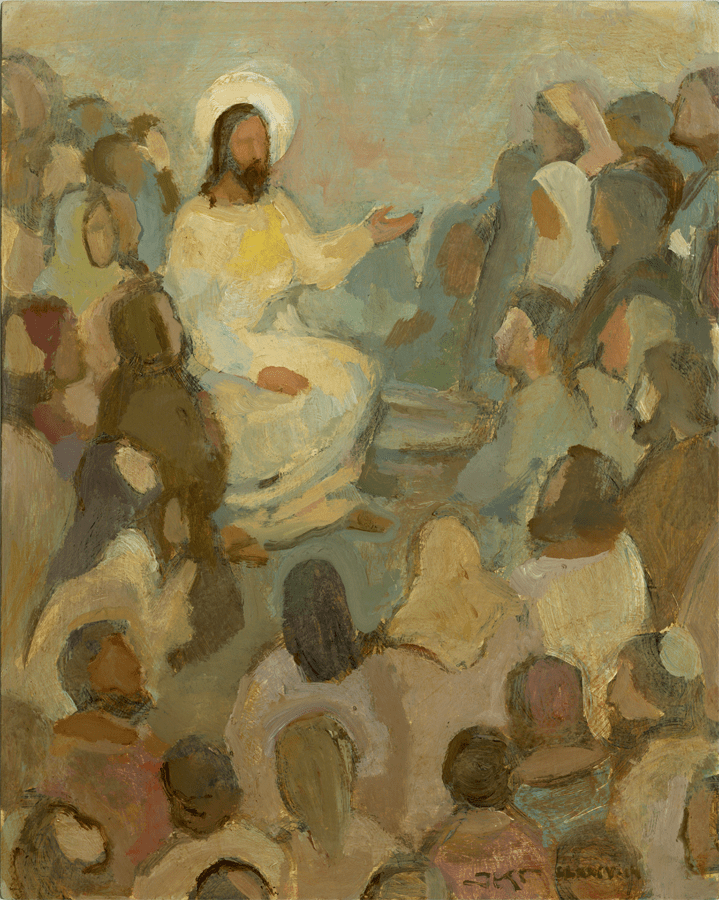
Jesus the Teacher by J. Kirk Richards

“I tell you, my friends, do not be afraid of those who kill the body and after that can do no more. But I will show you whom you should fear: Fear him who, after your body has been killed, has authority to throw you into hell. Yes, I tell you, fear him. Are not five sparrows sold for two pennies? Yet not one of them is forgotten by God. Indeed, the very hairs of your head are all numbered. Don’t be afraid; you are worth more than many sparrows.

“I tell you, whoever publicly acknowledges me before others, the Son of Man will also acknowledge before the angels of God. But whoever disowns me before others will be disowned before the angels of God. And everyone who speaks a word against the Son of Man will be forgiven, but anyone who blasphemes against the Holy Spirit will not be forgiven.

“When you are brought before synagogues, rulers and authorities, do not worry about how you will defend yourselves or what you will say, for the Holy Spirit will teach you at that time what you should say.” (New International Version)

A new resurrected life is a beautiful thing. And it can be a hard thing, at the same time.

Decades ago, I once preached in a church for morning and evening worship services. As I entered the church building for the evening sermon, one of the deacons greeted me by saying, “Man, did you ever stir the pot this morning!”

It turns out, because I did not stay behind the pulpit when I preached, but freely roamed around the sanctuary, many parishioners believed I was not being under the authority of God’s Holy Word. They took my actions as subversive, even rebellious. Others defended the action. The entire church became divided over it.

What I found so interesting about the whole affair is that I was simply and genuinely being myself – and it caused trouble to the point of families dividing and imploding in on themselves.

Sometimes people lose sight of what’s really important, and the gospel of grace ends up bringing division. Jesus tended to cause trouble in his earthly ministry, just by being himself – and a lot of folks didn’t take kindly to him exercising authority like God does.

Trouble tends to follow Christian mission and service. That may seem odd. Yet, God’s kingdom is an upside-down one. The way of resurrection and new life comes through a cross and a death; the way to succeed is to fail; the one who loses their life will find it.

We ought to expect opposition and trouble from the world.

Fortunately, nobody ever accused me of being in cahoots with the devil. But that happened to Jesus, on more than one occasion. (Matthew 10:24-25)

Christians are not above their Master – they will be treated as he was. Jesus didn’t want his followers to be surprised whenever they face opposition.

We don’t need to be afraid of getting into trouble.

Fear has to do with the unknown and about what is going to happen to us. Since we know opposition and trouble is expected, we can avoid living in dread. Early on in the church, Christians actually rejoiced in their suffering because they considered it a privilege to be walking in the way of Jesus.

We are given a promise that we’ll receive special help in times of adversity. Believers possess the Holy Spirit, given to us to be our helper and advocate for such difficult situations.

God sees all things. The Lord isn’t surprised by your hardship and will eventually deal with all that is wrong in this old fallen world. The wrath of God is to be much more feared than the wrath of people.

God observes all the details of our lives. If God cares and is attentive to the least little things in my life, then how much more will the big issues in my life be handled!?

Blaspheming (saying hard things against) the Holy Spirit is nothing more nor less than attributing the work of Satan to God.

We aren’t doomed to hell if we are crushed under a heavy load of distress and pressure. God won’t strike us with lightning if we make mistakes, mess up, or fail to live as we ought. The Lord will likely be sad, but fire and brimstone will not be in the picture.

You might be wondering how I handled the hubbub with the church who fractured over my preaching apart from the pulpit. I came back in the evening and purposely caused trouble by preaching the Beatitudes of Jesus while walking up and down the aisle.

After all, when somebody is secure in Christ, why not say and do what needs to be said and done?

Gracious God, your love is sufficient for us. May your guidance and wisdom hold us tightly, along with our brothers and sisters in Christ around the world. Guard the hearts and minds of believers in places of hardship, war, and persecution so that your church may stand strong in faith.

Although trouble may come, neither any person nor any power on this earth can take our souls from us. We belong to you. May your church stand strong in grace and love, being assured with the reality that Jesus Christ is Lord of all.

We pray for the day when we will all be together in worship and praise at the consummation of your benevolent kingdom. Until that day, may your love flow to all our persecuted brothers and sisters. May your blessed Holy Spirit strengthen and fill them with faith, hope, and love, through Jesus Christ your Son, our Lord. Amen