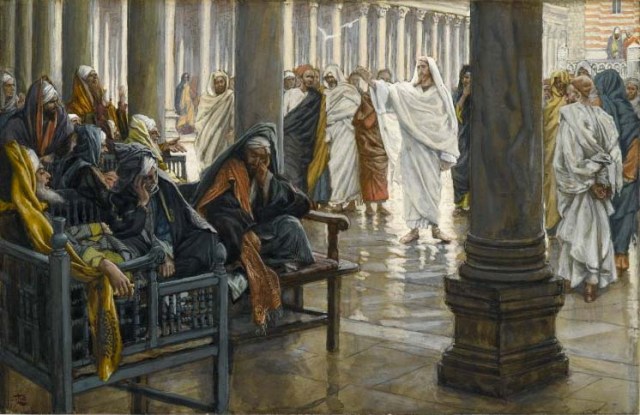
Luke 10:13-16 – Confronting Hard Hearts

“Woe unto You” by French painter James Tissot (1836-1902)

“Woe to you, Chorazin! Woe to you, Bethsaida! For if the miracles that were performed in you had been performed in Tyre and Sidon, they would have repented long ago, sitting in sackcloth and ashes. But it will be more bearable for Tyre and Sidon at the judgment than for you. And you, Capernaum, will you be lifted to the heavens? No, you will go down to Hades.

“Whoever listens to you listens to me; whoever rejects you rejects me; but whoever rejects me rejects him who sent me.” (New International Version)

Hardness of heart is the greatest malady and the most serious condition which could ever afflict a spiritual person.

A soft heart needs only gentle words and humble responses in order to continue learning and growing in life. Not so with the hard heart. It needs a mighty chisel from God to scrape the encrusted barnacles off the heart so that it might receive goodness.

This is why today’s Gospel lesson recounts some rather harsh words from Jesus. Christ had some hard things to say in order to get at the hardness of heart he was experiencing from the people. His scathing words were specifically leveled at the towns in which he had performed miraculous healings. Their inability to accept what was happening in front of their very faces testified to how hard their hearts truly were.

The miracles of Jesus, in addition to being gracious restorations of individual lives, were also meant to demonstrate that the kingdom of God has broken into history in the person of Jesus Christ. The crowd refused to acknowledge this reality. So, Jesus began leveling a rebuke to the towns who observed his ministry firsthand, and yet did nothing in response to those good works.

A hard heart observing Christ’s ministry will likely be unresponsive to Jesus. A soft heart will likely reply with humility by forsaking everything to follow him. For Jesus, the height of hubris was to simply ignore his righteous works of merciful teaching and benevolent healing.

Christ’s denunciation of the particular towns came not because he was experiencing opposition or persecution; rather, he was denouncing them for their bonehead lack of response and refusal to change their lives to conform to what they were seeing and experiencing from God.

The crowd heard Christ’s teaching and saw his miracles, and it had no effect on them. So, Jesus gave them a big “C’mon, man!”

Judgment becomes the lot of someone who is unaffected and unresponsive to the vast sea of human need around them, viewing Jesus as just another voice, and living a life of mediocrity in the face of opportunity.

The Holy Spirit has been provided, who is the power source of the Christian life. We possess all the resources of grace necessary to step into this world and make a difference, yet so many do nothing but occupy a place in the pew [or couch] because they are too afraid to sacrifice their time in meaningful ministry.

There are neighbors, relatives, and co-workers who are lost and lonely, in need of the kind of grace Jesus gives, yet too many of us are oblivious to them and instead are constantly worried about things that, in the end, don’t really matter at all.

We have opportunities to grow in the grace and knowledge of Jesus Christ through a vast array of available ministries, yet many do not take the chance to change and be spiritually stretched. For these situations and more, the words of Jesus are there in front of our faces, and yet some, out of hardness of heart, will have the audacity to read them and remain unchanged, unchallenged, and unresponsive.

If our highest values in life are sameness, stability, and security, we may very well, at the least, miss Jesus altogether, and, at worst, find ourselves under his condemnation. These verses are for those whom Jesus has become all too familiar, as if he is just another piece of furniture in the living room – the coffee table with a dusty Bible resting on it.

There are times when nice gets us nowhere and we must have hard conversations because of hard hearts.

Yes, conversations, and not verbal rockets launched from one group to another. Jesus did not denounce from a distance; he did it up close and personal. Furthermore, he was specific and not generic about why he was speaking in the way he did.

So, may you be able to pray this prayer of repentance today with heartfelt conviction:

Almighty God, Father of our Lord Jesus Christ, Sovereign Lord of the universe, Creator of humanity, we, your unfaithful children, are sorry for our sins and the lives that we have lived apart from your grace. We sincerely believe and confess in our hearts that only through the precious blood of our Lord Jesus Christ on the cross, can we obtain your forgiveness.

We repent that: in thought, word, and deed, we have committed serious offences against you and our neighbors. Through spiritual laziness and prideful lust for power, we have provoked hatred, division, despair, and hurt within our communities.

Through our greed, deceit, and indifference, we have inflicted serious damage, unnecessary conflict, and aggravated destruction to those different than us.

Through our selfishness, insensitivity, and bias (both conscious and unconscious) we have encouraged and emboldened those who inflict hurt, pain, and sorrow on those who are already oppressed and poor.

In the name of religion, doctrine, and even of Christ himself, we have wounded fellow believers and those who genuinely pursue a faith different than ours.

In stubbornness, pride, and arrogance, we have caused division and strife within your church and among your people.

Mercifully send your Holy Spirit, the Spirit of order and comfort, to cleanse us from all unrighteousness; to restore in us true faith in Christ which brings truth, peace and harmony; and, to help us walk together
with our brothers and sisters in the peace of our Lord Jesus Christ, to the glory of your name. Amen.

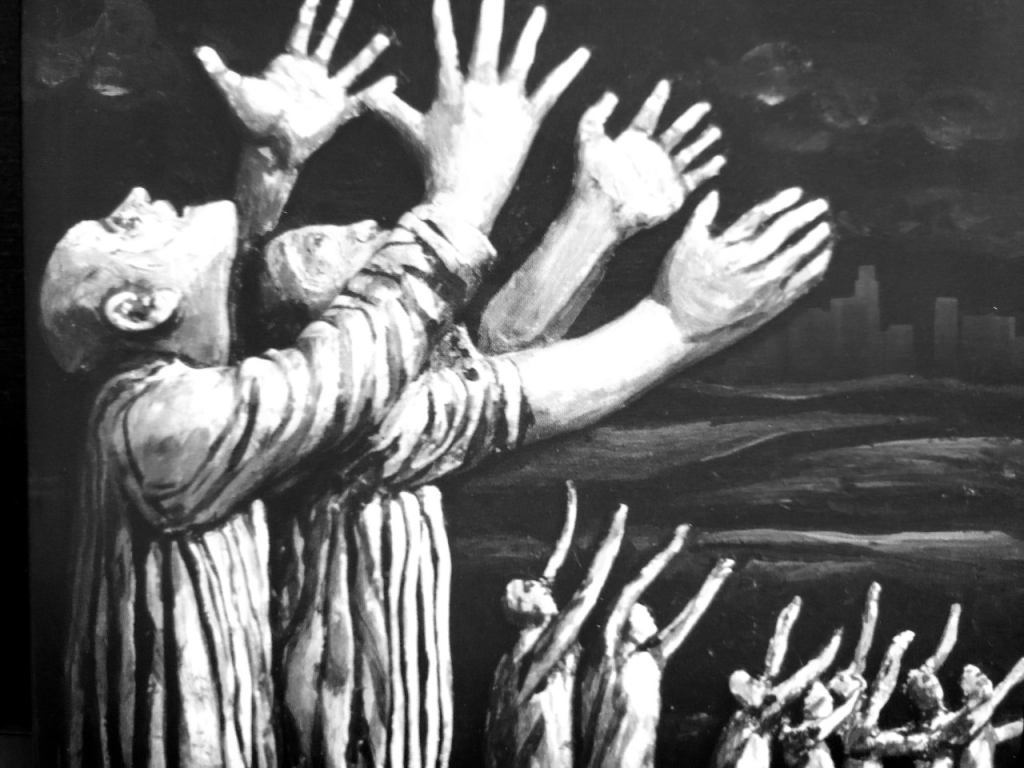
Psalm 6 – Our Tears Find a Better Way

Please, Lord,
    don’t punish me when you are angry;
    don’t discipline me when you are furious.
Have mercy on me, Lord,
    because I’m frail.
Heal me, Lord,
    because my bones are shaking in terror!
My whole body is completely terrified!
        But you, Lord! How long will this last?
Come back to me, Lord! Deliver me!
    Save me for the sake of your faithful love!
No one is going to praise you
    when they are dead.
Who gives you thanks
    from the grave?

I’m worn out from groaning.
    Every night, I drench my bed with tears;
    I soak my couch all the way through.
My vision fails because of my grief;
    it’s weak because of all my distress.
Get away from me, all you evildoers,
    because the Lord has heard me crying!
The Lord has listened to my request.
    The Lord accepts my prayer.
All my enemies will be ashamed
    and completely terrified;
    they will be defeated
    and ashamed instantly. (Common English Bible)

“Don’t ever discount the wonder of your tears. They can be healing waters and a stream of joy. Sometimes they are the best words the heart can speak.”

William Paul Young, The Shack

Sometimes, even oftentimes, our tears find a better way.

It seems as if many folks don’t know this. Whenever someone is distraught, discouraged, or in the throes of despair, the advice given to them is often unhelpful, and even hurtful.

“You just need to be strong,” “Keep your chin up, I’m sure you have a lot to be thankful for,” and “Don’t cry, everything will work out okay,” are statements which betray we are uncomfortable with tears and are unsure what to do with them in others.

It can also be worse than that, with exhortations which only harm and don’t assist. “Dry up those tears or I’ll give you something to really cry about,” “Being sad and depressed like that is a sin, you know,” and “God wants you to be happy, so just put a smile on your face and fake it until you make it,” are a misuse of words and an abuse of language’s power.

So, I say again: Our tears find a better way.

To hold back our tears, to stuff our sadness and grief, does not make it go away. It’s still in there. And, if left there for too long, will come out sideways in harming others or even ourselves.

Whenever we put away our tears, we’re setting aside God’s most powerful means of healing, health, and wholeness. Tears are the conduit of integrating body and soul, where what’s going on inside is expressed on the outside.

Often, you don’t even need words when you have tears. The presence of the tears themselves becomes a form of language. They’re just there, and they are beautiful. Tears are evidence of brokenness, and more importantly, of healing and of strength, not weakness.

Tears are the body’s release valve for stress, sadness, grief, anxiety, and frustration. Like the ocean, tears are saltwater. They protectively lubricate the eyes, remove irritants, and contain antibodies that fight pathogenic microbes.

Dr. William Frey is a biochemist and an expert on human tears at the University of Minnesota. He states that our bodies produce three kinds of tears: reflex, continuous, and emotional. Each kind has different healing roles. Reflex tears allow the eyes to flush noxious particles when they’re irritated by smoke or exhaust. Continuous tears are produced regularly to keep our eyes lubricated and protected from infection.

Emotional tears were the experience of the psalmist. Whereas reflex tears are 98% water, emotional tears contain stress hormones that get excreted from the body through crying. Emotional crying stimulates the production of endorphins – the hormone necessary for happiness and a decrease of pain.

As the only creatures carrying God’s image and likeness within us, humans alone shed emotional tears. And that’s because God cries.

Jesus wept. Real tears. Emotional tears. Tears of genuine feeling and solidarity with the community, lamenting at the death of a dear friend, Lazarus.

“The Teacher is here,” Martha said, “and is asking for you.” When Mary heard this, she got up quickly and went to him. Now Jesus had not yet entered the village but was still at the place where Martha had met him.When the Jews who had been with Mary in the house, comforting her, noticed how quickly she got up and went out, they followed her, supposing she was going to the tomb to mourn there.

When Mary reached the place where Jesus was and saw him, she fell at his feet and said, “Lord, if you had been here, my brother would not have died.”

When Jesus saw her weeping, and the Jews who had come along with her also weeping, he was deeply moved in spirit and troubled. “Where have you laid him?” he asked.

“Come and see, Lord,” they replied.

Jesus wept. (John 11:28-35, NIV)

The Lord Jesus came to the village three days after Lazarus died. He knew exactly what he was about to do: raise Lazarus from the dead in a miraculous resurrection. Yet, he did not come all smiles stating, “Hey, guys, don’t be sad! Watch what I’m going to do!”

No, instead, Christ participated fully in the sisters’ and the community’s grief. Only until he had done this did he proceed to performing the miracle.

The tears, just as much as the resurrection itself, were redemptive.

There was a time, long ago, when the word “loser” meant exactly what the word says – that someone had lost someone. It was a descriptive word recognizing the aching hole in the heart that one experiences from the death of a loved friend or family member.

Now, however, the word “loser” has taken an insidious twist over the years – meaning someone who hasn’t won, somebody who didn’t have what it took to be a winner. It is now a negative term that nobody wants to wear as a moniker, at all.

Perhaps that is one reason why so many people wear plastic smiles, pretend they are strong, and insist on keeping up appearances… And it is killing us with unprecedented numbers of depression, anxiety, and outright despair with nowhere to place it.

Our tears show us a better way. It was the way of the psalmist. It is the way of our Lord. It is the way of life.

You keep track of all my sorrows.
    You have collected all my tears in your bottle.
    You have recorded each one in your book.

Psalm 56:8, NLT

Beloved God, since all communion with You is prayer, my tears are psalms of petition and canticles of praise to You. The prayer You value greatly and always hear is the prayer of my tears; for You are a compassionate and kind God.

Surely, all truly great prayer rises from deep inside and springs spontaneously to the surface in the form of weeping. Perhaps, then, our tears are the purest and best worship of all.

May Your people not be ashamed of their tears; may they flow naturally and freely to You, my Blessed Redeemer. In times of joy or sorrow, blessed be the tears as the holy prayers of our hearts. Amen.

Psalm 6 – Independence Day Celebration or Mourning?

O Lord, do not rebuke me in your anger
    or discipline me in your wrath.
Be gracious to me, O Lord, for I am languishing;
    O Lord, heal me, for my bones are shaking with terror.
My soul also is struck with terror,
    while you, O Lord—how long?

Turn, O Lord, save my life;
    deliver me for the sake of your steadfast love.
For in death there is no remembrance of you;
    in Sheol who can give you praise?

I am weary with my moaning;
    every night I flood my bed with tears;
    I drench my couch with my weeping.
My eyes waste away because of grief;
    they grow weak because of all my foes.

Depart from me, all you workers of evil,
    for the Lord has heard the sound of my weeping.
The Lord has heard my supplication;
    the Lord accepts my prayer.
All my enemies shall be ashamed and struck with terror;
    they shall turn back and in a moment be put to shame. (New Revised Standard Version)

Methinks we Americans, especially on this our national Independence Day, must remember that this has not always been, nor currently is, a day of celebration for a sizable chunk of people in the United States.

Now before you begin offering some mental pushback that I am pouring cold water on a time-honored holiday, or begin believing I’m not a true patriot, I will simply point out that not only is today’s psalm lesson in the Revised Common Lectionary a lament, but also that I’m a guy with two academic degrees in American history.

If we only look at Independence Day from the perspective of white Northern European heritage persons, then it will seem that, speaking like this, I am not grateful for the blessings of being in this incredible country of my birth and the place I’ve lived my entire life.

But I am not looking from that angle today. I choose to acknowledge that on this day, every year for the past 246 years, today’s psalm has been the lived experience and expression of others who looked to the heavens and asked, “How long, O Lord!?”

A true people of compassion are able to suffer with those who suffer. The people of God really ought to be at the forefront of exhibiting empathy and standing in solidarity with suffering folk.

A patriot is one who acknowledges and affirms all it’s citizens, and not only the ones who look like me, talk like me, and act like me. After all, the original documents of the United States made room for this to be so. Empathy, compassion, and solidarity are intentionally built into our nation’s grand experiment of democracy and government.

“We the people of the Unites States, in order to form a more perfect union, establish justice, insure domestic tranquility, provide for the common defense, promote the general welfare, and secure the blessings of liberty to ourselves and our posterity, do ordain and establish this Constitution for the United States of America.”

Preamble of the United States Constitution

The very fact that the previous quotation is true for some, and not for everyone, is a telling testament to the reality that we need to keep striving to live into our heritage as Americans and ensure that welfare for the common good of all citizens is continually sought, even if done so imperfectly.

Grieving, tears, and lament was the response of the former slave Frederick Douglass.

“The rich inheritance of justice, liberty, prosperity and independence, bequeathed by your [white] fathers, is shared by you, not by me. The sunlight that brought light and healing to you, has brought stripes and death to me [a black man]. This Fourth July is yours, not mine. You may rejoice, I must mourn.”

Frederick Douglass, “What to the Slave is the 4th of July?” (An oration on July 4, 1852)

Mourning and weeping was and continues to be the experience of many Native American peoples.

“While the United States and its settlers claimed its independence from Great Britain, this came at a cost of others, including this land’s Indigenous Peoples that were stolen from their own homelands. This patriotic holiday is nothing to celebrate because freedom cannot come at the cost of another’s freedom. America’s Independence Day is a celebration of imperialism, genocide, and American exceptionalism, and there is no pride in genocide.”

Daisee Francour (Oneida Nation of Wisconsin)

We cannot change history, but we can work towards a better future where all of our rights are respected and we all experience freedom and independence equally. Those with non-European ancestry who today in our nation experience racism and anti-ethnic aggression need to be acknowledged and affirmed as Americans with equal standing and an equal voice alongside the white population.

So, I would argue that both celebration and weeping ought to occur on this day. We should weep for the dreams and lives of indigenous peoples who were destroyed through westward expansion, and even today experience the ongoing effects of cultural genocide.

We ought to acknowledge not only our nation’s blessings, but also our curses which are still seen in exploiting others through envy, greed, sloth, pride, lust, and gluttony.

We, the people of the United States of America, ought to actively seek to live in more simple and less harmful ways. We should offer our voices, not in violent speech and language, but with creative and healing words.

On this American Independence Day, the Church should reaffirm her allegiance and citizenship to Christ and God’s Kingdom and renounce any nationalistic, economic, ethnic, and political divisions which are contrary to the words and ways of Jesus.

All of the citizens of the earth should seek to embrace non-violent, self-sacrificial love on behalf of everyone. Today is an opportunity to affirm that Christ is the Friend of all people, not just some.

No one ought to be wasting away in their grief and languishing in their tears when we have the means to acknowledge their suffering and to do something about it.

Our Father who is in heaven,

uphold the holiness of your name.

Bring in your kingdom

so that your will is done on earth as it’s done in heaven.

Give us the bread we need for today.

Forgive us for the ways we have wronged you,

just as we also forgive those who have wronged us.

And don’t lead us into temptation,

but rescue us from the evil one. (Matthew 6:9-13, CEB)

Galatians 6:1-16 – Fulfill the Law of Christ

Brothers and sisters, if someone is caught in a sin, you who live by the Spirit should restore that person gently. But watch yourselves, or you also may be tempted. Carry each other’s burdens, and in this way you will fulfill the law of Christ. If anyone thinks they are something when they are not, they deceive themselves. Each one should test their own actions. Then they can take pride in themselves alone, without comparing themselves to someone else, for each one should carry their own load. Nevertheless, the one who receives instruction in the word should share all good things with their instructor.

Do not be deceived: God cannot be mocked. A man reaps what he sows. Whoever sows to please their flesh, from the flesh will reap destruction; whoever sows to please the Spirit, from the Spirit will reap eternal life. Let us not become weary in doing good, for at the proper time we will reap a harvest if we do not give up. Therefore, as we have opportunity, let us do good to all people, especially to those who belong to the family of believers.

See what large letters I use as I write to you with my own hand!

Those who want to impress people by means of the flesh are trying to compel you to be circumcised. The only reason they do this is to avoid being persecuted for the cross of Christ. Not even those who are circumcised keep the law, yet they want you to be circumcised that they may boast about your circumcision in the flesh. May I never boast except in the cross of our Lord Jesus Christ, through which the world has been crucified to me, and I to the world. Neither circumcision nor uncircumcision means anything; what counts is the new creation. Peace and mercy to all who follow this rule—to the Israel of God. (New International Version)

It’s all about grace. God’s grace. Not rules. Not a list of principles to live by. Not judgment. Not punishment or penance. Grace – amazing, wonderful, scandalous grace.

The Law of Christ is to help each other in our troubles, no matter what.

Overwhelming physical, mental, emotional, and spiritual burdens can become even more heavy through failing to live up to someone’s or some group’s unwritten list of rules. “Keep a stiff upper lip.” “Everything is possible for those who love God.” “Stay positive.” “Just have faith and trust God.” Or someone’s silence…. These and hundred other phrases communicate to people with crushing spiritual and emotional loads that they will have to carry them alone.

The letter to the Galatian believers spells out what is to truly characterize Christian interactions, and what it means to walk in the Spirit. Believers in Jesus are to emulate the behavior of Christ, the ultimate burden-bearer, who came to restore sinners, not condemn them. We have a responsibility to rescue, renew, and revitalize persons who have lost their way. We are our brother’s and our sister’s keeper.

Someone caught in the crosshairs of a bad decision, or ensnared by making a wrong step, who is now in over their heads, needs help. In such a case, we are to restore, not punish. The person’s wound needs spiritual cauterizing. The broken spirit needs to be set back into place to heal properly.

The tone and the attitude which we do this important work of restoring people is through gentleness (meekness). We are to have a mindset and a heart stance which understands there is no moral superiority with me. I could easily be that person in need of restoration.

With a gentle spirit, we discern no one is above falling into the same trouble. We, too, are ethically and morally vulnerable. So, the church has a corporate responsibility to bear one another’s burdens.

There are other people who, through no fault of their own, find themselves in over their heads, too. Their physical struggles, mental health challenges, the emotional weight of hard circumstances, and their broken spirits require others to help shoulder the load so that the weighted-down person is not crushed.

Burden-bearing is the work of everyone and not a select few. You and I are to take responsibility for our own backpack of stuff – our own actions and attitudes. A mature spiritual community of people are able to distinguish those loads which individuals must bear for themselves, and those burdens where help is sorely needed. We are accountable to carry our own backpack. And we are also accountable before Christ to share our load with others when it becomes too heavy to carry.

If we choose not to allow others to assist us when we need it, then we will reap what we sow – we’ll feel the full weight and consequences of our silence. The planting and harvesting metaphor isn’t just for those who have engaged in wrongdoing. It is also for those who don’t put any seeds in the ground to begin with. They shouldn’t expect a harvest, at all.

Grace lived out in real experiences knows when to get under a load and help carry it. And grace also knows when to be kind to self and share the heavy burden with others who can help shoulder it for a bit. This is a Christianity which relies on the enablement of the Spirit, made possible by Christ, who carried our crushing weight of guilt and shame for us.

“Come to me, all you who are weary and burdened, and I will give you rest. Take my yoke upon you and learn from me, for I am gentle and humble in heart, and you will find rest for your souls. For my yoke is easy and my burden is light.”

Jesus (Matthew 11:28-30, NIV)

Motives matter. The interior life of a person is important. Life is neither a mere getting things done nor doing what is needed on the exterior. A house may be beautiful and orderly on the outside, with careful landscaping, a manicured lawn, and attractive appearance – yet on the inside it might be disorderly, full of relational discord, and completely discombobulated.

The exterior life of a person is also important. But it’s only half the person. And, unlike God who sees the heart, we aren’t always privy to what’s going on inside someone. Folks who are enamored with outward displays of spirituality and righteousness tend to be compulsive about maintaining appearances – for both themselves, and everyone else.

Policing outward forms of righteousness through clear identifiable means is really nothing more than old fashioned judging of one another. It’s antithetical to grace. And it smacks of the snooty superiority of Star-Bellied Sneetches.

Rather than a star on the belly, in the Apostle Paul’s day it was circumcision. Those who had it were “in” and those without it were “out.” Never mind the interior life. A hard outward boundary of righteousness was established by false teachers who made the Christian life easy by simply holding to readily observable forms, like circumcision.

It wasn’t that circumcision was a bad thing. The issue was making it a necessary part of the Christian life. Not circumcised? Not a Christian, insisted the false teachers. In other words, one had to become Jewish before becoming a Christian. I can picture the Apostle Paul doing a  face palm, saying, “Oy vey.”

For the Christian, one must be vigilant not to exaggerate baptism. On the one hand, I would argue far too many believers underestimate the significance and importance of baptism. Flippantly making it a personal choice, as if the individual is in complete control of one’s own salvation, is not only wrongheaded – it’s downright blasphemous.

Yet, on the other hand, a preoccupation with getting a person, especially a child, baptized, as if the world might end if it doesn’t happen, betrays the same problem as Paul faced with circumcision in the first century.

The proper approach, it seems to me, is to embrace the full spectrum of Christianity – both outward and inward – the whole person. And Paul addresses this by anticipating a question of the Galatian congregation: What, then, is of central importance?

The answer is: a new creation. To be transformed by the power of the Spirit is what really counts. The grace of God in Christ, applied to a person, brings a change to inner motives and attitudes, as well as outer behavior through loving actions.

We must always keep in mind that the sign points to the substance. It would be weird if I were traveling to Milwaukee on I-94 and pulled over on the interstate next to the sign marking the city is ahead, crawl all over it, and say, “I’m here!”

The overall thrust of Paul’s letter to the Galatians is that they were debasing the true worship of God into an outward show, honoring Christ with their lips but not holding him in their hearts through carrying one another’s burdens.

Christianity is fundamentally not about what we do for God but what God has done for us in Jesus Christ. It is divine grace which saves people. We belong to God. Just as we neither chose our own parents nor the time when we were born, so also, before we chose God, God chose us. We don’t “born again” ourselves; God does the rebirthing.

Since salvation is solely the work of God in us, there is zero reason to boast about the circumstances of our new birth and becoming a new creation in Christ. We didn’t save ourselves. It would be like getting a COVID-19 vaccine and then bragging about how we personally stopped the pandemic.

Instead, we are to bear the spiritual marks of Christ’s crucifixion on our inner selves. No one is saved because they deserve it but simply because they need saving. That’s what grace truly is – and that’s how we are to live toward one another.

Merciful God, you are our Burden-Bearer. Awaken our hearts to remember your love. Open our eyes to see your grace. Stir up hope in those who are overwhelmed with sorrow and fear. Teach them to place their burdens at your feet as an offering — a sacrifice well-pleasing to you. Teach us all to allow others to help us in our time of need, through Jesus Christ our Lord, who with you and the Holy Spirit are one God, now and forever. Amen.