Luke 10:25-37 – The Parable of the Good Samaritan

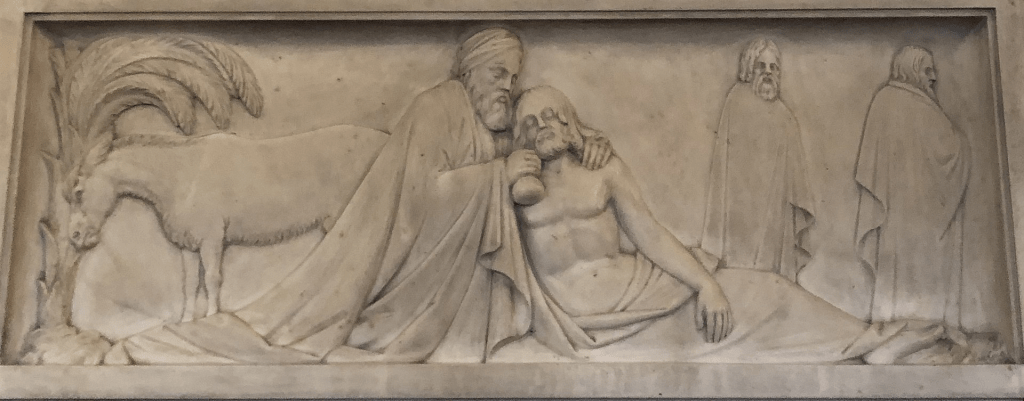
The Good Samaritan by Samuel Nixon. St. Paul’s Church, Halifax, Nova Scotia, Canada

 On one occasion an expert in the law stood up to test Jesus. “Teacher,” he asked, “what must I do to inherit eternal life?”

“What is written in the Law?” he replied. “How do you read it?”

He answered, “‘Love the Lord your God with all your heart and with all your soul and with all your strength and with all your mind’; and ‘Love your neighbor as yourself.”

“You have answered correctly,” Jesus replied. “Do this and you will live.”

But he wanted to justify himself, so he asked Jesus, “And who is my neighbor?”

In reply Jesus said: “A man was going down from Jerusalem to Jericho, when he was attacked by robbers. They stripped him of his clothes, beat him and went away, leaving him half dead. A priest happened to be going down the same road, and when he saw the man, he passed by on the other side. So too, a Levite, when he came to the place and saw him, passed by on the other side. 

But a Samaritan, as he traveled, came where the man was; and when he saw him, he took pity on him. He went to him and bandaged his wounds, pouring on oil and wine. Then he put the man on his own donkey, brought him to an inn and took care of him. The next day he took out two denarii and gave them to the innkeeper. ‘Look after him,’ he said, ‘and when I return, I will reimburse you for any extra expense you may have.’

“Which of these three do you think was a neighbor to the man who fell into the hands of robbers?”

The expert in the law replied, “The one who had mercy on him.”

Jesus told him, “Go and do likewise.” (New International Version)

Who do you relate to in the story? Which character most resonates with you in your life right now?

The Lawyer (an expert in the Old Testament Law)

The Gospel writer, Luke, gives us insight into the thought process of the person for whom Jesus told the parable to. That man sought to justify himself. In Christianity, no one justifies themselves. The kingdom of God turns on grace, and not with us working more or harder. 

Christ’s mercy is not dependent on what kind of people we are but is simply based on need. God graciously gives us the gift of faith and the mercy of deliverance. By Christ’s wounds we are healed. 

As Christians, we already possess justification by grace alone apart from human effort.

Each individual must realize they are in a theological ditch. We are all unable to get out of our predicament. Everyone needs the compassion of Christ.

But now God’s way of putting people right with himself has been revealed. It has nothing to do with law, even though the Law of Moses and the prophets gave their witness to it. God puts people right through their faith in Jesus Christ. God does this to all who believe in Christ, because there is no difference at all: everyone has sinned and is far away from God’s saving presence. But by the free gift of God’s grace all are put right with him through Christ Jesus, who sets them free. (Romans 3:21-24, GNT)

We do not need to justify ourselves.

The Priest and the Levite (experts in the Law)

The shock that hits closes to home, from Christ’s parable, is how frequently we are the ones who pass by and ignore the other. The command to “Go and do likewise,” extends about as far as the end of the story for modern hearers, landing us in the ditch between knowing the Samaritan and his compassionate generosity are set forth as an example and our tendency to ignore the cries of the downtrodden and disenfranchised.

Do not seek revenge or bear a grudge against anyone among your people but love your neighbor as yourself. I am the Lord…. When a foreigner resides among you in your land, do not mistreat them. The foreigner residing among you must be treated as your native-born. Love them as yourself, for you were foreigners in Egypt. I am the Lord your God. (Leviticus 19:18, 33-34, NIV)

The Lord defends the cause of the fatherless and the widow, and loves the foreigner residing among you, giving them food and clothing. And you are to love those who are foreigners, for you yourselves were foreigners in Egypt. (Deuteronomy 10:18-19, NIV)

We are to go and do likewise.

The Samaritan

The Samaritan, the Christ figure in the story, comes and shows the man mercy. This grace was free, lacked any sort of favoritism, and was full of sheer kindness. Without the Samaritan’s actions of binding up the man’s wounds and getting him to a safe place, the victim would have died.  

It is no coincidence that there are many hospitals throughout the country named “Good Samaritan.” Christians were at the forefront of establishing hospitals because of this very parable of Jesus. It was a significant way of living into the values of God’s kingdom.

Mercy is at the heart of all Christian ministry.

Jesus, responding to those who questioned his acts of mercy toward questionable people, said:

“Those who are well have no need of a physician, but those who are sick. Go and learn what this means, ‘I desire mercy, not sacrifice.’ For I have not come to call the righteous but sinners.” (Matthew 9:12-13, NRSV)

I appeal to you therefore, brothers and sisters, on the basis of God’s mercy, to present your bodies as a living sacrifice, holy and acceptable to God, which is your reasonable act of worship. (Romans 12:1, NRSV)

Do justice. Love mercy. Walk humbly. (Micah 6:8)

The Victim

The wounded hapless man was left for dead. In the story, we know he would die apart from help – the kind of help the man could not do for himself. He was completely dependent on someone to rescue him from his plight.

The victim in the ditch reminds us of what it feels like to be forgotten by others — and perhaps even by God. The feeling of loneliness and forsakenness invites compassion and empathy for all who experience it.

Victimization needs a voice and a champion. There are powerless people who either cannot speak or who are not heard by others. There are people, victims of abuse, who cannot get out of their traumatic ditch – overwhelmed by what another did to them.

God stands for the victim and against the robbers.

You will never again
    make victims of others
or send messengers to threaten
    everyone on this earth. (Nahum 2:13, CEV)

God will send help.

When the righteous cry out, the Lord listens;
    he delivers them from all their troubles.
The Lord is close to the brokenhearted;
    he saves those whose spirits are crushed.

The righteous have many problems,
    but the Lord delivers them from every one of them. (Psalm 34:17-19, CEB)

By his wounds we are healed.

Conclusion

The victim in the ditch is worthy of help because he carries the divine image of God.

The one who showed compassion and mercy, the Samaritan, reflected God’s likeness through his actions.

Those who passed by, the priest and the Levite, also bear the indelible mark of their Creator, yet chose to ignore their gut and got lost in their heads.

Maybe God — through Christ — comes to us as the one in the ditch or maybe as the one who shows compassion and mercy; perhaps God even comes to us as a reminder that the call to care for others frequently goes unheeded as we pass by the cries of those in need of help.

Lord God, heavenly Father, you did not spare your only Son, but gave him up for us all to be our Savior, and along with him you have graciously given us all things. We thank you for your precious, saving gospel, and we pray that you would help us to believe in the name of our Savior faithfully and steadfastly, for he alone is our righteousness and wisdom, our comfort and peace, so that we may stand on the day of his appearing, through Jesus Christ, your dear Son, our Lord. Amen.

Psalm 82 – Help Others, Without Prejudice

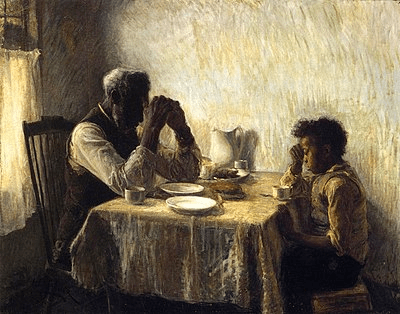
“The Thankful Poor” by Henry Ossawa Tanner, 1894

God takes his place in his own assembly.
He pronounces judgment among the gods:
“How long are you going to judge unfairly?
How long are you going to side with wicked people?”

Defend weak people and orphans.
Protect the rights of the oppressed and the poor.
Rescue weak and needy people.
Help them escape the power of wicked people.

Wicked people do not know or understand anything.
As they walk around in the dark,
all the foundations of the earth shake.
I said, “You are gods.
You are all sons of the Most High.
You will certainly die like humans
and fall like any prince.”

Arise, O God!
Judge the earth, because all the nations belong to you. (God’s Word Translation)

“My dear friends, pay attention. God has given a lot of faith to the poor people in this world. He has also promised them a share in his kingdom that he will give to everyone who loves him.”

James 2:5, CEV

God’s mercy and grace is what makes the world go round. God’s attention to people who possess little to nothing is what upholds the earth from being consumed with judgment.

An absence of grace in people is offensive to God. An uncharitable spirit, indifferent to those in need, will eventually face the crushing weight of God’s glory upon them.

The psalmist is uncompromisingly clear on divine imperatives for humanity: defend the weak; protect the rights of the poor; rescue the needy; and deliver them from unjust power. That’s what God does. And that is what we are to do, without prejudice.

When I was growing up, our family dog was named “Sam.” Sam loved being on the farm. One time he tussled with a skunk. I could barely get close enough to clean him up because he stunk so badly. 

Favoritism toward those with means over those who don’t, stinks, and God has a hard time getting close to us when we show partiality to others. And the Lord is going to clean us up when he smells the stench of discrimination on us. 

Showing favoritism to some over others is evidence that the dog is running away from the bath of grace. In order to develop relationships and interact with people the way God wants us to, we must be free from prejudice.

No matter how you slice the Bible, God cares about persons trapped in poverty. The poor are important to the Lord. 

When Jesus began his earthly ministry, he pointed people to the words of the prophet Isaiah.

“The Spirit of the Lord is upon me, because he has chosen me to bring good news to the poor.” (Isaiah 61:1; Luke 4:18) 

In the Old Testament, there are seven different words for the “poor” because poverty was such a pervasive reality (and still is across the world!). The range of meanings includes those who are poor because of laziness; those born into poverty; being poor because of inhuman oppression or slavery; simple beggars; and the pious humble poor. 

These spiritual poor persons are the Hebrew “anawim.” (pronounced “on-a-wheem”) The anawim are humble persons caught in grinding poverty, having no choice but to put their trust in God.

God has a lot to say about such persons because they are near and dear to the divine heart. Old Testament law was quite clear about how to treat the poor. 

Poor persons will never disappear from the earth. That’s why I’m giving you this command: you must open your hand generously to your fellow Israelites, to the needy among you, and to the poor who live with you in your land. (Deuteronomy 15:11, CEB)

Do not cheat poor and needy hired servants, whether they are Israelites or foreigners living in one of your towns. Each day before sunset pay them for that day’s work; they need the money and have counted on getting it. If you do not pay them, they will cry out against you to the Lord, and you will be guilty of sin. (Deuteronomy 24:14-15, GNT) 

The mistreatment, exploitation, and inattention to the poor, the anawim, was the chief reason God sent prophets to Israel. 

Listen to this, you who rob the poor
    and trample down the needy!
You can’t wait for the Sabbath day to be over
    and the religious festivals to end
    so you can get back to cheating the helpless.
You measure out grain with dishonest measures
    and cheat the buyer with dishonest scales.
And you mix the grain you sell
    with chaff swept from the floor.
Then you enslave poor people
    for one piece of silver or a pair of sandals.

Now the Lord has sworn this oath
    by his own name, the Pride of Israel:
“I will never forget
    the wicked things you have done! (Amos 8:4-7, NLT)

Instead of being generous to the poor and allowing them to forage for grain at harvest behind the harvesters, they kept “those people” away from the fields so that they could turn a profit at every little bit they could. And God thought it all stunk to high heaven.

Bear in mind, only the poor in spirit will enter the kingdom of heaven. The real issue is humility that demonstrates grace to people who cannot offer you something in return. 

It’s easy to be merciful to people who will turn around later and scratch your back. It’s altogether a different thing to be humble, gracious, and generous to those you know cannot give anything back to you.

God cares about the condition of our souls and not the balance of our bank accounts. 

Inattention to the needy only betrays a heart far from the Lord. God does not judge people on face value and the state of their finances, and neither should we.

The only way to rid ourselves of the stench of showing favoritism is to receive the cleansing bath of God’s mercy in Jesus Christ. The shampoo of grace is available, that is, if we will let God apply it. God is the expert in:

  • Turning people from only associating with those they are comfortable with, to lovingly reaching out to people very different from themselves
  • Changing people from the stinking thinking about what they can continually obtain and consume, to people who are loving and generous with their words and their physical resources
  • Putting to death a proud spirit that looks to get ahead and accomplish an agenda by any means possible, to giving new life through humble repentance.

Ministry to the poor is a non-negotiable for the Christian and Christ’s Church. 

Beyond mere dispensing of benevolent funds, the poor also need relationships, connections, resources, and a chance to give back in ways they can contribute. That’s just part of being attentive to them and extending basic human respect and dignity. 

How do you or your church show their concern for the poor in your city and/or region?

Almighty and most merciful God, we remember before you all the poor and neglected persons whom it would be easy for us to forget: the homeless and the destitute, the old and the sick, and all who have none to care for them. Help us to heal those who are broken in body or spirit, and to turn their sorrow into joy. Grant this, gracious Father, for the love of your Son, who for our sake became poor, Jesus Christ our Lord. Amen.

Amos 2:4-11 – Pay Attention to the Poor

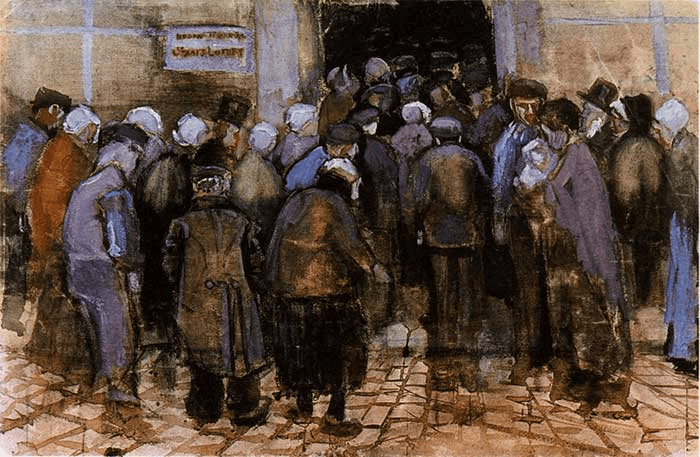
The Poor and Money by Vincent van Gogh, 1882

This is what the Lord says:

“For three sins of Judah,
    even for four, I will not relent.
Because they have rejected the law of the Lord
    and have not kept his decrees,
because they have been led astray by false gods,
    the gods their ancestors followed,
I will send fire on Judah
    that will consume the fortresses of Jerusalem.”

This is what the Lord says:

“For three sins of Israel,
    even for four, I will not relent.
They sell the innocent for silver,
    and the needy for a pair of sandals.
They trample on the heads of the poor
    as on the dust of the ground
    and deny justice to the oppressed.
Father and son use the same girl
    and so profane my holy name.
They lie down beside every altar
    on garments taken in pledge.
In the house of their god
    they drink wine taken as fines.

“Yet I destroyed the Amorites before them,
    though they were tall as the cedars
    and strong as the oaks.
I destroyed their fruit above
    and their roots below.
I brought you up out of Egypt
    and led you forty years in the wilderness
    to give you the land of the Amorites.

“I also raised up prophets from among your children
    and Nazirites from among your youths.
Is this not true, people of Israel?”
declares the Lord. (New International Version)

It’s not a sin to be poor. It is a sin to oppress, take advantage of, or exploit the poor.

Social justice isn’t something fabricated in the minds of progressive Christians. Social justice is biblical and at the heart of all sixteen prophetic books of Holy Scripture’s Old Testament.

The reason the prophets address poverty so often is that God hates injustice. God is not okay with an entire group of disadvantaged people having needed resources beyond arm’s reach – and the Lord’s ire is especially roused whenever the wealthy and powerful extort what little the poor have to begin with.

Even if there are some who tend to believe the poor are poor because of laziness or an unwillingness to work hard, you will not find that idea amongst the biblical prophets. You will, in fact, find just the opposite: fat cats who lie around with their privileged lives, not lifting a finger to help the underprivileged.

The Church does have a role in combating systemic oppression of the poor and needy, and the prophet Amos wants those who claim the name of the Lord to know it.

Amos not only harangued the nations who surrounded Israel and Judah of their sinful stances toward the poor, he leveled the very same message at God’s people who did the same things. Although the Israelites enjoyed a special status with God, that did not mean the Lord had a different set of values or expectations for them when it came to basic human justice.

Mistreating one another is a universal sin and all nations everywhere will be held accountable by God for how they treat the least persons among them. There is such a thing as universal human rights – and the godly person will care about this, at the least, because God cares.

Amos almost exclusively hones-in on the economic sins of the wealthy: taking away needed clothing from those who default on loans; assessing unnecessary and exorbitant fines; taking levies of grain; and living a lavish lifestyle on the backs of the less fortunate.

It was these continually repeated sins against one another which eventually led to both Israel and Judah being conquered by pagan nations and carried into exile.

Today, you will still easily find people being used by others, as if they were mere inhuman machines, here on this earth to make money for those who already have plenty of it. They’d sell their own grandmother if they could get a good price on her. Extortion and oppression are like eating and drinking to them.

Yet, such persons, groups, even entire governments are only stockpiling judgment upon themselves for the God whom they must eventually give an account in how they lived their lives on this earth.

Instead, intentionally paying attention to the poor and treating them with equity will involve the following:

  1. Donating to charitable causes, such as church denominational relief funds, and respected international organizations who can make your contributions count.
  2. Agitating politicians for better policies toward the poor. Writing letters, sending emails, and making phone calls are simple ways of letting your voice be heard in a democratic society.
  3. Learning about worldwide and local poverty. It’s hard not to be involved whenever there is pertinent information. Putting names and faces to struggling people is a must, as well as understanding some of the dynamics that go into poverty.
  4. Raising awareness of significant issues related to poverty and how it impacts the poor. Find others who care about this and share insights and understanding about how to educate others.
  5. Volunteering at a local organization who works with the poor.

There are many more ways to make a difference. As biblically informed people, care of the poor and being concerned for issues of poverty is a must, because the Lord is a Just God with a heart of justice for the disadvantaged, underprivileged, and needy among us.

Now if there are some poor persons among you, say one of your fellow Israelites in one of your cities in the land that the Lord your God is giving you, don’t be hard-hearted or tightfisted toward your poor fellow Israelites. To the contrary! Open your hand wide to them. You must generously lend them whatever they need. (Deuteronomy 15:7-8, CEB)

Just and merciful God, you give honor to the least, the forgotten, the overlooked, and the misjudged.

You give first place to the last, the left behind, the misunderstood, and the undervalued.

You give a warm welcome to the lost, the orphaned, the abandoned, and the destitute.

Help us, your people, to be your ears in listening to their cries.

Help us to be your voice speaking words of encouragement, affirmation, and acceptance.

Help us to be your feet walking beside those in need; and your hands to clothe, feed and shelter them.

You came for the least, the lost and last of this world. Lord, in your mercy, hear our prayer. Amen.

James 2:14-26 – Faith Is Active

My brothers and sisters, what good is it if people say they have faith but do nothing to show it? Claiming to have faith can’t save anyone, can it? Imagine a brother or sister who is naked and never has enough food to eat. What if one of you said, “Go in peace! Stay warm! Have a nice meal!”? What good is it if you don’t actually give them what their body needs? In the same way, faith is dead when it doesn’t result in faithful activity.

Someone might claim, “You have faith and I have action.” But how can I see your faith apart from your actions? Instead, I’ll show you my faith by putting it into practice in faithful action.It’s good that you believe that God is one. Ha! Even the demons believe this, and they tremble with fear. Are you so slow? Do you need to be shown that faith without actions has no value at all? 

What about Abraham, our father? Wasn’t he shown to be righteous through his actions when he offered his son Isaac on the altar? See, his faith was at work along with his actions. In fact, his faith was made complete by his faithful actions. So, the scripture was fulfilled that says, Abraham believed God, and God regarded him as righteous. What is more, Abraham was called God’s friend. So, you see that a person is shown to be righteous through faithful actions and not through faith alone.

In the same way, wasn’t Rahab the prostitute shown to be righteous when she received the messengers as her guests and then sent them on by another road? As the lifeless body is dead, so faith without actions is dead. (Common English Bible)

There is a difference between intent and impact.

A person may have a sincere and heartfelt intention of wanting to see another have their needs met. Yet, if it is only that, there is no impact on actual offerings of resources, friendship, or help.

Genuine authentic faith is more than mere sentiment and head knowledge. Faith without works does not work. Conversely, a strong robust faith is active and is able to withstand adversity.

The rhetorical questions the Apostle James asked were meant to awake his readers to the reality that true faith is always active – and that inactive faith is not really faith at all.

In his letters to the churches, the Apostle Paul typically talked about the relationship between faith and works before a person converts to Christ, whereas the Apostle James emphasized the role of works after a profession of faith in Christ.

St. James was getting at the heart of how a believer in Jesus ought to live. And he did this by giving an illustration of the relationship between faith and works: If someone is in need and a person expresses a sentimental feeling, even if that feeling is sincere, without backing it up with action – the expression is merely an expression, nothing more. 

If a person asks you for something, give it to him. Don’t refuse to give to someone who wants to borrow from you.

Jesus (Matthew 5:42, NCV)

I once came home after a long day at work on a Valentine’s Day several years ago. I had picked up some flowers at a drive through flower shop. I walked into the door and handed my wife the flowers with an “I love you.”  Then, I sat down in a heap and turned on the television. My dear wife’s response was not so favorable to my sentimental overtures. I did not really put any thought or action behind Valentine’s Day, and she knew it. My words of “I love you” just did not sync with my actions. 

I learned from my experience. I redeemed myself the next year by winning a contest on a local radio station for a spouse’s best love note, and it got read on the air several times throughout the day for my lovely wife to hear. My commitment and actions nicely aligned so that when I said “I love you” at the end of that workday, there was no doubt about it.

Faith requires that actions sync with words. For example, when we say “I will pray for you” it needs to be more than an expression of concern – we need to spend the time and commitment it takes in praying for them.

Upholding justice with words (which is very important) but without translating that language into concrete action which truly helps others, ends up speaking into the wind.

Faith involves emotions yet ought not be limited by them. Faith can neither exist nor survive without deeds. Christian works are not an added extra to faith any more than breathing is an added extra to the body. Both faith and action is needed for the Christian life.

True faith is shown as the genuine article by how it acts in real life situations. Faith is more than a checklist of right beliefs to sign-off on, as if it were some fire insurance policy against hell.

“In God’s eyes our words have only the value of our actions.”

St. Ignatius of Loyola

Frankly, as a Pastor, I have heard some pretty lame justifications over the decades for failing to help others, giving to the poor, involving oneself in justice work, and just plain serving in the church, like, “I’m not wired that way,” “That’s not my gift,” “That’s what we pay you to do,” and the ever-prolific, “This church is not meeting my needs.”

Those in the habit of complaining, without an intent to boots-on-the-ground helping, do not yet have an active faith. Each person is to do their part in serving the common good of all. And we all suffer when that does not happen. Bifurcating faith and action leave us with a bogus faith. 

If faith without action is okay, then so is the entire demonic realm. The glimpses of Satan we get in the Bible lead me to think that the devil has the entire thing memorized and knows it quite well. Yet, knowledge puffs up, whereas love builds up. Information by itself is useless unless it is accompanied by gracious and loving action. (1 Corinthians 8:1)

Salvation is a term Christians are familiar with. In the Christian tradition, it refers to being saved from sin, death, and hell. Sanctification is another term most Christians recognize. It means “to become holy,” or, “to be set apart” for God. Sanctification is not an event but a process.

Whereas saving faith is a gift given without works, sanctifying faith requires a great deal of effort. A lot of energy is expended to live the Christian life. The late Dallas Willard used to often say, “Grace is not opposed to effort, it is opposed to earning. Earning is an attitude. Effort is an action.” 

The Apostle James dealt primarily with the sanctifying faith every Christian needs to exhibit. It’s as if we have been graciously granted a full-ride scholarship to a university (salvation) but now the real work begins (sanctification) to learn, grow, and obtain the degree.

Furthermore, just as a student will surely become discouraged at some point throughout their education and wonder if they ought to drop out, so the Christian will face tremendous adversity and challenge. Indeed, a lot of blood-sweat-and-tears goes into our spiritual studies so that our faith will be strengthened for a lifetime of active loving service.

“Each activity of daily life in which we stretch ourselves on behalf of others is a prayer in action.”

Richard Foster

For example, the Old Testament character Abraham was saved from an empty way of life in a pagan country and given a gift of grace to move to the country God would show him. Abraham did nothing to earn this favor.  God just chose him (Joshua 24:2-3).

Abraham sojourned as a pilgrim throughout the land God gave him, which mirrored his spiritual sojourning and learning to be a follower of God. Abraham faced a monumental test of faith when asked to sacrifice his son Isaac (Genesis 22:1-19).

Abraham’s faith was made complete by what he did. Testing of faith is necessary so that we become mature and complete, not lacking anything (James 1:3-4). The way for authentic faith to develop and grow is in the fiery trial of adversity and hardship. Spiritual maturation, holiness, and a well-rounded faith comes through suffering.

To press the significance of faith and works, the example of the Old Testament character Rahab is highlighted. Rahab was a prostitute who lived in the red-light district of Jericho. St. James was doing something profound and important – he took two extreme examples, one a giant of the faith, and the other an almost overlooked example of faith, to demonstrate we all are candidates for real faith.

Rahab’s faith and actions worked harmoniously. She genuinely believed the city of Jericho was going to be overcome by God’s judgment, and, so, she housed the visiting Israelite spies (Joshua 2:1-11).

Methinks we must expand our understanding of faith to include persons others might exclude. Some may be quick to judge those with dubious lives and backgrounds, as well as the poor and needy. We cannot sanitize Rahab as something other than what she was – and because of her faith she ended up being an ancestor of Jesus himself (Matthew 1:5).

From the standpoint of faith, Abraham and Rahab are on the same level. In Christ’s new egalitarian society, all are welcome, all have equality in God’s kingdom.

Holy and active God, I submit to the adversity you bring as my teacher, and I choose to find solace in your Word and Spirit. With the grace, enablement, and resources you give me, I freely give to others in need, through Jesus Christ my Lord. Amen.