Colossians 1:27-2:7 – What Is God’s Goal For Your Life?

Gran Abuelo, a 3,600 year old Cyprus tree in Chile

God chose to make known how great among the gentiles are the riches of the glory of this mystery, which is Christ in you, the hope of glory.It is he whom we proclaim, warning everyone and teaching everyone in all wisdom, so that we may present everyone mature in Christ. For this I toil and strive with all the energy that he powerfully inspires within me.

For I want you to know how greatly I strive for you and for those in Laodicea and for all who have not seen me face to face. I want their hearts to be encouraged and united in love, so that they may have all the riches of assured understanding and have the knowledge of God’s mystery, that is, Christ, in whom are hidden all the treasures of wisdom and knowledge.I am saying this so that no one may deceive you with plausible arguments. For though I am absent in body, yet I am with you in spirit, and I rejoice to see your orderly conduct and the firmness of your faith in Christ.

As you therefore have received Christ Jesus the Lord, continue to walk in him, rooted and built up in him and established in the faith, just as you were taught, abounding in thanksgiving. (New Revised Standard Version)

I invite you to consider the question: “What is God’s goal for my life?” 

This might just be the most important question you ever answer. 

We are created in the image and likeness of God. We were designed for a purpose. Therefore, it is vital and necessary to know the aim, trajectory, and goal for your life.

First, however, let’s consider why we might be out-of-touch with the answer. 

In the beginning God created the heavens and the earth. Man and woman are the apex of God’s imaginative activity. Only humanity has within themselves the ability and the special character to connect with the divine in a special fellowship relationship. 

Yet, the original people fell from their place in Paradise. 

Now, in this current broken world we inhabit, and apart from God, people’s experience is fragmentation, disconnection, confusion, and separation in relationships and self-understanding.

One way of looking at the entirety of the Bible is that it reveals how God is graciously and patiently wooing wayward people back to Paradise. 

The ultimate fulfillment of this re-connection is found in the person and work of Jesus Christ. In Christ, what was lost is found; what was separated is connected; and what was scattered into a thousand pieces is being put back together again.

So, let’s get back to the question of God’s goal for you and me. Since we live in a fallen world, we have to deal with sin, death, and adverse situations. Yet we can take charge of our lives and face reality with a Christian life which thrives and flourishes.

“My friends, be glad, even if you have a lot of trouble.  You know that you learn to endure by having your faith tested.  But you must learn to endure everything, so that you will be completely mature and not lacking anything.  If any of you need wisdom, you should ask God, and it will be given to you.  God is generous and won’t correct you for asking.  But when you ask for something, you must have faith and not doubt.” (James 1:2-6, CEV)

What is God’s goal for my life? Maturity. That you and I will be completely mature. That we will work toward spiritual maturity in our own lives, and what’s more, labor toward presenting others mature in Christ Jesus.

Yes, maturity. Out of all the things which God might want from and for us, maturity is at the top of the list.

Maturity means to be a whole person, not fragmented, a complete and healthy person – in body, soul, spirit, mind, and emotions – all aligned together in a total package of wise living from encouraged hearts and loving faith communities.

Maybe that sounds too far from your own experience. Perhaps you feel that you are all over the place, as if you could never have it all together (or that others are never going to have it together). However, the goal is not about having it all together. 

Rather, maturity is about you and me submitting to adversity and hardship as our teachers. In other words, it’s suffering which leads us to God. Spiritual growth and development happens in the crucible of life. Faith formation occurs in the class of hard knocks.

And we are not to let any spiritual hucksters or charlatans come along and deceive us with all kinds of talk about how the Christian life is having every earthly desire satisfied and never having any significant problems again – that if we just name it and claim it, then our faith will move mountains of money into our bank account or put us into positions of power.

Wi’áaşal, a giant 1,000 year old oak tree in California, on the Pechanga Indian Reservation

Maturity requires spiritual growth over a long period of time. There is no substitute, no other way to be mature in Christ. And our faith will be tried at every turn so that it is strengthened in sustained living for Jesus.

Whenever things are going great, it’s too easy to attribute it to our own ingenuity, ability, or intellect. Yet, when things are rough and there is no apparent way out, we need something or someone outside of ourselves. 

Faith is a muscle that must be stretched, exercised, and used so that it will grow and develop. Trials to our faith and hard situations are the means of strengthening such a faith. The result of all that struggle is maturity, completeness, and wholeness. 

We learn to connect with a generous God who won’t chide us for our messiness and problems. God delights in hearing us and responding to our prayers.

God pays attention and responds… in his own good time and according to his own good grace, and not on our timetable or according to our expectations.

Sometimes we need to learn that the three-ring binder approach to Christian discipleship, with clear proven steps to move forward, is not what we really need. We need Jesus himself. 

In order to return to the Garden, we must walk through the gate of Christ and learn to enjoy the pasture we are currently in. 

Maybe our circumstances will change, and maybe they won’t. But that’s not the point. The aim of all Christian discipleship is that you and I will change, and that our perspective will be different.

So, what will you do today, even right now, to take charge of your life and make a step toward maturity and healthy spiritual wholeness? 

In truth, you know exactly what to do and who to be. You just need some encouragement and affirmation to get over a few fears. It’s okay to be afraid. It’s not okay to remain stuck in fear.

Gracious God of mission who reaches the world with mercy and love, you alone bring growth to your Church everywhere. Send your Holy Spirit to strengthen our faith, give shape to our Christian hope, and love to all our words and actions. May our witness in the world demonstrate a mature Christianity, full of grace and seasoned with salt, through Jesus Christ our Lord. Amen.

Amos 8:1-12 – A Prophet’s Perspective on Power and Poverty

Miners’ wives carrying sacks of coal by Vincent Van Gogh, 1881

This is what the Sovereign Lord showed me: a basket of ripe fruit. “What do you see, Amos?” he asked.

“A basket of ripe fruit,” I answered.

Then the Lord said to me, “The time is ripe for my people Israel; I will spare them no longer.

“In that day,” declares the Sovereign Lord, “the songs in the temple will turn to wailing. Many, many bodies—flung everywhere! Silence!”

Hear this, you who trample the needy
    and do away with the poor of the land,

saying,

“When will the New Moon be over
    that we may sell grain,
and the Sabbath be ended
    that we may market wheat?”—
skimping on the measure,
    boosting the price
    and cheating with dishonest scales,
buying the poor with silver
    and the needy for a pair of sandals,
    selling even the sweepings with the wheat.

The Lord has sworn by himself, the Pride of Jacob: “I will never forget anything they have done.

“Will not the land tremble for this,
    and all who live in it mourn?
The whole land will rise like the Nile;
    it will be stirred up and then sink
    like the river of Egypt.

“In that day,” declares the Sovereign Lord,

“I will make the sun go down at noon
    and darken the earth in broad daylight.
I will turn your religious festivals into mourning
    and all your singing into weeping.
I will make all of you wear sackcloth
    and shave your heads.
I will make that time like mourning for an only son
    and the end of it like a bitter day.

“The days are coming,” declares the Sovereign Lord,
    “when I will send a famine through the land—
not a famine of food or a thirst for water,
    but a famine of hearing the words of the Lord.
People will stagger from sea to sea
    and wander from north to east,
searching for the word of the Lord,
    but they will not find it. (New International Version)

I’ve been in the church most of my life. I have listened to thousands of sermons, as well as preaching thousands of them myself. I can count on both hands how many times I’ve heard a sermon from one of the twelve minor prophets in the Bible. Although I personally have preached on them more times than that, it still pales in comparison with how many sermons I’ve preached from the New Testament gospels or epistles.

This, I believe, is an indictment on us, especially those with privilege and power. If you add the major prophets, we have sixteen books contained in Holy Scripture calling out powerful and influential people’s oppression of others. To overlook such a girth of text is to stick our fingers in our ears and refuse to listen to God.

Those with power, position, and privilege must continually be vigilant to use such influence for the benefit of all persons – not just themselves or people just like them.

The books of the prophets make it very clear that God cares about justice. God will uphold the needy. The Lord will stand with the oppressed. If we fail to share a divine sense of justice and injustice, there will be hell to pay.

God is longsuffering. The Lord patiently awaits us to pay attention. Yet, eventually, that patience will run its course. A prophet will be sent to voice God’s concerns. Like a basket of ripe fruit now finally ready to be eaten, so God’s justice is ripe and ready for action.

The prophet Amos delivered a scathing message to the ancient Israelites about their total disregard for the poor and needy in the land. The people in positions of authority and power only looked on the less fortunate as commodities – as pawns to be taken advantage of for the rich merchants. 

Because the wealthy never took the time to listen to the poor, God would not listen to them. Judgment was coming, and it would not go so well for the power brokers of society who only thought of their business and squeezing others for more money.      

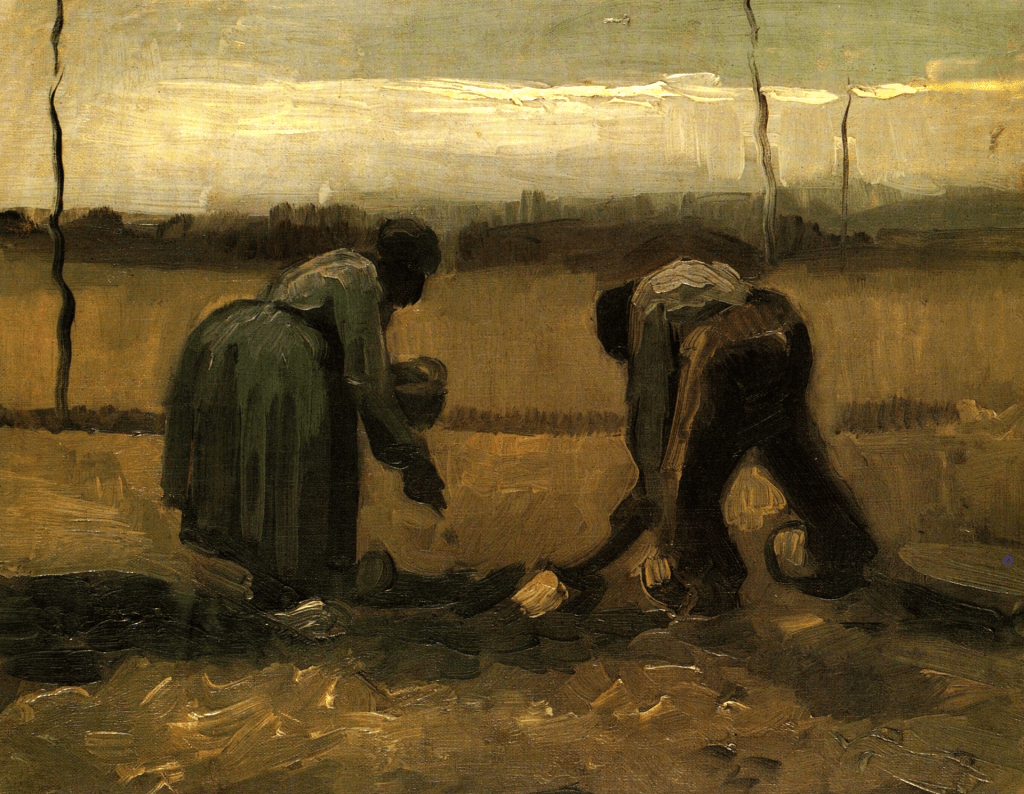
Peasants planting potatoes by Vincent Van Gogh, 1885

Few people rush to have poor folk as their friends. Those in poverty are often overlooked and disregarded. Either they are ignored altogether or are given hand-outs and services without ever having any significant human contact. Even when there is help, it comes from a distance.

In other words, those in authority rarely take the time to listen and get to know the real face of poverty. If there isn’t a photo opportunity, then encounters with the poor are not likely to happen with politicians, or anyone else. After all, so many are busy making money, checking stock portfolios, and considering how to get bigger market shares…. 

Perhaps we have an answer as to why there is no revival in the land. God shows such solidarity with the poor that to ignore them is to ignore him.  No matter our financial picture and outlook, every one of us can grace the poor with the gift of time and listening.  For in doing so we might just be listening to the voice of God.

Justice is the responsibility of everyone, not just a few.

God identifies closely with the poor, the distressed, the underprivileged, and the needy. The Lord listens to the lowly. So, we as God’s people, are to share this same concern. It is a theme throughout the entirety of Holy Scripture.

From the Old Testament:

God will rescue the needy person who cries for help
and the oppressed person who has no one’s help.
He will have pity on the poor and needy
and will save the lives of the needy. (Psalm 73:12-13, GW)

Those who mock the poor insult their Maker; those who rejoice at the misfortune of others will be punished. (Proverbs 17:5, NLT)

Those who are gracious to the poor lend to the Lord, and the Lord will fully repay them. (Proverbs 19:17, CEB)

If you close your ear to the cry of the poor, you will cry out and not be heard.

Proverbs 21:13, NRSV

Those who give to the poor will lack nothing, but those who turn a blind eye will be greatly cursed. (Proverbs 28:27, CEB)

Give your food to the hungry
    and care for the homeless.
Then your light will shine
    in the dark;
your darkest hour will be
    like the noonday sun. (Isaiah 58:10, CEV)

The Spirit of the Sovereign Lord is on me,
    because the Lord has anointed me
    to proclaim good news to the poor. (Isaiah 61:1, NIV)

From the New Testament:

“If you want to be complete, go, sell what you own, and give the money to the poor. Then you will have treasure in heaven.”

Jesus (Matthew 19:21, CEB)

Command those who are rich in this present world not to be arrogant nor to put their hope in wealth, which is so uncertain, but to put their hope in God, who richly provides us with everything for our enjoyment. Command them to do good, to be rich in good deeds, and to be generous and willing to share. (1 Timothy 6:17-18, NIV)

 If we are rich and see others in need, yet close our hearts against them, how can we claim that we love God? My children, our love should not be just words and talk; it must be true love, which shows itself in action. (1 John 3:17-18, GNT)

Poverty is not only an issue in some far away place; the poor are found everywhere, and they are always among us.

I believe an honest hearing of the prophet Amos would change the world. I’m not talking about angry ranting which works people into a frenzy of fear and suspicion. I am referring to giving Amos a serious hearing, just like we give the Apostle Paul our focused attention.

Just because poverty has always been with us, doesn’t mean we ought to only shrug our shoulders and say, “Meh, what’s a guy to do?” Instead, we can determine to address the issues which create a large class of poor people to begin with – including malevolence and materialism.

The moral compass of many of the earth’s nations is askew, even broken. It needs to be recalibrated to the true north of biblical justice. Back in the prophet’s day, bullying, bribery, and backstabbing were tools used for malevolent purposes. Those same implements are still being used by some today.

You must not pervert justice or show favor. Do not take a bribe, for bribes blind the eyes of the wise and distort the words of the righteous. (Deuteronomy 16:19, NET)

Those who plant injustice will harvest disaster,
    and their reign of terror will come to an end. (Proverbs 22:8, NLT)

But why would people be so unjust to other people? What would motivate someone to purposefully harm another in this way?… Materialism would.

Whenever people have an exorbitant amount of stuff, generosity is typically not their first impulse (Ecclesiastes 5:10). Rather, the extremely rich among us have an equally extreme temptation to hold on tight to their wealth – so much so that money and acquiring more stuff becomes their religion. That’s why Scripture is replete with warnings about money.

In short, poverty must be tackled, from a biblical perspective, on both the personal and systemic level. Individuals, families, churches, faith communities, organizations, corporations, and governments must all remove the obstacles which keep people in poverty. This is an appropriate use of power and authority.

What will you and I do?…

Gracious God, you are found everywhere – both the halls of power, and the back alleys of slums. As we seek you more and more, help us to see the face of Jesus in everyone we encounter, whether rich or poor, so that we might share the gift of life with them, through Jesus Christ our Lord, in the power of your Holy Spirit. Amen.

Psalm 52 – Deliver Us From Evil

The world’s oldest olive tree, 3,000 years, on the island of Crete

Hey, powerful person!
    Why do you brag about evil?
    God’s faithful love lasts all day long.
Your tongue devises destruction:
    it’s like a sharpened razor, causing deception.
You love evil more than good;
    you love lying more than speaking what is right.
You love all destructive words;
    you love the deceiving tongue.

But God will take you down permanently;
    he will snatch you up,
    tear you out of your tent,
    and uproot you from the land of the living!
The righteous will see and be in awe;
    they will laugh at those people:
“Look at them! They didn’t make God their refuge.
    Instead, they trusted in their own great wealth.
        They sought refuge in it—to their own destruction!”

But I am like a green olive tree in God’s house;
    I trust in God’s faithful love forever and always.
I will give thanks to you, God, forever,
    because you have acted.
In the presence of your faithful people,
    I will hope in your name because it’s so good. (Common English Bible)

Ideally, every person on planet earth would be safe to talk to and work with. But we know this is not true. That’s because we have our own experiences of persons in authority who used their power and influence for malevolent purposes – knowing exactly what kind of harm they’re doing.

This is precisely what once happened with David. Before he was king over all Israel and Judah, David was on the run from King Saul.

David had done nothing wrong. In fact, he had done everything right from a good heart. And yet, because of Saul’s jealousy and lust for power, he saw David as a threat and not an asset. So, he hunted him like an animal.

King Saul’s abuse of power was bad enough. But that abuse reached it’s evil height with Doeg the Edomite. (1 Samuel 22:6-23)

Doeg was a nasty guy. He wasn’t just bad; he enjoyed being bad. Saul was so obsessed with getting rid of his perceived rival, that he sought to kill anyone who aided and abetted David. And Doeg had such a lust for murder that he was willing to kill anyone.

And that’s what he did. When Saul found out that the priests in the village of Nob had helped David when he was on the run, the jealous king tried to use his authority to command the army to slaughter them all. However, being reasonable men, they could not do it.

Yet, Doeg stepped in and stepped up to single-handedly wipe out the priests. Sadly, he didn’t stop there…

Doeg the Edomite turned and attacked the priests; on that day he killed eighty-five who wore the linen ephod. Nob, the city of the priests, he put to the sword; men and women, children and infants, oxen, donkeys, and sheep, he put to the sword. (1 Samuel 22:18-19, NRSV)

It was after this horrific event that David crafted the psalm for today.

There is abuse, trauma, and oppression – and then there is the continual harming from another which goes unabated. The abuser, the oppressor, the murderer keeps going, unchecked. And we are powerless to stop it.

There is only One who can right such terrible wrongs.

Today’s psalm speaks of God’s constancy, the continual love which persists all day long. David lifted his grief and anger to the Lord concerning the misuse of power and authority by Saul and Doeg. In light of God’s justice and faithful love, David affirms and believes that the Lord will bring ruin on those who despise divine commands and ethical instruction.

We don’t know always know why evil continues, or how it will end. Those enduring questions out of our own human condition and experience of evil may persist. Yet, the believer knows with certainty, as follower of a righteous, just, and holy God, that the downfall of the wicked will be total, and it will be permanent.

There is a day coming when evil shall be finished forever. And it’s hard not knowing exactly when that’s going to happen.

Perhaps this sort of talk seems like a cop out. It may appear that if God is so loving and powerful that evil ought to be stopped this very second.

Yet, consider this: There is so much evil and injustice in this world that to forcefully and immediately pull up those nasty wicked weeds will end up taking out the good plants next to them. The cure ends up being the harm.

The Lord is presently, patiently, and meticulously moving all things toward an inexorable ending – and it must be done carefully so that the godly are preserved from annihilation.

Fortunately, most people on earth aren’t like Doeg the Edomite or King Saul. Unfortunately, having one of them in your life is likely to happen because of the world’s great evil. One wicked person is bad enough to foment hate, spread lies, create havoc, and outright murder people – both verbally and actually.

The biblical psalms exist to serve us well whenever we experience the wrath of a person like Doeg. The psalms let us know we aren’t alone and help give us a voice. This is highly important, especially when the wicked seek to silence us and squelch our voice.

Trusting in the Lord, day after day… week after week… month after month… year after year… decade after decade… with the same slow and deliberate plod of God, strengthens us like a big old thick olive tree. And the psalms are here to help that happen.

May the Lord Jesus Christ guard and deliver you from the snares of the devil, the assaults of evil spirits, the wrath of the wicked, all base passions, and the fear of the known and unknown. Amen.

Ephesians 3:14-21 – A Prayer for Every Believer

A mosaic of the Apostle Paul in St Isaac’s Cathedral, St. Petersburg, Russia

For this reason, I fall on my knees before the Father, from whom every family in heaven and on earth receives its true name. I ask God from the wealth of his glory to give you power through his Spirit to be strong in your inner selves, and I pray that Christ will make his home in your hearts through faith. I pray that you may have your roots and foundation in love, so that you, together with all God’s people, may have the power to understand how broad and long, how high and deep, is Christ’s love. Yes, may you come to know his love—although it can never be fully known—and so be completely filled with the very nature of God.

To him who by means of his power working in us is able to do so much more than we can ever ask for, or even think of: to God be the glory in the church and in Christ Jesus for all time, forever and ever! Amen. (Good News Translation)

In Jesus Christ, the believer has been given incredible blessings – adoption into God’s family and belonging with God, redemption through Christ’s cross and experiencing freedom from the power of sin, and intimacy and help by means of God’s own Spirit.

Today’s New Testament lesson is a prayer of the Apostle Paul for the Church. After three chapters of describing who we are and what we have in Christ as Christians, he goes to prayer, asking that the new life we have in Christ will be pressed firmly into our heads and our hearts so that this reality of spiritual blessings will be practically realized for the believer.

Here’s a quick remedial grammar lesson: a “verb” expresses an action between two things; a “participle” or “participial phrase” is a word or group of words which help describe the action of the verb.

There are two main verbs Paul uses: “I ask (pray)” for God “to give.” The participles all explain or modify the action of pray and give. In other words, the following actions are what Paul deeply desires that God will do for us as believers in Jesus….

To Become Mighty Through the Spirit

God grants us all the blessings of being in Christ. We are delivered from sin, death, and hell so that we will live into God’s purposes for this new life of freedom.

We live into the Christian life, on a practical level, as our faith is strengthened, and our inner person becomes powerful. This is the Spirit’s work in us – to strengthen our spiritual spine so that we can bear and carry our cross in this life, despite whatever the adversity or difficulty.

We are not alone. The Spirit is with us always. God is present. The believer is never promised that life will be a bowl of cherries and that being a Christian is all rainbows and unicorns. However, the believer is assured that God will be with us through the trouble – which is why we need a strong and robust faith.

You set a table for me
    right in front of my enemies. (Psalm 23:5, CEB)

To Dwell In Christ Through Faith

The “heart” in the New Testament is a reference not to the physical muscle in our chest but the seat or center of our inner person.

Paul’s prayer is that God gives or plants the seeds of the gospel in the hearts of people. Those good seeds then take root and become anchored firmly in the soul. They grow and mature, producing a harvest of love.

Not only do those roots grow down and deep, but they also grow out and connect with all other believers everywhere.

To Grasp God’s Love in Christ Through the Spirit

Enjoying this mystical union with Christ and connection with Christians, we come to experientially grasp together the vast dimensions of God’s love for us. God’s love is a multiverse of blessing. In fact, an eternity in heaven will never reach the bottom or top of the God who is Love itself.

When God our Savior made his kindness and love for humanity appear, he saved us, but not because of anything we had done to gain his approval. Instead, because of his mercy he saved us through the washing in which the Holy Spirit gives us new birth and renewal. God poured a generous amount of the Spirit on us through Jesus Christ our Savior. (Titus 3:4-6, GW)

To be filled with all the fullness of Love, is to be filled thoroughly with God – because God is Love.

My dear friends, we must love each other. Love comes from God, and when we love each other, it shows we have been given new life. We are now God’s children, and we know him. God is love, and anyone who doesn’t love others has never known him. (1 John 4:7-8, CEV)

Conclusion

Prayer is a gift. Like a little child bursting into her daddy’s office at work and crawling up on his lap, so we have the wondrous privilege of coming to God without hindrance and asking for whatever we need and want.

And what God wants and enjoys hearing, is us asking for spiritual strength, faith, and love. Because it is these things which create a thriving inner person who blesses others.

May it be so, to the glory of God, for the edification of the Church, and in the proclamation of the gospel. Amen.