Acts 2:22-36 – From Flake to Fearless

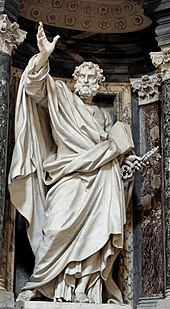
Statue of St. Peter in Rome

“Fellow Israelites, listen to this: Jesus of Nazareth was a man accredited by God to you by miracles, wonders and signs, which God did among you through him, as you yourselves know. This man was handed over to you by God’s deliberate plan and foreknowledge; and you, with the help of wicked men, put him to death by nailing him to the cross.But God raised him from the dead, freeing him from the agony of death, because it was impossible for death to keep its hold on him.David said about him:

“‘I saw the Lord always before me.
    Because he is at my right hand,
    I will not be shaken.
Therefore my heart is glad and my tongue rejoices;
    my body also will rest in hope,
because you will not abandon me to the realm of the dead,
    you will not let your holy one see decay.
You have made known to me the paths of life;
    you will fill me with joy in your presence.’

“Fellow Israelites, I can tell you confidently that the patriarch David died and was buried, and his tomb is here to this day. But he was a prophet and knew that God had promised him on oath that he would place one of his descendants on his throne. Seeing what was to come, he spoke of the resurrection of the Messiah, that he was not abandoned to the realm of the dead, nor did his body see decay. God has raised this Jesus to life, and we are all witnesses of it. Exalted to the right hand of God, he has received from the Father the promised Holy Spirit and has poured out what you now see and hear. For David did not ascend to heaven, and yet he said,

“‘The Lord said to my Lord:
    “Sit at my right hand
until I make your enemies
    a footstool for your feet.”’

“Therefore, let all Israel be assured of this: God has made this Jesus, whom you crucified, both Lord and Messiah.” (New International Version)

Throughout my ministerial life, there have been individuals who have come to me a bit discouraged because they have not experienced a changed life. After trying, time and again, to be different, they say to me, “Nobody ever really changes. We’re basically the same people throughout our whole lives.”

I couldn’t disagree more.

In the New Testament Gospels, the Apostle Peter was a flake. He sometimes was discerning and got it, and sometimes didn’t. 

Peter could understand Jesus was Messiah, but then turn around and refuse that Christ had to die on a cross. He would get bold and walk on water, but then also end up afraid, needing help from drowning. Peter stood tall for Jesus, ready to take on the world, and then turn around and deny the Lord three successive times.

However, when we come to biblical book of Acts, Peter is a completely changed man. Peter gets it. He is brave and fearless. He boldly confesses Christ. And all the while he does not falter, flinch, or back down. 

So, what in heaven’s name, happened and made the difference for Peter between the Gospels and Acts? 

The Holy Spirit, that’s what, or rather, who.

God’s Spirit comes upon Peter, and he is never the same again. He is a changed man. Peter goes from flake, to fearless.

Everything falls into place for Peter, who preaches with such boldness and effectiveness that thousands turn from their previous ways of thinking and living and turn to Jesus as the hope of the world. They changed, too.

Peter was all-in with a simple and straightforward message of good news, that God raised Jesus from death. He went on to insist, without wavering and with firm conviction, that this was so, because it was not possible for the Son of God to be held by anything, even death. The proof being the resurrection.

If it was impossible for death to keep a grip on Jesus, then there is absolutely nothing that can deter Jesus or hold him back from accomplishing what he wants to accomplish. 

Flaky believers are not going to frustrate Jesus or upset his plans; he’ll just send the Holy Spirit. 

We may too often imprison ourselves in self-made spiritual jail cells. Like the pre-Pentecostal Peter, we flake and flip-flop in the Christian life. Once-in-a-while we are spot-on, but cannot really explain why, like a golfer who hits an amazing shot but can’t reproduce it no matter how hard he tries. 

The truth is that Jesus has conquered sin, death, and hell. By faith, we have forgiveness of sins in him, and have the way opened to a new life in the Spirit. It isn’t a secret; it’s a new reality.

At the front end of the Christian season of Ordinary Time, we are reminded that God’s Holy Spirit is with us. We remember what good old Peter said so long ago, which is still relevant for us today:

We have everything we need to live a life that pleases God. It was all given to us by God’s own power, when we learned he had invited us to share in his wonderful goodness. God made great and marvelous promises, so his nature would become part of us. Then we could escape our evil desires and the corrupt influences of this world. (2 Peter 1:3-4, CEV)

The message Peter proclaimed was powerful, not only because it was inherently potent, but also that the gospel dwelled mightily in Peter and inhabited a central place within him.

We, too, have that same opportunity and privilege.

Loving Lord Jesus, I confess my faults, shortcomings, sins, and rebellious acts, and ask you to forgive me. I embrace you as my Savior and Lord. Thank you for your atoning death on the cross in obedience to your Father’s will to put away my sins. Be in charge of every part of my life. Indwell and empower me with your Holy Spirit, so that I may live as your faithful follower, now and forever. Amen.

Psalm 85 – God Gives Grace

Psalm 85 by American artist John August Swanson, 2003

Lord, you poured out blessings on your land!
    You restored the fortunes of Israel.
You forgave the guilt of your people—
    yes, you covered all their sins.
You held back your fury.
    You kept back your blazing anger.

Now restore us again, O God of our salvation.
    Put aside your anger against us once more.
Will you be angry with us always?
    Will you prolong your wrath to all generations?
Won’t you revive us again,
    so your people can rejoice in you?
Show us your unfailing love, O Lord,
    and grant us your salvation.

I listen carefully to what God the Lord is saying,
    for he speaks peace to his faithful people.
    But let them not return to their foolish ways.
Surely his salvation is near to those who fear him,
    so our land will be filled with his glory.

Unfailing love and truth have met together.
    Righteousness and peace have kissed!
Truth springs up from the earth,
    and righteousness smiles down from heaven.
Yes, the Lord pours down his blessings.
    Our land will yield its bountiful harvest.
Righteousness goes as a herald before him,
    preparing the way for his steps. (New Living Translation)

Unfailing love, truth, righteousness, and peace are terms which all spiritual folk need to be familiar with, as well as experience every day.

Such love and commitment have their ground in God’s covenant loyalty and kindness which always holds on, even despite people’s fickle commitment.

Righteousness and peace are primarily relational terms which communicate a harmonious way of being with others and all creation.

Today’s psalm informs us that God will give exactly what the people have prayed for. This divine giving is a blessing by the Lord to those who long for wholeness, integrity, and unhindered connection with God and creation.

The metaphors surrounding the wonderful words give us a beautiful picture of the blessing realized, as if a big bucket of grace were being liberally poured over our heads.

This is no generic blessing from the almighty and everlasting God; it is personal.

In the grand immensity of the universe, the Creator God bends and condescends to the individual, as well as to all humanity. God’s steadfast love and ever-present faithfulness will meet to bless you and me.

The Lord will come alongside us with divine blessing. God’s grace will stick to us like glue in the form of right relationships and unity. It’s as personal as a kiss on the lips.

All of God’s attributes and character work in a seamless whole to bring divine acceptance and assistance to our lives. The good news here is that our struggles to be right and live right amidst terrible conditions of disease, war, and unrest will be vindicated with divine help.

So, take a big breath and exhale, allowing the worries and anxieties of adverse situations to be expelled from your weary soul. The Lord will give what is good.

“God gives where he finds empty hands.”

St. Augustine

Today’s psalm is a good reminder that salvation is not limited to a future state; it is also deliverance in this present world we inhabit, basking in the Lord’s love and shalom, and enjoying the good gifts God wants to give us right now.

But what if we have strayed from the truth and wandered down a bad road with unsavory characters?

The Lord will restore us. Why? Because that’s what God does.

Grace isn’t grace if we deserved it. Grace is only operable whenever there is a stink of a situation we have created for ourselves. God’s mercy exists to deal with all of our shortcomings, failings, sins, confusion, and misguided attempts at life.

Without mercy we are lost. Apart from grace, there’s no hope. The good news is that mercy really does exist, and, what’s more, there is an infinite storehouse of it. There is no point in which our screw-ups exhaust the supply of grace.

This reality brings us confident hope and inner gratitude. God’s unfailing and steadfast love brings deliverance, not bondage. The Lord’s infinite mercy, when truly experienced, is not taken as a license to do whatever I want but as a joyous get-out-of-jail-free-card which leads to a righteous life of wanting to please God in all I say and do.

He Giveth More Grace by Annie Johnson Flint, 1941

1. He giveth more grace as our burdens grow greater,
He sendeth more strength as our labors increase;
To added afflictions He addeth His mercy,
To multiplied trials He multiplies peace.

2. When we have exhausted our store of endurance,
When our strength has failed ere the day is half done,
When we reach the end of our hoarded resources
Our Father’s full giving is only begun.

3. Fear not that thy need shall exceed His provision,
Our God ever yearns His resources to share;
Lean hard on the arm everlasting, availing;
The Father both thee and thy load will upbear.

4. His love has no limits, His grace has no measure,
His power no boundary known unto men;
For out of His infinite riches in Jesus
He giveth, and giveth, and giveth again.

Amen.

John 6:41-51 – The Bread of Life

“I Am the Bread of Life” by Lebanese painter Joseph Matar

The Jews there began to grumble about him because he said, “I am the bread that came down from heaven.” They said, “Is this not Jesus, the son of Joseph, whose father and mother we know? How can he now say, ‘I came down from heaven’?”

“Stop grumbling among yourselves,” Jesus answered. “No one can come to me unless the Father who sent me draws them, and I will raise them up at the last day.It is written in the Prophets: ‘They will all be taught by God.’ Everyone who has heard the Father and learned from him comes to me. No one has seen the Father except the one who is from God; only he has seen the Father. Very truly I tell you, the one who believes has eternal life.

I am the bread of life. Your ancestors ate the manna in the wilderness, yet they died. But here is the bread that comes down from heaven, which anyone may eat and not die. I am the living bread that came down from heaven. Whoever eats this bread will live forever. This bread is my flesh, which I will give for the life of the world.” (New International Version)

Christians everywhere hold to Jesus as the Son of God, Lord of the universe, and Savior of all.

However, for most people who were following Jesus around in the first century, this was not their understanding of Christ. In his earthly ministry, Jesus spoke in ways that introduced people to who he really was and sought to bring them to a point of following him based on his identity. 

Jesus wanted the crowds to see him for who he really is – themselves for what they really needed – and follow him based on the deepest needs of their lives.

I believe Jesus is the hope of all nations and all people, and in him humanity’s most basic and profound needs are met for forgiveness, love, and purpose in life. To address this, I ask three basic philosophical and theological questions of life:

What should human beings seek in life?

The responses in history are legion. The ancient Greek philosopher Aristotle thought a proper appreciation for an ethical and virtuous life found in practical wisdom was where people’s most concerted efforts should be. 

Karl Marx, the father of communism and socialism believed the proletariat should use their heads and their hands to rise above their economic conditions and oppression.

In the late 1960’s, Bobby Kennedy said we ought to be working the hardest to achieve justice and not advance ourselves on the misfortunes of others.

In more recent times, the Harvard Business Review is continually on the lookout for the best ways of being efficient, productive, and making the most of time because work itself is paramount.

Jesus insisted that people are not to work for food that spoils, but for food that endures to eternal life. Christ positioned himself as the bread of life – the one who is able to sustain humanity and enable to thrive and flourish in life.

By literally feeding thousands of people, Jesus wanted the people to understand the source of life itself comes from him. Jesus aspired beyond providing a supper for folks – he desired the people to feast on himself – to ingest him, to take him into their lives in a deep and profound way as the fulfillment of all the hope and promises of the Old Testament. 

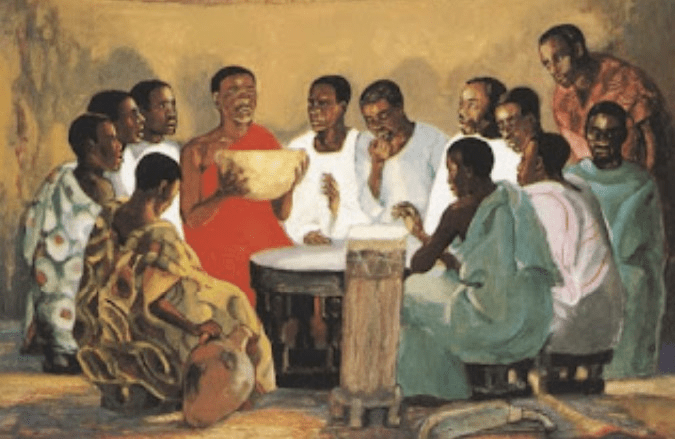
“The Lord’s Supper” by Cameroon artist Jesus Mafa, 1973

Jesus is the bread, the basic staple of life, that meets the cravings and needs of all people everywhere. Starving people, in both body and soul, find in Jesus a meal which keeps on giving, a feast of grace that is both delectable and unending.

The answer to my own question is that, for me, one’s highest pursuit and greatest quest is Jesus. Apart from Christ, I will starve. Furthermore, Jesus is not some cheap fast food off a value menu; he is real soul food to be ingested and enjoyed with others.

I believe people need Jesus. A passionate seeking of Jesus, to follow him, live for him, center life around him, is my most ardent desire. I do not simply desire Jesus for what he can do for me; I vigorously chase after him because if I do not have Jesus, I will die, I will starve to death. 

For me, Jesus is so much more than a nice addition to my life, like a new puppy; Jesus is Lord and Savior. I must consume him, or I will be completely undone, and I will not survive! Jesus is my bread, my food, my life!  I cannot survive on a daily crumb, but I feast on every word that comes from the mouth of Jesus because in Christ there is the life that is truly life.

What should human beings do in life?

Believe. To have and keep faith in the One God has sent, Jesus, is the primary “work” that pleases God.

Jesus communicated to the crowd that they can do so much more than follow him for another earthly meal – they can place their faith and hope in him for food that will last, food that will transcend the three-dimensional world.

Faith is more than an intellectual recognition to some facts about Christianity.

Belief is not about always having clarity and certainty to every facet and loci of Christian doctrine. Rather, Christian faith is a complete trust in Jesus as our hope and our life.

Education, economic uplift, political stability, and institutional peace and justice are important activities for this world. For the Christian, the accomplishment of these and so much more comes from the grace of God in Christ. As people come to the end of themselves with their homebrewed and half-baked attempts at being satisfied, Jesus stands at the door and knocks, the Living Bread who offers himself for humanity’s deepest needs.

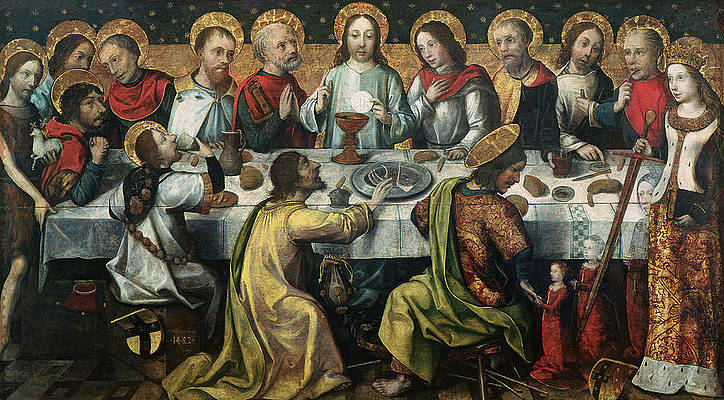
“The Last Supper” by Godefroy, 1482, C.E.

Giving kudos to Jesus might be nice, yet Christ himself cares about folks placing their trust in him for grace, forgiveness, and hope in their world. Jesus longs to reconnect people with God through giving himself as the means of making that happen.

All the works we do in this life, every good deed we accomplish, and each positive action we do are all helpful and necessary… and they all pale in comparison to the greatest work of all, to believe in Jesus Christ as the hope of this world, the hope of your family, the hope of the church, and the hope of your life. It’s all accessed by faith in the Son of God who loved me and gave himself for me.

Church buildings and furniture, stained-glass windows, pews, and even the Bible are not Jesus – they are simply and hopefully signs which point to him. They are all designed to lead us to Christ so that we may come to him. And coming to Christ is what the Lord’s Supper, Holy Communion, the Eucharist, and any other description you want to give about ingesting Jesus is about. The elements of bread and cup bring us to Christ so that we can experience Jesus and be joined to him by faith in a mystical union of human and divine in the unseen heaven.

Conclusion

Where will you find true satisfaction and hope? Probably not in the clearance aisle at Wal-Mart. Likely not in conforming to cultural Christianity or embracing generic forms of Jesus as merely a good teacher and moral example.

Furthermore, life’s ultimate satisfaction and hope are not to be found in a spotless house and perfect kids; in working more hours and making more money. Nor will we find contentment and peace in the radical independence of doing things my way.

Jesus is the Bread of Life. Through ingesting him, passionately pursuing him, believing in him, and coming to him in everything, we find the life that is truly life. Do not settle for any substitutes to Jesus. Come to the real person.

Lord God, you said that when we seek you with all our hearts, you will be found.  As the deer pants for streams of water, so we, your people, long for you in a dry and weary land.  We hunger and thirst for your righteousness.  We deeply desire your presence in all things. So, we die to ourselves and surrender to your will and way for us, by faith trusting you will come into our lives and completely take over. May your blessing rest upon us as we seek Jesus. Amen.

Psalm 119:17-32 – Examine the Wonders of God’s Instructions

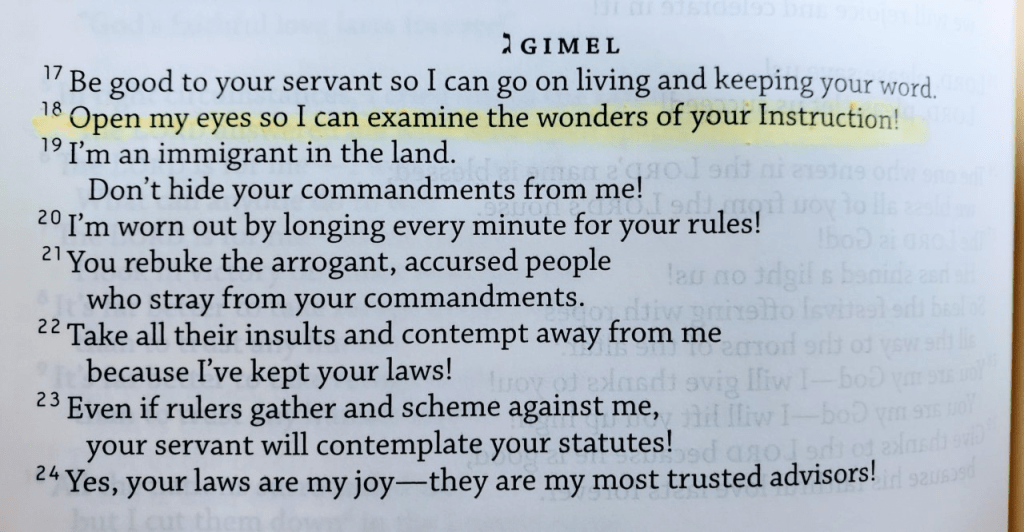
Psalm 119:17-24, Common English Bible

ג Gimel

Be good to your servant while I live,
    that I may obey your word.
Open my eyes that I may see
    wonderful things in your law.
I am a stranger on earth;
    do not hide your commands from me.
My soul is consumed with longing
    for your laws at all times.
You rebuke the arrogant, who are accursed,
    those who stray from your commands.
Remove from me their scorn and contempt,
    for I keep your statutes.
Though rulers sit together and slander me,
    your servant will meditate on your decrees.
Your statutes are my delight;
    they are my counselors.

ד Daleth

I am laid low in the dust;
    preserve my life according to your word.
I gave an account of my ways and you answered me;
    teach me your decrees.
Cause me to understand the way of your precepts,
    that I may meditate on your wonderful deeds.
My soul is weary with sorrow;
    strengthen me according to your word.
Keep me from deceitful ways;
    be gracious to me and teach me your law.
I have chosen the way of faithfulness;
    I have set my heart on your laws.
I hold fast to your statutes, Lord;
    do not let me be put to shame.
I run in the path of your commands,
    for you have broadened my understanding. (New International Version)

The biblical psalms are one of my favorite places in the whole of Holy Scripture. I especially like Psalm 119 because it reminds me that I am not only saved from something, but I am also saved to something.

Genuine and real deliverance comes so that we can be free to love and serve God with our whole being. And Psalm 119 is there to help us know how to do just that.

Psalm 119 stretches for 176 verses as an acrostic to the Hebrew alphabet. Each Hebrew letter has its own 8 verse stanza, with each of those verses beginning with that letter. Unfortunately, of course, we lose this insight through translation.

One of the reasons the psalm was organized this way is because it was meant to be learned and memorized. In fact, the entire psalter was meant for public consumption – to be engrafted into the soul and hidden in the heart.

The wonders of Psalm 119 are, overall, a paeon of reverence and praise of God’s law. That’s because the Lord’s commands and instructions are an extension of the divine character. Laws of mercy and holiness are given to the people because God is merciful and holy.

Grace and law are not antithetical. They go together like a hand in a glove and rely upon each other. The hand of grace is what fills the glove of the law, and together, they extend divine help and direction to people in this fallen world of ours.

The heartfelt prayer of the psalmist is that the Lord would open his eyes so that he could see the wonders contained within God’s divine instructions for humanity.

“Open my eyes so I can truly see
the marvelous things in your law.”

Psalm 119:18, NET

This is a prayer for us, as well. Those who desire to please the Lord and walk in the way of God are continually seeking awareness of the divine all around them, insight into others, and understanding of self.

It is one thing to read the Bible, but it’s another thing altogether to understand it. The psalmist is asking for God to intervene on his behalf and remove anything and everything that would inhibit his ability to understand and discern God’s words and actions.

Insight, understanding, and application to life comes from dwelling in the Word. It is a process. A daily crumb will neither do to satiate our physical hunger nor our spiritual appetite.

Going days, even weeks, without ingesting God’s instructions will only lead to spiritual emaciation. It harms us and helps no one. Instead, we need to feed on Holy Scripture and savor every bite. Like the cow, we need to slowly chew and ruminate on Scripture so that it can be fully digested and become part of us.

I have memorized large chunks of the Bible over the years. The main reason my memory can call up so much Scripture is that I have read it, and continue to read it, over and over again. Even though I’ve read the Old Testament about one-hundred times and the New Testament in the neighborhood of three-hundred times, I still gain insight and understanding, seeing new and wondrous things.

I truly believe the Bible is an inexhaustible source of sage instruction and a continual fountain of wisdom. I’ll spend an eternity in heaven examining God’s Word and will never reach the height, depth, length, and breadth of it’s incredible, massive, and glorious precepts.

I am a strong advocate of straightforward readings of Scripture, over and over again. Although I encourage looking at devotionals, commentaries, and reflections (like this blog!) to help and encourage us, nothing can replace our constant and continual reading of the Bible.

The biblical Book of Psalms is the Church’s prayerbook. All 150 of them are meant to be used for every sort of life circumstance. Whether discouraged or anxious, joyful or confident, the psalms encompass the full range of the human condition – and Psalm 119 lets us know how central God’s instructions are to the life of God’s people.

So, read today’s psalm… several times. Let Scripture do it’s marvelous and wondrous work within you.

Blessed Lord, you caused all Holy Scriptures to be written for our learning. Help us so to wisely hear, read, mark, learn, and inwardly digest them so that by our patient reading of your holy Word, we may embrace and ever hold fast the blessed hope of everlasting life, which you have given us in our Savior Jesus Christ.