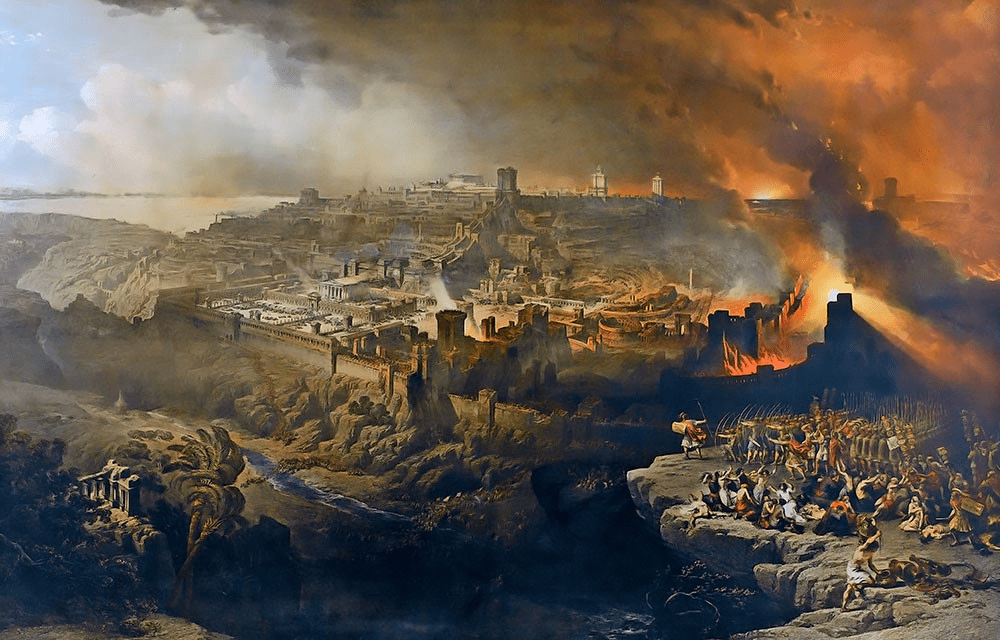
Psalm 74 – A Devastating Loss

Our God, why have you
    completely rejected us?
Why are you so angry
    with the ones you care for?
Remember the people
    you rescued long ago,
the tribe you chose
    for your very own.

Think of Mount Zion,
    your home;
walk over to the temple
left in ruins forever
    by those who hate us.

Your enemies roared like lions
    in your holy temple,
and they have placed
    their banners there.
It looks like a forest
    chopped to pieces.
They used axes and hatchets
    to smash the carvings.
They burned down your temple
    and badly disgraced it.
They said to themselves,
    “We’ll crush them!”
Then they burned each one
of your meeting places
    all over the country.
There are no more miracles
    and no more prophets.
Who knows how long
    it will be like this?

Our God, how much longer
    will our enemies sneer?
Won’t they ever stop
    insulting you?
Why don’t you punish them?
    Why are you holding back?

Our God and King,
you have ruled
    since ancient times;
you have won victories
    everywhere on this earth.
By your power you made a path
    through the sea,
and you smashed the heads
    of sea monsters.
You crushed the heads
    of the monster Leviathan,
then fed him to wild creatures
    in the desert.
You opened the ground
for streams and springs
    and dried up mighty rivers.
You rule the day and the night,
and you put the moon
    and the sun in place.
You made summer and winter
    and gave them to the earth.

Remember your enemies, Lord!
They foolishly sneer
    and won’t respect you.
You treat us like pet doves,
    but they mistreat us.
Don’t keep forgetting us
and letting us be fed
    to those wild animals.
Remember the agreement
    you made with us.
Violent enemies are hiding
in every dark corner
    of the earth.
Don’t disappoint those in need
    or make them turn from you,
but help the poor and homeless
    to shout your praises.
Do something, God!
    Defend yourself.
Remember how those fools
    sneer at you all day long.
Don’t forget the loud shouts
    of your enemies. (Contemporary English Version)

God’s temple was violated. The center and symbol of Jewish worship, culture, and life was gone.

Although we know that nothing lasts forever, that doesn’t mean we are always okay with it.

Asaph, the psalmist, was definitely not okay with the temple’s destruction. It was more than the loss of a building. For Asaph and his people, Jerusalem and the temple were the glue which held the world together.

They lost their center of being. And it was devastating to them.

Everyone and every society has their center, those values and practices which makes them a people. We all need a public center that defines who we are and what we are about. There must be a gravity that holds us to our place and doesn’t allow us to stray into oblivion and nothingness.

The central core of the people was eviscerated. So, today’s psalm is a lament for Jerusalem. It is a painful emotional and spiritual cry which goes well beyond bricks and mortar and the mere physical.

The ruin of the temple, Asaph complains, is the ruin of their God. Yes, it was the Babylonians who came and did the destroying and the de-centering. But it was God’s temple. God is the One responsible. It was God’s action. So, Asaph contends with God and comes at him with full challenge.

Asaph appealed to the Lord much like we do today. “Hey, God, remember how things were back there. It was good, right!? Now look at everything. It’s a mess.” The language is all meant to persuade God that things are so bad, that they are completely intolerable; thus, the Lord should do something about it.

God is bigger than the temple. So, therefore, God can and should restore the temple and make things right again, Asaph reasons. He sounds much like a person in the throes of grief, desperately trying to bargain with God to get things back to the way they were.

Point by point, the psalmist gives a sort of play-by-play to God about the awful situation and what happened. These guys who came and did their dirty work are ultimately your enemies, God, not just ours. So, take notice and act!

Remember the good old days, God, when you performed mighty acts of power against formidable foes, Asaph insisted. Against all odds, the Lord came through for the people… But now… there’s nothing. No divine action. The Babylonians came to Jerusalem, destroyed the city and temple, and got away with it.

Like a person experiencing extreme dizziness, Asaph and the people had a terrible spiritual vertigo which left them unable to get their balance and find their center.

Along with Asaph, in our horrible grief, we not only appeal to God, but we also insist, even tell God exactly what he must do, as if we were the Creator and Yahweh the creature. “Listen, Mr. Almighty God, you made a covenant with us and now you’re reneging on it with all this ridiculous silence and inaction.”

Yet, Asaph really knows better. He knows that, although the temple and the city are important as visible structures, the invisible God transcends all the tangible things we hold so tightly to.

We live in a day and age when all our religious structures are being dismantled, destroyed, done away with. Few persons now look to an institutional and visible building or system for their spirituality and worship.

And, although many believers may lament the changes and the disappearance of churches and religion, there still remains an invisible God to whom we can address – the very same God whom Asaph addressed all those millennia ago.

We are not, therefore, reduced to despair. In the end, it isn’t about buildings, ministries, programs, budgets, or church attendance – it’s about the source of life and hope in the absence of past knowable structures. It is a naked faith in the God who is there.

Lord Jesus Christ, by your patience in suffering you hallowed earthly pain and gave us the example of obedience to your Father’s will: Be near me in my time of weakness and pain; sustain me by your grace so that my strength and courage may not fail; heal me according to you will; and help me always to believe that what happens to me here is of little account if you hold me in eternal life, my Lord and my God. Ame

Isaiah 5:1-7 – A Parable of the Vineyard

I will sing for the one I love
    a song about his vineyard:
My loved one had a vineyard
    on a fertile hillside.
He dug it up and cleared it of stones
    and planted it with the choicest vines.
He built a watchtower in it
    and cut out a winepress as well.
Then he looked for a crop of good grapes,
    but it yielded only bad fruit.

“Now you dwellers in Jerusalem and people of Judah,
    judge between me and my vineyard.
What more could have been done for my vineyard
    than I have done for it?
When I looked for good grapes,
    why did it yield only bad?

Now I will tell you
    what I am going to do to my vineyard:
I will take away its hedge,
    and it will be destroyed;
I will break down its wall,
    and it will be trampled.

 I will make it a wasteland,
    neither pruned nor cultivated,
    and briers and thorns will grow there.
I will command the clouds
    not to rain on it.”

The vineyard of the Lord Almighty
    is the nation of Israel,
and the people of Judah
    are the vines he delighted in.
And he looked for justice, but saw bloodshed;
    for righteousness, but heard cries of distress. (New International Version)

God is the owner of the vineyard. Israel and Judah are the beloved. The Lord graciously chose them, gave them divine promises, and set his steadfast love upon them. God sang over them with affection and took care of them.

The Lord God put time, effort, and love into the relationship. God anticipated good things, looked forward to a bright future, and expected a flowering of justice and righteousness from the people.

It didn’t happen. The relationship went sour. Nothing but rotten grapes.

God builds. God gives. God sustains…. And God destructs. God takes away. God ends what he begins.

The Lord didn’t put all that work into the people to have them perpetuate injustice toward the poor and disadvantaged. God didn’t choose Israel so that they would then neglect God’s law by mistreating others and ignoring the right.

The bloodshed of the people was that they squeezed and bled the poor to death. The cries and anguished responses of the needy were ignored. There was no mercy. So, God was not about to idly stand by and let such rotten grapes abuse and ruin the good, the just, and the right.

The relationship between and God and God’s people was an ancient love song that went off key and struck a minor chord. The Lord has extreme love and patience… until he doesn’t. There’s no way the just and right God is going to put up with abusive, ignorant, and bad folks forever.

Jesus had this allegorical image of Isaiah in mind when he spoke in parables about the impossibility of good fruit coming from bad vines and trees, and the necessity of removing dead branches. (Luke 6:43-45; John 15:1-17)

If the grapes are bad, the vine is bad. If the words are hateful, sarcastic, passive-aggressive, manipulative, conniving, racist, hurtful, mean, foolish, and either subtly or overtly abusive, then the person has a dark heart and is need of redemption, not excuses.

Every tree that does not bear good fruit will be cut down and thrown into the fire. The wicked heart will not be able to speak ill of others and act hatefully with impunity forever. They will be called to account for their abusive words and actions, whether overtly violent, or subtly undermining.

The righteous heart, however, shall experience divine pleasure and reward, as if the careful construction of helpful and building up words with loving deeds wins first-prize at the great heavenly fair.

The good person loves and does not hate. They are so far from harming anyone that they even pray and wish well for their enemies. They pray for blessings on those who curse them. There is an honest striving to speak good words to everyone, regardless of who they are.

The upright heart thinks the best of everyone and holds nothing over someone else’s head. Such a good heart condemns no one, leaving all judgment to God alone. It is patient with the most exasperating of people, praying they might come to their senses and become spiritually healthy.

The righteous are able to use their speech to admonish their neighbor with care and affection. They freely forgive, happily give, liberally encourage, and use their tongue to speak words of life. Indeed, their speech is wise, humble, full of grace, and above all, loving.

The just and right person uses their hands and feet to build good things for others, especially the most vulnerable and needy among us. They willingly meet needs without bitterness or with a begrudging heart.

If there is a problem with words, it will not do to simply change the speech. That’s because it is a heart issue. And the heart must be willing to change and be transformed by sheer mercy.

If there is an issue with actions, it will not do to merely enforce a change in behavior. That’s because it’s a heart problem. And the heart desperately needs to acknowledge sin and repent from evil.

Fortunately, God is the expert on renovating dilapidated hearts and performing effective heart transplants.

Oftentimes something needs to be destroyed for a building to be erected. There always needs to be a death before there can be a resurrection. New life cannot occur without forsaking an old life.

Believers in Jesus are mindful that our life of faith, hope, and love comes from a death. So, we journey with Jesus along the road of suffering, up Calvary, and are crucified with him so that we might rise with him.

This is the way.

It is the way of repentance, of genuine change, of new habits, of Christianity. So now, let’s go to him outside the camp, bearing his shame. We don’t have a permanent city here, but rather we are looking for the city that is still to come. (Hebrews 13:13-14)

May justice, righteousness, and peace be yours in abundance through him who gave himself for us and for our salvation.

Merciful Father, we pray that violence will be overcome by the power of love; that opposition and division give way to reconciliation; and that the desire for power and control be transformed into the desire for forgiveness, justice, and peace.

May peace be in our hearts so that they are open to the action of your divine grace.

May all humanity – especially the poor, the needy, the least among us, and the lost – feel the warmth of your steadfast love and the love of your people toward them.

May the fruit of love, joy, peace, patience, kindness, goodness, faithfulness, gentleness, and self-control be our breakfast, lunch, and dinner; and may your divine abundance of mercy and justice be scattered throughout our city, our nation, and our world, through Jesus Christ our Lord, in the strength of your Holy Spirit.

Amen.

Matthew 24:15-27 – Everything Will Change

“The prophet Daniel said that the disgusting thing that will cause destruction will stand in the holy place. When you see this (let the reader take note), those of you in Judea should flee to the mountains. Those who are on the roof should not come down to get anything out of their houses. Those who are in the field should not turn back to get their coats.

“How horrible it will be for the women who are pregnant or who are nursing babies in those days. Pray that it will not be winter or a day of rest, a holy day, when you flee. There will be a lot of misery at that time, a kind of misery that has not happened from the beginning of the world until now and will certainly never happen again. If God does not reduce the number of those days, no one will be saved. But those days will be reduced because of those whom God has chosen.

“At that time don’t believe anyone who tells you, ‘Here is the Messiah!’ or ‘There he is!’ False messiahs and false prophets will appear. They will work spectacular, miraculous signs and do wonderful things to deceive, if possible, even those whom God has chosen.Listen! I’ve told you this before it happens. So, if someone tells you, ‘He’s in the desert!’ don’t go out looking for him. And don’t believe anyone who says, ‘He’s in a secret place!’ The Son of Man will come again just as lightning flashes from east to west.” (God’s Word Translation)

Midwest American summers can be brutally hot and humid. And the winters can be terribly frigid and full of snow. 

Having lived in various university towns and worked with many college students, every Fall there are always new international students, and students from the American Deep South, that have never experienced a Midwest winter and snow. 

I might tell them, repeatedly, of the need for a sturdy winter coat before the snow flies. Yet, having never known sub-freezing, let alone sub-zero temperatures, it’s difficult to imagine such cold when the weather is warm. 

There is little belief that everything around them will change in a few short months to the point that it will be felt down to the bone.

At the coming of winter, I, or someone else, helped ensure they had a suitable coat. Even then, those students often bodily shake all winter and never take their scarves off.

Since none of us have yet experienced it, it might be difficult to imagine that someday Christ will return to judge the living and the dead. 

So, in order to help the disciples to grasp the coming future, Jesus told them to use discernment. Although it may seem improbable now, a time is coming which will be loaded with cosmic and cataclysmic changes. 

Sometimes, even for myself who has lived through many hard winters, it’s incredible to know that the landscape, as it is right now, will be completely different in another six months.

Seasons come and go. Eventually, the sky and the earth as we know it now will pass away. However, the words and ways of Jesus Christ will endure for all time. 

If we are attentive and alert, we will be ready. We will have a warm winter parka on hand.

For now, it means taking off the old clothes of fear, insecurity, hopelessness, and hate; and putting on the new clothes of righteousness, peace, and love in the Holy Spirit. 

You may not think winter is coming. But it is. It may even be here sooner than you believe.

Do you feel that chill in the air?

Almighty and everlasting Father, we long for the coming of your kingdom in Jesus Christ our Lord. We lament before you the signs that your kingdom has not yet come in its fullness. The signs of brokenness and divisions, oppression and abuse, poverty and loneliness, are everywhere present in this present world.

So, we cry out from the depths of our being for you to come and bring us humility, wisdom, discernment, comfort, and hope. Dispel the shadows of the night and turn our darkness into light, through Jesus Christ, your Son, our Lord who with you and the Holy Spirit reign as one God, now and forevermore. Amen.

Hebrews 10:32-39 – Don’t Throw Away Your Confidence

Remember those earlier days after you had received the light, when you endured in a great conflict full of suffering. Sometimes you were publicly exposed to insult and persecution; at other times you stood side by side with those who were so treated. You suffered along with those in prison and joyfully accepted the confiscation of your property, because you knew that you yourselves had better and lasting possessions. So, do not throw away your confidence; it will be richly rewarded.

You need to persevere so that when you have done the will of God, you will receive what he has promised. For,

“In just a little while,
    he who is coming will come
    and will not delay.”

And,

“But my righteous one will live by faith.
    And I take no pleasure
    in the one who shrinks back.”

But we do not belong to those who shrink back and are destroyed, but to those who have faith and are saved. (New International Version)

Confidence is necessary for the Christian life. It’s not optional. One can only persevere through trouble with some confident hope.

It’s one thing to bear up under a hard circumstance for a few days or weeks. It’s altogether another thing for that same hardship to continue for months, even years.

Living with such adversity everyday makes one tired… really tired. Feelings of hopelessness slowly creep within. And, after a while, the person or group of people just want the madness to end. So, they simply give up, being lost in their troubles, feeling alone and bereft of options.

Without the confident expectation of better days ahead, while in the throes of difficulty, a failure of faith can too easily happen.

To realize better days, it’s important to remember the earlier days. I’m not talking about living in the past and wishing it were the 1950s again with Beaver Cleaver across the street. This is not about believing that the past was the good old days, and that the present is bad.

Instead, we can recall and remember the ways we endured and persevered with joy in past experiences.

The original Christian recipients of the message of Hebrews needed to recall the various ways they stood firm and tall in their faith, despite the adversity.

In earlier times, they were insulted and persecuted. Yet, they showed solidarity with others in similar situations. The believers were attentive to prisoners and sought to meet their needs. And they responded to the confiscation of their property with joy because they knew there was so much more than this present life and it’s possessions.

But the persecution and the insults continued… day after day… with no apparent end….

The Christians began to lose their grip on faith. They needed to reconnect with their purpose, with why they were Christians to begin with.

Originally, the reason they had such incredible attitudes while enduring hard things is because they were pursuing heavenly treasure. Their earthly possessions were merely temporary things, not of eternal value. They understood that people have eternal value, not stuff, so the believers willingly focused their efforts in helping others.

However, over time, the band of believers lost their focus. All they could see was the pain and the difficulty. They became disconnected with their purpose. And so, they were in danger of losing their faith and becoming utterly hopeless.

What to do? Give up? Renege on faith? Adopt a “whatever will be, will be,” sort of philosophy?

No. Instead,

Remember what God has done for you.

Affirm what is right, just, and true.

Embrace faith and patience.

That’s what the prophet Habakkuk did. And his resilience helped to bring proper perspective to present troubles.

“Nothing that is worth doing can be achieved in a lifetime; therefore, we must be saved by hope.”

Reinhold Niebuhr (1892-1971)

Habakkuk was distressed over the corruption of his fellow Israelites. Things were askew and not right. So, he complained to God about it. 

God responded by informing Habakkuk that judgment was coming to Israel through the Babylonians. This was neither what Habakkuk expected nor wanted. The prophet grumbled even more because the Babylonians were more corrupt than the Israelites. 

The prophet was having a hard time, and it seemed God was only making things worse, not better.

Habakkuk struggled to come to terms with what God was doing, and not doing. Finally, he concluded the matter by reconnecting with his faith: 

Even though the fig trees have no blossoms,
    and there are no grapes on the vines;
even though the olive crop fails,
    and the fields lie empty and barren;
even though the flocks die in the fields,
    and the cattle barns are empty,
yet I will rejoice in the Lord!
    I will be joyful in the God of my salvation!
The Sovereign Lord is my strength!
    He makes me as surefooted as a deer,
    able to tread upon the heights. (Habakkuk 3:17-19, NLT)

Perhaps the most significant faith experience we can have, is to come to the point of complete trust in God so that our happiness is not dependent upon good circumstances. 

The truth we all must eventually come around to is that joy and security is independent of what’s going on around us. 

Even though we face difficulty, and even evil, confidence can still exist and thrive within us. We can still rejoice because we don’t need everything to go our way in order to be happy.

Faith, patience, and joy are neither cheap, nor easy. For them to remain rooted within us, we must affirm our commitment to Christ daily. And that requires remembering.

What’s more, there is a reward ahead if we persevere to the end.

We can remain patient, express faith, kindle hope, and remember necessary things whenever we stop doing unimportant things which do not add value to our ultimate goals.

So, be mindful of the things which are most important to you; and move through life at a pace of hope, not anxiety. Don’t throw away your spiritual confidence, just because things are continually hard.

God, give us grace to accept with serenity
the things that cannot be changed,
Courage to change the things
which should be changed,
and the Wisdom to distinguish
the one from the other.

Living one day at a time,
Enjoying one moment at a time,
Accepting hardship as a pathway to peace,
Taking, as Jesus did,
This sinful world as it is,
Not as I would have it,
Trusting that You will make all things right,
If I surrender to Your will,
So that I may be reasonably happy in this life,
And supremely happy with You forever in the next.

Amen. – The Serenity Prayer by Reinhold Niebuhr