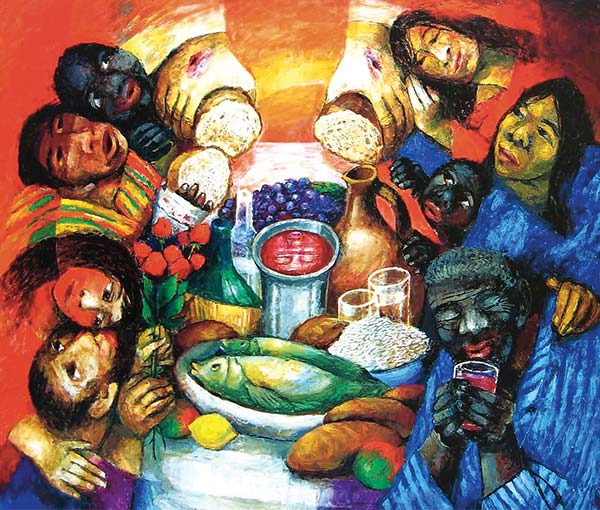
Luke 14:15-24 – The Parable of the Great Banquet

When one of those at the table with him heard this, he said to Jesus, “Blessed is the one who will eat at the feast in the kingdom of God.”

Jesus replied: “A certain man was preparing a great banquet and invited many guests. At the time of the banquet, he sent his servant to tell those who had been invited, ‘Come, for everything is now ready.’

“But they all alike began to make excuses. The first said, ‘I have just bought a field, and I must go and see it. Please excuse me.’

“Another said, ‘I have just bought five yoke of oxen, and I’m on my way to try them out. Please excuse me.’

“Still another said, ‘I just got married, so I can’t come.’

“The servant came back and reported this to his master. Then the owner of the house became angry and ordered his servant, ‘Go out quickly into the streets and alleys of the town and bring in the poor, the crippled, the blind and the lame.’

“‘Sir,’ the servant said, ‘what you ordered has been done, but there is still room.’

“Then the master told his servant, ‘Go out to the roads and country lanes and compel them to come in, so that my house will be full. I tell you, not one of those who were invited will get a taste of my banquet.’” (New International Version)

If the gospel of forgiveness in Jesus Christ is such good news, and God is so good, then why aren’t people breaking the door down to get into the Church? 

Today’s Gospel lesson gives us one reason why: They just aren’t interested. The parable Jesus told was of people, when invited to come to the great banquet, kept making one excuse after the other why they couldn’t come.

Keep in mind that Jesus wasn’t talking to sinful outsiders, but the religious insiders – they were the ones making the excuses why they could not participate. 

Let’s cut to the chase: If professing believers in Jesus Christ are not excited about the gospel… If Christians are not enthused over what they possess in the gospel… If the Church is content to go through the motions of Christianity without a concern to be with Jesus… If we are simply too busy to come and attend God’s banquet of grace…

Then, why in the world would any Christian or any Church believe that others ought to show up and be a part of their fellowship, that they would even remotely entertain a thought to profess Christ as Savior and break down the door to get into Christianity?

Jesus was offering a penetrating warning: The unresponsive religious insiders will be replaced by the responsive sinful outsiders. 

If the insiders take for granted what they possess and have better things to do, then God is going to call people who will hear, listen, and respond to the gracious invitation.

The deeply probing question for every believer in Christ today is: Are we so familiar with Jesus, and so content with the way things are that when God breaks into our lives in the form of an invitation that we refuse to respond because we are not interested in going to some stupid banquet? 

There is an incredible abundant feast for us – in fact, Jesus said that his food and drink was to do the Father’s will, that Scripture was his bread. (John 4:34) 

It’s much too easy to take the spiritual abundance of grace and mercy – as well as our physical abundance of food and water – for granted. After all,…

  • Being well-fed, it’s easy to assume that everyone else is, too.
  • Enjoying good health, it’s easy to forget that others are hurting and in pain.
  • Having money and the ability to work hard, it’s easy to think that there are not many poor people around.
  • Living around other Christians all the time, it’s natural to assume that everyone knows the gospel of Jesus – but they don’t!

In Christ’s story, the people making excuses see no real importance to take the invitation to the banquet seriously. And so, they go off to take care of their business and their family.

Like them, we can be much too busy with mundane activities to notice that people need the Lord. And then, when we get around to acknowledging that there are people who need Jesus, we keep devising ways to reach them without having to change our own lives to do it.

Jesus has no intention of calling and inviting us to a discipleship that requires no change on our part. The refusal to alter our lives to accommodate God’s invitation will result in the invitation going out to others. 

So, the master’s servant in the parable goes out into the roads and country lanes and invites any common person to come – anyone he can find.

And that is the scandal of Christ’s gospel – that the invitation to God’s abundant mercy is open to outcasts and failures, to problem people and unimpressive low-life’s, to backwater rednecks and uneducated hicks, to the jobless and the needy, to all sorts of people who are not like your circle of friends. 

People who are flawed are especially dear to Jesus, and not just people who have it all together. It’s the people who outwardly have it all together that are being replaced wholesale with those who admit their guilt, shame, and brokenness. 

Lord, have mercy. Christ, have mercy. Lord, have mercy upon us sinners.

Gracious God, forgive me for wasting time in things that just don’t matter in the scope of eternity. I choose to go out and compel outsiders to come in, so that your house will be full for the great feast at the end of the age. Through Jesus, in the power of the Holy Spirit, I pray. Amen.

Psalm 58 – Curse the Wicked

Do you rulers indeed speak justly?
    Do you judge people with equity?
No, in your heart you devise injustice,
    and your hands mete out violence on the earth.

Even from birth the wicked go astray;
    from the womb they are wayward, spreading lies.
Their venom is like the venom of a snake,
    like that of a cobra that has stopped its ears,
that will not heed the tune of the charmer,
    however skillful the enchanter may be.

Break the teeth in their mouths, O God;
    Lord, tear out the fangs of those lions!
Let them vanish like water that flows away;
    when they draw the bow, let their arrows fall short.
May they be like a slug that melts away as it moves along,
    like a stillborn child that never sees the sun.

Before your pots can feel the heat of the thorns—
    whether they be green or dry—the wicked will be swept away.
The righteous will be glad when they are avenged,
    when they dip their feet in the blood of the wicked.
Then people will say,
    “Surely the righteous still are rewarded;
    surely there is a God who judges the earth.” (New International Version)

The term “imprecatory” means to call down a curse on a person or group of people. There are eighteen imprecatory psalms within the Old Testament psalter, all of which make a clear petition for God to turn the evil back on the people who inflict it (or try to) on others. Maybe this surprises you that there is such language in the Bible.

There is nothing sanitized about imprecatory psalms. They are as raw and real as it gets, expressing deep anger. Whatever you might think about how a proper pious person ought to pray, imprecatory curses are likely not your first thought. But here they are, contained in Holy Scripture for our use.

One reason for the imprecatory psalms is that it is not any person’s place for revenge or retaliation. Instead, for people who are genuinely caught in the crosshairs of evil, for those who have awful trouble dogging them, prayer is their most effective recourse.

Sometimes you just have to tell it like it is. There is a time to do your best in putting up a good face so that you can deal with people who keep gossiping, slandering, and trying to get their way. Yet, there is also a time to call such behavior “evil” and cry out to God for help.

There are many folks who consider imprecatory psalms a problem because of their detailed expressions of cursing. Yet, such psalms refuse to put a positive spin on malevolent motives, wicked words, and destructive actions.

Desperate people utter desperate prayers. Their unflinching sense of injustice will not allow them to sugarcoat the villainous plans of corrupt people.

Evil is never toppled with tepid prayers from wimpy worshipers. Rather, nefarious agendas are thwarted in the teeth of specific, focused, and intense prayers directed with spiritual precision to the very core of diabolical forces.

We need not be shy about being real with God, even with praying imprecatory prayers. There really are people in this world, maybe even in your own life, that have malicious intent against you or others. Our job is not personal revenge, but to entrust ourselves to the God who fights for the poor, the oppressed, and the needy against the arrogant and the powerful. Let your prayers reflect your life.

With no cursing of evil, our emotional pain and spiritual anger come out sideways in an unkind sort of “snarky-ness” toward each other. What I am proposing is that our terrible hurt and our rage needs to be acknowledged and voiced.

Our bitterness must have an outlet, not directed toward one another, but toward the evil itself – and even toward God because God is big enough to handle our rage, whereas other humans are not.

Victimization needs a voice, and a bit of raging and cursing is the means to do it. Giving voice to our deep anger is cathartic and therapeutic. Our speech needs to be congruent with the intensity of our pain because where there are no valued words of assault for victims, the risk of hurting each other becomes much higher.

Despair with no voice and no one to hear will eventually transition to harming others.

Spiritual problems require spiritual implements to solve. And the imprecatory psalms are a major tool for pushing back the dark forces of this world. They are a significant means of spiritual assertiveness against heinous acts, acerbic words, systemic evil, depraved people, and horrible circumstances.

God’s wrath is an expression of God’s love because God is not okay with evil taking root in the lives and institutions of humanity.

Prayer is our privilege of coming to the God who upholds justice and righteousness. For if God is for us, who can be against us?

Hebrews 13:7-21 – Keep On Doing Good

Remember your leaders, who spoke the word of God to you. Consider the outcome of their way of life and imitate their faith. Jesus Christ is the same yesterday and today and forever.

Do not be carried away by all kinds of strange teachings. It is good for our hearts to be strengthened by grace, not by eating ceremonial foods, which is of no benefit to those who do so. We have an altar from which those who minister at the tabernacle have no right to eat.

The high priest carries the blood of animals into the Most Holy Place as a sin offering, but the bodies are burned outside the camp. And so, Jesus also suffered outside the city gate to make the people holy through his own blood. Let us, then, go to him outside the camp, bearing the disgrace he bore. For here we do not have an enduring city, but we are looking for the city that is to come.

Through Jesus, therefore, let us continually offer to God a sacrifice of praise—the fruit of lips that openly profess his name. And do not forget to do good and to share with others, for with such sacrifices God is pleased.

Have confidence in your leaders and submit to their authority, because they keep watch over you as those who must give an account. Do this so that their work will be a joy, not a burden, for that would be of no benefit to you.

Pray for us. We are sure that we have a clear conscience and desire to live honorably in every way.I particularly urge you to pray so that I may be restored to you soon.

Now may the God of peace, who through the blood of the eternal covenant brought back from the dead our Lord Jesus, that great Shepherd of the sheep, equip you with everything good for doing his will, and may he work in us what is pleasing to him, through Jesus Christ, to whom be glory for ever and ever. Amen. (New International Version)

I once rode a horse named “Old Glue.” The tired old horse got his name because he stuck to the ground like glue. I can testify firsthand that it took a furious amount of kicking to get that the old guy to move at all. 

I think about Old Glue every time I look at the final chapter of Hebrews. It feels like the author is firing off exhortation after exhortation trying to kick some life into a group of people who have lost their enthusiasm for Jesus:

  • Don’t forget about your spiritual leaders who faithfully keep watch over you and model how to live the Christian life
  • Don’t be fooled by a bunch of unfamiliar and strange gobbledygook teachings
  • Share in the disgrace of Christ by sharing in his sufferings
  • Keep offering praise to God in the name of Jesus
  • Don’t forget to help others through benevolence and generosity
  • Live a sacrificial life
  • Pray for your spiritual fathers and mothers
  • Be generous
  • Do good!

All these exhortations come kicking one after the other in a short amount of space. The reason why we ought to pay attention to them is that we were bought at the price of Christ’s blood. God has redeemed us with the ultimate price.

Let’s not allow ourselves to get fatigued doing good. At the right time we will harvest a good crop if we don’t give up or quit.

Galatians 6:9, MSG

We need to work at becoming holy and to serving with genuine Christian love as if this was the last day of our lives. 

We are to run like wild stallions for Jesus, instead of being stuck to the ground like Old Glue. 

Don’t be hateful to people, just because they are hateful to you. Rather, be good to each other and to everyone else. (1 Thessalonians 5:15, CEV)

There is no advantage to only moving when there is something in it for “me.” There is no benefit in griping and complaining. Yet there is eternal advantage in trotting along for the Savior. There’s life in following the trail outside the camp and meeting Jesus at the place of humility, disgrace, and suffering. 

After all, if it is God’s will, it’s better to suffer for doing good than for doing wrong. (1 Peter 3:17, GW)

There is no advantage to being stubborn and having to constantly be prodded into moving. However, there is joy awaiting the believer who learns to move with the unforced rhythms of grace.

Don’t be like Old Glue.

Keeping going. Keep doing good.

May Jesus help you do what pleases God. To Jesus Christ be glory forever and ever! Amen.

Luke 14:1, 7-14 – How Can I Be Blessed?

Jesus eating with “sinners.”

One Sabbath, when Jesus went to eat in the house of a prominent Pharisee, he was being carefully watched….

When he noticed how the guests picked the places of honor at the table, he told them this parable:“When someone invites you to a wedding feast, do not take the place of honor, for a person more distinguished than you may have been invited. If so, the host who invited both of you will come and say to you, ‘Give this person your seat.’ Then, humiliated, you will have to take the least important place. But when you are invited, take the lowest place, so that when your host comes, he will say to you, ‘Friend, move up to a better place.’ Then you will be honored in the presence of all the other guests. For all those who exalt themselves will be humbled, and those who humble themselves will be exalted.”

Then Jesus said to his host, “When you give a luncheon or dinner, do not invite your friends, your brothers or sisters, your relatives, or your rich neighbors; if you do, they may invite you back and so you will be repaid. But when you give a banquet, invite the poor, the crippled, the lame, the blind, and you will be blessed. Although they cannot repay you, you will be repaid at the resurrection of the righteous.” (New International Version)

A lot of people live by the old adage, “You scratch my back and I’ll scratch yours.” It’s a phrase referring to reciprocity. In other words, if you give me something I want, I will then respond by giving you something you want.

That old adage works fine, that is, unless you have no ability to give or give back to another. If we only operate by the principle of reciprocity, a large chunk of people automatically get left out. And this situation is untenable and unacceptable to Jesus.

Christ observed that the religious insiders of his day were keeping entire groups of people on the outside through their practice of scratching one another’s backs.

We need to get ahold of the reality that God loves us, as well as everyone else – even the people we may not give the time of day to. God so loved the world that he sent his Son. Jesus has come to feed us all, not just some.

Jesus eats with sinners by Sieger Köder (1925-2015)

The kingdom of God is about food. The food given by Jesus is to feed the hungry by staging a banquet. It is a feast of God’s abundance. Yet, many seem to hoard the resources they have, only thinking about their friends, family, and people just like them. They act as if there is no need to invite outsiders, consumed as they are with their own daily lives.

We have an incredible abundant feast contained in Scripture – in fact, Jesus said that his food and drink was to do the Father’s will, that Scripture was his bread. (Matthew 4:4; John 4:34) 

It’s much too easy to take our blessings of food for granted. After all, when we are well-fed, it’s easy to assume that everyone else is, too. Feeling healthy, it’s easy to forget that others are hurting. Making money, it’s easy to think there are not many poor people around. Living in a community with plenty of churches and more bibles than people, it’s natural to assume that everyone knows the gospel of Jesus – but they don’t!

Then, whenever we get around to acknowledging there are people who need Jesus, we keep devising ways to reach them without having to change or accommodate our own lives to do it.

Christ’s call to faithful discipleship requires people to change from having a narrow focus on our small circle of friends, to including those who have no means to pay us back.

Table fellowship by Sieger Köder 

The gospel of Jesus Christ is open to outcasts and failures, to problem people and unimpressive persons. People with needs and flaws are especially dear to Jesus. It’s the people who outwardly have it all together who are being replaced wholesale with those who admit their need. 

We must not be picky about who we invite to participate in the largess of abundance we possess. We are to avoid the spiritual snobbery of looking down our noses at the needy and less fortunate, who have nothing to offer us in return.

Those who give need to do so without prejudice or favoritism. Even the lazy, the fool, and the sinner still need basic resources to live. By opening our hearts in almsgiving, we open ourselves to Christ, who is present in the least of those among us.

Refusing mercy to people deemed as unworthy, givers then actually shut themselves off from the very mercy God desires for them. There is no reward from God when there is only reward from others.

“If we are going to examine lives, we will never have mercy upon any human being; rather, hindered by this inopportune meddlesomeness, we will remain fruitless and destitute of all help ourselves.”

St. John Chrysostom, On Repentance and Almsgiving

It’s not only the poor who suffer when the rich fail to give. In judging whether or not a particular person is worthy of love and aid, the wealthy person rejects the spiritual fruit that he would have received by giving with humility.

Giving to the poor, simply to relieve our own conscience, is not real charity; it doesn’t consider the other. We attend fully to the other by observing their spiritual and holistic needs for community, purpose, respect, and dignity. Dispassionate giving from a distance, without relationship, refuses to acknowledge the whole person. It exploits the poor for the mental comfort of the rich.

We need to be involved in people’s lives, and that takes a lot of blood, sweat, and tears. There are too many lost people who need Jesus – and, I may add, too many Christians who are the walking wounded and need the healing touch of Jesus – for us to pay scant attention to the call of Jesus to invite the needy into our lives. 

Seeing people come into God’s great banquet, and into a joyous and vital relationship with Christ, will likely take ten times more work than what you are thinking it does right now. Yet, this is the pathway of true blessing – to having God’s stamp of approval on our lives.

How can I be blessed? Not by posturing for the best place in the room but by being a blessing to the most vulnerable and needy amongst us.

Merciful God, thank you for the abundance of life, relationships, health, comfort, and wealth you have provided to so many. Thank you that, even in times of need, despair, and brokenness, you are there. Please, put your arms around children and families in  poverty and disability so that they feel your comfort and hope. Meet their needs both physically and spiritually. And guide me so I can be your hands and feet pursuing justice for the poor and upholding the cause of the needy, in the way of Jesus Christ our Lord. Amen.