Less Is More (Luke 17:5-10)

The apostles said to the Lord, “Increase our faith!”

He replied, “If you have faith as small as a mustard seed, you can say to this mulberry tree, ‘Be uprooted and planted in the sea,’ and it will obey you.

“Suppose one of you has a servant plowing or looking after the sheep. Will he say to the servant when he comes in from the field, ‘Come along now and sit down to eat’? Won’t he rather say, ‘Prepare my supper, get yourself ready and wait on me while I eat and drink; after that you may eat and drink’? Will he thank the servant because he did what he was told to do? So, you also, when you have done everything you were told to do, should say, ‘We are unworthy servants; we have only done our duty.’” (New International Version)

You and I do not need control. Authority and power belong to God. And we are not God.

You and I need faith. And, since we belong to God, who is the ultimate authority and controls all things, we already have it.

You already have what you need: Jesus. There is no need to hustle and cajole for something you do not need.

Jesus tells his disciples two parables designed to reorient their thinking and their lives around God, and not around the typical worldly tools of power and authority.

We find self-control something very hard. We’d rather have plain old control.

In the 1990s, The Department of Transportation set aside $200 million dollars for research and testing of an automated Highway System. The plan was that this system would relieve traffic problems by placing all cars that entered the highway on “super cruise control,” allowing them to move in unison as they traveled in heavily congested cities.  

Such travel would be made possible by using special magnets embedded in the asphalt every four feet, which would transfer signals between the vehicles and a main computer system.  

Steering, acceleration and braking would be controlled by sensors, computer navigation systems and cameras along the side of the road. Control would be returned to drivers as they exited the highway.  According to the technology manager of the project, “The only thing we can’t do yet is get people to comfortably trust the system. It’s not a technology issue.”

The grace of God in Jesus Christ is our fail-safe system designed to put us in “super cruise control” when dealing with circumstances and relating to people. There is just one difficulty with the system: Getting people to comfortably trust it.

The real problem is that we prefer to retain control of life’s steering wheel, even though it is this tendency that drives us to discontentment and endless relational conflict. Rather than insisting on doing life our way, we need Jesus to take the wheel.

And the irony to all this is that we already have what we so desperately seek.

Just a little bit of Jesus makes a large impact on the world.

            Our Lord’s entire kingdom movement looked as insignificant as a mustard seed. Christ’s little band of disciples were, at best, a motley crew of very human characters who vacillated between faith and doubt; they spent as much time arguing amongst themselves as they did engaging in ministry. Yet, it was these same people who ended up turning the world upside-down.

            The insignificant and small looking mustard seed eventually becomes a world-sheltering tree. In the same way, a barbaric, bloody, seemingly insignificant cross became the means of changing the world.

            We, even though imperfect and small, can become, with Jesus in us, a healing force for the world. Little is much when God is in it. Although Gideon believed he needed to be in charge of a large army to defeat Israel’s enemies, God whittled his soldiers down to just 300, against a force described as an army with men as many as the sand on the seashore. Victory was no problem. Gideon already had what he needed: God. (Judges 7:1-25)

Never underestimate the potency of our little bit of ministry with Jesus animating it. Our…

Kind words spoken in the name of Jesus…

Hidden prayers uttered silently behind closed doors…

Secret giving in which the right hand doesn’t know what the left is doing…

Gentleness in the face of violence…

Humility in the midst of pride…

Mercy given instead of judgment…

Peacemaking wherever frustration exists…

These and so much more, when energized by Jesus, becomes a mighty force for good and change in this old fallen world.

Yet so many Christians think they need all kinds of power, authority, and control – then mountains can be moved, trees uprooted, and things can happen.

With this misguided notion, we too easily succumb to the temptations of winning success, spinning a superior self-image, and pinning down power to get what we want and need.

However, we already have what we need, Jesus, and we do not need what he has – power and authority; we just need him.

The Lord Jesus has shown us the way in this. In Christ’s incarnation, he emptied himself and became like one of us – eschewing the typical power dynamics of the world. At the beginning of his ministry, Jesus spends 40 days in the desert fasting – making himself empty.

And at the end of that time, the devil came to Christ and tempted him in the very same ways we are tempted (Matthew 4:1-11):

Satan: “You need to be successful.”

Jesus: “Nope, don’t need that.”

Satan: “Well, you definitely need to be on the right religious track.”

Jesus: “Get out of my face. I don’t need to play that game.”

Satan: “It’s simple. You can do your Father’s will with the tools of power I have.”

Jesus: “I’m not going there. I don’t need your sort of help.”

In submitting to his Father’s plan and will, Jesus showed us the way to live as his followers.

We, too, have to stare the same three temptations in the eye: the belief that I need to be successful, to be right, and to have everything under control.

The truth, however, is just the opposite. In actuality, we need to be poor in spirit, powerless,  and humble – not full of strength and control.

Jesus said, “My grace is sufficient for you, for my power is made perfect in weakness.” And Paul responded, “Therefore, I will boast all the more gladly about my weaknesses, so that Christ’s power may rest on me. That is why, for Christ’s sake, I delight in weaknesses, in insults, in hardships, in persecutions, in difficulties. For when I am weak, then I am strong.” (2 Corinthians 12:9-10, NIV)

In reality, we need to be open and vulnerable – not spinning a self-image which projects strength, authority, and power.

 In your relationships with one another, have the same mindset as Christ Jesus:

Who, being in very nature God,
    did not consider equality with God something to be used to his own advantage;
rather, he made himself nothing
    by taking the very nature of a servant,
    being made in human likeness.
And being found in appearance as a man,
    he humbled himself
    by becoming obedient to death—
        even death on a cross! (Philippians 2:5-8, NIV)

We need to be meek and gentle – just like our Lord – not puffing our chests out with a show of strength and authority.

Jesus said, “Come to me, all you who are weary and burdened, and I will give you rest.Take my yoke upon you and learn from me, for I am gentle and humble in heart, and you will find rest for your souls. For my yoke is easy and my burden is light.” (Matthew 11:28-30, NIV)

Less is truly more. Only those who have nothing to prove and nothing to protect can receive Christ. And Jesus himself will lead us on this path of self-emptying.

We already have Jesus. Therefore, we already have everything we need. Even a smidgeon of Christ is more than enough for us. What we may think we need – to win at success, to spin a narrative of rightness, and to pin down control through power and authority – amounts to nothing in the kingdom of God.

Instead, what we really need is to walk in the way of Jesus – to be weak through self-emptying, to leak out our pride and embrace humility and vulnerability, and to be meek by having a gentle spirit.

Being a servant is a good thing. And being a servant of the Lord Jesus Christ – the author and perfecter of our faith – is the only vocation we need. With Jesus, less is more.

Almighty and everlasting God, we are far too often influenced by what others think of us. We pretend to be in control, with it, in charge, and strong. Prevent us from trying to attract attention. Don’t let us gloat over praise on one hand or be discouraged by criticism on the other. Nor let us waste time weaving imaginary situations in which the most heroic, put together, and powerful person present is me. Rather, show us how to be humble of heart, just like your Son, our Lord, Jesus Christ, who with you and the Holy Spirit are one God, now and forever. Amen.

How Can I Move Through My Grief? (Lamentations 1:7-15)

The Lamentations of Jeremiah by Marc Chagall (1887-1985)

Her people recall the good life
    that once was theirs;
now they suffer
    and are scattered.
No one was there to protect them
from their enemies who sneered
    when their city was taken.

Jerusalem’s horrible sins
    have made the city a joke.
Those who once admired her
    now hate her instead—
she has been disgraced;
    she groans and turns away.

Her sins had made her filthy,
but she wasn’t worried
    about what could happen.
And when Jerusalem fell,
    it was so tragic.
No one gave her comfort
    when she cried out,
“Help! I’m in trouble, Lord!
    The enemy has won.”

Zion’s treasures were stolen.
Jerusalem saw foreigners
    enter her place of worship,
though the Lord
had forbidden them
    to belong to his people.

Everyone in the city groans
    while searching for food;
they trade their valuables
for barely enough scraps
    to stay alive.

Jerusalem shouts to the Lord,
“Please look and see
    how miserable I am!”
No passerby even cares.
Why doesn’t someone notice
    my terrible sufferings?
You were fiercely angry, Lord,
and you punished me
    worst of all.
From heaven you sent a fire
    that burned in my bones;
you set a trap for my feet
    and made me turn back.
All day long you leave me
    in shock from constant pain.
You have tied my sins
    around my neck,
and they weigh so heavily
    that my strength is gone.
You have put me in the power
    of enemies too strong for me.

You, Lord, have turned back
my warriors and crushed
    my young heroes.
Judah was a woman untouched,
but you let her be trampled
    like grapes in a wine pit. (Contemporary English Version)

“The darker the night, the brighter the stars. The deeper the grief, the closer is God.”

Fyodor Dostoevsky

The only way to the mountain is through the valley. The only way to make the pain go away is to move through it – not by avoiding it, pretending it’s not there, or trying to move around it. Pain and suffering are inevitable; misery is optional.

The reality is that, when experiencing catastrophic loss, you and I will grieve forever. We shall never “get over” it; we only learn to live with it.

Yes, I do believe there is spiritual and emotional healing. Significant change and grinding loss doesn’t need to define who we are. We can rebuild ourselves around the loss we have suffered.

Yes, you and I will be whole again. However, we shall never ever be the same again. It isn’t possible – nor should it be.

The prophet Jeremiah, the exiles in Babylon, and the remaining people of Jerusalem faced a tremendous and heartbreaking adjustment to a new world full of changes and losses. Expressing that grief was central to not becoming stuck in the past, living in the here and now, and moving into the future.

Grief is the normal mental, emotional, spiritual, and/or physical response to any significant change or loss. Grief is not optional but necessary. It is our personhood’s way of facing the pain and moving through it to a place of finding renewed meaning, support, and purpose in life.

How do people move through the grief?

  • Community: Grief needs a witness. It must be expressed. We must tell our stories of life, love, and loss. Otherwise, the grief just sits unmoved deep within and eventually becomes gangrene of the soul.

Help carry each other’s burdens. In this way you will follow Christ’s teachings.

Galatians 6:2, GW
  • Connection: Grief doesn’t so much go away as it morphs into fond memories of remembrance through ritual behavior.

Then Jesus took a loaf of bread, and when he had given thanks he broke it and gave it to them, saying, “This is my body, which is given for you. Do this in remembrance of me.” (Luke 22:19, NRSV)

  • Character: No one is defined by their grief, their disease, their mental disorder, their disability, or their addiction. In many religious traditions, people are identified as carrying the image and likeness of G-d.

God knew what he was doing from the very beginning. He decided from the outset to shape the lives of those who love him along the same lines as the life of his Son. The Son stands first in the line of humanity he restored. We see the original and intended shape of our lives there in him.

After God made that decision of what his children should be like, he followed it up by calling people by name. After he called them by name, he set them on a solid basis with himself. And then, after getting them established, he stayed with them to the end, gloriously completing what he had begun. (Romans 8:29-30, MSG)

  • Care: Practice caring for yourself. Give yourself the grace and the permission to be happy… or sad… or angry – to feel what you need to feel. Treat yourself like you would treat your best friend.

Jesus said, “Come to me, all you who are struggling hard and carrying heavy loads, and I will give you rest. Put on my yoke and learn from me. I’m gentle and humble. And you will find rest for yourselves. My yoke is easy to bear, and my burden is light.” (Matthew 11:28-30, CEB)

  • Compare not: Please do not compare your grief and loss with anyone else’s. The truth is this: The absolute worst loss is your loss, not somebody else’s.

The Lord is close to the brokenhearted and saves those who are crushed in spirit. (Psalm 34:18, NIV)

  • Count: Count your wins. Count your blessings. Say them out loud. Write them down. Share them with a friend or loved one.

Bless the Lord, O my soul,

    and forget not all his benefits,

who forgives all your iniquity,

    who heals all your diseases,

who redeems your life from the pit,

    who crowns you with steadfast love and mercy. (Psalm 103:2-4, ESV)

Sometimes, prayer is the only possible way forward. Maybe the Lord will once again hear us and respond, as of old:

“I have surely seen the affliction of my people… I have heard their cry… for I know their sorrows.” (Exodus 3:7, NET)

May the presence of the Lord melt your fear and discouragement. May God strengthen and help you. May the Lord lift you and hold you in gracious and compassionate hands. Amen.

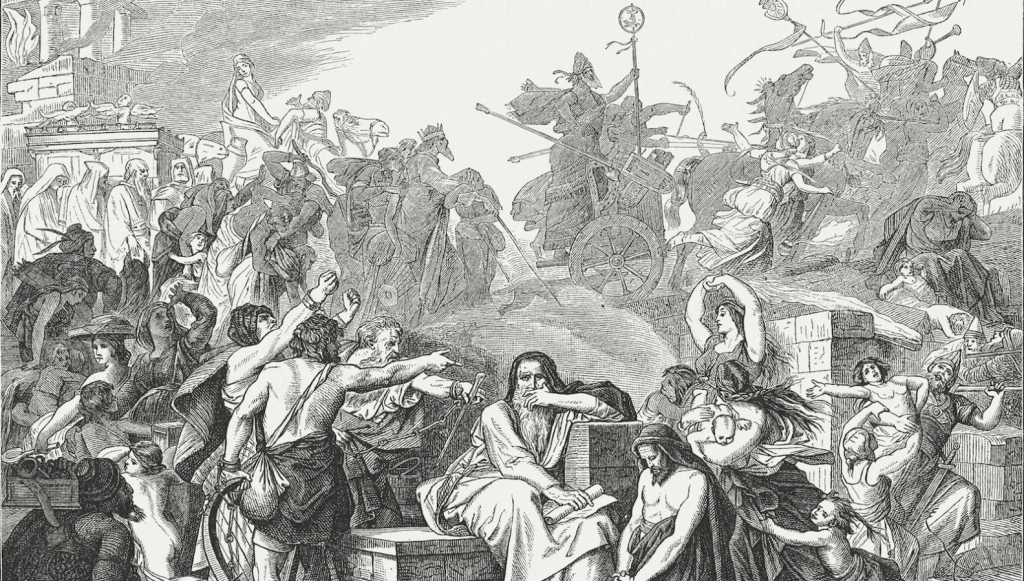
Exiled (Jeremiah 52:12-30)

The Babylonian Exile by Jewish-German painter Eduard Bendemann (1811-1889)

In the nineteenth year of Nebuchadnezzar king of Babylon on the seventh day of the fifth month, Nebuzaradan, the king of Babylon’s chief deputy, arrived in Jerusalem. He burned the Temple of God to the ground, went on to the royal palace, and then finished off the city. He burned the whole place down. He put the Babylonian troops he had with him to work knocking down the city walls. Finally, he rounded up everyone left in the city, including those who had earlier deserted to the king of Babylon, and took them off into exile. He left a few poor dirt farmers behind to tend the vineyards and what was left of the fields.

The Babylonians broke up the bronze pillars, the bronze washstands, and the huge bronze basin (the Sea) that were in the Temple of God and hauled the bronze off to Babylon. They also took the various bronze-crafted liturgical accessories, as well as the gold and silver censers and sprinkling bowls, used in the services of Temple worship. The king’s deputy didn’t miss a thing. He took every scrap of precious metal he could find.

The amount of bronze they got from the two pillars, the Sea, the twelve bronze bulls that supported the Sea, and the ten washstands that Solomon had made for the Temple of God was enormous. They couldn’t weigh it all! Each pillar stood twenty-seven feet high with a circumference of eighteen feet. The pillars were hollow, the bronze a little less than an inch thick. Each pillar was topped with an ornate capital of bronze pomegranates and filigree, which added another seven and a half feet to its height. There were ninety-six pomegranates evenly spaced—in all, a hundred pomegranates worked into the filigree.

The king’s deputy took a number of special prisoners: Seraiah the chief priest, Zephaniah the associate priest, three wardens, the chief remaining army officer, seven of the king’s counselors who happened to be in the city, the chief recruiting officer for the army, and sixty men of standing from among the people who were still there. Nebuzaradan the king’s deputy marched them all off to the king of Babylon at Riblah. And there at Riblah, in the land of Hamath, the king of Babylon killed the lot of them in cold blood.

Judah went into exile, orphaned from her land.

3,023 men of Judah were taken into exile by Nebuchadnezzar in the seventh year of his reign.

832 from Jerusalem were taken in the eighteenth year of his reign.

745 men from Judah were taken off by Nebuzaradan, the king’s chief deputy, in Nebuchadnezzar’s twenty-third year.

The total number of exiles was 4,600. (The Message)

The Babylonian Exile by Fahri Aldin, 2017

Eventually, God’s words and decrees happen. It may take minutes. It might take centuries. But it will happen.

God promised destruction. It happened. The temple, the city walls, and the houses of Jerusalem were destroyed.

God decreed deportation of the people. It happened. Thousands of Jews were uprooted and moved to Babylon.

God foretold depression. It happened. The social and economic system of Judah collapsed.

God said there would be an occupation of Gentiles. It happened. The occupying force seized and confiscated the holy temple articles. They violated that which was sacred to Judah.

God repeatedly told the people that there would be a reckoning for the years of social injustice and religious infidelity. It happened. There was not just a deportation of persons; there were waves of removal.

The long prophecy of Jeremiah began with a proclamation of exile. It moved toward that exile. And then, in the end, the exile became reality.

Surely, it must have seemed to the citizens of Jerusalem that the end of the world was at hand. Their very identity as God’s people, as they had understood it for centuries, was now obliterated. Who are they now?

The Jewish exile changed forever their understanding of themselves and of God because they needed to reimagine what being the people of God really means without a place and without a temple.

God is both subject and object of all Holy Scripture, including the book of Jeremiah. Perhaps neglected in all the talk of exile is that the Lord was also cast-off, put away, and exiled. And rather than this being bad news, it becomes the good news that divine presence was right alongside the exiles.

In our darkest times, in the worst of circumstances, when all seems hopeless – there is a God who shows such solidarity with us that he is crucified and put to death so that we might live.

The Lord does not stand afar off from us but is beside us, even within us.

The sheer violation and agony of Good Friday and the depressive silence of Holy Saturday are the means of demonstrating the power of resurrection and new life.

We may be deported, depressed, and destroyed – exiled to a place we do not know and do not want to be. Yet, that is not the end of the story.

Exile is temporary. Mercy is forever. There cannot be a resurrection without a death. There must be suffering before there is glory.

Love wins. Every time.

God is Love. Thus, there is always hope….

Lament Your Losses (Lamentations 3:19-26)

“The Lamentations of Jeremiah,” a woodcut by Julius Schnorr von Carolsfeld (1794-1872)

I remember my affliction and my wandering,
    the bitterness and the gall.
I well remember them,
    and my soul is downcast within me.
Yet this I call to mind
    and therefore I have hope:

Because of the Lord’s great love, we are not consumed,
    for his compassions never fail.
They are new every morning;
    great is your faithfulness.
I say to myself, “The Lord is my portion;
    therefore I will wait for him.”

The Lord is good to those whose hope is in him,
    to the one who seeks him;
it is good to wait quietly
    for the salvation of the Lord. (New International Version)

“Through the prism of my tears I have seen a suffering God. It is said of God that no one can behold his face and live. I always thought this meant that no one could see his splendor and live. But I have come to see that it more likely means that no one can see his sorrow and survive.”

Nicolas Wolterstorff, Lament for a Son

None of us gets off this planet without experiencing terrible grief. It is endemic to the human condition.

Grief attaches itself to any significant change or loss – bereavement, divorce, surgery, losing a job, bankruptcy, and so much more – bring grief to our lives. They are unwanted events we did not ask for. 

The worst response to grief-producing events is to ignore them, minimize them, say they are simply in the past, stuff the feelings down, and just move on.

It’s actually unbiblical to respond that way because Holy Scripture discerns that we need to lament our losses.

Lamentations is an entire book of the Bible given to a single purpose: lamenting a grievous loss.

The prophet Jeremiah was called by God to pronounce judgment against Jerusalem. Not only was Jeremiah commissioned to proclaim an unpopular message, but he was also given a promise that the people would not listen to him. Jerusalem would be destroyed. The people sent into exile. This only compounded Jeremiah’s sadness with complicated grief.

Jeremiah is a melancholy messenger who preached exactly what the Lord wanted him to preach. God’s words came true. The people did not turn from their empty worship and wayward lifestyles. And they persecuted Jeremiah for speaking words of judgment.

The Babylonians came and tore down the walls of Jerusalem, decimated the city and the temple, and carried off the people into exile.

In his terrible grief over the ruined city of Jerusalem, Jeremiah wept and lamented the loss of his hometown and the temple.

It was only after an extended time of grieving that Jeremiah turned his attention toward the love of God. The Lord’s compassions become new every morning. And the renewal will happen without Jerusalem at the center of Jewish life.

Cheap hope tries to circumvent grieving and lamenting of loss. Genuine hope knows the true path of renewal is through the grief, not around it.

There are two popular phrases in Western culture that need to be jettisoned altogether when speaking with people experiencing change or loss. These phrases, at the least, are not helpful; and, at worst, are harmful:

  1. “Get over it!” can short circuit the grief process and puts grieving people in the awkward position of not seeing the power of lament through to its end of acceptance, resolution, and fresh hope. Far too many people in the world, and even the church, remain stuck in some stage of grief, unable to effectively move through it because others expect them to be joyful and victorious; but they really feel downright awful – and now also feel guilty for being sad.
  2. “You have to be strong!” is typically said to people who are in a state of weakness. But they can’t be strong. We would never think of telling someone with broken bones to have the strength to walk or even drive anywhere without assistance. We understand they need to heal. Yet, we tell this to people with broken spirits, and then can’t understand why they don’t just bounce back from their emotional stupor. Broken spirits and broken hearts, like broken bones, need time to heal.

Lament is the pathway to knowing compassion and becoming a compassionate person, like Jesus. Wallpapering over our losses without lamenting them is at the root of many, if not most, emotional problems today. 

“Catastrophic loss by definition precludes recovery.  It will transform us or destroy us, but it will never leave us the same….  I did not get over my loved ones loss; rather I absorbed the loss into my life until it became part of who I am. Sorrow took up permanent residence in my soul and enlarged it.”

Jerry Sittser, A Grace Disguised: How the Soul Grows Through Loss

We all accumulate losses over the course of a lifetime. Many are small losses; some are devastating losses. The death of children, disability, sexual assault, abuse, cancer, infertility, suicide, and betrayal are all examples of crushing loss – losses that need to experience lament. 

All these changes are irreversible; we cannot return to how things once were. We must move through the grief by lamenting each loss. And as we lurch ahead, we cling to the words of Jeremiah. Because of the Lord’s great love, we are not consumed and swallowed whole from grief, for his compassions never fail. They are new every morning. Great is God’s faithfulness.

So, how do we lament our losses in a healthy way?

  1. Remember our afflictions and losses. Avoid superficial responses to significant events. Acknowledge, own, and feel the pain of the loss. This is the path to realizing new life.
  2. Pay attention to faith, hope, and love. This can only be done if we are alert to the grief process. Elizabeth Kubler-Ross identified five stages of grief: denial, anger, bargaining, depression, and resolution or acceptance. We rarely move neatly through each stage. The important thing is that we get to the place of seeing God’s committed love to us, not just in spite of the suffering, but because of it.
  3. Do not minimize your pain and suffering. We must sit with our pain. Do not dismiss your loss by saying others have it worse, or that it’s nothing. Year after year, many Christians do not confront the losses of life, minimizing their failures and disappointments. The result is a profound inability to face pain. And it has led to shallow spirituality and an acute lack of compassion.
  4. Know that Jesus grieved. Messiah is a man of sorrows and acquainted with grief. (Isaiah 53:3) At the tomb of Lazarus, Jesus did not say “Come on everyone, stop all this crying” but wept with the people. (John 11:35) When entering Jerusalem, Jesus did not say “too bad guys, I’m moving on without you” but lamented over the city desiring to gather them as a hen does her chicks. (Luke 13:34) On the cross, Jesus did not say “Lighten up everyone; God is good; he will be victorious!” But instead said, “My God, my God, why have you forsaken me?” (Matthew 27:46) Holy Scripture tells us that Jesus learned obedience from what he suffered. (Hebrews 5:8)

Grief and lament is an indispensable part of a full-orbed spirituality and essential for emotional health.

Life does not always make sense. There is deep mystery to the ways of God. The Lord is doing patient and careful work inside of each one of us. While he is busy within our souls, we will likely feel lost and disconnected, not seeing the full tapestry of what he is creating. Weariness, loneliness, a sense that prayers are not being heard, and a feeling of helplessness are all common experiences of God’s resetting a broken spirit.

John Milton’s classic piece of literature, Paradise Lost, compares the evil of history to a compost pile – a mixture of decaying food, animal manure, dead leaves, and whatever else you put on it. Yet, if you cover the compost with dirt, after a long while it no longer smells. The soil becomes a rich natural fertilizer and is ideal for growing a garden. 

We must be willing to wait, in some cases, years. Milton’s point was that the worst events of history and the evil we experience are compost in God’s overall plan. Out of the greatest wrong ever done, the betrayal, crucifixion, and death of Jesus, came the greatest good – God transformed the stench of evil into good without diminishing the awfulness of that evil.

People who have submitted to grief and lamented their losses are:

  • Patient with others and able to wait on God
  • Kind and compassionate
  • Lack pretense and have no need to impress others
  • Comfortable with mystery and don’t need all the answers
  • Humble, gentle, and meek
  • Able to see God in the mundane, banal, and lowly
  • At home with themselves and with God
  • Equipped to love others as Jesus did

Maybe we are always running, working, and playing because we are constantly trying to keep grief from catching up to us.

Slow down. Let grief catch you. Express lament. Allow grief and lament to do its deep and powerful work within you, to the glory of God. Amen.