What’s On Your Wish List? (Acts 26:24-29)

Before Paul finished defending himself, Festus shouted, “Paul, you’re crazy! Too much learning has driven you out of your mind.”

But Paul replied, “Honorable Festus, I am not crazy. What I am saying is true, and it makes sense. None of these things happened off in a corner somewhere. I am sure that King Agrippa knows what I am talking about. That’s why I can speak so plainly to him.”

Then Paul said to Agrippa, “Do you believe what the prophets said? I know you do.”

Agrippa asked Paul, “In such a short time do you think you can talk me into being a Christian?”

Paul answered, “Whether it takes a short time or a long time, I wish you and everyone else who hears me today would become just like me! Except, of course, for these chains.” (Contemporary English Version)

The Apostle Paul was quite the guy – a zealous, indefatigable, intense, Type-A dude. Yet it wasn’t those characteristics that Paul wanted others to see in him. He simply desired others to see Christ in him. 

Having been arrested for preaching the good news of forgiveness and new life in Jesus Christ, Paul found himself before King Agrippa, engaging in a DTR (define the relationship) talk; and making a strong apologetic for the Christian faith. 

Agrippa asked Paul, “In such a short time do you think you can talk me into being a Christian?” Paul answered with confidence and conviction, “Whether it takes a short time or a long time, I wish you and everyone else who hears me today would become just like me!” 

“Trial of the Apostle Paul” by Nikolai Bodarevsky, 1875

I wonder how many of us could boldly say the same thing as Paul. 

Are we the sort of Christians that others could emulate? 

Has our faith journey led us to the place of being a solid model of what a follower of Christ should look like? 

Do we expect others to change while avoiding change ourselves? 

Do we deeply desire and work toward others coming to know Jesus? 

So, what is on your wish list?

  • I wish each Christian everywhere would spend their relational and emotional energy making this world a better place by living into the words and ways of Jesus Christ.
  • I wish every person I encounter would have the privilege of knowing Christ as I have.
  • I wish all my parishioners and patients would become what I am, except, of course, for my self-made chains.

Perhaps we all must look in the mirror and examine our true desires. It’s easy to put our energy into good yet lesser wishes in life. Yet, if Christians are to become like their ancient forefather in the faith, the Apostle Paul, we will begin focusing our energies into things such as the following:

  • Making outreach a priority. We do what is most important to us. That’s probably self-evident. But churches and believers that do not make outreach a primary priority are really making it no priority, at all.

Paul said, “Do the work of telling the Good News. Do all the duties of a servant of God.” (2 Timothy 4:5, ERV)

  • Mentoring others into the words and ways of Jesus. Many church laypersons believe that training other Christians is what we pay the clergy to do.But this is really the responsibility of every believer.

Paul said, “You have often heard me teach. Now I want you to tell these same things to followers who can be trusted to tell others.” (2 Timothy 2:2, CEV)

  • Taking responsibility for spreading the good news. Blaming and shaming gets us nowhere. Pastors complain about churches. Churches bellyache about Pastors. And both attack the culture, the denomination, or some other external scapegoat. It’s time for all of us to own what needs to be said and done.

Paul said, “Be ready to spread the word whether or not the time is right. Point out errors, warn people, and encourage them. Be very patient when you teach.” (2 Timothy 4:2, GW)

  • Connecting prayer with telling the message of Christ. It doesn’t take a lot of energy to pray for Aunt Mable’s bunions to go away. It’s altogether another thing to pray sustained, focused, and passionate prayers for the people in my life to know Christ and him crucified, risen, ascended, and coming again.

Paul said, “Don’t forget to pray for us, that God will open doors for telling the mystery of Christ… Pray that every time I open my mouth I’ll be able to make Christ plain as day to them.” (Colossians 4:3-4, MSG)

  • Being compassionate and kind, like Christ, to others. There not only needs to be a clear articulation of the gospel, but also a clear demonstration of basic human kindness. Many Christians never get the opportunity to share the gospel because they’re just downright obnoxious.

Set Christ apart as Lord in your hearts and always be ready to give an answer to anyone who asks about the hope you possess. Yet do it with courtesy and respect, keeping a good conscience. (1 Peter 3:15-16, NET)

  • Establishing every Christian ministry as an opportunity to share the gospel. Intentional effort and energy toward proclaiming the gospel in both word and deed needs to go into everything we do.

Paul said, “So take special care how you conduct yourselves. Don’t be unwise but be wise. Make use of any opportunity you have because these are wicked times we live in.” (Ephesians 5:15-16, NTE)

  • Caring, not at all, that new Christians will change our lives or our church too much. I’m serious. I’ve heard the line many times by church folk in my years of pastoral ministry that new believers come in and change things we like. Come on, man. Get over it. Change is built into the Christian experience. God said:

I am about to do a new thing; now it springs forth; do you not perceive it? I will make a way in the wilderness and rivers in the desert. (Isaiah 43:19, NRSV)

You don’t need a personality like the Apostle Paul to live into your calling as a Christian. You and I only need to put our will and energy into things that matter most to God.

Risen and ascended Lord, you are the king of all creation. May your rule and reign take over my life to such a degree that everything that comes out of my mouth, and every action I take would be worthy of emulation in your way of love. Amen.

Give Thanks and Praise (Luke 17:11-19)

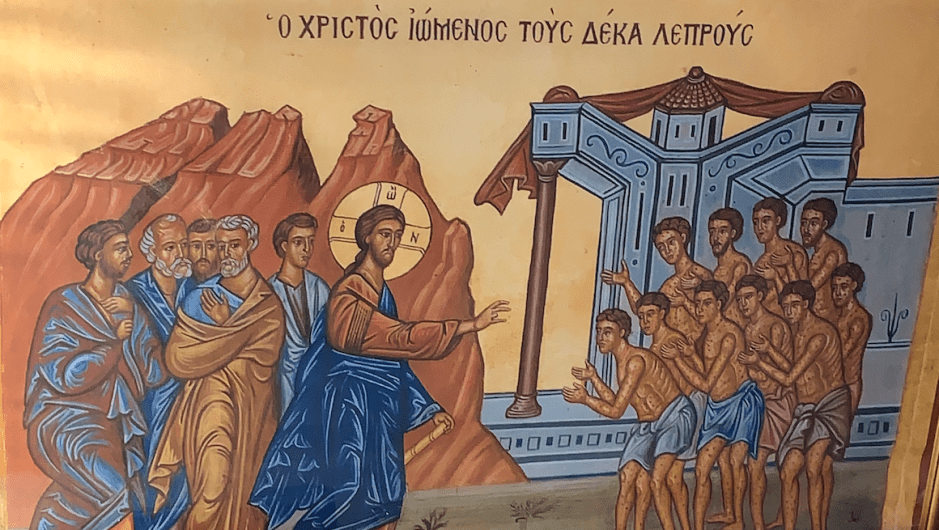
Eastern Orthodox depiction of Jesus Christ healing the ten lepers

Now on his way to Jerusalem, Jesus traveled along the border between Samaria and Galilee. As he was going into a village, ten men who had leprosy met him. They stood at a distance and called out in a loud voice, “Jesus, Master, have pity on us!”

When he saw them, he said, “Go, show yourselves to the priests.” And as they went, they were cleansed.

One of them, when he saw he was healed, came back, praising God in a loud voice. He threw himself at Jesus’ feet and thanked him—and he was a Samaritan.

 Jesus asked, “Were not all ten cleansed? Where are the other nine? Has no one returned to give praise to God except this foreigner?” Then he said to him, “Rise and go; your faith has made you well.” (New International Version)

Today’s Gospel story is both joyous and sad. The healing of ten lepers is astonishing and elicits praise and thanks… from only one. Maybe it’s because they stood at a distance. After all, it’s a close connection to God which causes praise and gratitude to arise within us – and not some appreciation from afar. Therefore, methinks we ought to consider what the nature of our own connection is. 

“Thanksgiving” to most Americans is Thanksgiving Day – a holiday filled with food, football, and family, the trifecta of American celebration. I myself admit to liberally indulging in all three. Although Thanksgiving has become a form of secular liturgical worship, I believe that underneath all the gravy, naps at halftime, and the occasional obnoxious relative, we know why we celebrate: To praise God and give thanks for our abundant blessings. 

It seems that even those who do not readily acknowledge the Divine intuitively know there is a power and source of blessing well beyond themselves which makes all good things occur.

Celebrations are a spiritual activity. God invented parties. When Israel was preparing for a new national life in the Promised Land, God told them to celebrate the Feast of Harvest with the first fruits of the crops (Exodus 23:16). The Levitical law prescribed how to go about giving thanksgiving offerings and offering praise (Leviticus 7:11-34).

Gratitude and praise was commanded, expected, and an important dimension of Old Testament worship. King David established a group of 288 full-time musicians to do nothing but praise and give thanks before God day and night (1 Chronicles 25).

Let us come into his presence with thanksgiving; let us make a joyful noise to him with songs of praise!

Psalm 95:2, NRSV

Enter his gates with thanksgiving
    and his courts with praise.
    Give thanks to him; bless his name.

For the Lord is good;
    his steadfast love endures forever
    and his faithfulness to all generations. (Psalm 100:4-5, NRSV)

It ought to have been reflexive for all ten lepers healed by Jesus to offer their worship to Jesus. A Samaritan, considered by many of the time as the lowliest of the low, a “half-breed,” was the lone person who came and fell at Christ’s feet with effusive praise and heartfelt gratitude. While the other nine went about their lives, free from disease and glad for it, only one guy took the time to thank Jesus and give glory to God. 

The Samaritan leper alone gives thanks to Christ, by Unknown artist

Sometimes we need to be reminded that celebration is a spiritual practice. It’s important to celebrate Jesus and for the ways God has provided and blessed us. In Holy Scripture, it is often the homeless, the sick, the lowly, and the outsiders who lead the way and demonstrate what genuine praise and honest thanksgiving looks like.

We, the Church, who belong to God and possess the Spirit, are to always remember and be mindful of what we truly have in Jesus Christ:

So then, just as you received Christ Jesus as Lord, continue to live your lives in him, rooted and built up in him, strengthened in the faith as you were taught, and overflowing with thankfulness. (Colossians 2:6-7, NIV)

We, like King David of old, are to establish continual worship of God:

Rejoice always, pray continually, give thanks in all circumstances; for this is God’s will for you in Christ Jesus.

1 Thessalonians 5:16-18, NIV

Our sacrifice as Christians is not with the blood of animals but with our lips and our lives:

Through Jesus, therefore, let us continually offer to God a sacrifice of praise—the fruit of lips that openly profess his name. (Hebrews 13:15, NIV)

And the worship service is eternal; it will never end:

And the twenty-four elders, who were seated on their thrones before God, fell on their faces and worshiped God, saying:

“We give thanks to you, Lord God Almighty,
    the One who is and who was,
because you have taken your great power
    and have begun to reign.” (Revelation 11:16-17, NIV)

Praising God and giving thanks to the Lord go together like mashed potatoes and gravy. Since God created everything, and since Jesus has brought healing to us through the cross, every juicy morsel of goodness we have is to be received with the full cognizance that God is behind it all.

Our lives need to be punctuated with times of celebration, praise, gratitude, and even blowout parties. Otherwise, we become dull, boring, lifeless, and bereft of Christ’s lifeblood coursing through our spiritual veins. A joyous and raucous group of healed believers jabbering incessantly with thanksgiving of God’s goodness are winsome and peculiar (in a good way and not in the strange way of your weird uncle who wants the turkey neck to gnaw on at the Thanksgiving meal).

Seems to me that Christians really ought to be at the forefront of having maximum fun because we are forgiven people; we know and experience the presence of God; our lives are hidden with God in Christ; we are confident and can approach the throne of God with boldness; and we possess the power of the Spirit and the shepherding ministry of Jesus.

Remember to give thanks. Plan to praise – out loud and with others – for the God who stands behind every good gift of creation. Let thanksgiving (not complaint) shape your life. Be the person who comes back to Jesus and offers praise and gratitude – and see how such gratefulness and glory can change the world.

Gracious God, Father of all mercies, we your unworthy servants give you humble thanks for all your goodness and steadfast love to us and to all whom you have made. We bless you for our creation, preservation, and all the blessings of this life; but above all praise you for your immeasurable love in the redemption of the world by our Lord Jesus Christ; for the means of grace, and for the hope of glory.

Give us such an awareness of your mercies, that with truly thankful hearts we may show forth your praise, not only with our lips, but in our lives, by giving up ourselves to your service, and by walking before you in holiness and righteousness all the days of our lives, through Jesus Christ our Lord, who with you and the Holy Spirit, be honor and glory throughout all ages and forevermore. Hallelujah! Amen!

Jesus: Introvert or Extrovert? (Luke 5:12-16)

A 4th century mural of Jesus from the Catacomb of Commodilla, Rome, Italy

While Jesus was in one of the towns, a man came along who was covered with leprosy. When he saw Jesus, he fell with his face to the ground and begged him, “Lord, if you are willing, you can make me clean.”

Jesus reached out his hand and touched the man. “I am willing,” he said. “Be clean!” And immediately the leprosy left him.

Then Jesus ordered him, “Don’t tell anyone, but go, show yourself to the priest and offer the sacrifices that Moses commanded for your cleansing, as a testimony to them.”

Yet the news about him spread all the more, so that crowds of people came to hear him and to be healed of their sicknesses. But Jesus often withdrew to lonely places and prayed. (New International Version)

Occasionally, I ask fellow clergy colleagues this question: “Was Jesus an introvert, or an extrovert?”

Let me be clear that extroversion and introversion are neither sinful nor blessed – they both are personality traits that cannot be changed any more than tiger stripes. That’s important to state upfront because some clergy make it about personal choices instead of inherent brain wiring.

So, setting aside the anti-reality kooky answers to my question, I’ve found that extroverted pastors, almost without fail, tell me Jesus was an extrovert. And they make a solid case for it. 

Conversely, with solid consistency, introverted pastors tell me Jesus was an introvert. And they give compelling reasons for it, as well. 

I believe the answer to my own question is that both are correct. Jesus, as the perfect human, displays the best of both extroversion and introversion. And Christ’s personality comes through wonderfully in today’s Gospel lesson.

This short story of healing begins with Jesus fully engaged in walking the city, a man of the people, interacting with the crowd, attentive to even the most marginal of them. Christ’s extroverted nature is on full display. Jesus, as the superb Son of God, is willing and ready; he fully heals the man from his leprosy. 

Jesus healing the leper, 12th century mosaic, Monreale Cathedral, Sicily, Italy

As the news of this people-centered Healer spread, more and more people flock to Jesus. An extroverted person would bask in the situation of having more people to connect with. 

However, the story ends with the note that, instead of engaging the mass of people and gaining energy from the crowd, Jesus would withdraw to quiet and deserted places in order to pray. I can think of no better description of an introvert that could be said.

Jesus lived on this earth in a way that modeled and demonstrated how humanity was truly meant to live. 

Christ had consistent rhythms of both human and divine engagement. He spent time with people – lots of them. The Lord talked and taught, healed and moved, from one person to next with all the seeming random activity of the extrovert. 

Yet, the Lord Jesus also consistently withdrew from all the people to be in solitude. He spent healthy amounts of extended time alone with his heavenly Father, deeply connected with him. 

We, too, need good healthy rhythms of being with others in effective and prolonged interaction, as well as extended time alone with God in silence and solitude.

Extroverts must understand that nowhere in Holy Scripture will you find that we have been called by God to be talkers. But instead, you will find a lot of biblical references on being called to servanthood. The Lord does not accept us because of our many words; God approves of us because of divine grace and the state of our hearts. 

My children, we should love people not only with words and talk, but by our actions and true caring. (1 John 3:18, NCV)

Too much talk leads to sin. Be sensible and keep your mouth shut. (Proverbs 10:19, NLT)

And introverts need to appreciate that the spoken word, not just the written word, is important and powerful. The world was created through divine speech. Jesus healed with words that people heard. And conversations with others are the effective means of restoring this fallen planet to Paradise.

By speaking the truth with love, let’s grow in every way into Christ. (Ephesians 4:15, CEB)

Encourage each other every day while you have the opportunity. If you do this, none of you will be deceived by sin and become stubborn. (Hebrews 3:13, GW)

Perhaps we might encounter more of the miraculous in our lives if we emulated the healthy rhythms of Jesus. The Spirit works in us and through us so that the words and ways of Jesus on this earth may impact a mass of humanity that desperately needs Christ’s healing from a heart that is deeply connected to God.

Loving Lord Jesus, I am in awe of your capacity to engage all kinds of people, as well as your close relationship to the heavenly Father. Let me be like you in the ability to move freely and effectively between human interaction and divine prayer so that the church is edified, and the world is blessed. Amen.

Letters to the Old and the Young (2 Timothy 2:1-7)

Paul and Timothy by Unknown artist, 1886

As for you, my son, be strong through the grace that is ours in union with Christ Jesus. Take the teachings that you heard me proclaim in the presence of many witnesses, and entrust them to reliable people, who will be able to teach others also.

Take your part in suffering, as a loyal soldier of Christ Jesus. A soldier on active duty wants to please his commanding officer and so does not get mixed up in the affairs of civilian life. An athlete who runs in a race cannot win the prize unless he obeys the rules. The farmer who has done the hard work should have the first share of the harvest. Think about what I am saying, because the Lord will enable you to understand it all. (Good News Translation)

The Apostle Paul was a spiritual father to Timothy. Oh my, how we desperately need Paul and Timothy relationships today!

Too much independence breeds nothing but goofy thinking, messed up emotions, extreme ascetic practices, doctrinal heresy, and shallow spirituality. A good and godly spiritual father or mother is an absolute necessity to properly guide others, pass on sound teaching, and model how we ought to live.

I’m going to address two groups of people: older generations and younger generations….

Dear Older Generations:

Hey, if you are concerned about younger generations, then by God do something about it!

Heed the words of Paul to Timothy and be a spiritual director of souls to those who are like sheep without a shepherd.

Get your mental and emotional energy off of retirement, your economic portfolios, only giving money, and placing your hope in political elections.

You have built a lifetime of knowledge concerning personal piety and ethics, human behavior and community, and divine ways and means of living. Don’t squander it by dying and leaving only a material inheritance. Rather, die to self, and leave a spiritual legacy of mentoring others in the faith.

Guide a younger man or woman in discerning between the workings of the Holy Spirit and the machinations of evil spirits. Help them unlock the mysteries of being united to Christ. Assist them in moving into greater self-awareness and God-consciousness.

Keep learning and growing. Don’t rest on your laurels. Continue navigating the circuitous ways of the interior life – and leading other younger Christian disciples into the life of the Spirit.

Warn and encourage with all spiritual wisdom. Warn against the temptations of wealth, security, and attention. Don’t be the answer guy but learn to ask good and helpful questions which pilot the soul and inspire the spirit – instead of rigid lectures telling others what exactly to do and how to do it.

Don’t be a putz, a schmuck, a curmudgeon, or a blockhead. Be winsome, kind, self-effacing, gentle, and above all, humble. You have learned many things in the school of hard knocks. So, give the space and grace for younger generations of people to fail and be trained by their mistakes. And be there to help them get back up.

With sincerity and humility,

Pastor Tim

Dear Younger Generations:

This may or may not be obvious: You don’t know it all. And you cannot do it all by yourself. You need a spiritual guide.

So, go find one. Actively seek for a spiritual father or mother. In your search, look for a virtuous person, especially looking to see humility, self-control, service toward others, wisdom, deep and prayerful contemplation, a heart for God and a love of neighbor.

This may take a while but that’s okay. The journey is as much or more important than the destination. Once your search finds such a person, take advantage of the opportunity by submitting fully to your mentor with obedience. Follow their advice because they’ve been there, and they know what is useful for you.

You haven’t reached the Promised Land. There is a lot of wilderness wandering that needs to happen, a lot of soul-searching, and many temptations to face down. Your director knows these challenges better than their back door, so don’t think for a moment that everything is going to be victory in Jesus. Suffering can be your greatest teacher.

It isn’t the outer person who needs all the attention; it’s the inner person. And the journey to the heart is fraught with many trials.

Stick with the process. Don’t flame out early. Persevere, endure, and don’t give up. Work hard at not having a “meh” attitude. Expect to struggle with spiritual laziness, emotional heaviness, physical weakness, fearful apprehension, depressing despondency, desertion of hope, and dark thoughts.

Nobody is going to give you a shot in the arm which inoculates you against harm, heresy, or half-baked obnoxious people. Every good thing in life requires a great deal of blood, sweat, and tears, so be willing to roll up your sleeves and put in the work of sanctification.

The Christian life is a marathon, not a hundred meter dash. When the metaphorical bear jumps on your back, and you feel you cannot go on, remember that your spiritual mentor has your back – not the bear.

Be patient and do the consistent practices which will add up to a godly life, blessing both the church and the world.

With encouragement and love,

Pastor Tim