Struggling in the Season (Genesis 25:19-28)

Art by Sefira Lightstone

These are the descendants of Isaac, Abraham’s son: Abraham was the father of Isaac, and Isaac was forty years old when he married Rebekah, daughter of Bethuel the Aramean of Paddan-aram, sister of Laban the Aramean. Isaac prayed to the Lord for his wife because she was barren, and the Lord granted his prayer, and his wife Rebekah conceived. The children struggled together within her, and she said, “If it is to be this way, why do I live?” So she went to inquire of the Lord. And the Lord said to her,

“Two nations are in your womb,
    and two peoples born of you shall be divided;
the one shall be stronger than the other;
    the elder shall serve the younger.”

When her time to give birth was at hand, there were twins in her womb. The first came out red, all his body like a hairy mantle, so they named him Esau. Afterward his brother came out, with his hand gripping Esau’s heel, so he was named Jacob. Isaac was sixty years old when she bore them.

When the boys grew up, Esau was a skillful hunter, a man of the field, while Jacob was a quiet man, living in tents. Isaac loved Esau because he was fond of game, but Rebekah loved Jacob. (New Revised Standard Version)

As we near the end of Advent and the anticipation of the Christ child, today’s Old Testament lesson is a reminder to us of a much earlier birth.

The birth of the twins Jacob and Esau from Rebekah and the patriarch Isaac, are part of the promise given to Abraham, which would find its fulfillment centuries later, according to Christians, with the incarnation of Christ.

In this time of year, we may commonly associate the season with an emphasis on peace and unity. Yet, we must bear in mind that the need to emphasize these positive elements arises because enmity and discord exists among us.

In our story for today, we are reminded that God also works within conflict, even family conflict, to further divine purposes and promises. God’s presence exists through times of strife and disagreement, just as much as it does in times of joy of celebration.

The sibling rivalry between Jacob and Esau began within the womb and at their birth. Their adverse relationship and continual competition was something God used, and bent it toward the Lord’s good plans and purposes for people.

Just as Mary and Elizabeth were mothers central to the direction of God’s will accomplished on this earth, so Rebekah is a pivotal character in the early history of the people of Israel, and their covenantal promises.

And similar to Mary and Elizabeth in the New Testament, Rebekah in the Old Testament was given children by means of God’s gracious power. We are meant to see God’s sovereign authority over all things, including control of the future. The text of Scripture values faith, and trusting in divine promises.

The two babies, Esau and Jacob, are more than twins. They each are ancestors of entire nations of people: Esau of Edom, and Jacob of Israel.

Against all odds, Jacob is the one who kept coming out on top of things. His character reveals something of the nation of Israel’s understanding of themselves. Israel is a small, and by all appearances, an insignificant nation; and yet, they become identified as God’s covenant people.

The ways of the Lord are often quite contradictory to societal convention and cultural expectations. The smallest and the youngest, the least and the forgotten, become prominent in God’s economy of things. This is a common pattern throughout Holy Scripture. (e.g. Genesis 17:18-19; 42:6-9; 1 Samuel 16:10-13; 17:33, 50)

Even though the two of them are twins, Esau and Jacob have very different personalities and interests. Esau was an outdoorsman, a hunter, who wasn’t home much. He had an extroverted life which had him interacting with all sorts of different people, especially women from other places. Jacob, however, hung around the home tents, an introvert. He comes across a stereotypical mama’s boy.

Yet, despite Jacob’s continual conniving, and Esau’s constant disdain for his family’s heritage with God, the Lord nevertheless showed generosity to both brothers.

But for a long time, it seemed as if one might kill the other, or both of them may do away with each other. Yet, eventually, there is a reunion between the brothers.

Ultimately, their story as brothers ends without any more sibling rivalry or hatred. Instead, there is reconciliation, blessing, and peace, as they positively accept one another and share in the burial of their father Isaac.

Especially in this time of year, when families gather around tables to eat, watch football games together, and go outside for semi-ceremonial smokes and drinks – and all that goes with being together around family, there is the inevitable conflict.

And when it comes, each individual responds in their typical way of either avoidance, confrontation, or quick-fix resolution. But there is also another way to respond.

Know that struggle, rivalry, emotion, longing, and belonging are all part of our human experience. And God is just as much present within those times, as God is in the blessing before eating, or the spiritual conversation between friends, or the collective sojourn to church on Christmas Eve and/or Christmas Day.

The blessing and abundance of God comes through all sorts of means. The ways of the Lord are often beyond what we might think or believe.

This season is an opportunity to embrace the conflict and the struggle, in order to know God better, know friends and family better, and better know what it means to be blessed.

Almighty, ever-living, and ever-loving God, the Nativity of your Son draws near. May divine mercy flow from your Word, made flesh for us of the Virgin Mary, to us, your unworthy yet faithful servants. Let him establish his dwelling on this earth, and in our hearts, Jesus Christ, our Lord, who lives and reigns with you in the unity of the Holy Spirit, one God, now and forever. Amen.

Fourth Sunday of Advent – Mary and Elizabeth (Luke 1:39-55)

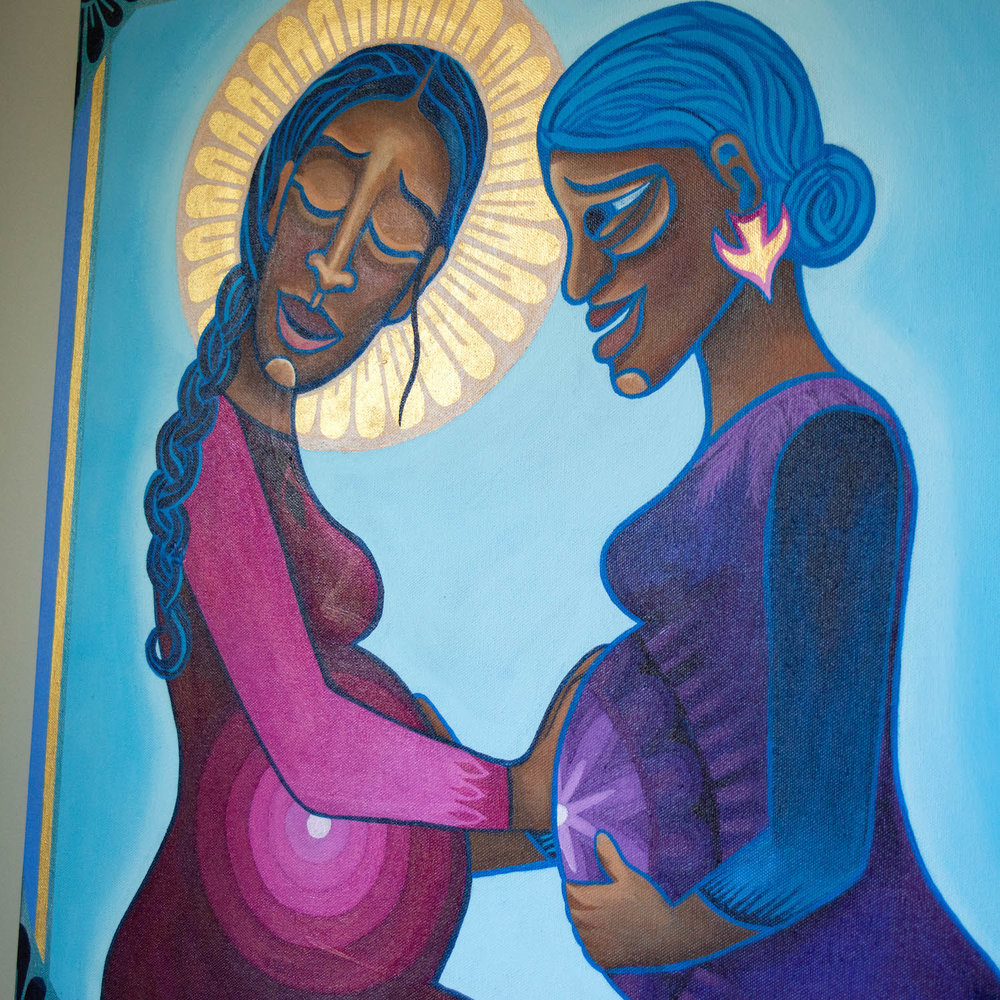
Mary and Elizabeth, by Lauren Wright Pittman

In those days Mary set out and went with haste to a Judean town in the hill country, where she entered the house of Zechariah and greeted Elizabeth. When Elizabeth heard Mary’s greeting, the child leaped in her womb. And Elizabeth was filled with the Holy Spirit and exclaimed with a loud cry, “Blessed are you among women, and blessed is the fruit of your womb. And why has this happened to me that the mother of my Lord comes to me? For as soon as I heard the sound of your greeting, the child in my womb leaped for joy. And blessed is she who believed that there would be a fulfillment of what was spoken to her by the Lord.”

And Mary said,

“My soul magnifies the Lord,
    and my spirit rejoices in God my Savior,
for he has looked with favor on the lowly state of his servant.
    Surely from now on all generations will call me blessed,
for the Mighty One has done great things for me,
    and holy is his name;
indeed, his mercy is for those who fear him
    from generation to generation.
He has shown strength with his arm;
    he has scattered the proud in the imagination of their hearts.
He has brought down the powerful from their thrones
    and lifted up the lowly;
he has filled the hungry with good things
    and sent the rich away empty.
He has come to the aid of his child Israel,
    in remembrance of his mercy,
according to the promise he made to our ancestors,
    to Abraham and to his descendants forever.” (New Revised Standard Version)

Mary had a visitation by an angel, informing her that she would give birth to the Son of God. She immediately hurried to visit her relative Elizabeth, who was pregnant with the forerunner to the Son of God.

In the two women’s encounter, the baby within Mary is portrayed as of greater significance than the one within Elizabeth. And that was not because of the adults, but because of the babies themselves.

Something amazing and spectacular was about to occur in history. It would be so cataclysmic that these two babies, especially the one within Mary, would change the world in profound ways.

There was nothing particularly special about either Mary or Elizabeth – which is probably why they were perfect for the jobs of raising the Messiah and the Prophet.

The lowly non-descript persons are usually favored by God, even though the world knows nothing about them. After all, the kingdom of God knows nothing of billionaires and those in high places, even though the world knows nearly everything about them.

Throughout the history of the world, women have often been overlooked and underrated. Even in today’s Western world, even though it’s better than it was, women are still viewed not as qualified like men are. But that’s a topic for another time.

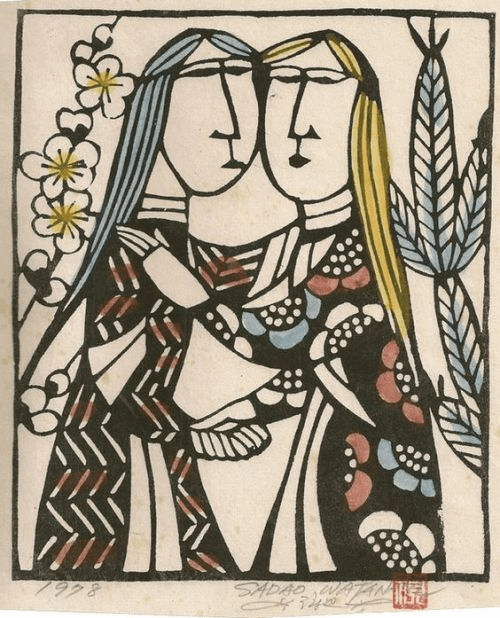
The Visitation, by Sadao Watanabe (1913-1996)

The most obvious observation from today’s Gospel story is that we wouldn’t have babies born without women. There were two in utero babies that had responses, because of two women.

Inside of Elizabeth’s womb, John leaped at the voice of Mary carrying his new cousin. Indeed, even before birth, John was filled with the Holy Spirit and began pointing to Jesus. (Luke 1:15)

John, although getting his prophetic leap from the Spirit, also got some significant prophetic oomph from his mother. Elizabeth spoke the prophetic word about Mary, who is “the mother of my Lord.”

Good people bestow blessing on others. And that is what Elizabeth did for Mary. This then, enabled Mary to express her own inspired blessing to God. To bless and be blessed means, on the practical level, that spiritual eyes are opened to see what is truly there.

Mary is a blessed person, not only because she is the Lord’s mother, but more fundamentally because she is faithful, and trusted in the promise of God to her.

To be blessed is to have God’s stamp of approval on your life. It has little to do with wealth or abundant resources. But it does have a lot to do with living a life of godly virtue and values.

So, again, it only makes sense that God used Mary and Elizabeth, two women who embodied being poor in spirit (humble) as the divine conduits for blessing the world.

Both Mary and Elizabeth believed. Elizabeth believed the words of the angel to her husband Zechariah. And Mary believed the angel’s direct words to her when she heard them. Without hesitation or any ambiguity.

Faith accepts what it cannot see; and when faith does see with actual eyes, it can see what is underneath the physical appearance.

Let’s also make sure to observe that this sort of faith, this particular way of seeing, has its consequences. Elizabeth and Mary both knew quite well that one of them was an unmarried pregnant woman.

They understood the social judgments to come, along with the shaming, and perhaps even the ostracism that would likely occur – even though all of this is divine through and through.

But grace can always use the eyes of faith to see beyond social status and convention in order to do what is right, just, and good. Mercy can always see what is truly honorable.

Elizabeth was perfectly comfortable extending hospitality to a person for whom others were likely to whisper, judge, and reject. Which is why I like Elizabeth. Every generation needs more women like her.

The welcome and love of Elizabeth is of the same sort that Jesus would show to prostitutes, tax collectors, and sinners. Like Elizabeth, Jesus could see beyond any societal shame to what was divinely happening in front of him.

Mary magnified the Lord with immortal words infused from the blessing bestowed upon her by Elizabeth. To bless another person is to open them to the possibilities of God’s actions in them and through them to the world.

That is the real gift that keeps on giving. And it is the most appropriate and valuable gift that we can give to another this season.

O God of Elizabeth and Mary, you visited your servants with news of the world’s redemption in the coming of the Savior. Make our hearts leap with joy, and fill our mouths with songs of praise, so that we may announce glad tidings of peace, and welcome Christ in our midst. Open our souls to receive the One who came to love your flock. Amen.

Delivery and Deliverance (Isaiah 66:7-11)

Before she was in labor
    she gave birth;
before her pain came upon her
    she delivered a son.
Who has heard of such a thing?
    Who has seen such things?
Shall a land be born in one day?
    Shall a nation be delivered in one moment?
Yet as soon as Zion was in labor
    she delivered her children.
Shall I open the womb and not deliver?
    says the Lord;
shall I, the one who delivers, shut the womb?
    says your God.

Rejoice with Jerusalem, and be glad for her,
    all you who love her;
rejoice with her in joy,
    all you who mourn over her—
that you may nurse and be satisfied
    from her consoling breast,
that you may drink deeply with delight
    from her glorious bosom. (New Revised Standard Version)

Conception. Happiness. Wondering. Uncomfortable. Preparation. Pain. More pain. Delivery. Exhaustion. Joy. Celebration. New life. Bringing children into this world is a process. And its hard work.

Feeding. Pooping. Sleeping. Exhaustion. More feeding. Lots more pooping. Thank God, more sleeping. Still exhausted. So, when does the mother ever get to eat, go to the bathroom by herself, and sleep? Maybe tomorrow, or maybe in another life….

Despite all of this, there are still words which keep mothers (and fathers) going: Satisfaction. Delight. Awe. Praise. Love. Hope. Faith. Yes, faith. Lots of faith. So much faith that it’s as if the parent puts all their weight on it, and leans into it, perhaps more out of sheer necessity than anything else.

The Christian season of Advent has been growing over the past weeks. It is now large and very ready for Christmas Day and the celebration of the Christmas season (the 12 days from December 25 to the Day of Epiphany on January 6).

But we aren’t quite there yet. There is still the anticipation of birth. The Christ child is coming.

It’s quite something to imagine that God would be so humble as to become humiliated. What a wonder it is, that there is such a thing as an incarnation, that Jesus entered this world as both a human baby and a divine king.

God came to this world for us, on our behalf, to redeem, renew, and restore lost humanity. That’s a lot of love. If you think about it, the mother’s incredible love had to come from somewhere.

Love is what sustains the world. So, love must be nurtured. The feelings of it are not always there within us.

Yet, if we will continually seek to maintain the godliness which is love inside of us, we can find ourselves being little incarnations of Jesus walking about this earth providing succor, without any withholding or hatred.

To love is to love. Without conditions. To love a friend but hate an enemy is to cancel out the love. It must be all love, or it isn’t love, at all.

The person, group, organization, institution, community, or church in a miserable and wretched state is in need of restoration. That is, they are in a great need of receiving love and giving love.

If they have responsibilities toward others, and have been neglectful, they must come to the breast of God. And those who did not receive their due justice and fair recompense must also come.

Advent is more than a season in the year to recognize. And Christ’s incarnation is much more than a doctrine to believe. Advent and incarnation are powerful realities which we must live into.

The good news of this season is that God intervenes effectively to do good for those who are faithful. It’s a newness as sudden and as wonderful as the birth of a baby. The Lord does away with barrenness and hopelessness, and brings new life.

It is this good news that brings out joy. Where once there was mourning and sadness, there is now satisfaction, comfort, and consolation. God is the One who brings it about.

Therefore, it is helpful to remember and recall the words of Jesus to his disciples:

Very truly, I tell you, you will weep and mourn, but the world will rejoice; you will have pain, but your pain will turn into joy. When a woman is in labor, she has pain because her hour has come. But when her child is born, she no longer remembers the anguish because of the joy of having brought a human being into the world. So you have pain now, but I will see you again, and your hearts will rejoice, and no one will take your joy from you. (John 16:20-22, NRSV)

The joy and celebration of this first advent will lead to a second advent, the return of Christ. The peace and satisfaction we may enjoy now is only here in part. The fullness of peace will be ushered in at the end of time.

This is the sort of tension that we must continually maintain, holding together in both hands our sorrow and joy, disappointment and hope, hardship and love, at the same time, all the time, until that day when there is not only a delivery, but a deliverance from all evil.

Lord God, we adore you because you have come to us in the past.
You have spoken to us in the Law of Israel.
You have challenged us in the words of the prophets.
You have shown us in Jesus what you are really like.

Lord God, we adore you because you still come to us now.
You come to us through other people and their love and concern for us.
You come to us through people who need our help.
You come to us as we worship you with others.

Lord God, we adore you because you will come to us at the end.
You will be with us at the hour of death.
You will still reign supreme when all human institutions fail.
You will still be God when our history has run its course.

We welcome you, the God who comes.
Come to us now in the power of Jesus Christ our Lord. Amen.

Look Up (Isaiah 42:10-18)

Sing to the Lord a new song,
    his praise from the end of the earth!
Let the sea roar and all that fills it,
    the coastlands and their inhabitants.
Let the desert and its towns lift up their voice,
    the villages that Kedar inhabits;
let the inhabitants of Sela shout for joy;
    let them shout from the tops of the mountains.
Let them give glory to the Lord
    and declare his praise in the coastlands.
The Lord goes forth like a soldier;
    like a warrior he stirs up his fury;
he cries out; he shouts aloud;
    he shows himself mighty against his foes.

For a long time I have held my peace;
    I have kept still and restrained myself;
now I will cry out like a woman in labor;
    I will gasp and pant.
I will lay waste mountains and hills
    and dry up all their herbage;
I will turn the rivers into islands
    and dry up the pools.
I will lead the blind
    by a road they do not know;
by paths they have not known
    I will guide them.
I will turn the darkness before them into light,
    the rough places into level ground.
These are the things I will do,
    and I will not forsake them.
They shall be turned back and utterly put to shame—
    those who trust in carved images,
who say to cast images,
    “You are our gods.”

Listen, you who are deaf,
    and you who are blind, look up and see! (New Revised Standard Version)

All creation, along with all creatures, are to praise the Lord. The coastlands and borderlands serve as witnesses to God’s justice and to human injustice.

The trees aren’t just standing there with their majestic trunks and branches. They are present to any and all of the wickedness that people may do.They experience all good that God does, and the evil which humanity does.

The rocks, the hills, the plants, all that is alive around us are sacred witnesses to what is happening on this earth – both the good and the bad.

All of creation declares God’s praise, and testifies to God of what is going on in the world.

As a result, the Lord is roused to action; God comes to attention like a soldier and is ready to move out.

The Lord will lead the (spiritually) blind in new directions. God’s active participation will put to shame all the people who trust in alternative gods or other things.

The prophet Isaiah says that the people were called to look up and see.

Everyone, look up. Look. Up.

Because the Lord knows that if folks will look up, and see God, that it changes everything for them.

We are invited to look up and sing praises to the Lord. The singers include every creature on earth, the oceans, the seas, the waters, the desert, the coast, the land, and the people.

Look up and see that God is about to act. And the action will be good for some, and not so good for others.

Whenever God moves, you know it. There will be some noise to it, like a woman in labor.

Nothing is beyond the reach of God. The Lord will do divine work of building up, tearing down, and building up again – all according to the divine will.

God will act on behalf of the faithful, the humble, the needy, and all those who look to the Lord. So, we must look up.

We cannot see what is happening, or who is there, if our heads are down. Everything has the potential to be different and changed if we will but lift our heads and look up.

There are a lot of reasons why we may be looking down. We might believe God doesn’t see or isn’t watching. But the Lord is neither deaf nor blind – we are. For us to notice, we must look up.

We may lack self-awareness, not realizing who we truly are, or what the state of things with us really is. Perhaps there is discouragement, despondency, or depression. Maybe hope has disappeared.

It could be that there is guilt, or shame, or uncertainty, and so fear is keeping the head down and eyes looking at the ground.

So, look up.

Abram looked up, saw an incredible future, and heard an amazing promise:

He [the Lord] took him outside and said, “Look up at the sky and count the stars—if indeed you can count them.” Then he said to him, “So shall your offspring be.” Abram believed the Lord, and he credited it to him as righteousness. (Genesis 15:5-6, NIV)

Mary Magdalene looked up at Jesus, and her deep sorrow turned to great astonishment and joy:

Mary was standing outside the tomb crying, and as she wept, she stooped and looked in.She saw two white-robed angels, one sitting at the head and the other at the foot of the place where the body of Jesus had been lying. “Dear woman, why are you crying?” the angels asked her.

“Because they have taken away my Lord,” she replied, “and I don’t know where they have put him.”

She turned to leave and saw someone standing there. It was Jesus, but she didn’t recognize him. “Dear woman, why are you crying?” Jesus asked her. “Who are you looking for?”

She thought he was the gardener. “Sir,” she said, “if you have taken him away, tell me where you have put him, and I will go and get him.”

“Mary!” Jesus said.

She turned to him and cried out, “Rabboni!” (which is Hebrew for “Teacher”). (John 20:11-16, NLT)

Stephen looked up, and his persecution turned to glory:

When the members of the Sanhedrin heard this, they were furious and gnashed their teeth at him. But Stephen, full of the Holy Spirit, looked up to heaven and saw the glory of God, and Jesus standing at the right hand of God. “Look,” he said, “I see heaven open and the Son of Man standing at the right hand of God.” (Acts 7:54-56, NIV)

We are to look up so that we can see how things truly are, and whom we really serve. Only then can we accept what is, and what God is doing.

Spiritual awareness enables us to see clearly and discern well. It comes when we look up, see the glory of God, and accept the invitation to respond.

Lord God almighty, Creator of heaven and earth:

How awesome are your works!
    Because of your great strength,
        your enemies cringe before you.
All the earth worships you,
    sings praises to you,
        sings praises to your name!

If I had cherished evil in my heart,
    my Lord would not have listened.
But God definitely listened.
    He heard the sound of my prayer.
Bless God! He didn’t reject my prayer;
    he didn’t withhold his faithful love from me. Amen. (Psalm 66:3-4, 18-20, CEB)