The Idea of Spiritual Separation (2 Corinthians 6:14-7:1)

Do not be yoked together with unbelievers. For what do righteousness and wickedness have in common? Or what fellowship can light have with darkness? What harmony is there between Christ and Belial? Or what does a believer have in common with an unbeliever? What agreement is there between the temple of God and idols? For we are the temple of the living God. As God has said:

“I will live with them
    and walk among them,
and I will be their God,
    and they will be my people.”

Therefore,

“Come out from them
    and be separate,
says the Lord.
Touch no unclean thing,
    and I will receive you.”

And,

“I will be a Father to you,
    and you will be my sons and daughters,
says the Lord Almighty.”

Therefore, since we have these promises, dear friends, let us purify ourselves from everything that contaminates body and spirit, perfecting holiness out of reverence for God. (New International Version)

There are entire Protestant denominations built upon verses such as today’s. They take the admonition to be separate as a cornerstone value. Ever since the Reformation, various Christian groups have struggled to maintain their witness in the world through, essentially, having nothing to do with the world whatsoever.

The dogma of separation inevitably leads to defining precisely what is “worldly” and what isn’t. This is where the idea of creating lists of what’s not acceptable come from. Each group or denomination has it’s own teaching about how to identify oneself as a Christian, and what sorts of behaviors communicate one isn’t a Christian. And the lists often vary quite a bit.

The Puritans had detailed lists and laws of what must be done and not done in order to remain in the community and be pure without spiritually contaminating oneself. For example, here are just a few of the many puritanical laws in Massachusetts in the 1600’s:

Sunday was a holy day. Trade and business were not allowed. No other public meetings could be held (except church services). No travel, except for walking to and from church and for emergencies. No entertainment. Church attendance was required. If a person missed church, they had to go to court (on Monday) and pay a fine.

All the other days were holy, too. Immodest and ostentatious clothes was illegal. Long hair for men was illegal. Smoking was illegal in the street. Courting a girl without her parents’ consent was illegal. Kissing in public was illegal. The following behaviors were illegal: using bad words, drinking too much alcohol, laziness, gluttony, fighting, poorly made products, having a bad attitude, and gossip.

Any violation, in Puritan thought, put the entire community at risk of raising the ire of God – who may punish them with various natural disasters. With all of these laws and lists, there was no opportunity for anyone to ever marry an unbeliever or be in business with a non-Christian, simply because it was illegal to be anything but a Christian!

None of this is meant to pick on the Puritans. It’s commendable that a group of people would want to be holy in all that they do and say. Yet, attempting to legislate every facet of another’s life isn’t so admirable – especially against their own Christian convictions.

Because, the reality of it all is that, in such systems, the few (usually old white guys) make the laws and decisions for everyone else – whether everyone likes it, or not. And worse, the old guys would couch their laws in the pious language of maintaining the common good of all persons (that is, themselves).

That sort of practice is still done today, in every system and every institution; the few call the shots for everyone else. And yes, even in a stated democracy like the United States of America.

So, if that isn’t what the Apostle Paul was getting at with the Corinthian Church, what then did he mean when he talked of separating from unbelievers, not being contaminated, and maintaining purity amongst the community?

Paul was speaking about the reality that the Corinthians – who had been ardent pagan worshipers before their conversion to Christianity – were still making significant accommodations to their surrounding pagan environment. Like a pair of ox yoked together, it just did not work. The two were greatly mismatched; they would not be able to go anywhere or get anything done.

In a series of rhetorical questions, Paul sought to illustrate the incompatibility of being a spiritual square peg trying to fit into a round hole. To be holy means to be set apart for the specific purpose of and devotion to God.

Rather than making holiness be the avoidance of dancing, drinking, playing cards, and dressing up, holiness and purity is to be characterized by righteous humility and gentleness; warm and compelling light; peace and peacemaking, like Christ did; love for fellow believers; and commitment to Christian community.

Put another way, avoiding spiritual contamination means to work on separating from sinful pride; giving into the shadows and the darkness of one’s heart; fostering arguments and division; and being unmerciful.

If the Apostle were to write to us today, on this topic of separation, what would he say to us? Maybe his rhetorical questions would be something like this:

What are you doing, failing to make a distinction between good and bad, right and wrong? How can you partner up with people who have ethics which are opposed to Christ? Can the light of justice ever be best friends with unjust darkness? Do Jesus and Satan ever have a midnight stroll holding hands with each other? Would anyone ever set up a worship altar to the wealthy or powerful in a church building?

Paul may argue, even today, that we contaminate ourselves in rather creative ways by employing illegitimate means to try and accomplish a legitimate need.

The truth is that anything that hinders us from doing God’s will; anyone who draws us away from a good relationship with Jesus; and whatever causes us to put the Christian life on the back burner of life, needs to be jettisoned. It will make us impure, ineffective, and eventually bite us in the backside.

We can always look at other groups of people whom we believe didn’t get things quite right. Yet, we really must deal with ourselves in this moment and for this time. Comparative holiness will get us nowhere (except maybe hell). Instead, let us contend with God and God’s people in ways that are redemptive, life-giving, and helpful for us and for our salvation.

Almighty God,
to whom all hearts are open,
all desires known,
and from whom no secrets are hidden:
cleanse the thoughts of our hearts
by the inspiration of your Holy Spirit,
that we may love you completely,
and rightly magnify your holy name;
through Christ our Lord. Amen.

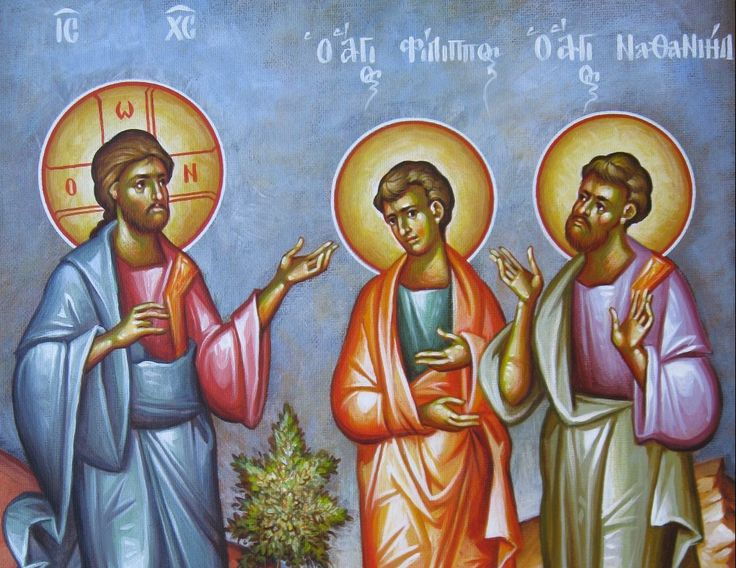
“Follow Me” (John 1:43-51)

The next day Jesus decided to go to Galilee. He found Philip and said to him, “Come, follow me.” Philip was from Bethsaida, Andrew and Peter’s hometown.

Philip went to look for Nathanael and told him, “We have found the very person Moses and the prophets wrote about! His name is Jesus, the son of Joseph from Nazareth.”

“Nazareth!” exclaimed Nathanael. “Can anything good come from Nazareth?”

“Come and see for yourself,” Philip replied.

As they approached, Jesus said, “Now here is a genuine son of Israel—a man of complete integrity.”

“How do you know about me?” Nathanael asked.

Jesus replied, “I could see you under the fig tree before Philip found you.”

Then Nathanael exclaimed, “Rabbi, you are the Son of God—the King of Israel!”

Jesus asked him, “Do you believe this just because I told you I had seen you under the fig tree? You will see greater things than this.” Then he said, “I tell you the truth, you will all see heaven open and the angels of God going up and down on the Son of Man, the one who is the stairway between heaven and earth.” (New Living Translation)

I describe myself as a follower of Jesus. I have been for decades. I found, and continue to find, in Jesus Christ a compelling person full of grace, truth, and love.

But my early life was not characterized with knowing Christ. I certainly learned about Jesus, that this ancient guy lived an altruistic life, got tortured and killed on a cross, and that Christians believe in his resurrection from death. However, back then it was more like some strange history lesson. The information made no difference to me.

That is, until I heard a voice – not an audible one that others could hear. Yet, it was just a real as any daily conversation with another person. I heard the call of Jesus. The Ancient of Days showed up.

I know with every epistemic fiber in my being that it wasn’t an undigested bit of beef, a blot of mustard, a crumb of cheese, a fragment of an underdone potato. I am sure beyond certainty that there was more of an empty grave than gravy about my experience of the risen Christ.

I experienced the call of Jesus to “follow me.” And that is really, at its simplest, the call which continually goes out to all humanity. It is a gracious and merciful call. It isn’t a summons to experience a cataclysmic event of total belief in one fell swoop. Rather, it’s a call to believe that is much more an unfolding awareness of the deep spirituality and connection with the divine within.

Important to that faith process is another call to “come and see.” Whereas there are some Christian traditions which focus solely on a singular one-time experience of saving faith in Christ, the Gospel of John displays a drama of faith with multiple layers which people move through.

There is no egalitarian zap in which God grants total and immediate understanding. Instead, faith is an ever-increasing process. It is appropriate and biblical to say that our salvation has happened, is happening, and will happen. We follow, we come and see, and we keep following, keep coming, keep seeing more and more.

Like a muscle, our faith grows, develops, stretches, and strengthens over time. To use another metaphor, we ascend a stairway to heaven, one step at a time, day after day, following Jesus and ascending to spiritual maturity.

Orthodox icon of Christ calling Philip and Nathanael

Methinks this is likely part of what Jesus was getting at with Nathaniel in today’s Gospel lesson. Nathaniel would have quickly picked up on the reference Jesus was making, way back to the first book of Genesis. The Jewish patriarch, Jacob, had an experience of seeing the angels of God on some celestial stairway, ascending and descending. It was an encounter of God’s presence with Jacob, assuring him of divine intervention into the muck of humanity. (Genesis 28:10-17)

Jesus connected that ancient portrait to himself so that Nathaniel would understand, would believe, that God has again broken into this world with a special divine presence. To look at Jesus and follow him, is to see and follow God.

Christ Jesus is the ultimate example and embodiment of God with us. Throughout John’s Gospel, Jesus presents himself as:

  • Living water – connecting to Jacob’s well (John 4:5-14)
  • The Temple of God – the place where the Lord dwells in all divine fullness (John 2:18-22)
  • Bread from heaven – linking the giving of manna to the Israelites in the desert (Exodus 16:4-7; John 6:1-59)
  • The good shepherd – fulfilling divine Old Testament imperatives of caring for people (Ezekiel 34:11-16; John 10:1-30)

In all these ways, and more, Jesus intentionally connects himself as fulfilling God’s ancient promises to people.

In whichever way we need to hear the call to follow, Jesus accommodates to us. For some, Christ comes knocking on the front door. For others, he enters the side door, or slips into the backdoor of our lives.

And, if we will come and see, Jesus will also accommodate us by being the authority over us, the teacher to us, or the friend beside us. The Lord Jesus shall shepherd us and woo us to the flock for guidance and protection.

However it may be that Jesus comes to you, it most likely will be in ways you aren’t expecting. Surely, nothing good can come from Nazareth! Yet, it did. Can anything good come from Calcutta, India, or Juarez, Mexico, or Hoboken, New Jersey, or Milwaukee, Wisconsin, or even from a small rural area that doesn’t show up on a map? Yes, it can. Because with Jesus, God has entered this world, and, as it turns out, the Lord’s presence is everywhere.

Follow me. Come and see. Two of the simplest exhortations ever uttered. Yet, two of the most gracious phrases ever said, with profound implications for us beyond what we can fathom or imagine.

Guide us waking O Lord, and guard us sleeping; that awake we may watch with Christ and asleep we may rest in peace. May the shape of each day be formed by the pedantic following of my Lord; and may I come and see the wonders you have done, are doing, and will do. Almighty and merciful God – Father, Son and Holy Spirit – bless us and keep us. Amen.

Parable of the Ten Bridesmaids (Matthew 25:1-13)

The Parable of the Ten Virgins, by Lilibeth Kindle

“When the end comes, the kingdom of heaven will be like ten bridesmaids. They took their oil lamps and went to meet the groom. Five of them were foolish, and five were wise. The foolish bridesmaids took their lamps, but they didn’t take any extra oil. The wise bridesmaids, however, took along extra oil for their lamps. Since the groom was late, all the bridesmaids became drowsy and fell asleep.

“At midnight someone shouted, ‘The groom is here! Come to meet him!’ Then all the bridesmaids woke up and got their lamps ready.

“The foolish ones said to the wise ones, ‘Give us some of your oil. Our lamps are going out.’

“But the wise bridesmaids replied, ‘We can’t do that. There won’t be enough for both of us. Go! Find someone to sell you some oil.’

“While they were buying oil, the groom arrived. The bridesmaids who were ready went with him into the wedding hall, and the door was shut.

“Later the other bridesmaids arrived and said, ‘Sir, sir, open the door for us!’

“But he answered them, ‘I don’t even know who you are!’

“So stay awake because you don’t know the day or the hour. (God’s Word Translation)

Here’s the point of Christ’s parable, up front, so that we know what we are dealing with:

We prepare for things we really care about; we anticipate things that are important to us.

For example, people who really care about hunting make careful preparations for the season and anticipate opening day. Those who care about professional football look forward to game-day, plan for special food to eat, and set aside normal activities to watch them play.

And, of course, weddings are events that take lots of preparation because families care about the upcoming marriage. Since I have raised three girls, I can testify first-hand that wedding plans begin in third grade for many females.

The Wise and the Foolish Virgins, by Charles Haslewood Shannon, 1920

Here’s the point of Christ’s parable, stated in the negative: People show up to things unprepared mostly because they don’t value the event enough to be ready for it.

Casual hunters and fair-weather football fans go home when it gets too cold. That’s because they are not adequately prepared for the conditions.

Quickie weddings happen in Las Vegas where two people are not prepared to have a marriage for a lifetime. 

People drop out of impromptu events when there is no fun or gets too hard. However, if they really care about it, they prepare for it, have patience through it, and persevere in it when things get tough.

The true test of authentic commitment comes when things are not easy and it takes blood, sweat, and tears to see something through.

A Christian is one who not only professes Christ as Lord and Savior, but also backs the words up with a resolve to:

  • live into their baptism
  • avail themselves of communion
  • plan and prepare for both personal and public worship
  • make it their aim to love God, one another, and neighbor

There are few human events more freighted with emotion and preparation than weddings. Parents invest a lot of time, energy, resources, and love to have a meaningful wedding for their kids. There’s also the potential for disaster at a wedding.

A Greek Orthodox fresco of Jesus and the Parable of the Ten Virgins

Since I have done many weddings, I can tell you that a lot of things go sideways in the preparation process and even at the wedding itself. I have seen bridesmaids pass out, grooms forget the ring, and families fight like cats and dogs in the narthex just as the bride is ready to come down the aisle. All kinds of crazy stuff can happen with a wedding. 

At my own wedding, the bridesmaids were literally sown into their dresses by the seamstress just hours before the wedding; one of my groomsman did not show up because, I later found out, he was in jail; and, we were married on the hottest and most humid day of the year – 100 degrees – which did not go so well for a bunch of women trying to have their best ever hair day.

But you know what? We got married anyway. The wedding happened because it was important to us. I think it’s interesting that Jesus chose a parable about a wedding to tell us what the kingdom of God is really like. Weddings in Christ’s day were just as prone to mishap, maybe even more, than weddings today.

In ancient Israel, a couple would become engaged but not set a wedding date. The groom would take the time to busily prepare a home for himself and his bride to live. It might take days, or weeks, or months, even years. It is this imagery that Jesus picked up to communicate his point of being prepared for things we care about. 

No one knew when the groom would be finished with preparations. (Note: We are told in the Gospel of John that Jesus the bridegroom is busy preparing for a great wedding feast at the end of the age when he will come back and take us to be with him forever).

When the groom was ready, he left the home he had prepared and went to the bride’s house. Then, the two of them, along with their wedding party, would have a grand procession through the streets of the town, almost always after dark, and then back to the home of the groom. So, oil lamps were important to have ready, and on standby.

Here is the parable’s setting: The groom has left his house and begun his trek through town. He might come straightaway, and he might not, depending on what route he takes. The bridesmaids (virgins) have their oil lamps ready. Five of them have plenty of oil, and five of them do not.

The groom takes the circuitous route, so the virgins fell asleep waiting. At midnight the groom finally shows up at the bride’s house. Five virgins spring into action and are ready. The other five aren’t ready, at all. 

The five virgins without enough oil go out to find or buy some more, while the five virgins with plenty of oil join the celebration. The procession goes back to the groom’s house, posthaste, before the five virgins who were not part of the procession finally catch up to them at the house.

The five foolish bridesmaids knock on the door and expect to get in. But the door is shut and it isn’t going to be opened. The marriage will happen without them. Therefore, the bottom line of the story: The five foolish virgins were not ready because they did not care enough to be prepared.

Orthodox icon of Jesus and the Parable of the Ten Virgins

This, at face value, might seem harsh. Yet, in Christ’s time, not having the oil needed for the lamps would be like, in our day, having half the bridesmaids show up at the wedding at the last minute in jeans and t-shirts without having done their hair and expecting to stand up with the bride. No bride or groom and their family in our culture is going to roll with that kind of behavior. Why? Because it is deeply offensive.

As in all of Christ’s parables, the characters represent the people listening. The five wise and five foolish bridesmaids point to the mixed characters who were following Jesus. They consisted of both faithful authentic disciples of Jesus, as well as wedding crashers who were not there because they valued and respected Jesus.

Jesus told us to keep watch, because we do not know the day or the hour when he will return. So, today’s parable raises the big question: Are you prepared? 

We are to maintain constant vigilance, being always alert for Jesus to show up. It’s one thing to make a profession of Christ; and it is quite another thing to live each day doing God’s will and being prepared for Jesus to return.

Jesus wants more than fair-weather Christians. 

We cannot assume someone else will give us oil. No one can simply rely on another person to have everything they need to live the Christian life. Each one of us must listen and learn from God’s Word for ourselves, cultivate a life of prayer, and serve the church and the world in ways God has called us to – without relying on someone else to do the work that I should be doing. 

Every day is a fresh opportunity and privilege to serve Jesus. My personal practice is to rise each morning by 4:30am. I light a candle and spend some quiet unhindered time reading the lectionary passages for the day. I spend time in prayer. Throughout the day I pause to intentionally connect with God in prayer and some Scripture reading. 

I get up early in the morning regardless of how I feel. I engage in spiritual disciplines even when it does not strike my fancy. I go to work and do what it takes to get myself in a position to be a blessing to others.

Now, let’s come back to the message of Christ’s parable: We prepare for things we really care about, and we anticipate things that are important to us. The return of Jesus is a future reality. It’s up to each of us, whether it will be on our spiritual radar, or not.

Yet, I can tell you this: Jesus wants us to watch and pray, and to be prepared, because today the bridegroom may show up.

The Motivation for Ministry (Acts 13:16-25)

Standing up, Paul motioned with his hand and said: “Fellow Israelites and you Gentiles who worship God, listen to me! The God of the people of Israel chose our ancestors; he made the people prosper during their stay in Egypt; with mighty power he led them out of that country; for about forty years he endured their conduct in the wilderness; and he overthrew seven nations in Canaan, giving their land to his people as their inheritance. All this took about 450 years.

“After this, God gave them judges until the time of Samuel the prophet. Then the people asked for a king, and he gave them Saul son of Kish, of the tribe of Benjamin, who ruled forty years. After removing Saul, he made David their king. God testified concerning him: ‘I have found David son of Jesse, a man after my own heart; he will do everything I want him to do.’

“From this man’s descendants God has brought to Israel the Savior Jesus, as he promised. Before the coming of Jesus, John preached repentance and baptism to all the people of Israel. As John was completing his work, he said: ‘Who do you suppose I am? I am not the one you are looking for. But there is one coming after me whose sandals I am not worthy to untie.’ (New International Version)

Paul and Barnabas were a dynamic duo. In their missionary journey, they had the practice of traveling from city to city and attending the local synagogue services. It was customary to have a time in the worship when a word of encouragement could be offered from folks in the congregation. Paul consistently took those opportunities to talk of Jesus as the fulfillment of God’s promises to Israel.

“Life can only be understood backwards; but it must be lived forwards… Life is not a problem to be solved, but a reality to be experienced.”

Søren Kierkegaard

When Paul converted to Christianity, it totally altered his motivation. Jesus became everything to him. Jesus was what got him up in the morning; who sustained him through his days; who he thought about when he went to sleep at night.

Concerning Jesus, the Apostle Paul was unabashedly Christo-centric in everything he said and did; he followed Christ in every aspect of his life and ministry.

A fifth century mosaic of the Apostle Paul

I can relate to operating like that in life. Once God got ahold of my life and Jesus became the door upon which everything I did hinged, this was, and still is, my preeminent driving force. For me, therefore, the spiritual care of others is important, and comes out of the overflow of my heart. As a Christian, I believe all spiritual care begins and ends with Jesus.

The Christian tradition emphasizes that in the beginning, God created the heavens and the earth. The apex of creation, the height of all God’s creative activity, is the formation of humanity upon the earth. Human beings alone have been created in the image and likeness of God – reflecting the divine in their care for all creation (Genesis 1:26-27).

Therefore, all persons on the good earth which God created are inherently good creatures and deserve utmost respect and common decency. So, my identity as a person is firmly rooted and grounded in the soil of God’s grace in Jesus Christ. My Christianity has the practical effect of acknowledging that each person on planet earth is inherently worthy of love, support, concern, and care. 

What is more, everything in my life centers (ideally) around Jesus. As such, I take my cues for how to extend care to others from him. For me, Jesus is the consummate caregiver. Christ entered people’s lives and their great sea of need with the gift of listening; a focus on feelings; and the power of touch.  Christ was able to listen to others because he first listened to the Father. Jesus was present to others because he was present with the Father. Jesus Christ gave love to others with the love he enjoyed with the Father and the Spirit. 

By the wounds of Christ, we are healed. Paul knew this firsthand. He needed a boatload of emotional and spiritual healing from his guilt and shame as a persecutor of faith before his conversion. Paul discovered in Christ the grace of healing, both body and soul.  

People’s stories of joy and pain, laughter and sorrow, certainty and wondering, are sacred narratives – continuously being written and revised in the heart, trying to make sense of life and faith. The Apostle Paul had a doozy of a life story to tell. Coupled with his keen intellect and training, Paul could be very persuasive.

Paul’s ministry, emulating the life of Christ, was not to force the gospel obnoxiously and belligerently onto others but to pastorally respond to everyone he encountered. Both Paul and Jesus confronted and confounded folks with incredible love.

Every person, without exception, is precious and carries within them the image of God. The personal journey and discovery of Godlikeness within each person is an emotional adventure worth taking. 

One of the great Christian theologians of the twentieth-century, the Protestant Swiss Karl Barth, believed that we are not fully human apart from mutual seeing and being seen, reciprocal speaking and listening, granting one another mutual assistance, and doing all of this with gratitude and gratefulness. Only in relation to each other, including those in need, do we thrive as people – which is why Paul was intensely personal and relational in his missionary ministry. Christianity is a fellowship with God and one another, and not an isolated odyssey. Paul always traveled with others.

Christian ministry is a symbiotic relationship between the servant and the served, expressed with grace and hope given by Jesus in the power of the Holy Spirit. The person in need not be Christian for this to occur, since all share the common human experience of birth, life, and death as people distinct from all other creatures, worthy of compassionate support and spiritual uplift. 

That’s the reason why I do what I do, as a believer in Jesus and a minister for Christ. And I have a hunch it was the same for Paul.

Loving God, the One who cares and saves, enable me, like your servant Paul, to speak peace, be hospitable, heal the sick, proclaim that the kingdom of God has come near, not take rejection personally, and let you do your work of changing lives and bringing them into the dance of the Trinity with Christ and your Spirit. Amen.