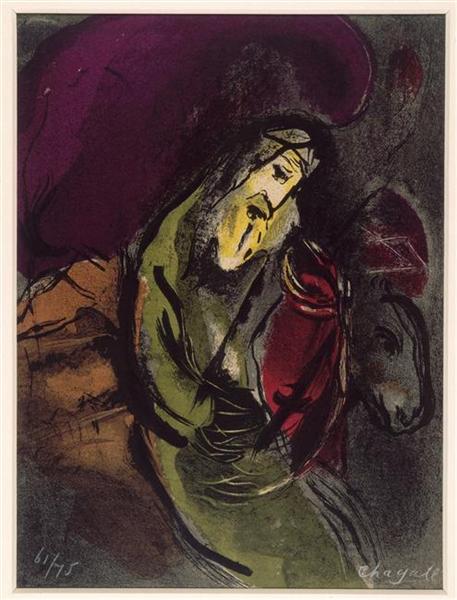
Loneliness and Silence (Jeremiah 20:7-13)

The Prophet Jeremiah, by Marc Chagall, 1956

O Lord, you misled me,
    and I allowed myself to be misled.
You are stronger than I am,
    and you overpowered me.
Now I am mocked every day;
    everyone laughs at me.
When I speak, the words burst out.
    “Violence and destruction!” I shout.
So these messages from the Lord
    have made me a household joke.
But if I say I’ll never mention the Lord
    or speak in his name,
his word burns in my heart like a fire.
    It’s like a fire in my bones!
I am worn out trying to hold it in!
    I can’t do it!
I have heard the many rumors about me.
    They call me “The Man Who Lives in Terror.”
They threaten, “If you say anything, we will report it.”
    Even my old friends are watching me,
    waiting for a fatal slip.
“He will trap himself,” they say,
    “and then we will get our revenge on him.”

But the Lord stands beside me like a great warrior.
    Before him my persecutors will stumble.
    They cannot defeat me.
They will fail and be thoroughly humiliated.
    Their dishonor will never be forgotten.
O Lord of Heaven’s Armies,
you test those who are righteous,
    and you examine the deepest thoughts and secrets.
Let me see your vengeance against them,
    for I have committed my cause to you.
Sing to the Lord!
    Praise the Lord!
For though I was poor and needy,
    he rescued me from my oppressors. (New Living Translation)

Jeremiah was a lonely man.

In reality, loneliness has little to do with geography. A person can be surrounded by people, and yet still be lonely. Loneliness is the personal sense that either no one cares, or that nobody is taking me seriously. To be alone means that a person doesn’t have another human being to share their thoughts, feelings, and beliefs with. Nobody wants to listen.

That’s how the prophet felt. Jeremiah was called by God to preach a message to the city of Jerusalem. He was faithful to do it. However, the message was very unpopular. Jeremiah was discounted, dismissed, and dissociated from others.

So, how would you feel in a similar situation?

The Prophet Jeremiah by Michelangelo, c.1545

Jeremiah felt almost betrayed by the Lord. He understood that the message would be tough to swallow by the people. What’s more, God even promised Jeremiah that no one would respond, nobody was going to repent, and not one person would listen and take the prophet seriously. In short, God let Jeremiah know up front that he was embarking on a very lonely ministry. (Jeremiah 1:4-19)

And it was this loneliness that began to gnaw at the prophet Jeremiah. Yet, what was he really going to do about it? After all, Jeremiah was compelled to speak. He just could not simply hold it in. The message was like fire in his belly; he had to let it out!

The prophet’s calling and life’s work bubbled up and out of him, no matter what he did to try and keep a lid on it. Whenever Jeremiah would try and walk away and say, “Forget it! No more God-Messages to the people from me!” then the words from God burned inside of him.

The hot furnace within had to find the outlet of preaching because Jeremiah was worn out trying to keep God’s words domesticated within him.

Maybe you can relate in some small way. It isn’t always easy talking about God to others, let alone talking about some subject other people really don’t want to hear. Yet, as the people of God, we discover it’s more painful to keep it inside than it is letting it out and taking the consequences as they may come.

Or it could be that you resonate with Jeremiah’s trying to distance himself from God. You were hurt, wounded in some way, and no matter how hard you run from God, your inner sacred space will not leave you alone – it relentlessly tracks you down and hounds you, barking to be heard and expressed.

What then should we do? How, then, shall we live? Don’t keep silent. Speak! Let your voice out. Say what is important to you. Because ignoring it, wishing that it would go away, or believing God will give-up on you isn’t going to happen.

At some point, there must be an acceptance of the way things are, and not what we want them to be. If others are not taking me seriously, nor listening at all to what I am saying, then this doesn’t mean that I remain silent. There are plenty of folks around who want that; they just want you to keep your mouth shut. But you have a voice – and your voice needs to be heard.

When the blind man, Bartimaeus, voiced his need out loud in the crowd, nobody took him seriously. People told him to shut up and leave Jesus alone. But Bartimaeus wasn’t having it. He simply lifted his voice louder. He wanted to be heard by Jesus, and he didn’t care if it upset the folks around him. (Mark 10:46-52)

Perhaps you will have to go it alone, or speak without anyone’s help. Well, then, that’s what you do. If your gut is crying out inside of you to speak, then speak! Not all silence is golden. Sometimes silence is a sign that someone is being oppressed and not allowed to talk – or, at least, isn’t being listened to.

God called Jeremiah to proclaim some very inconvenient interruptions to the people’s delusional thoughts. It left the prophet alone and hurt. But there was a message that needed proclaiming.

There are times when silence only ends up protecting the privileged over the underprivileged. The Old Testament prophets speak into this environment of unjust actions and unloving words.

Unspoken words that need to be heard by others will only fester inside your gut, that is, until you speak out. Then, when we do let the words out, let’s make sure it is precisely the message that has been locked up and kept silent. It doesn’t matter whether it is unpopular, or not; what matters is that the voice God gave you has a chance to be heard.

God Almighty, you have your ways in this world, and they don’t always make sense to me. Sticking my fingers in my ears trying to pretend you are not there isn’t working – my heart burns within me. So, help me to speak with all the confidence of the message I have, through Jesus Christ my Lord, in the power of the Holy Spirit. Amen.

Against Injustice (Jeremiah 19:1-15)

This is what the Lord says: “Go and buy a clay jar from a potter. Take along some of the elders of the people and of the priests and go out to the Valley of Ben Hinnom, near the entrance of the Potsherd Gate. There proclaim the words I tell you, and say, ‘Hear the word of the Lord, you kings of Judah and people of Jerusalem. This is what the Lord Almighty, the God of Israel, says:

Listen! I am going to bring a disaster on this place that will make the ears of everyone who hears of it tingle. For they have forsaken me and made this a place of foreign gods; they have burned incense in it to gods that neither they nor their ancestors nor the kings of Judah ever knew, and they have filled this place with the blood of the innocent. 

They have built the high places of Baal to burn their children in the fire as offerings to Baal—something I did not command or mention, nor did it enter my mind. So beware, the days are coming, declares the Lord, when people will no longer call this place Topheth or the Valley of Ben Hinnom, but the Valley of Slaughter.

“‘In this place I will ruin the plans of Judah and Jerusalem. I will make them fall by the sword before their enemies, at the hands of those who want to kill them, and I will give their carcasses as food to the birds and the wild animals. I will devastate this city and make it an object of horror and scorn; all who pass by will be appalled and will scoff because of all its wounds. I will make them eat the flesh of their sons and daughters, and they will eat one another’s flesh because their enemies will press the siege so hard against them to destroy them.’

“Then break the jar while those who go with you are watching, and say to them, ‘This is what the Lord Almighty says: I will smash this nation and this city just as this potter’s jar is smashed and cannot be repaired. They will bury the dead in Topheth until there is no more room. This is what I will do to this place and to those who live here, declares the Lord. I will make this city like Topheth. The houses in Jerusalem and those of the kings of Judah will be defiled like this place, Topheth—all the houses where they burned incense on the roofs to all the starry hosts and poured out drink offerings to other gods.’”

Jeremiah then returned from Topheth, where the Lord had sent him to prophesy, and stood in the court of the Lord’s temple and said to all the people, “This is what the Lord Almighty, the God of Israel, says: ‘Listen! I am going to bring on this city and all the villages around it every disaster I pronounced against them, because they were stiff-necked and would not listen to my words.’” (New International Version)

When God wants to get someone’s full attention, the Lord engages the people’s full senses in order to communicate an important message. Through the prophet Jeremiah, we get symbolic action that does just that.

The symbolism, in this case, is a judgment speech, visually and viscerally depicted through the breaking of a pottery jug. The point of the action, and the words, was meant to convey a singular message: God will bring disaster and destruction against Jerusalem and its surrounding towns.

The act of breaking the pottery took place at the entrance to the Potsherd Gate – which was also known as the Dung Gate because that is where the garbage and refuse came out of the city to a dump located in the Valley of Ben Hinnom. It just so happened that this valley was also the location of altars to false gods other than Yahweh. Idolatrous practices – including child sacrifice – were carried on there.

In the ancient Near East, smashing pottery was a ritual act that depicted the destruction of enemies.

I will proclaim the Lord’s decree:

He said to me, “You are my son;
    today I have become your father.
Ask me,
    and I will make the nations your inheritance,
    the ends of the earth your possession.
You will break them with a rod of iron;
    you will dash them to pieces like pottery.” (Psalm 2:7-9, NIV)

The prophet Jeremiah was going to make his oracle against the people both unforgettable and irreversible. He wanted to be clear about what God truly thinks about harming children in religious rituals. But more than that, that it’s absolutely unacceptable for people who worship Yahweh to let it happen, just outside their own city gates, and to even participate in it.

The pottery jar represented Jerusalem. And when a piece of pottery is broken and smashed, there is no opportunity of remaking it from all that destruction. That’s what it would be like for the city who turned their backs on the Lord’s holiness.

Sometimes contemporary people may struggle with the reality that God gets angry – even angry to the point of pouring out wrath on a city. Yet, perhaps we fail to notice the gross and terrible injustice that has been done in the name of religion. The anger of God is always a reflection of God’s love. For love cannot contend with evil perpetrated on innocent people, especially children.

Love is purely subversive. It declares that harming others and hurting people by means of religious violence is not to be accepted nor tolerated. Love is an absolute refusal to settle for the injustice that exists in the world.

Today, and every day, is our opportunity, purpose, and privilege to put love where love is not – to upset the status quo of injustice and establish love as the supreme ethic of God’s commands.

Grant us, Lord God, a vision of your world as your love would have it:
a world where the weak are protected, and none go hungry or poor;
a world where the riches of creation are shared, and everyone can enjoy them;
a world where different races and cultures live in harmony and mutual respect;
a world where peace is built with justice, and justice is guided by love.
Give us the inspiration and courage to build it, through Jesus Christ our Lord. Amen.

What Is Your View of God? (Psalm 86)

Incline your ear, O Lord, and answer me,
    for I am poor and needy.
Preserve my life, for I am devoted to you;
    save your servant who trusts in you.
You are my God; be gracious to me, O Lord,
    for to you do I cry all day long.
Gladden the soul of your servant,
    for to you, O Lord, I lift up my soul.
For you, O Lord, are good and forgiving,
    abounding in steadfast love to all who call on you.
Give ear, O Lord, to my prayer;
    listen to my cry of supplication.
In the day of my trouble I call on you,
    for you will answer me.

There is none like you among the gods, O Lord,
    nor are there any works like yours.
All the nations you have made shall come
    and bow down before you, O Lord,
    and shall glorify your name.
For you are great and do wondrous things;
    you alone are God.
Teach me your way, O Lord,
    that I may walk in your truth;
    give me an undivided heart to revere your name.
I give thanks to you, O Lord my God, with my whole heart,
    and I will glorify your name forever.
For great is your steadfast love toward me;
    you have delivered my soul from the depths of Sheol.

O God, the insolent rise up against me;
    a band of ruffians seeks my life,
    and they do not set you before them.
But you, O Lord, are a God merciful and gracious,
    slow to anger and abounding in steadfast love and faithfulness.
Turn to me and be gracious to me;
    give your strength to your servant;
    save the child of your maidservant.
Show me a sign of your favor,
    so that those who hate me may see it and be put to shame,
    because you, Lord, have helped me and comforted me. (New Revised Standard Version)

The biblical psalms are first and foremost a collection of prayers. Spanning the scope of the human condition, and plumbing the depths of human emotion, we find that there are psalms for every sort of situation we may find ourselves in – whether the circumstance is good or bad.

In David’s particular case, he knew what it was like to have evil men hate him and pursue taking his life through no fault of his own. Although I have never faced adversity to such a degree as David did, I do know something about people who, to put it bluntly, just flat-out hate my guts. It feels awful, and it can be terribly draining emotionally and spiritually. Having disrespectful and rude people talk behind your back (and sometimes even to your face) is in direct contrast to who God is.

God is described by David as merciful and gracious, slow to anger, abounding in steadfast love, and faithful. Whereas insolent people objectify others and seek their own selfish agendas, God always acts in accord with a basic character of love and grace. 

Based upon the nature of just and benevolent God, we can choose to cry out, just like David did, to show us a sign of God’s favor. We can pray for God to provide us with some tangible communication of divine love in ways we can understand so that we can be helped and receive the kind of comfort we need through our adversity.

Be assured that with such a God, our pleas, cries, and tears will be noticed, affirmed, and answered. We can trust the sovereign Lord of all creation to address the insolence and injustice that exists around us and toward us.

All of this talk about adverse circumstances and unjust people, gets down to our view of God and our theological understanding of the basic Divine nature and purpose. 

For some people, God is up there, somewhere, like some white-bearded old guy who is aloof to what is going on down here – there is neither anything personal nor personable about him, at all. 

For others, God is a force which binds all things together. In this theology, God exists, but you are never quite sure how to connect – it’s like a crapshoot trying to get in touch with him. 

For yet others, God is perpetually perturbed about something; God has a bee in his bonnet, and it is apparently our job to figure out what he is so sullen and upset about all the time so that we can appease him in some way.

However, the psalmist David, sees God in wholly other ways than this. For David, God is personal, knowable, and reachable. David thought about God in ways which transcend either gendered or personality-type categories. 

Note the descriptions David provided: a willingness to forgive; an abiding, consistent, and steadfast presence of divine love; always having the time and desire to listen; possessing the power and ability to provide help and protection; being kind and merciful; not being easily angered; and extending needed comfort and consolation.

Now this is a God you can sink your teeth into – attentive, engaged, and anything but upset all the time. This is the reason why David has confidence to ask for deliverance, direction, and delight. Such a God is like a caring grandmother who seeks to always love and serve, and not a crotchety old curmudgeon who always seems bothered by everyone and everything.

If your theology and your view of God cannot support and bear the weight of life’s hardest circumstances, then you need a different view of God!

I invite you to see the God of David. Theology proper discerns the being, attributes, and works of God as fundamentally faithful and loving. This God has both the ability and the will to meet and satisfy your life’s greatest needs.

Great God of David, you are above all things and beside all things and with all things. You are uniquely positioned and powerful to walk with me through all the situations of my life. Thank you for sending the Son of David to make real your promises to me. Amen.

The Truth about Lying (Acts 5:1-11)

Now a man named Ananias, together with his wife Sapphira, also sold a piece of property. With his wife’s full knowledge he kept back part of the money for himself, but brought the rest and put it at the apostles’ feet.

Then Peter said, “Ananias, how is it that Satan has so filled your heart that you have lied to the Holy Spirit and have kept for yourself some of the money you received for the land? Didn’t it belong to you before it was sold? And after it was sold, wasn’t the money at your disposal? What made you think of doing such a thing? You have not lied just to human beings but to God.”

When Ananias heard this, he fell down and died. And great fear seized all who heard what had happened. Then some young men came forward, wrapped up his body, and carried him out and buried him.

About three hours later his wife came in, not knowing what had happened. Peter asked her, “Tell me, is this the price you and Ananias got for the land?”

“Yes,” she said, “that is the price.”

Peter said to her, “How could you conspire to test the Spirit of the Lord? Listen! The feet of the men who buried your husband are at the door, and they will carry you out also.”

At that moment she fell down at his feet and died. Then the young men came in and, finding her dead, carried her out and buried her beside her husband. Great fear seized the whole church and all who heard about these events. (New International Version)

We all know what a deceitful liar is because, well, we have all lied and practiced deceit in our lives. How ubiquitous is lying? According to one Harris poll:

  • The average person tells at least 2 lies every day. (That’s the equivalent of 730 lies per year)
  • 60% of people lie at least once in a 10-minute conversation.
  • 40% of people deceive prospective employers by lying on their resumes.
  • 90% of peoplelie on their online dating profiles.
  • 80% of spouses lieto their partner about their spending habits.
  • 50% of teenagers lieto their parents about their whereabouts.

And those are just lies that have been admitted. So, how many more lies and deceptions are there really out there?…

We also all know why we lie. You will likely find yourself in these top five reasons for lying:

  1. Fear of punishment
  2. Protection from harm
  3. Avoidance of shame or embarrassment
  4. To gain advantage and/or power over others
  5. Out of habit and/or compulsion

However, maybe you aren’t in touch with how lying really impacts you, how powerful deceitfulness truly is on your own psyche and personhood. Lying has major consequences for us including:

  • Loss of trust and damage to relationships
  • Loss of physical health and damage to mental health
  • Loss of job and damage to reputation
  • Loss of resources and experience of damages in lawsuits

In the instance of two people, Ananias and Sapphira, it meant loss of life and damage to the fellowship of new believers in the fledgling church.

The couple’s guilt, in front of the Apostle Peter and the entire church, is that they were counterfeit community members. Ananias and Sapphira were not what they seemed to others. They were not truthful because they were not vulnerable.

By lying in order to achieve an honor and a status they had not earned, Ananias and Sapphira not only dishonored and shamed themselves as patrons; they also unwittingly exposed themselves as outsiders who were pretending to be honest believers. In short, the two of them were imposters.

Their deceit demonstrates that they were still functioning within the existing Roman patronage system. Yet, true followers of Christ in the believing community, purposefully practiced a different system. The Christians had an interpersonal relation of giving and receiving love – which worked out itself in sharing all things in common with one another, without the class distinctions of the patronage system.

The cross of Christ abolished walls of separation and established a truly egalitarian society. To feign equality, but actually still live about in the inequitable world, is tantamount to rejecting the work of Christ’s cross.

The deception of Ananias and Sapphira was an attempt to appear just like Barnabas – who was the real deal, and the consummate steward of resources. Barnabas was an encourager, always thinking of others and the needs of the community (Acts 4:36-37).

Ananias and Sapphira wanted to look generous, but their motives were really to give in order to maintain their class status, and not for the sake of love. What’s more, their lie about it and their lack of honesty and vulnerability was clearly seen by Peter and interpreted by him as nothing less than lying to the Holy Spirit of God.

One of the purposes of the Holy Spirit is to form God’s people into a community that uses resources in accordance with a deep concern for others. It’s not surprising, then, that Ananias and Sapphira’s fakery of generosity is presented as falsifying the work of the Spirit. Their deception was an outright threat to Christian spiritual identity and community.

Like Ananias and Sapphira of old, our contemporary lying is typically to misrepresent who we are and how we are really doing and feeling.

The most common lie of people in the United States is saying “I’m fine” when they are really and truly not okay. Anxiety, depression, and the appearance of negativity is a source of guilt and shame for many Americans – so they lie about how they’re really doing.

It’s better to fake it, they believe, because no one actually cares how I’m doing. There is still very much a cultural stigma around people who admit not feeling well or not being okay. And that, my friends, very much needs to change.

It’s always good to begin with being honest with small things and avoiding white lies. Instead of lying, practice gratitude. Being thankful for all the small things in life is a truthful replacement to a lie. I wonder what Anania and Sapphira would have been like with that sort of healthy spiritual practice. But alas, we can only imagine.

In the case of you and I, we need not have to wonder. We can begin today by observing the good, the beautiful, and the truthful, and express gratitude for all the little ways for the good which is seen.

Grant me today, O God, some new vision of your truth. Inspire me with the spirit of joy and gladness. Make me the cup of strength to suffering souls; in the name of the strong Deliverer, our Lord and Savior, Jesus Christ. Amen.