1 Samuel 8:1-22 – Be Careful What You Ask For: You Might Get It

Now when Samuel got old, he appointed his sons to serve as Israel’s judges. The name of his oldest son was Joel; the name of the second was Abijah. They served as judges in Beersheba. But Samuel’s sons didn’t follow in his footsteps. They tried to turn a profit, they accepted bribes, and they perverted justice.

So, all the Israelite elders got together and went to Samuel at Ramah. They said to him, “Listen. You are old now, and your sons don’t follow in your footsteps. So, appoint us a king to judge us like all the other nations have.” It seemed awfully bad to Samuel when they said, “Give us a king to judge us,” so he prayed to the Lord.

The Lord answered Samuel, “Comply with the people’s request—everything they ask of you—because they haven’t rejected you. No, they’ve rejected me as king over them. They are doing to you only what they’ve been doing to me from the day I brought them out of Egypt to this very minute, abandoning me and worshipping other gods. So, comply with their request, but give them a clear warning, telling them how the king will rule over them.”

Then Samuel explained everything the Lord had said to the people who were asking for a king. “This is how the king will rule over you,” Samuel said:

“He will take your sons and will use them for his chariots and his cavalry and as runners for his chariot. He will use them as his commanders of troops of one thousand and troops of fifty, or to do his plowing and his harvesting, or to make his weapons or parts for his chariots. He will take your daughters to be perfumers, cooks, or bakers. He will take your best fields, vineyards, and olive groves and give them to his servants. He will give one-tenth of your grain and your vineyards to his officials and servants. He will take your male and female servants, along with the best of your cattle and donkeys, and make them do his work. He will take one-tenth of your flocks, and then you yourselves will become his slaves! When that day comes, you will cry out because of the king you chose for yourselves, but on that day the Lord won’t answer you.”

But the people refused to listen to Samuel and said, “No! There must be a king over us so we can be like all the other nations. Our king will judge us and lead us and fight our battles.”

Samuel listened to everything the people said and repeated it directly to the Lord. Then the Lord said to Samuel, “Comply with their request. Give them a king.”

Samuel then told the Israelite people, “Go back, each of you, to your own hometown.” (Common English Bible)

“No one but a fool would measure their satisfaction by what the world thinks of it.”

Oliver Goldsmith

In the days of the prophet Samuel, the people asked for a king. They had never had one before. Samuel, and others before him, served as Judges, leading the people in special times and acting as intercessors between the people and God. 

Samuel was quite displeased that the people asked for a king. Ever the wise and discerning leader, Samuel understood there were two realities behind such a request:

  1. Israel wanted to be just like all the other nations in having a king.
  2. Israel was rejecting God as their rightful king.

The ancient Israelites wanted from an earthly king what God was really supposed to do for them. Whereas an earthly mortal king can only rule partially and temporarily, the eternal sovereign God reigns supreme over everyone and everything. 

It is impossible for an earthly king to provide the totality of everyone’s needs within a geographical realm. Yet, even in this present day and age, all kinds of people still look to earthly politicians, pundits, presidents, prognosticators, pastors, and/or people in charge to meet their every need. That’s likely why so many people get upset and have strong visceral reactions to politics and the church – far too many of them expect a human authority figure to do for them what God is supposed to do. 

No other human being can fight your battles for you. No other person can do your relational and spiritual work for you. We must all take charge of our own lives and be responsible to develop and cultivate spiritual and relational practices which connect us with the God who is in charge of the universe. 

We can then ask God for what we need and want according to divine purposes, and not ask for what everyone else has that we don’t. God ended up giving Israel a king, even when it was not the best of ideas on their part. 

Be careful what you ask for. You just might get it.

All-wise God, I look to you for the discernment to even know what I ought to be asking for in prayer. Guide me into truth and grace so that in everything I will make wise decisions that reflect your sovereignty over the church and the world. In Jesus’ name I pray.  Amen.

**Above art comes from the Morgan Picture Bible, c.1250. The aging Samuel is approached by four elders representing the people of Israel who ask him to anoint a King so that Israel will be powerful like other nations. Samuel warns them of the dangers a king would pose to the liberties of the Israelite people.

Psalm 108 – My Heart Is Unwavering

My heart is unwavering, God.
    I will sing and make music—
    yes, with my whole being!
Wake up, harp and lyre!
    I will wake the dawn itself!
I will give thanks to you, Lord, among all the peoples;
    I will make music to you among the nations,
    because your faithful love is higher than heaven;
    your faithfulness reaches the clouds.
Exalt yourself, God, higher than heaven!
    Let your glory be over all the earth!
    Save me by your power and answer me
    so that the people you love might be rescued.

God has spoken in his sanctuary:
“I will celebrate as I divide up Shechem
    and portion out the Succoth Valley.
Gilead is mine, Manasseh is mine;
    Ephraim is my helmet, Judah is my scepter.
But Moab is my washbowl;
    I’ll throw my shoe at Edom.
    I shout in triumph over Philistia!
I wish someone would bring me to a fortified city!
    I wish someone would lead me to Edom!”

But you have rejected us, God, haven’t you?
    You, God, no longer accompany our armies.
Give us help against the enemy—
    human help is worthless.
With God we will triumph:
    God is the one who will trample our adversaries.
(Common English Bible)

“Our faith is not meant to get us out of a hard place or change our painful condition. Rather, it is meant to reveal God’s faithfulness to us in the midst of our dire situation.”

David Wilkerson

Little did my wife and I know when we were married decades ago that our vows to one another would be put to the test time and time again over the years: a commitment to be with each for better or for worse; to hang in there whether rich or poor; to persevere in sickness or in health till the very end. Through all the ups and the downs, I am tremendously thankful that we are close and together. We have truly taken the stance that, no matter the circumstance, we will face it together.

Just as in a marriage, where there are times that stretch the relationship and the couple must make choices for the benefit of each other, so the follower of God will face difficulty as a believer and must decide to remain faithful. 

The psalmist decided on a steadfast heart toward, a committed and faithful stance which would stick to the Lord, no matter the circumstances. The psalmist also recognized God is forever faithful, that steadfast love would continually mark the relationship toward humanity.

If we lived by the whims of our feelings, many of us would never get out of bed in the morning, and not even bother to put on pants when we do. Yet, many believers take such an approach in their relationship with God: praying whenever it might fancy them to do so; and praising the Lord only when things are going their way. 

Yet, the psalmist chose to give thanks because of who God is. David, the psalmist, made the daily decision of being faithful by choosing to look at the faithfulness of God. The truth is that God is with us, and the Lord longs for us to recognize and enjoy it because that is the nature of a committed relationship.

It makes sense to tether oneself wholly and completely to a God who is consistently faithful and loving. The vicissitudes of life are unrelenting, having us ride waves of ups and downs. No one living in 2019 saw a pandemic coming in 2020 with all the changes associated with it. And who knows what the rest of this year will be like? Or next year?

There are a great many things we do not know. Yet, there are two unchangeable truths for which we can anchor our souls: God loves us; and God is with us. When all else is going to hell around us, the rock of the Lord’s presence and mercy is unfazed and endures.

So, in those times, when we feel like giving up or giving in, we can come back to a psalm like today’s, and choose to give thanks, sing, pray, and affirm our vows to God.

Remember your baptism. Remember to whom you belong. Remember the steadfast love of God and allow such love to shape your life – even when every circumstance around you is off and awry. Our relationship with the Lord will be tested time and time again, yet God is steadfast and will not let go.

For you Jesus Christ came into the world; for you he died and for you he conquered death. All this he did for you. We love because God first loved us.

Gracious God, bless and strengthen your people daily with the gift of your Holy Spirit; unfold to us the riches of your love, deepen our faith, keep us from the power of evil and enable us to live a holy and blameless life until your kingdom comes. Amen.

2 Corinthians 4:13-5:1 – Do Not Lose Heart

It is written: “I believed; therefore, I have spoken.” Since we have that same spirit of faith, we also believe and therefore speak, because we know that the one who raised the Lord Jesus from the dead will also raise us with Jesus and present us with you to himself. All this is for your benefit, so that the grace that is reaching more and more people may cause thanksgiving to overflow to the glory of God.

Therefore, we do not lose heart. Though outwardly we are wasting away, yet inwardly we are being renewed day by day. For our light and momentary troubles are achieving for us an eternal glory that far outweighs them all. So, we fix our eyes not on what is seen, but on what is unseen, since what is seen is temporary, but what is unseen is eternal.

For we know that if the earthly tent we live in is destroyed, we have a building from God, an eternal house in heaven, not built by human hands. (New International Version)

We all face seasons and circumstances that stretch our faith and press the limits of what we can handle.

We have no promise from Scripture we will avoid trouble. 

Instead, Jesus promises his followers there will be adversity and stressful predicaments. 

The pressures of life can sometimes be so overwhelming, we might lapse into losing heart, either by chiding ourselves for the adversity and wishing things were different, or blaming others for our troubles, and believing that if they would just get their act together, all would be well with my soul. 

The ancient Corinthian Church had a bevy of relational issues and problems. Some they created themselves. Some came from other people. Other issues arose simply by living in a fallen world, surrounded by the effects of ever-present sinful crud. 

Yet, no matter the source or nature of the problem, the Corinthians needed a point of focus to direct their troubled hearts. They needed to be reminded of the grace they possessed in Jesus Christ.

Faith is a gift given by God. It is planted in the heart of the believer so that, over time, it will nurture, grow, and bear spiritual fruit. Out of that belief arises speaking words of hope and love that embrace the work of God in the life of the believer. The Apostle Paul said elsewhere to the Roman Church: 

If you openly declare that Jesus is Lord and believe in your heart that God raised him from the dead, you will be saved. For it is by believing in your heart that you are made right with God, and it is by openly declaring your faith that you are saved. (Romans 10:9-10, NLT)

Christ’s resurrection from death is both a spiritual and a physical reality. If we believe this truth in our hearts, we will be raised both spiritually and physically. Faith in Christ gives shape to the hope that, although we might be experiencing the effects of mortality and the fall of humanity, we are, at the same time, being spiritually renewed day by day. 

The very same afflictions causing our bodies to degenerate and challenging our spirits, are the same means to achieving a glorious, resurrected existence. There cannot be the glory of spiritual and bodily resurrection without a shameful death. Jesus absorbed the shame of the world’s violent ways onto himself so that we might be raised with him. 

However, this does not mean we will never experience difficulty in this present life. In fact, daily spiritual renewal can and does happen through adverse circumstances. There must be suffering before glory, both for Jesus and for us. Deliverance from sin, death, and hell is not an inoculation from trouble. Because it is the troubles of this life which teach us to trust in God, as well as weaning us from everything we previously trusted to deal with those troubles.

“Don’t let your hearts be troubled. Trust in God, and trust in me.”

Jesus (John 14:1, NIV)

So, we need to fix our gaze firmly on the unseen reality of faith and hope. All we see with our physical eyes is temporary. All that is unseen is eternal, especially and namely, God. Therefore, it is imperative we traffic in building heavenly treasure, learning to deal with the intangible and unseen dimensions of life.

We are to allow the physical to serve as a sign and seal of the spiritual realities they represent.

For example, Christians come to the Lord’s Table so that the tangible elements of bread and cup will bolster and fortify our faith with the grace that points to the intangible. The Table is to accomplish for us a spiritual renewal of lifting us up by God’s Spirit and joining us with Jesus. This union with Christ can never be taken away from us, even in death, because we have an eternal building from God which makes this present life look like a camping trip.

When I think of a person who is outwardly wasting away, yet inwardly being renewed, I think of Joni Eareckson Tada. She has been a paraplegic for fifty years, after an accident as a teenager in which she dove into shallow water and broke her neck. Afterwards, lying in a hospital for months unable to move, she had completely lost heart to the point of being suicidal. 

Joni could not even kill herself since she could not physically move. Finally, in her darkest moment, she cried to God with what she says was the most significant prayer she ever prayed: “Lord, if I can’t die, show me how to live.” And God did. Joni’s faith is as strong and robust as anyone’s, despite her infirmity and handicaps. She has learned to embrace her troubles as the means of growing her faith.

The path to accept, cope, and transcend our troubles and afflictions begins with acknowledging them. They only have power over us for ill if we ignore them or put up a false front to hide them. The Apostle Paul was open with the Corinthians about his life: 

We do not want you to be unaware, brothers and sisters, of the affliction we experienced in Asia; for we were so utterly, unbearably crushed that we despaired of life itself. Indeed, we felt that we had received the sentence of death so that we would rely not on ourselves but on God who raises the dead. (2 Corinthians 1:8-9, NRSV) 

Paul faced whippings, beatings, stoning, shipwreck, hunger, poverty, danger, and trouble, not to mention the stress of caring for fledgling churches. Through it all, Paul was transparent, and named his troubles so he could apply the poultice of God’s grace to his afflictions. 

It is our brokenness – not having it all together – which shows the grace of God to others.

Paul consistently described his life and ministry in apparent paradoxes: strength in weakness; glory through shame; life through death; riches through poverty. 

Although we experience the fallen nature of the world, God bends each situation toward divine purposes so that what seems to be our downfall becomes the means to our spiritual renewal.

Therefore, we do not lose heart. 

Holy Scripture encourages us not to give up because of hardship, since those very same troubles are the divine implements used to form us into solid followers of Jesus.

We need some stress. Just like a violin needing its strings adjusted to the right pressure, God will tune us with the right amount of stress we need to produce beautiful melodious music. God is the musician, and we are the instrument, not the other way around. 

We are to interpret our stress as God tuning us for good purposes. The pressure we experience becomes the means of glorious music in daily spiritual renewal for the life of the world.

Believers are being renewed daily into a valuable work of God. The stress and trouble we experience is very real and sometimes quite hard. Yet, we have the hope God will bend each circumstance for good purposes so that, even though we seem to be wasting away on the outside, on the inside those experiences are renewing us. 

When this present life is over, it is not the end; it is just the beginning.

God Almighty, you reign supreme, including over our stress and pressure in this present life. You have brought us in safety to this day. So, preserve us according to your mighty power, so that we might not fall into sin, nor be overcome by adversity. In all the situations of life, whether good or bad, direct us to the fulfilling of your purposes through Jesus Christ our Lord. Amen.

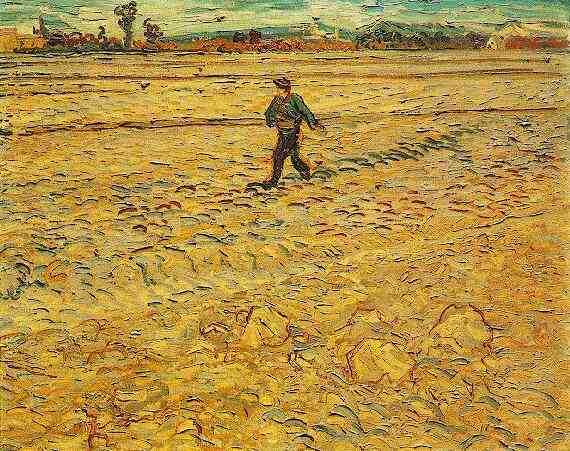
Luke 8:4-15 – Christ’s Parable of the Soils

While a large crowd was gathering and people were coming to Jesus from town after town, he told this parable: “A farmer went out to sow his seed. As he was scattering the seed, some fell along the path; it was trampled on, and the birds ate it up. Some fell on rocky ground, and when it came up, the plants withered because they had no moisture. Other seed fell among thorns, which grew up with it and choked the plants. Still other seed fell on good soil. It came up and yielded a crop, a hundred times more than was sown.”

When he said this, he called out, “Whoever has ears to hear, let them hear.”

His disciples asked him what this parable meant. He said, “The knowledge of the secrets of the kingdom of God has been given to you, but to others I speak in parables, so that,

“‘though seeing, they may not see;
    though hearing, they may not understand.’

“This is the meaning of the parable: The seed is the word of God. Those along the path are the ones who hear, and then the devil comes and takes away the word from their hearts, so that they may not believe and be saved. Those on the rocky ground are the ones who receive the word with joy when they hear it, but they have no root. They believe for a while, but in the time of testing they fall away. The seed that fell among thorns stands for those who hear, but as they go on their way they are choked by life’s worries, riches and pleasures, and they do not mature. But the seed on good soil stands for those with a noble and good heart, who hear the word, retain it, and by persevering produce a crop. (New International Version)

The Parable

“Whoever has ears, let them hear,” said Jesus. Truly hearing Christ’s words and listening with focused attention is paramount to the Christian life. Our ears are the soil of our lives. Ears attentive and devoted to listening to Jesus are good soil; ears distracted, inattentive, and stopped up with ear wax are bad soil. Receptive listening to the Word of God brings a fruitful harvest of righteousness, peace, and joy in the Holy Spirit. Genuinely believing what we hear from Jesus is crucial. God’s Word falls on four different soils….

  1. The seed on the path. A path is for walking, which is why the seed never takes root. Here there is no listening. When we act without listening, our actions will be misguided. 
  2. The seed on rocky soil.  Here there is no deep listening. A lack of attentive hearing results in a shallow person who perhaps relies more on Christian clichés or on their personality or abilities instead of the sown Word.
  3. The seed on the thorny soil. Here there is significant listening. However, there is too much listening to a cacophony of voices and not enough singular listening to the sown Word. Listening to the wrong voices will cause an unfruitful life. So, we must be careful to whom we are listening.
  4. The seed on good soil. A devoted listening to the Word without distraction leads to a productive, fruitful believer.

“There is a difference between listening and waiting for your turn to speak.”

Simon Sinek

The Nature of Parables

A parable is a genre of biblical literature. Parables are as much about concealing truth as they are conveying truth. A person must give focused attention to the story to learn from it, much like a good novel conveys truth about the human condition without being preachy or outright saying the truth. Or it’s much akin to a good movie relying on character development and the power of story for its message, instead of being a straightforward documentary.

Jesus neither strong-arms people nor puts them in a full nelson to force them into God’s will. We will miss out on God’s working, if we are looking for a big dramatic hoo-ha of an event. That’s because it comes as an awareness within people and works its way out. For those not intent on changing, they will find Christ’s words confusing. They might “hear” Jesus, yet fail to really listen, since they have their own ideas about how God ought to operate.

Yet, grace is still present. The very fact that Jesus addressed the crowd of people demonstrates he cared enough to communicate. He could have said, “Hey, you guys, get lost, I’m just going to interact with people who really listen to me.” Instead of coming at the crowd and bursting through the front door, Jesus mercifully came to them through the side door so that they would be able to receive the message. 

Puking the good news of Jesus all over people without really listening is a bad idea. Neither is being worried about saying something offensive, so nothing is said at all. A better approach is asking permission to tell your story of what Jesus means to you, or what you are learning from God’s Word.

The Parable Interpreted

The focus is the experience of the seed in a variety of soils. Outside powers acting on the Word – devouring birds, rocks, the burning sun, choking thorn-bushes – demonstrate the Word is central and needs to be received well:

  1. The path is the inability to hear God’s Word because of hard-heartedness. The devil snatches it before any real understanding can take place.
  2. The rocky soil is hearing just enough to respond with joy. But the person drops out when hard circumstances occur. “I didn’t sign up for this!” is their cry. They needed to count the cost of discipleship before responding to the message. This is merely a professing Christian, nothing more.  Rather than listening and internalizing the Word, there is only positive affirmation without any action or practice. So, tomorrow the message is gone and forgotten. When difficulty comes, there are no supporting words to draw from, so the person fades away, unable to navigate life successfully.
  3. The thorny soil also hears and responds to the message. This person is also a professing Christian, nothing more. The issue here is that they also listen to voices of worry and wealth. In a sort of spiritual attention-deficit-disorder, there is no ability to filter all the voices calling out, and so, no growth.
  4. Listening with the intention of understanding and putting into practice the message heard is what brings about fruit. Receiving the Word through careful listening brings about spiritual growth. God brings the growth when we focus on the Word. And when a whole group does this, then it creates a greenhouse effect in which people cannot help but grow in the Lord.

Conclusion to the Parable

The simple reception of God’s Word leads to fruitfulness. The first soil did not receive the Word, though it listened. The second received it with joy but under pressure let it go. The third received it with only one hand because the other hand was busy. Only the fourth soil received the Word with both hands.

Blessed is the one who does not walk in step with the wicked or stand in the way that sinners take or sit in the company of mockers, but whose delight is in the law of the Lord, and who meditates on his law, day and night. That person is like a tree planted by streams of water, which yields its fruit in season and whose leaf does not wither—whatever they do prospers. (Psalm 1:1-3, NIV)

The old adage that we were created with two ears and one mouth, so that we will listen twice as much talk, is a truism. It’s hard to receive any words of encouragement, help, or reproof if you’re tongue is flapping in the wind.

Careful listening, attention to memory, and patient application are the pathways to realizing an abundant spiritual harvest of righteousness and peace.

*Above paintings, The Sower by Vincent Van Gogh, 1881 & 1888