The Effects of the Fall (Genesis 6:11-22)

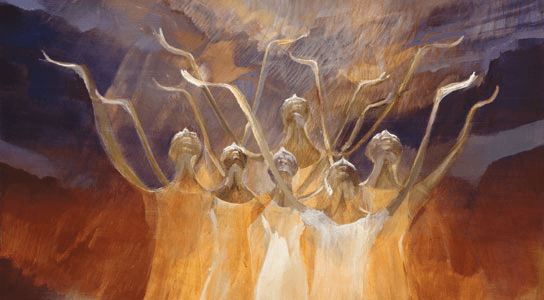
The Flood of Noah by Majd Ramadan, 2014

In God’s sight, the earth had become corrupt and was filled with violence. God saw that the earth was corrupt because all creatures behaved corruptly on the earth.

God said to Noah, “The end has come for all creatures, since they have filled the earth with violence. I am now about to destroy them along with the earth, so make a wooden ark. Make the ark with nesting places and cover it inside and out with tar. This is how you should make it: four hundred fifty feet long, seventy-five feet wide, and forty-five feet high. Make a roof for the ark and complete it one foot from the top. Put a door in its side. In the hold below, make the second and third decks.

“I am now bringing the floodwaters over the earth to destroy everything under the sky that breathes. Everything on earth is about to take its last breath. But I will set up my covenant with you. You will go into the ark together with your sons, your wife, and your sons’ wives. From all living things—from all creatures—you are to bring a pair, male and female, into the ark with you to keep them alive. From each kind of bird, from each kind of livestock, and from each kind of everything that crawls on the ground—a pair from each will go in with you to stay alive. Take some from every kind of food and stow it as food for you and for the animals.”

Noah did everything exactly as God commanded him. (Common English Bible)

The entire world is profoundly broken. 

Everywhere, people are messed-up. In one breath they can tell you they’re sorry for another’s abuse or violence against you, then turn right around and say some irrational nonsense and terribly insensitive things to you.

It doesn’t matter where you go – whether school, work, home and even church, there is institutional brokenness. Individual persons, and the human structures and systems they put in place, all contain elements of bondage instead of freedom. It doesn’t take a religious person to observe that there’s such a thing as sin.

Holy Scripture’s description of this sad reality goes all the way back to a story about the fall of humanity into sin and rebellion. Satan, the devil, led the original persons, Adam and Eve, into disobedience of God. Satan tempted Eve to doubt whether God really had her best interests at mind; to question the truthfulness of God’s Word; and, to wonder about the wisdom of listening to God (Genesis 3:1-5). Adam just flat out chose to disobey God, and, so, the entire world changed (Genesis 3:16-17). 

Immediately, everything was different in the world and with people. The choice to disobey God brought feelings of fear and shame; a loss of fellowship with God; hiding from God; a bent to pervert the truth; the propensity for the genders to try and dominate each other; expulsion from the garden; and physical death (Genesis 3:7-24). 

And the unholy tools people used against one another were violent and corrupt. People thought nothing of oppressing each other, abusing one another, attacking others – both verbally and physically. Rape, assault, theft, and murder became daily experiences. That’s some downright icky stuff. 

No wonder the world is messed up.

God saw that human evil was out of control. People thought evil, imagined evil—evil, evil, evil from morning to night. God was sorry that he had made the human race in the first place; it broke his heart. God said, “I’ll get rid of my ruined creation, make a clean sweep: people, animals, snakes and bugs, birds—the works. I’m sorry I made them.” (Genesis 6:5-7, MSG)

Noah was the only guy on the face of the earth for whom the Lord saw any good. And it was enough good worth saving. Yet, people are still in the nasty habit of turning on each other, like a bunch of sharks with blood in the water.

Unfortunately, the fall of humanity still affects us all. It has brought not only physical death, but spiritual death. That means we are alienated from God, in rebellion, and enslaved to our own passions and desires (Isaiah 1:2-6; Romans 2:14-15; Ephesians 2:1-3). 

We are also alienated from one another by having continual bents toward discord, suspicion, and jealousy instead of love and trust (Romans 1:29-31; James 3:14-16). 

We are even alienated and totally out of touch with ourselves by either loving ourselves as gods or hating ourselves with an inordinate emotional masochism (Philippians 2:21; 2 Timothy 3:2-4). In short, we are selfish people who experience separation from God, others, and self.

If this is the true reality of humanity, then it is awfully depressing, discouraging, and damaging. And we know it’s true because we’ve all been both victims and victimizers. So, who then, will rescue us from this horrific death? 

Thanks be to God who has given us the victory through our Lord Jesus Christ (Romans 7:24-25; 1 Corinthians 15:57). 

The good news is that, through the death and resurrection of Jesus, the curse has been reversed. Christ has restored us to our original place of fellowship with God. He is the way, the truth, and the life. In Christ, there is hope for humanity (John 14:6). 

To live in freedom, therefore, involves knowledge, honesty, and sincere decisions of faith and love whereby truth is applied to life.

Just as the world needed a thorough purging of evil through a cleansing worldwide flood, so we need a bath of grace, to be completely awash with the love of God in Christ, to have all the crud of evil scrubbed from our soul. And this is precisely what Christian baptism symbolizes.

Jesus offered himself for us so that we might live without violence and no longer be separated from God, others, and self. He has brought us reconciliation. In him we have been blessed with every spiritual blessing (2 Corinthians 5:16-19; Ephesians 1:3; 2 Peter 1:3).

In Christianity, the purpose of ministry is to come alongside people trapped in their awful cycles of brokenness and communicate good news of grace and forgiveness with both words and actions.

Although the world is terribly askew, God has demonstrated his love for us in that, while we were still violent and corrupt sinners, Christ died for us (Romans 5:8). 

We needed a Savior. God provided One. 

Are you in touch with the ways you are separated from God, others, and self? 

Are you aware of the ways in which your church or faith community has an unhealthy separation from the world? 

In what ways can you apply the love of God to broken people and systems in your community? What will it take to reach them?

Sin, guilt, shame, rebellion, disobedience, and violence need not define us. We can do better.

Almighty God, we have sinned against you, through our own fault, in thought, and word, and deed, and in what we have left undone. For the sake of your Son, our Lord Jesus Christ, forgive us all our offenses; and grant that we may serve you in newness of life, to the glory of your Name. Amen.

I Was (Not) Glad When They Said, “Let’s Go to Best Buy” (Psalm 122)

I was glad when they said to me,
    “Let us go to the Lord’s house.”
And now we are here,
    standing inside the gates of Jerusalem!

Jerusalem is a city restored
    in beautiful order and harmony.
This is where the tribes come,
    the tribes of Israel,
to give thanks to the Lord
    according to his command.
Here the kings of Israel
    sat to judge their people.

Pray for the peace of Jerusalem:
    “May those who love you prosper.
    May there be peace inside your walls
    and safety in your palaces.”
For the sake of my relatives and friends
    I say to Jerusalem, “Peace be with you!”
For the sake of the house of the Lord our God
    I pray for your prosperity. (Good News Translation)

I am confident, on this Black Friday, that the vast majority of Americans are on a different pilgrimage than the type described by David. They’re singing an alternative song and reading a secular psalm:

When they said, “Let’s go to Best Buy,”
    my heart leaped for joy.
And now we’re here, O Circuit City,
    inside the walls of electronic heaven!

The gaming systems! The glorious computer firewalls,
    all built as a place for unceasing worship!
Sin City, er, I mean Sim City, to which the gamers ascend,
    allows us to build a New Jerusalem in our own image.

Give thanks to all the Skylines and Rimworlds—
   
 this is what it means to be master of a small world.
Game of Thrones is the righteous judgment in my petty kingdom,
    a Kingdom at War with me as sovereign.

Pray for the peace of Wal-Mart!
    Prosperity to all you Target-lovers!
Friendly insiders, get along!
    Hostile outsiders, keep your distance!

For the sake of my family and friends,
    I say it again: live in peace, once I conquer you all!
For the sake of Amazon sales,
    I’ll do my very best to land the best deal on this holy Black Friday.

It’s not my purpose to try and be a prude (but I’m clearly not above doing some parody!) I just like how my spiritual forebears have chosen to mark time, events, and seasons – instead of how corporate and secular America chooses to. And I’m convinced I have a better life because of it.

As for me, I’ll stick with the ancient and historic way of pilgrimage, not the secular liturgy of Black Friday, Cyber Monday, etc. I’m going to sojourn through the year, as I do every year, marking my calendar with the rhythms of Christ’s incarnation, life, ministry, death, resurrection, ascension, and glorification.

We have now entered the new Christian liturgical year. Whereas most of Western society is holding to all sorts of holidays, mostly centering around a market economy and past political events, I’m choosing to build my year around the person and work of Jesus Christ.

If you’d like to participate in the movement of seasons and events along with me, then this is what we will be observing in this next liturgical year:

Advent (November 27–December 24, 2022)

Nativity of the Lord, Christmas Eve: December 24

The Christian Year begins not on January 1, but four Sundays before Christmas Day and up to Christmas Eve.  The purpose of Advent is to anticipate Christ’s incarnation and prepare Christians to celebrate the coming of Jesus. We are also reminded during the season of Advent that Jesus will return again at the end of the age.

Christmas (December 25, 2022–January 5, 2023)

Christmas Day: December 25

Yes, Christmas is more than just a day on the Church Calendar and encompasses the “12 Days of Christmas”.  Christmas is a full twelve days of celebrating the birth of Christ.

Epiphany (January 6–February 21, 2023)

Epiphany of the Lord: January 6

Baptism of the Lord: January 8

Transfiguration of the Lord: February 19

Epiphany follows Christmas up to the day before Ash Wednesday. The term Epiphany means “manifestation.”  This is a celebration of God’s revelation, his manifestation to the entire world, not just to the Jews, but to the Gentiles, as well. Epiphany emphasizes Jesus Christ’s earthly ministry of teaching, healing, and preaching.

Lent (February 22–April 8, 2023)

Ash Wednesday: February 22

Holy Week: April 2-8

Palm Sunday: April 2

Maundy Thursday: April 6

Good Friday: April 7

There are forty days (not including Sundays) in the season of Lent, from Ash Wednesday to Holy Saturday. Lent is a time to recall Christ’s temptation, conflict, suffering, and death. It is a season to contemplate Christian discipleship through the light of Christ’s Passion, engage in repentance, and put deliberate focus on spiritual disciplines that connect the penitent with Jesus.

Easter (April 9–May 27, 2023)

Resurrection of the Lord, Easter Sunday: April 9

Ascension of the Lord: May 18

As with Christmas, Easter is not just one Sunday; it is a season of fifty days up to the day of Pentecost. Easter, or “Eastertide,” celebrates the resurrection of Jesus; helps believers recognize new life in Christ; and includes celebrating the Ascension of the Lord.

Pentecost (May 28–December 2, 2023)

Day of Pentecost: May 28

Trinity Sunday: June 4

This season runs from Eastertide to the Sunday before Advent. Pentecost celebrates the gift of the Holy Spirit, the birth of the church, acknowledges personal and communal spiritual power, and calls Christians to rejoice in receiving God’s power.

Ordinary Time (May 28–December 2, 2023)

All Saints Day: November 1

Christ the King Sunday: November 26

This is the same season as Pentecost. Ordinary time (also known as Proper Time) refers to the ongoing work of the church to spread the gospel of Jesus Christ, which is the typical, expected, proper and ordinary work of ministry that Christ’s followers are to do.

Everybody likes a good deal, which is why everyone ought to love the good news of grace and forgiveness. It’s free but not cheap, and wildly generous while being, at the same time, costly, but definitely worth it.

Journeying with Jesus throughout the Christian Year helps us to receive the gospel of grace, especially when our post-holiday budget begins judging us.

Thanksgiving Day (Psalm 100)

By Rochelle Blumenfeld

Make a joyful noise to the Lord, all the earth.
    Serve the Lord with gladness;
    come into his presence with singing.

Know that the Lord is God.
    It is he who made us, and we are his;
    we are his people and the sheep of his pasture.

Enter his gates with thanksgiving
    and his courts with praise.
    Give thanks to him; bless his name.

For the Lord is good;
    his steadfast love endures forever
    and his faithfulness to all generations. (New Revised Standard Version)

On this day, many of us Americans will engage in our annual rituals. Several verbs characterize our activities. We will:

  • “Shout” at that crazy uncle
  • “Serve” the food
  • “Come” to the table and eat
  • “Know” how much preparation went into such a big spread
  • “Enter” the living room with praise because the Dallas Cowboys lost the game
  • “Give thanks” for food, family, and football

And at the end of the day, when everyone has finally quieted down with food comas, and crazy Uncle Frank is mercifully asleep in the recliner, that underneath it all, there really is love and gratitude for everything and everyone – even Uncle Frank and his now crazy snoring.

Today’s psalm is filled with verbs, actions for both believers and unbelievers, for the animate and inanimate, for the entire earth. When the psalmist, David, and other Hebrew writers penned their poetry, they centered what they most wanted to draw attention to in the middle, so that what came before it, and after it, pointed to that central message.

The center of Psalm 100 is this: Know that the Lord is God. There are three verb imperatives (commands) that come before this central encouragement; and then, three imperatives come after it. All six verbs help us to know God better. 

The three verbs that lead up to knowing the Lord:

  • Shout or “make a joyful noise” to the Lord
  • Worship or “serve” the Lord with gladness
  • Come into God’s presence with joyful songs 

The three verbs which follow the exhortation to know God and point back to it:

  • Enter the Lord’s gates and court with thanksgiving and praise
  • Give thanks to God
  • Praise or “bless” God’s name

To “know” God is more than to have some information or some understanding of theology; it is to take that knowledge and fully internalize the Lord, to have an experiential knowledge through relational intimacy. 

We know God by God’s historical work in Holy Scripture, God’s work in other people’s lives, and God’s work in our own lives. 

It’s important to have public opportunities of praising the Lord because it strengthens everyone’s faith. And gratitude to God centers us personally and corporately so that complaints and bitterness don’t take center stage.

Our stories of God’s work helps each other to know the Lord. And knowing God is what brings about life, purpose, hope, and love.

The Lord is worthy of all the praise, adoration, and worship we can offer. So, let us do it with heartfelt thanksgiving and some emotional flavor!

I am thankful for a great many things and a great many people. I am thankful for God’s Holy Word.  It literally is my food and drink. I cannot imagine being without it. I eat it every day and have a steady diet of the Spirit teaching me. 

One of my favorite places in the Bible has to do with knowing God:

I want to [experientially] know Christ—yes, to know the power of his resurrection and participation in his sufferings, becoming like him in his death. (Philippians 3:10, NIV)

Everything in the Christian’s life, whether good or bad, is designed to help us know Jesus better. Sharing our experiences with each other encourages us to keep living for Jesus.

So, in between all the turkey and stuffing, the family drama, and the football games, let us intentionally give thanks today, out loud, for all the ways God has worked and revealed grace to us.

Accept, O Lord, our thanks and praise for all that you have done for us. We thank you for the splendor of the whole creation, for the beauty of this world, for the wonder of life, and for the mystery of love.

We thank you for the blessing of family and friends, and for the loving care which surrounds us on every side.

We thank you for setting us at tasks that demand our best efforts, and for leading us to accomplishments that satisfy and delight us.

We thank you also for those disappointments and failures that lead us to acknowledge our dependence on you alone.

Above all, we thank you for your Son Jesus Christ; for the truth of his Word and the example of his life; for his steadfast obedience, by which he overcame temptation; for his dying, through which he conquered death; and for his rising to life again, in which we are raised to the life of your kingdom.

Grant us the gift of your Spirit, that we may know Christ and make him known; and through him, at all times and in all places, may give thanks to you in all things. Amen.

Hebrews 8:1-13 – Deliverance through a Manger

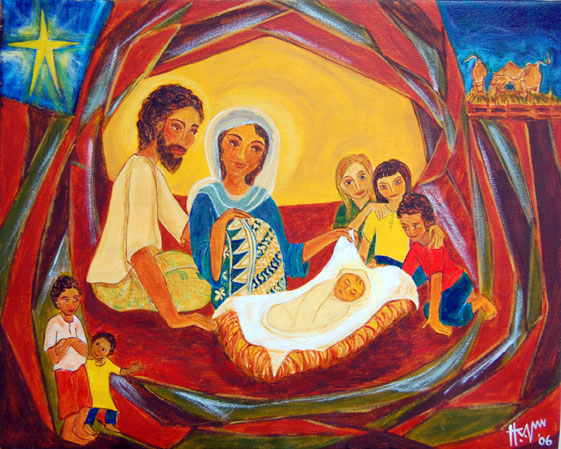
God Is With Us, by Malaysian artist Hanna Varghese, 2006

Now the main point of what we are saying is this: We do have such a high priest, who sat down at the right hand of the throne of the Majesty in heaven, and who serves in the sanctuary, the true tabernacle set up by the Lord, not by a mere human being.

Every high priest is appointed to offer both gifts and sacrifices, and so it was necessary for this one also to have something to offer. If he were on earth, he would not be a priest, for there are already priests who offer the gifts prescribed by the law. They serve at a sanctuary that is a copy and shadow of what is in heaven. Therefore, Moses was warned when he was about to build the tabernacle: “See to it that you make everything according to the pattern shown you on the mountain.” But in fact, the ministry Jesus has received is as superior to theirs as the covenant of which he is mediator is superior to the old one, since the new covenant is established on better promises.

For if there had been nothing wrong with that first covenant, no place would have been sought for another. But God found fault with the people and said:

“The days are coming, declares the Lord,
    when I will make a new covenant
with the people of Israel
    and with the people of Judah.
It will not be like the covenant
    I made with their ancestors
when I took them by the hand
    to lead them out of Egypt,
because they did not remain faithful to my covenant,
    and I turned away from them,
declares the Lord.
This is the covenant I will establish with the people of Israel
    after that time, declares the Lord.
I will put my laws in their minds
    and write them on their hearts.
I will be their God,
    and they will be my people.
No longer will they teach their neighbor,
    or say to one another, ‘Know the Lord,’
because they will all know me,
    from the least of them to the greatest.
For I will forgive their wickedness
    and will remember their sins no more.”

By calling this covenant “new,” he has made the first one obsolete; and what is obsolete and outdated will soon disappear. (NIV)

Our wait is nearly over. Christmas Day is almost here. The Messiah is coming. I genuinely believe that Jesus is the mid-point of history; everything for all time hinges upon Christ’s incarnation. The most cataclysmic event in the history of the world is a birth. The hopes of humanity are focused, of all things, in a stinky old feeding trough for animals – a manger.

Yes, Christians put a lot of focus on the cross and resurrection. Yet, the incarnation was the signature event of God’s breaking into this world. The inconceivable was conceived. God became human. Nothing would ever be the same again….

Nativity by African artist Joseph Mulamba-Mandangi, 2001

Jesus is our great high priest, the nexus between heaven and earth. All else are only mere shadows of the real Savior. Christ is the hinge upon which our own personal lives turn. The old system of law fades and gives way to the person for whom it all pointed. For the law, as important as it was, has never been able to save. In Christ there is a new covenant established by grace, taking care of the sin issue once for all.

Through the Christ child, all other means of deliverance have become obsolete. No matter how much he washed his hands, Pilate could not wash away his guilt. Despite all our efforts to hide or undo our shame, it will not go away. It is through Jesus that all guilt and shame have been banished. Human iniquity is taken away. All that we have done and left undone is forgiven – our sin is purged forever.

A new age has dawned. A new era has been inaugurated. The miracle of the Nativity explodes with continuing effect throughout history. Its continuing effects can still be felt, two-thousand years later. Nothing will ever undo the power of love and grace which was unleashed in the little town of Bethlehem.

Here is a clear and confident declaration to any and all in despondency or despair, no matter the reasons why: We may feel crushed, dejected, confused, or broken because of this past year’s events; but our salvation depends not on our mood or the constant changing of circumstances. Christ has offered himself once for all. The work is finished. Our faithful high priest is even now interceding for you and me in heaven.

Our faith is grounded not in our pedigree, our position, or our ability to produce but forever in what Christ has done in becoming human on our behalf. See the manger where he lies. Know that salvation is before us. Believe the promise of God.

May this eternal truth be always on our hearts:
That the God who breathed this world into being
Placed stars into the heavens
And designed a butterfly’s wing
Is the God who entrusted his life
to the care of ordinary people
became vulnerable that we might know
how strong is the power of Love
A mystery so deep it is impossible to grasp
A mystery so beautiful it is impossible to ignore.