How You Are Matters (Ruth 4:13-17)

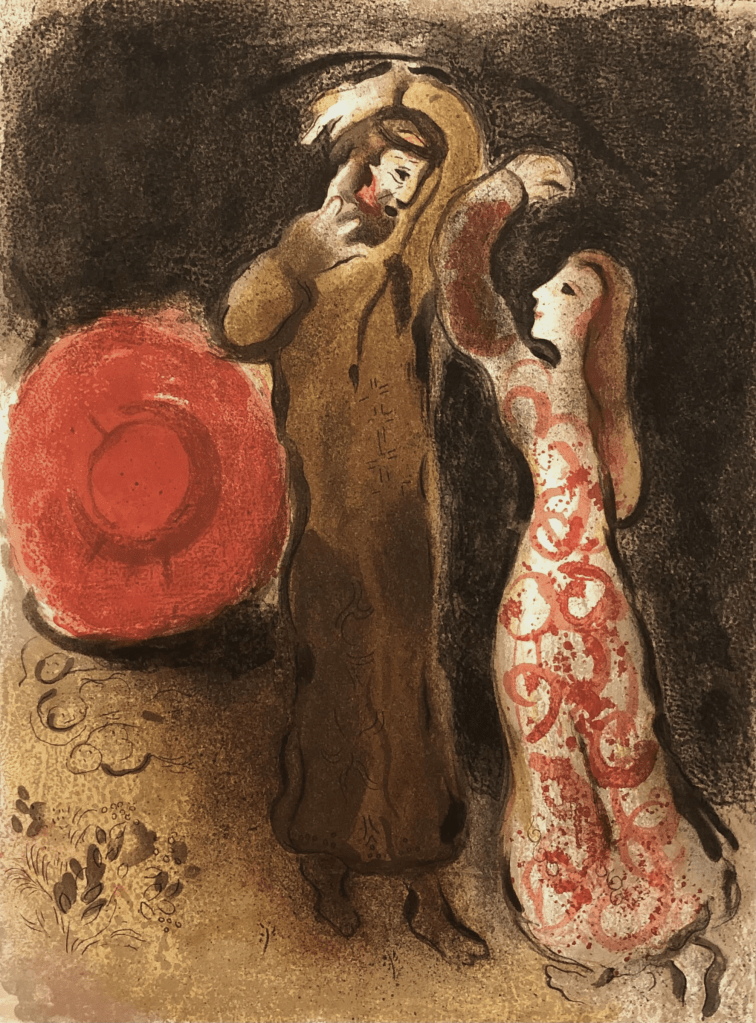
The Meeting of Ruth and Boaz by Marc Chagall, 1960

So Boaz took Ruth home as his wife. The Lord blessed her, and she became pregnant and had a son. The women said to Naomi, “Praise the Lord! He has given you a grandson today to take care of you. May the boy become famous in Israel! Your daughter-in-law loves you and has done more for you than seven sons. And now she has given you a grandson, who will bring new life to you and give you security in your old age.” Naomi took the child, held him close, and took care of him.

The women of the neighborhood named the boy Obed. They told everyone, “A son has been born to Naomi!”

Obed became the father of Jesse, who was the father of David. (Good News Translation)

Your Commitment Matters

Ruth, although not a Jew, committed herself fully to her Jewish mother-in-law and to the Jewish people. Her faithfulness mattered and eventually realized the blessing of family and community.

It wasn’t an easy path for Ruth to enjoy such blessing. She and her mother-in-law, Naomi, came to Bethlehem as two poor widows. Even though Bethlehem today is known around the world, back then there wasn’t much to it – just a small non-descript village in Judah a few miles south of Jerusalem.

Your History Matters

The Bible contains a lot of genealogies. Bible readers often skip over those portions of Holy Scripture to get to the more meaty and interesting stuff. But there’s a lot there.

Genealogies serve to remind us of who we are, where we have come from, and thus, what direction we are headed. Each and every human life has an historical context, a past which informs the present and can help guide for the future.

Naomi had a long history as part of the Jewish community. Ruth was a Moabite. Moab was an ancient kingdom which was located in the present day nation of Jordan. The original ancestor of the Moabites was Moab, a son of Lot. Lot was a nephew of the Jewish patriarch Abraham.

Moabites and Israelites didn’t get along. Moab had their own god, Chemosh, and did not serve Israel’s Yahweh. The person, Moab, was conceived under difficult and dubious circumstances – and it seems this context set the tone for the entire nation of people. (Genesis 19:30-38)

Our genealogical histories can bog us down or they can inspire us. Yet, the unseemly parts of our past family can actually serve to reveal something wonderful.

Your Receiving of Grace Matters

All genealogies are filled with less than stellar characters. But they’re also testaments to grace.

Both Ruth and her husband Boaz were recipients of the Lord’s grace.

Boaz, having a long history of the covenant as a Jew, nonetheless also had a difficult family past. Much like the conception of the ancient character of Moab, one of the ancestors of Boaz, Tamar, and one of the Jewish patriarchs, Judah, had a rather twisted experience. (Genesis 38:1-30)

Both Boaz and Ruth became great grandparents to King David. And they both are listed together in the opening genealogy of Matthew’s Gospel as ancestors to Jesus the Messiah, known as the son of David.

Grace changes history. If Jesus can have a genealogy, much like us, filled with both faithful committed people and dubious characters, then I believe we can give ourselves, and each other, a bit of slack on our shared human condition.

Your Spiritual Family Matters

For the Christian, there is an historical continuity across the millennia with our ancient spiritual forebears. The drama of redemption unveiled throughout the whole of Scripture connects us with Father Abraham, to the deliverance out of Egyptian slavery, to the saving events of Christ’s life, death, resurrection, and ascension, and beyond into the union of Christ and the Church.

A Moabite widow is redeemed into a new community. She marries a Jewish man and conceives a child in grace, born in the humble village of Bethlehem. Centuries later, another woman, Mary, experiences a conception of grace and gives birth to a child in the very same place – Christ the Lord, our Immanuel, God with us.

Jesus was born of David’s genealogical line, from ordinary people, just like Ruth and Boaz. Because it is only from humility that greatness can arise.

Your Faith Matters

Your faith and my faith grows in the context of an ordinary life. We live and move and have our being within the grace and providential care of God. Our faith is rooted in the soil of grace, anchored and moored in the deep of faithful servants who have gone before us.

Like Ruth, we humbly attach ourselves to a larger community and seek to give ourselves for the life of the world. Like Mary, we willingly confess to the angelic messenger:

“I am the Lord’s servant. May your word to me be fulfilled.” (Luke 1:38)

Our Father in heaven, you hold all that you have made within your gracious and merciful hand. Help us in all things to see your loving providence working out a good plan for the earth. Just as Ruth from Moab became one of your people, so you call us by name and hospitably invite us to your Table.

In Jesus Christ, our Redeemer, you meet us in the ordinary routines of our lives. You have graciously taken our pains, fears, sorrows, bitterness, guilt, shame, and sins upon yourself and given us a new life and a new community.Turn our suffering to glory, and our tears into joy.

Holy Spirit, giver of life, you guide us into grace and truth through generous love. As Boaz went out of his way to provide abundance for a poor widow, let us be generous with both our speech and our actions. Teach us to be alert to the needs of others so that everyone may have their daily bread.

Blessed Holy Trinity – Father, Son, and Spirit – the God whom we serve, you are our past, present, and future. We give you praise and commit ourselves to the words and ways of Jesus, in whose name we are bold to pray. Amen.

Your People Will Be My People (Ruth 1:6-18)

Naomi and Ruth by Chana Helen Rosenberg, 2017

When Naomi heard in Moab that the Lord had come to the aid of his people by providing food for them, she and her daughters-in-law prepared to return home from there. With her two daughters-in-law she left the place where she had been living and set out on the road that would take them back to the land of Judah.

Then Naomi said to her two daughters-in-law, “Go back, each of you, to your mother’s home. May the Lord show you kindness, as you have shown kindness to your dead husbands and to me. May the Lord grant that each of you will find rest in the home of another husband.”

Then she kissed them goodbye, and they wept aloud and said to her, “We will go back with you to your people.”

But Naomi said, “Return home, my daughters. Why would you come with me? Am I going to have any more sons, who could become your husbands? Return home, my daughters; I am too old to have another husband. Even if I thought there was still hope for me—even if I had a husband tonight and then gave birth to sons—would you wait until they grew up? Would you remain unmarried for them? No, my daughters. It is more bitter for me than for you, because the Lord’s hand has turned against me!”

At this they wept aloud again. Then Orpah kissed her mother-in-law goodbye, but Ruth clung to her.

“Look,” said Naomi, “your sister-in-law is going back to her people and her gods. Go back with her.”

But Ruth replied, “Don’t urge me to leave you or to turn back from you. Where you go I will go, and where you stay I will stay. Your people will be my people and your God my God. Where you die I will die, and there I will be buried. May the Lord deal with me, be it ever so severely, if even death separates you and me.” When Naomi realized that Ruth was determined to go with her, she stopped urging her. (New International Version)

Every time I read this account of Naomi and her daughters-in-law I’m reminded of my Dad because this was his favorite Old Testament story.

Dad was a lifelong farmer, and so, always related to the agrarian society of ancient Israel. But what really resonated for him in Scripture was Ruth’s response to her mother-in-law: “Your people are my people and your God my God. Where you die I will die, and there I will be buried.”

My father did not want to be a farmer. He wanted to go to college and become an engineer. In fact, without my grandfather’s knowledge, he was accepted to a university and secured an on-campus job. Yet, when Grandpa found out, he was less than pleased because Dad was needed on the farm during the depression era.

So, Dad, although he could have went to college, decided to stay on the farm. And the reason he decided to do so was not because he got his arm twisted, but because of the story of Ruth. He made the decision to stick with farming and never looked back. My Dad died ten years ago and is buried in the same cemetery as his father.

Ruth and Naomi by He Qi, 2001

The biblical character of Ruth is a solid example of one who was cognizant that she was part of a larger whole – that, although she was indeed an individual with personal choices, the decisions she made impact a much wider community. I believe Ruth discerned that the Israelite community understood this truth, and she wanted to be a part of it.

It is rare, in this age of extreme individualism, that people willingly give themselves to do what is best for the group, the family, the neighborhood, the faith community, the nation, and the world. There is a tendency to view things very narrowly in terms of what’s in it for me and ignore the rest.

So, I invite you to consider becoming ever more aware and connected to the communities around you. Discover the issues, problems, joys, sorrows, celebrations, and challenges they hold. And give yourself to the great struggles of that place. Jesus said:

If any of you want to be my followers, you must forget about yourself. You must take up your cross and follow me. If you want to save your life, you will destroy it. But if you give up your life for me, you will find it. (Matthew 16:24-25, CEV)

The One who is concerned to save the entire world only tolerates disciples who share his care for the entire human family.

Therefore, we ought neither to participate in nor support causes, activities, or speech that is harmful to others. Instead, we should find ways of using our particular gifts and abilities to serve the common good of all persons. We need more commitment and love, and a lot less anger, divisiveness, and hatred.

Grace and humility will always serve us, and others, very well. Judgment and pride, not so much.

Tell them to do good, to be rich in the good things they do, to be generous, and to share with others. (1 Timothy 6:18, CEB)

How, then, shall we live?

Your people will be my people.

Can you imagine a world in which all persons ascribe to this?

May it be so, to the glory of God.

We pray to you, Lord God, for all people everywhere:

For all people in their daily life and work;
For our families, friends, and neighbors, and for those who are alone.

For our community, the nation, and the world;
For all who work for justice, freedom, and peace.

For the just and proper use of your creation;
For the victims of hunger, fear, injustice, and oppression.

For all who are in danger, sorrow, or any kind of trouble;
For those who minister to the sick, the friendless, and the needy.

For the peace and unity of the Church;
For all who proclaim and seek the Truth.

Hear us, Lord; For your mercy is great. Amen.

The Heart of Words (Matthew 12:33-37)

A good tree produces good fruit, and a bad tree produces bad fruit. You can tell what a tree is like by the fruit it produces. You are a bunch of evil snakes, so how can you say anything good? Your words show what is in your hearts. Good people bring good things out of their hearts, but evil people bring evil things out of their hearts. I promise you on the day of judgment, everyone will have to account for every careless word they have spoken. On that day they will be told they are either innocent or guilty because of the things they have said. (Contemporary English Version)

Words are important. They have meaning and power.

Our speech is the outward demonstration of what is really within the heart. There really isn’t any room to believe that a constant stream of gossip, backbiting, slander, and negative comments is anything but coming from a heart of evil. The person who speaks such words is not a loving, gracious, merciful person. Conversely, the person who continually encourages, uplifts, and seeks to be positive, reflects a deep heart of love for others.

Therefore, simply altering our speech when we’re around particular people is not the point; and it does no good. That kind of talking only breeds hypocrisy and is two-faced. Instead, the place to aim is the heart because that’s where the words come from. And the way to truly renovate a heart is to sub-contract the project to Jesus.

The people we typically hang-out with the most are the people that most influence our attitudes and our speech. 

So, if we spend copious amounts of time with Jesus, it’s inevitable that our hearts will become more like his heart, and thus, our words will be in alignment with the words and ways of Christ. Be rooted in Christ and the fruit of the tree will demonstrate it.

I always find public confessions on TV to be a rather disingenuous affair. Typically, celebrity apologies only take shape when one has been caught saying something and are called on the carpet. Then, when the apology comes, it’s predictably odd and incongruent, with the person saying something to the tune of, “I’m sorry if I hurt anybody by what I said. Saying that really wasn’t me. I’m not really like that.”

Well, apparently you are. It came out of your mouth. Jesus said that out of the overflow of the heart the mouth speaks. The words we say out loud betray what is truly inside us.

Jesus used the metaphor of a tree to illustrate his point. If the roots, the trunk, and the branches are good and healthy, then you can be sure the tree will produce good healthy fruit. However, if the tree is diseased, or infested with insects and rotting from the inside out, then no one can expect anything other than bad fruit, not fit to consume.

If the fruit is bad, the tree is bad. If the words are hateful, sarcastic, passive-aggressive, manipulative, conniving, racist, hurtful, ignorant, mean, unjust, foolish, and either subtly or overtly abusive, then the person has a dark heart and is need of redemption, not excuses.

Conversely, if the words are affirming, encouraging, loving, compassionate, gentle, caring, direct, helpful, peaceful, kind, giving hope and life, then there is a good heart behind it.

Yes, bad hearts can parrot good words. However, those words are not genuine but mere rote recitations to achieve some sort of personal agenda. And, of course, good people will occasionally say dumb or hurtful words. In such times, let it be a reminder that we all have some shadowy places within our hearts – and that we must depend on God’s grace to enlighten those dark spaces.

Let’s observe patterns, rather than focusing on isolated events where either good or bad words were said. A consistent pattern of invalidating another’s experiences or feelings; intimidating or threatening others; dismissing or discounting someone’s input; or being unnecessarily blunt, are all major red flags pointing to a severe heart issue.

Evil exists in the world. And if we are not vigilant to the power of language, wickedness can easily smack us upside the head when we aren’t looking.

The heart cannot be concealed forever. Eventually, the virtuous person will be shown as such by the stream of gracious speech which pours forth from the heart, as if it were living water for others to drink and enjoy. Their words reflect their good character.

The wicked person, however, cannot keep the bad words down. Those vile words sit in the soul, poisoning and making the person ill. Then, all of a sudden, the evil words come up and out with a great vomitous heave and spew impurity and unholiness all over the innocent. Their words betray their foolish and poor character.

Every tree that does not bear good fruit will be cut down and thrown into the fire. The wicked heart will not be able to speak ill of others with impunity forever. They will be called to account for their abusive words, whether overtly violent, or subtly undermining.

The righteous heart, however, shall experience divine pleasure and reward, as if the careful construction of helpful and building up words wins first-prize at the great heavenly fair.

The good person loves and does not hate. They are so far from harming anyone that they even pray and wish well for their enemies. They pray for blessings on those who curse them. There is an honest striving to speak good words to everyone, regardless of who they are.

The upright heart thinks the best of everyone and holds nothing over someone else’s head. Such a good heart condemns no one, leaving all judgment to God alone. It is patient with the most exasperating of people, praying they might come to their senses and become spiritually healthy.

The righteous are able to use their speech to admonish their neighbor with care and affection. They freely forgive, happily give, liberally encourage, and use their tongue to speak words of life. Indeed, their speech is wise, humble, full of grace, and above all, loving.

Almighty God, to you all hearts are open, all desires known, and from you no secrets are hid: Cleanse the thoughts of our hearts by the inspiration of your Holy Spirit so that we may perfectly love you, and worthily magnify your holy Name; through Christ our Lord. Amen.

Because of Love (Psalm 21)

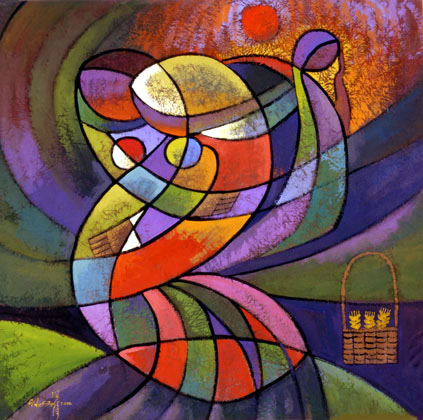
God Is Love by Lisa Voss, 2015

How the king rejoices in your strength, O Lord!
    He shouts with joy because you give him victory.
For you have given him his heart’s desire;
    you have withheld nothing he requested.

You welcomed him back with success and prosperity.
    You placed a crown of finest gold on his head.
He asked you to preserve his life,
    and you granted his request.
    The days of his life stretch on forever.


Your victory brings him great honor,
    and you have clothed him with splendor and majesty.
You have endowed him with eternal blessings
    and given him the joy of your presence.


For the king trusts in the Lord.
    The unfailing love of the Most High will keep him from stumbling.

You will capture all your enemies.
    Your strong right hand will seize all who hate you.
You will throw them in a flaming furnace
    when you appear.
The Lord will consume them in his anger;
    fire will devour them.

You will wipe their children from the face of the earth;
    they will never have descendants.
Although they plot against you,
    their evil schemes will never succeed.

For they will turn and run
    when they see your arrows aimed at them.
Rise up, O Lord, in all your power.
    With music and singing we celebrate your mighty acts. (New Living Translation)

The structure of today’s psalm is significant. Our contemporary way of crafting arguments is by stating a thesis at the beginning of a paper, then providing points of support for that thesis, and concluding with a restatement of the thesis. That’s not how the biblical psalms do it.

The psalm’s major thesis statement is not found at the beginning but in the middle. The verses before the major statement lead to the middle; and the verses after the middle look back and point to it.

So, what’s in the middle? An affirmation of faith in the Lord’s love prevents the king from having a failure of faith.

God’s love is smack in the middle because everything hinges on love.

The Lord leads us to victory, and prayers are answered because of love.

The Lord guides us toward prosperity of body and preservation of soul because of love.

The Lord shepherds us to the green pastures of blessing and encouragement because of love.

God is Love.

The Lord has our backs by eradicating the enemies to our souls.

The Lord follows after us and foils the evil plots of wicked people.

The Lord works behind the scenes for us, putting down devilish strategies so they won’t come near us.

Just as the core of God is love, we have been created in God’s image and likeness of love; love is the very core of our being.

So, why in the world are people not always loving in everything they do and say?

Because we have lost touch with our middle; we lack awareness of who we truly are.

How do we get in touch and reconnect with the core of our being? Here are a few simple ways of doing so:

  • Pray a psalm every single day, even multiple times in the day. Notice I said pray, not read. Psalms are prayers meant to be prayed. Reading them is wonderful but praying them is sublime!

I will praise you seven times a day because all your regulations are just. (Psalm 119:164, NLT)

Answer me, Lord, out of the goodness of your love; in your great mercy turn to me. (Psalm 69:16, NIV)

  • Pay attention to what makes you happy. The psalmist experienced God giving him the desires of his heart. He asked for what he wanted and needed to be happy.

Be happy with the Lord, and he will give you the desires of your heart. (Psalm 37:4, GW)

  • Pursue someone you’ve lost touch with. Reconnect with an old friend. Oftentimes, doing this helps reawaken a part of ourselves we forgot about.

Loyal love and faithfulness meet; deliverance and peace greet each other with a kiss. (Psalm 85:10, NET)

  • Practice self-care. Observe the Sabbath. Put your feet up. Give yourself a break. and don’t try to be perfect. Make some margin in your schedule – enough to have some extended times of silence and solitude. After all, one cannot connect with their inner core unless they are quiet enough to hear themselves.

When you are disturbed, do not sin;
    ponder it on your beds, and be silent.
Offer right sacrifices,
    and put your trust in the Lord. (Psalm 4:4-5, NRSV)

  • Praise the Lord and give thanks to God. Our self-awareness comes alive by means of offering trust and thanksgiving back to the Lord for the great things God has done.

Know that the Lord is God.
    It is he who made us, and we are his;
    we are his people and the sheep of his pasture.

Enter his gates with thanksgiving
    and his courts with praise.
    Give thanks to him; bless his name.

For the Lord is good;
    his steadfast love endures forever
    and his faithfulness to all generations. (Psalm 100:3-5, NRSV)

Since God is Love, God is in the middle and is the center of all things. Everything in the universe revolves around the Lord of Love. So, as we align our lives around this reality, we rediscover the love at the core of our being.

If we desire love, then let us go to the source of Love.

Bless us with love, O Merciful God, so that we may love as you love – and that we might be patient, tolerant, kind, caring, and loving to all people. Grant us your compassion so that we may help those in need. And bless us with your divine Love, O Lord, bless us with your love! Amen.