I Am Sending You (Judges 6:11-24)

The Messenger of the Lord came and sat under the oak tree in Ophrah that belonged to Joash from Abiezer’s family. Joash’s son Gideon was beating out wheat in a winepress to hide it from the Midianites. The Messenger of the Lord appeared to Gideon and said, “The Lord is with you, brave man.”

Gideon responded, “Excuse me, sir! But if the Lord is with us, why has all this happened to us? Where are all the miracles our ancestors have told us about? Didn’t they say, ‘The Lord brought us out of Egypt?’ But now the Lord has abandoned us and has handed us over to Midian.”

The Lord turned to him and said, “You will rescue Israel from Midian with the strength you have. I am sending you.”

Gideon said to him, “Excuse me, sir! How can I rescue Israel? Look at my whole family. It’s the weakest one in Manasseh. And me? I’m the least important member of my family.”

The Lord replied, “I will be with you. You will defeat Midian as if it were only one man.”

Gideon said to him, “If you find me acceptable, give me a sign that it is really you speaking to me. Don’t leave until I come back. I want to bring my gift and set it in front of you.”

“I will stay until you come back,” he said.

Then Gideon went into his house and prepared a young goat and unleavened bread made with 18 quarts of flour. He put the meat in a basket and the broth in a pot. Then he went out and presented them to the Messenger of the Lord under the oak tree.

The Messenger of the Lord told him, “Take the meat and the unleavened bread, put them on this rock, and pour the broth over them.” Gideon did so. Then the Messenger of the Lord touched the meat and the bread with the tip of the staff that was in his hand. Fire flared up from the rock and burned the meat and the bread. Then the Messenger of the Lord disappeared. That’s when Gideon realized that this had been the Messenger of the Lord. So he said, “Lord God! I have seen the Messenger of the Lord face to face.”

The Lord said to him, “Calm down! Don’t be afraid. You will not die.” So Gideon built an altar there to the Lord. He called it The Lord Calms. To this day it is still in Ophrah, which belongs to Abiezer’s family. (God’s Word Translation)

Today’s story is familiar in more ways than one. It’s a typical interaction between the Lord and the individual. And it’s also the typical way people respond to God, even now in our contemporary world.

Notice how the interaction between the Lord and Gideon unfolds:

The message: The Lord is with you. You are brave.

The pushback: It doesn’t look like the Lord is with our people (and a purposeful ignoring of the bravery thing).

The message: The Lord is sending you (and a purposeful ignoring of the pushback).

The pushback: I’m too weak for that.

The message: The Lord is with you. You got this.

The pushback: It can’t be me. Give me sign.

The message: I will stay. I am with you.

The pushback: I am not acceptable. Here’s an offering.

The message: Chill, dude. You’re wound way too tight. I am with you. You got this.

The acceptance of the message: Here’s an altar to remind me that God is here, and God calms my fear.

Sound familiar? How many times have you had a similar sort of interaction with the Lord?

The message: “Don’t be afraid. The Lord is with you. You have everything you need.” (assurance and reassurance)

The pushback: “Huh!? If I had everything I need, why are my circumstances so hard? Every time I turn around, there’s another adversity staring me in the face!” (ignoring the presence of God)

The message: “Go and make disciples. Love God. Love your neighbor.” (ignoring the bunny trail)

The pushback: “I’m the least gifted person in the world to be doing that sort of ministry.” (goes off point)

The message: “I am with you always until the end of time.” (stays on point)

The pushback: “It can’t be me. Give me a sign.” (i.e. I can’t accept myself, so there’s no way that you do!)

The message: “You will receive power when the Holy Spirit comes upon you.” (a demonstration of the presence)

The pushback: “I’m not the acceptable person for this… Here, I’ll put something in the offering plate.” (having a hard time wrapping head and heart around God’s grace)

The message: “You are anxious and upset about a great many things. I am with you. You got this.” (still remains on point)

The acceptance of the message: “Here I am, Lord, a living sacrifice.” (now on the same page with the Lord)

Christian ministry is not the absence of doubt or fear; it is doing what the Lord calls us to do, despite the surrounding circumstances.

We are never promised anywhere in Holy Scripture that life will be a bowl of cherries, that somehow circumstances will always be smooth. Instead, we are continually reminded of the promise that God is with us.

It’s the presence of the Lord that makes all the difference. Our abilities, or lack thereof, have nothing to do with the equation. We are already in the image and likeness of God, created with the inner resources to do the will of God.

The Lord is my shepherd;
    I have everything I need. (Psalm 23:1, GNT)

We have everything we need to live a life that pleases God. It was all given to us by God’s own power. (2 Peter 1:3, CEV)

You already have God’s acceptance; you don’t need to earn it.

“I now realize that it is true that God treats everyone on the same basis. Those who fear him and do what is right are acceptable to him, no matter what race they belong to.” (Acts 10:34-35, GNT)

When God promised Abraham and his descendants that the world would belong to him, he did so, not because Abraham obeyed the Law, but because he believed and was accepted as righteous by God. (Romans 4:13, GNT)

Honor God by accepting each other, as Christ has accepted you. (Romans 15:7, CEV)

There’s a lot we don’t know. Yet, what we do know is that God is with us and God has accepted us. And that’s all we need to hang our hat on.

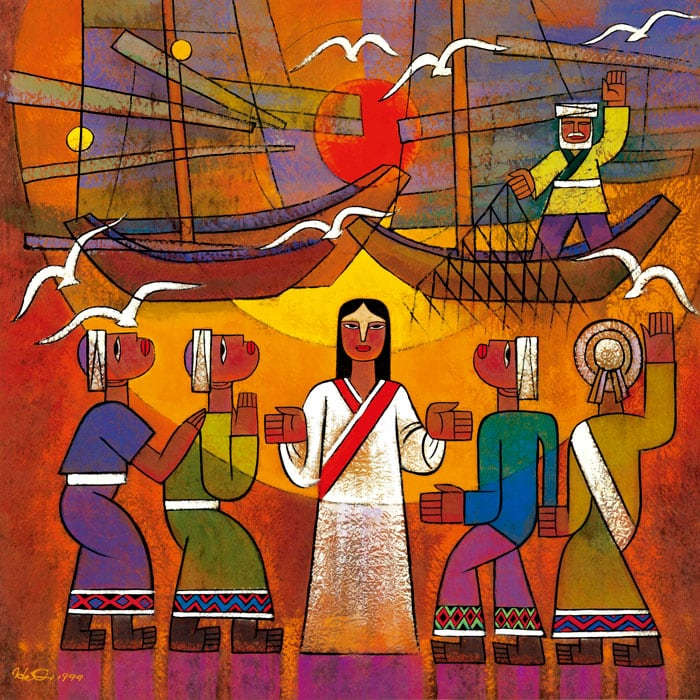
The Ministry of Jesus (Matthew 4:12-23)

Jesus Calls His Disciples by He Qi

When Jesus heard that John had been put in prison, he withdrew to Galilee. Leaving Nazareth, he went and lived in Capernaum, which was by the lake in the area of Zebulun and Naphtali—to fulfill what was said through the prophet Isaiah:

“Land of Zebulun and land of Naphtali,
    the Way of the Sea, beyond the Jordan,
    Galilee of the Gentiles—
the people living in darkness
    have seen a great light;
on those living in the land of the shadow of death
    a light has dawned.”

From that time on Jesus began to preach, “Repent, for the kingdom of heaven has come near.”

As Jesus was walking beside the Sea of Galilee, he saw two brothers, Simon called Peter and his brother Andrew. They were casting a net into the lake, for they were fishermen. “Come, follow me,” Jesus said, “and I will send you out to fish for people.” At once they left their nets and followed him.

Going on from there, he saw two other brothers, James son of Zebedee and his brother John. They were in a boat with their father Zebedee, preparing their nets. Jesus called them, and immediately they left the boat and their father and followed him.

Jesus went throughout Galilee, teaching in their synagogues, proclaiming the good news of the kingdom, and healing every disease and sickness among the people. (New International Version)

What is “ministry”? 

For some, ministry is only about the souls of people; it is seeing as many people respond to the message of salvation in Christ as possible. 

For others, ministry is meeting the tangible needs of people because there is such a breadth and depth of human social and physical problems. 

And, for others, ministry is defined in terms of what takes place within the four walls of a church building, led by pastors and church leaders.

“Ministry takes place when divine resources meet human needs through loving channels to the glory of God.”

Warren Wiersbe

Problems, however, arise whenever we:

  • Focus on one dimension of ministry. Because, in reality, ministry is multidimensional.
  • Fulfill the outward, administrative demands of ministry – without going after the relational heart of what ministry entails. 
  • Forget about whole groups of people who are different than us. Ministry is for everyone, not some.

We need to look at the ministry of Jesus – what he did and why he did it. Christ’s purpose is to be our purpose: Minister to the total life of all people.

Jesus Preaching

Before there were newspapers, CNN, and 24 hour news cycles, ancient people heard what was happening from heralds or preachers who loudly announced in the streets the important news of the day.

Jesus had a ministry to both Jew and Gentile. Although his ministry was chiefly directed toward his fellow Jews, Christ went out of his way to engage Gentiles, as well, with a message of repentance.

Repentance is turning the whole person – body, soul, mind, will, and emotions – from sin and disobedience to God in obedience to the message of Christ. It involves humility, sorrow for sin, and a commitment to following Jesus.

To repent doesn’t mean to manage sin or clean up parts of my life; it’s a radical conversion from an old way of life to a new way of life. Repentance is not simply adding Jesus to our schedule but is a complete change of how we live.

Christianity is a life, not just an event. Following Jesus is a journey, a life-long process of inner transformation; a complete forsaking of anything that does not please God; and a desire to reorient my life around what’s important to God. 

To illustrate this in a contemporary context, I ask, “What does it mean to follow the Green Bay Packers football team?” A fan not only watches all the games from start to finish, but cheers loudly for the Packers; talks about the Packers with everyone, even strangers; and doesn’t cheer for the Chicago Bears! Fans are committed to their team.

The difference, however, between football and Christianity, is that followers of a team are fans, whereas followers of Jesus are not fans in the stands or watching the television. Instead, Christ followers are on the field of play as teammates with Jesus.

So, when it comes to repentance, we turn from being fans of Jesus to followers of Jesus, doing what he did and saying what he said. We are active participants in the kingdom of God – embracing and embodying a message of repentance to new life in Christ.

Jesus Calling

Jesus calling the first disciples illustrates the kingdom message: a radical break with the old life. Each disciple walked away from a good life and embraced of a new life following Jesus.

Some understanding of Jewish culture in the time of Jesus is helpful here. Central to the life of any Jew was the Torah, the Law. Around age 6, Jewish boys would begin to go to the synagogue for schooling in the Torah by the local rabbi. 

This first level of education was called Beth Sefer (“House of the Book”) and would last until about age 10. In those four years, the first five books of the Old Testament, the Pentateuch, were thoroughly memorized.

By age 10, some of the boys would distinguish themselves as good students and able to handle Torah. So, they would continue on in the second level of schooling called Beth Talmud (“House of Learning”). Those that did not continue with school would then learn the family trade and become an apprentice. Those that went on with school would then memorize the rest of the Old Testament.

At about age 14, only the best of the best were studying Torah. At the completion of their studies, they would apply to a well-known rabbi in order to become his disciple. The goal of this third level was to become just like the rabbi. This was called Beth Midrash (“House of Study”). The rabbi essentially interviews the teenager to find out if he has the stuff to become like the rabbi. 

If the rabbi believes the kid doesn’t have it in him, he tells him to go back to the family business. If, however, the rabbi grills the kid and finds he has what it takes, then he will say to him, “Come, follow me.” It was considered a great privilege and opportunity, and the teenager would leave everything to literally follow the rabbi everywhere he went.

Now, let’s return to Christ’s disciples. Jesus calls Andrew, Peter, James, and John. At the time, they were fishing because they were fishermen. That meant somewhere along the line they didn’t have what it took to further their education, or to follow a rabbi. 

Let’s, then, not miss the import and impact of Jesus saying to them, “Come, follow me!”  Jesus is expressing a belief that these men can become just like him. Well, of course you drop your nets and follow him! Jesus believes I can be like him! Jesus took a group of young men who couldn’t make the grade and used them to change human history. 

Jesus also says the same thing to you and me: I choose you. Come, follow me. 

Christ believed in us before we believed in him. Yes, Jesus believes you can do all the work of embodying the very words of God and becoming like him.

The attitude here is not, “Oh, geez, I have to go do ministry,” as if I were a teenager who was just asked to do the dishes. Rather, the attitude is of privilege and opportunity. If we fail to view ministry in this way, then we must come back to the message of repentance and have an attitude adjustment. People who follow Jesus do so because they get to, not because they have to.

Jesus Healing

            Envision yourself walking with Jesus and following him. You observe several things about his ministry of healing:

  • Jesus heals every problem. Christ has the power and authority to do so.
  • Jesus heals the whole person – not just the physical, or just the spiritual.
  • Jesus heals people whether they repent or not. Christ never made repentance a prerequisite for healing. He heals simply because he wants to.
  • Jesus heals to defeat the devil. Christ continually looks to reverse the hold that sin has on people.
  • Jesus chose to focus on healing the destitute, the poor, and the disadvantaged – rather than directing ministry to the higher classes and royalty to mediate his wishes to the people.

Who are the people – the least, the lonely, the lost – in need of healing in your family, neighborhood, and community?

  1. Those who are ill with various diseases
  2. Those suffering severe pain – of body, mind, emotion, and spirit
  3. The demon possessed or demonically influenced
  4. Prisoners and ex-convicts
  5. The working poor, and the elderly poor
  6. Those in the hospital with no one to visit them
  7. Those who grieve alone
  8. Those with addictions and behavioral issues
  9. Victims of verbal or physical abuse
  10. And many, many more….

Jesus had a ministry of both word and deed. To follow Christ is to become like him and pass on what we have learned to reliable people who will do the same.

Shining the Light on Fear (Psalm 27:1-6)

The Lord is my light and my salvation.
        Should I fear anyone?
    The Lord is a fortress protecting my life.
        Should I be frightened of anything?
When evildoers come at me trying to eat me up—
    it’s they, my foes and my enemies,
    who stumble and fall!
If an army camps against me,
        my heart won’t be afraid.
    If war comes up against me,
        I will continue to trust in this:
    I have asked one thing from the Lord—
    it’s all I seek:
        to live in the Lord’s house all the days of my life,
        seeing the Lord’s beauty
        and constantly adoring his temple.
Because he will shelter me in his own dwelling
    during troubling times;
    he will hide me in a secret place in his own tent;
        he will set me up high, safe on a rock.

Now my head is higher than the enemies surrounding me,
    and I will offer sacrifices in God’s tent—
        sacrifices with shouts of joy!
    I will sing and praise the Lord. (Common English Bible)

Being afraid of the dark is a common fear. After all, whenever we cannot see anything around us, then we don’t know what’s really there – and that’s understandably frightening for most people. Typically, it’s not what we see that’s so scary; the scary stuff is what our imagination conjures up that’s out there in the dark, which we cannot see.

Kids, with their curiously active imaginations, tend to be fearful of the dark – which is why we parents, and grandparents, ensure there’s a nightlight for them so they can sleep. The light illumines their surroundings, reminding them of where they are; the light also helps them remember that we are with them.

As children of God, we need the same reminders. We must continually check-in with our internal selves, reorienting our lives around the reality that the Lord is present, that Jesus is our Immanuel, God with us.

Having the Light of the World surrounding us provides confidence that God is watching and will save us from whatever threatens our life. Indeed, being immersed in the Lord helps us snuggle down and realize our ultimate security blanket holds us tight.

Not only do we have confidence with God’s presence, but we are also fearless in the face of the most adverse and scary of circumstances. Knowing that God has our back enables us to accept, cope, and transcend overwhelming situations.

God protects because God is present.

Admittedly, we don’t have all the answers as to why the Lord sometimes seems absent in the midst of our trouble. That’s maybe because God is a Being, a Person, and not an insurance policy. Ultimately, personal presence and protection is a whole lot better than the impersonal and legal sort.

Which is why it’s important to delight in the Lord, to enjoy being in God’s house, to bask in the beauty of divine holiness, righteousness, and justice. With this as our way of life, we tend to better understand that not everything is necessarily going to go right but that the Lord is alongside us, giving strength and hope.

It’s important to note that divergent emotions can be held together. Many folks tend to believe that if there is fear within the heart, then faith, courage, and praise cannot exist. But nothing could be further from the truth.

The more likely scenario is that trying to suppress feelings of fear only results in becoming more afraid; thus, leading to forced or manufactured praise with little to no bravery behind it.

Instead, the sage thing to do is acknowledge whatever emotions bubble up for us. That is our inner spirit’s way of alerting us that we must pay attention to something. Ignoring the fear makes the monster under the bed more fearsome.

Being aware of the emotion and acknowledging it brings options and choices. Getting it out there to actually feel it means that now we can choose what we’re going to do with the emotion. Hiding the fear only gives it power; naming the fear gives us control over it.

This is one reason why I believe it is significant to read the psalms out loud; it provides more fortitude in dealing with what’s in front of us.

Holding both our fears and our faith together enables us to face our troubles with wisdom and courage. If attacked – whether it be spiritual, emotional, mental, or physical – the worst thing to do is grin and bear it or plaster a fake smile on your face.

It’s okay to be conflicted, to wonder what the heck is going on, to not know what’s up or down, to live with the seeming incongruence of emotions.

Healing comes through feeling, speaking, and acting – and not by suppressing emotions, keeping words bottled up inside, and acting as though everything is peachy keen when it isn’t. Expressing words of trust in the Lord, without having first expressed words describing our emotions, is a fool’s errand. If we trust God to answer a prayer, then we also need to trust God in hearing our real emotions.

God encourages honesty, sincerity, and feeling; the Lord disparages ingenuine offerings of praise and inauthentic gestures merely meant to fake-it-till-you-make-it. The psalmist encourages us to express all our emotions – whether “positive” or “negative” – and find the empathy, solidarity, and healing we need.

God is our light. So, let’s not keep him in the dark about our real selves.

Keep the Main Thing the Main Thing (Galatians 2:1-10)

Fourteen years after that first visit, Barnabas and I went up to Jerusalem and took Titus with us. I went to clarify with them what had been revealed to me. At that time I placed before them exactly what I was preaching to the non-Jews. I did this in private with the leaders, those held in esteem by the church, so that our concern would not become a controversial public issue, marred by ethnic tensions, exposing my years of work to denigration and endangering my present ministry.

Significantly, Titus, non-Jewish though he was, was not required to be circumcised. While we were in conference we were infiltrated by spies pretending to be Christians, who slipped in to find out just how free true Christians are. Their ulterior motive was to reduce us to their brand of servitude. We didn’t give them the time of day. We were determined to preserve the truth of the Message for you.

As for those who were considered important in the church, their reputation doesn’t concern me. God isn’t impressed with mere appearances, and neither am I. And of course these leaders were able to add nothing to the message I had been preaching. It was soon evident that God had entrusted me with the same message to the non-Jews as Peter had been preaching to the Jews.

Recognizing that my calling had been given by God, James, Peter, and John—the pillars of the church—shook hands with me and Barnabas, assigning us to a ministry to the non-Jews, while they continued to be responsible for reaching out to the Jews. The only additional thing they asked was that we remember the poor, and I was already eager to do that. (The Message)

The former devout Jew, Saul, had become the Christian apostle and missionary, Paul. His ministry was as radical and dramatic as his conversion to Christianity was.

The Struggle

Keep in mind that the earliest church was predominantly made up of Jewish Christians. They had to struggle with the relationship between their historic Judaism and their newfound Christianity. For many of them, Paul was doing the unthinkable; he not only purposely sought to reach Gentiles (non-Jewish people) with the message of Jesus Christ, but he also did not require them to be circumcised. For Paul, one did not have to first become Jewish before becoming Christian.

Paul doggedly sought to preserve the core essence and spirit of Christ’s message, that is, to proclaim the good news of forgiveness and new life through the person and work of Jesus – and not by means of retaining Jewish customs or laws, including circumcision.

The Main Thing

Christianity is more than set of beliefs and practices; it’s a way of life which can be summed up in three important words: faith, hope, and love. 

Both new believers in Jesus and veterans in the faith know from experience how difficult it can be to live the Christian life. One reason for this difficulty, even when we want to please the Lord, is due to the confusion that occurs between our inner feelings and our outer actions.

The Confusion

The confusion starts with the creation and fall of humanity. In the beginning, God created humans as persons with a divine/human relationship as central to daily life. (Genesis 1:26; 2:16-25) 

What’s more, God created people with the capacity to receive divine revelation through our ability to think and reason. (Ephesians 4:24; Colossians 3:10) 

Before disobedience entered the world, in the original state before humanity’s fall, all human functions were under complete control with an inner experience of unity and harmony with one another and God. (Genesis 1:31; 2:7, 16-25) 

It is imperative for us to recognize the distinction between our personal being and our personal functions. (Romans 1:21-32; 6:16-22; 1 Corinthians 9:27; Ephesians 4:21-32)

If we don’t grasp how cataclysmic the fall of humanity was, we are going to have big struggles with living the Christian life – illustrated in the way that Paul needed to fend off a bunch of professing Christians who still seemed spiritually stuck. 

The Disobedience

In Adam and Eve’s original disobedience to God, the authority for life was transferred from God to us so that our sinful bent is to call our own shots without God. The source of authority also got whacky, transferred from a holistic and synergistic approach of body, mind, emotions, and spirit to a one-dimensional approach of simply how we feel at any given moment.

If we fail to understand this dynamic, we will be continually frustrated with people because they do irrational things. For example, many church pastors are flabbergasted that parishioners do not simply take what they teach them and go and do it. Yet, if it were that simple, there would be no place for the Holy Spirit!

Unfortunately, there’s more. In humanity’s fall, we lost control of our capacity to function well. We are all now vulnerable to manipulation, too easily swayed by the surrounding culture, and, of course, Satan. (Ephesians 2:2-3; Galatians 5:16-21) 

As a result, our inner conscience has become confused. We are not always certain of right and wrong. We misunderstand what life is really supposed to be all about. 

We lose sight of the main thing. And, in that state, there’s no way we can keep the main thing the main thing.

Instead, we become obsessed with feeling comfortable and secure; so, we pursue false gods – leaving usdisappointed and with a lack of fulfillment in life.

The Good News

However, the good news is that through the redeeming work of Jesus Christ, new life emerges; the bondage of sin is broken in our lives, and we are legally reinstated in a relationship with God in which the Lord is central in our daily life and the final authority. 

In this new relationship we can again receive truth through the Holy Spirit and the Holy Scriptures. We regain control of our functions. 

Yet, unless we learn the Scriptures and growin a daily walk with Jesus, the practical experience of this relationship with all its freedom, joy, assurance,  power, and fruitfulness may be greatly limited. (Romans 7:14-25; 1 Corinthians 3:1-4)

Even though we have redemption and faith, it is still possible to regress and give in to our old ways of functioning. This is a big reason why Christians can experience conflict, doubt, fear, anxiety, frustration, disappointment, and confusion.

To live keeping the main thing the main thing means to grow in the experience and application Christ’s centrality and authority in our lives. 

The Awareness

We must, therefore, make daily decisions of faith, hope, and love based in who we are in Christ and recognize his authority in our lives. The following seven recognitions and awareness may be helpful for you in experiencing Christian freedom and unity:

  1. You are a person with the ability to function in faith, hope, and love as God’s beloved child in Christ (2 Corinthians 7:1; Romans 8:14-17)
  2. There is a difference between who you are and what you do (or don’t do).  Evil thoughts and emotions do not make you evil, anymore than fantasizing about being a unicorn makes you a unicorn.
  3. You can take charge of your actions and your life (Galatians 5:22-23)
  4. The key is the use of your will through living in harmony with revealed biblical truth. In other words, you really can make choices of faith, hope, and love, no matter the situation. (Romans 4:17-21; Psalm 56:3; Psalm 43:5-11)  
  5. Reject whatever is contrary to Scripture, reason, and conscience. Listen to your whole self. Unhealthy patterns of acting and speaking must be broken in Jesus’ name. (Ephesians 4:22; Colossians 3:5-9; Titus 2:11-12)
  6. Choose to obey the Holy Spirit and the Holy Scriptures. Learn to think and act on the basis of truth. (Acts 27:25)
  7. Practicing the truth results in freedom, a re-patterning of thinking and functions, as well as the fruit of the Spirit. (John 8:32; Titus 2:11-14; Philippians 2:12-16)

The church is intended to be a supportive community of fellow redeemed people who worship and love Jesus together. 

Without sharing our collective learning of the Scriptures and daily struggles of faith, hope, and love, believers will inevitably be spiritually immature over the long haul. Instead, talk about your shared experiences of worship, Scripture reading, and Christian living. 

In doing so, God is glorified, the church is strengthened, and the cranky circumcisers are seen as the legalistic lunkheads they really are.