Some Well-Ordered Wisdom (Psalm 37:1-17)

Don’t be worried on account of the wicked;
    don’t be jealous of those who do wrong.
They will soon disappear like grass that dries up;
    they will die like plants that wither.

Trust in the Lord and do good;
    live in the land and be safe.
Seek your happiness in the Lord,
    and he will give you your heart’s desire.

Give yourself to the Lord;
    trust in him, and he will help you;
he will make your righteousness shine like the noonday sun.

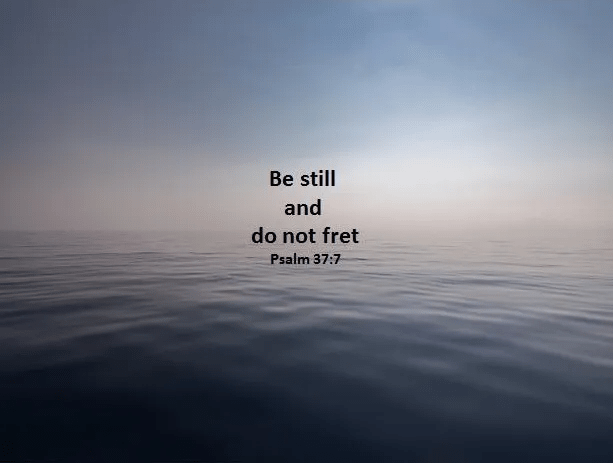
Be patient and wait for the Lord to act;
    don’t be worried about those who prosper
    or those who succeed in their evil plans.

Don’t give in to worry or anger;
    it only leads to trouble.
Those who trust in the Lord will possess the land,
    but the wicked will be driven out.

Soon the wicked will disappear;
    you may look for them, but you won’t find them;
but the humble will possess the land
    and enjoy prosperity and peace.

The wicked plot against good people
    and glare at them with hate.
But the Lord laughs at wicked people,
    because he knows they will soon be destroyed.

The wicked draw their swords and bend their bows
    to kill the poor and needy,
    to slaughter those who do what is right;
but they will be killed by their own swords,
    and their bows will be smashed.

The little that a good person owns
    is worth more than the wealth of all the wicked,
because the Lord will take away the strength of the wicked,
    but protect those who are good. (Good News Translation)

Today’s Psalm feels as if it could be in the book of Proverbs; it’s chocked full of wisdom sayings. And wisdom is most definitely something you, me, and the entire world needs. Indeed, we have enough fools around us running their mouths with a bunch of gobbledygook that’s nonsensical and meaningless.

We need helpful language and well-ordered words which reflect our ordered creation.

The underlying assumption of all biblical wisdom literature is that our world has been created by God with a material and moral order built into it.

That means that to buck this order is stupid and foolish. Somebody who walks off the roof of their house because they don’t believe in gravity will experience the harsh reality of that belief. Likewise, anyone who walks any old way they want in this world, without regard to the divine force operating within it, is going to experience a broken spirit.

Our human well-being depends on knowing the ordered creation we inhabit. There are social expectations which need to be realized in order to conform and be in sync with the natural (and supernatural!) universal rhythms all around us. Those expectations are framed for us as wisdom sayings.

Our actions and inactions have consequences. It’s our task to gain experiential knowledge as we move about this earth and interact with others. Notice I did not say we need to be perfect. No, instead, we are continually in a mode of improvement – seeking and learning to be better and do better.

And one of the things we all must discover is that our own personal actions and attitudes effects the entire surrounding community.

Biblical wisdom literature communicates how we receive blessing and how we hold onto it. True wisdom is to live in a responsible awareness of both Creator and creation – and then to make appropriate choices which will bless God and others.

So, in our Psalm for today, we have some wise choices to make that put us in the groove of how things are ordered and established:

  • Don’t worry about the evil simpletons around you. Why? Because in the Lord’s well-ordered world, the wicked cannot and will not survive; their end is certain, just as sure as death and taxes.

Those who are evil—
they are like straw
    blown by the wind.
Sinners won’t have an excuse
    on the day of judgment,
and they won’t have a place
    with the people of God.
The Lord protects everyone
    who follows him,
but the wicked follow a road
    that leads to ruin. (Psalm 1:4-6, CEV)

  • Trust the Lord. Everything changes. Everyone is fickle. Why trust? Because God, unlike everything and everyone else, is consistent, stable, and always true to character.

Trust God from the bottom of your heart;
    don’t try to figure out everything on your own.
Listen for God’s voice in everything you do, everywhere you go;
    he’s the one who will keep you on track. (Proverbs 3:5-6, MSG)

  • Be patient and wait on the Lord. Why? Because God is good, all the time, and has only good plans in mind for you and me. We short circuit what God is doing whenever we fail to have patience.

Be patient, then, brothers and sisters, until the Lord’s coming. See how the farmer waits for the land to yield its valuable crop, patiently waiting for the autumn and spring rains. You too, be patient and stand firm, because the Lord’s coming is near. (James 5:7-8, NIV)

The best things in life are internal, not external. One’s inner well-being, peace of mind, emotional awareness, and spiritual health are worth infinitely more than any title, position, wealth, or delusions of control.

A well-ordered life comes from tapping into the divine resources available to us.

Grant us patience, O Lord, to follow the road you have taken. Let our confidence not rest in our own understanding but in your guiding hand; let our desires not be for our own comfort, but for the joy of your kingdom; for your cross is our hope and our joy now and unto the day of eternity. Amen.

– A Prayer of St. Augustine

Changing the System (Philemon 1-25)

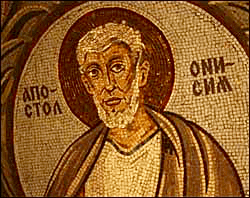
A mosaic of Philemon’s slave, Onesimus

Paul, a prisoner of Christ Jesus, and Timothy our brother,

To Philemon our dear friend and fellow worker—also to Apphia our sister and Archippus our fellow soldier—and to the church that meets in your home:

Grace and peace to you from God our Father and the Lord Jesus Christ.

I always thank my God as I remember you in my prayers, because I hear about your love for all his holy people and your faith in the Lord Jesus. I pray that your partnership with us in the faith may be effective in deepening your understanding of every good thing we share for the sake of Christ. Your love has given me great joy and encouragement, because you, brother, have refreshed the hearts of the Lord’s people.

Therefore, although in Christ I could be bold and order you to do what you ought to do, yet I prefer to appeal to you on the basis of love. It is as none other than Paul—an old man and now also a prisoner of Christ Jesus—that I appeal to you for my son Onesimus, who became my son while I was in chains. Formerly he was useless to you, but now he has become useful both to you and to me.

I am sending him—who is my very heart—back to you. I would have liked to keep him with me so that he could take your place in helping me while I am in chains for the gospel. But I did not want to do anything without your consent, so that any favor you do would not seem forced but would be voluntary. Perhaps the reason he was separated from you for a little while was that you might have him back forever—no longer as a slave, but better than a slave, as a dear brother. He is very dear to me but even dearer to you, both as a fellow man and as a brother in the Lord.

So if you consider me a partner, welcome him as you would welcome me. If he has done you any wrong or owes you anything, charge it to me. I, Paul, am writing this with my own hand. I will pay it back—not to mention that you owe me your very self. I do wish, brother, that I may have some benefit from you in the Lord; refresh my heart in Christ. Confident of your obedience, I write to you, knowing that you will do even more than I ask.

And one thing more: Prepare a guest room for me, because I hope to be restored to you in answer to your prayers.

Epaphras, my fellow prisoner in Christ Jesus, sends you greetings. And so do Mark, Aristarchus, Demas and Luke, my fellow workers.

The grace of the Lord Jesus Christ be with your spirit. (New International Version)

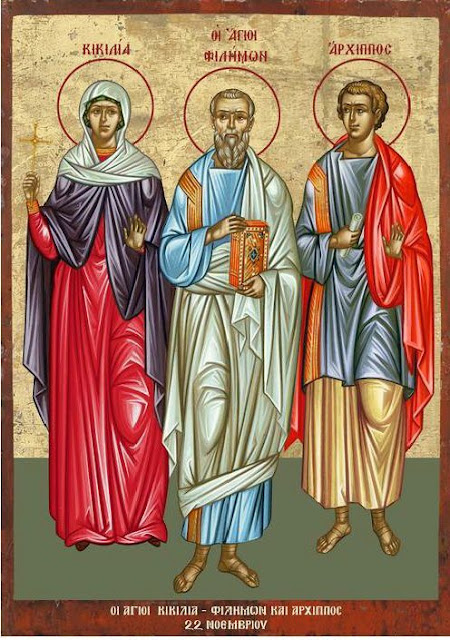
Orthodox depiction of Saints Apphia, Philemon, and Archippus

Tucked away near the end of the 66 books of the Holy Bible is the little letter of Philemon. Many Christians have neither heard a sermon preached on it, nor ever discussed it. Yet, there it is, contained as part of the New Testament canon. So, it could use some attention from us.

The letter is an appeal to Philemon concerning his slave Onesimus – who fled from his master and subsequently ended up converting to Christianity through the Apostle Paul’s influence.

At the time, Paul was imprisoned and Onesimus attended to his needs. Although Paul desired to keep Onesimus with him, he sent the slave back to Philemon. The Apostle was wanting the master to receive the slave as a beloved brother in the Lord, and not just as a servant. Then, Paul hoped Philemon would send Onesimus back to him, thus smoothing out the master/slave relationship and having his own needs met, as well.

The bottom line of the letter is that Paul very much desired that Onesimus be freed from his servitude by Philemon. He didn’t want to pull rank and twist Philemon’s arm to do it. Even though we don’t precisely know what happened in response to Paul’s letter, it’s likely that Onesimus was freed, since the appeal was included in the New Testament.

Christianity, ideally, is meant to transform lives, to change social relationships, to establish a truly egalitarian society in which the status of humans owning other humans would be done away with. Men ought to become brothers with one another and not highly stratified and separated with gross power inequities between them.

Now, in Christ, it doesn’t matter if you are a Jew or a Greek, a slave or free, male or female. You are all the same in Christ Jesus.

Galatians 3:28, ERV

Sitting where we are now, a few millennia later, we might find it curious that Paul and other biblical writers didn’t simply call for the outright abolition of slavery altogether. And yet, slavery was such an ensconced part of the ancient world (some places in the Roman Empire had up to 70% of the population as slaves) that to do so immediately would have likely brought such shock to the system that more harm than good may result.

In Paul’s experience, he continually went about the business of agitating for change by proclaiming a gospel of grace for all people. And the places where he did so saw great societal transformation – which is why Paul got so much pushback from so many authorities who benefited from keeping others under their feet.

In the household of faith, all persons are sisters and brothers and useful servants of one another and of the Lord.

The healings by Jesus in the Gospels not only restored one’s physical health but also restored the individual back to the community. The leper’s social stigma was lifted; the woman’s isolation due to bleeding was done away with; and stereotypes of those born with disabilities were overturned.

No one is inferior in the kingdom of God. Everyone is inherently worthy and has a vital purpose in God’s new society. Since the cross of Christ has erased all barriers, Christian community is to be realized through respectful equality, mutual love, and caring fellowship.

That’s how the system is changed.

Almighty God, by your Holy Spirit you have made us one with your saints in heaven and on earth. May our earthly pilgrimage be always supported by this fellowship of love and prayer, and know ourselves surrounded by their witness to your power and mercy; through Jesus Christ our Lord. Amen.

Christ’s Beatitudes (Matthew 5:1-12)

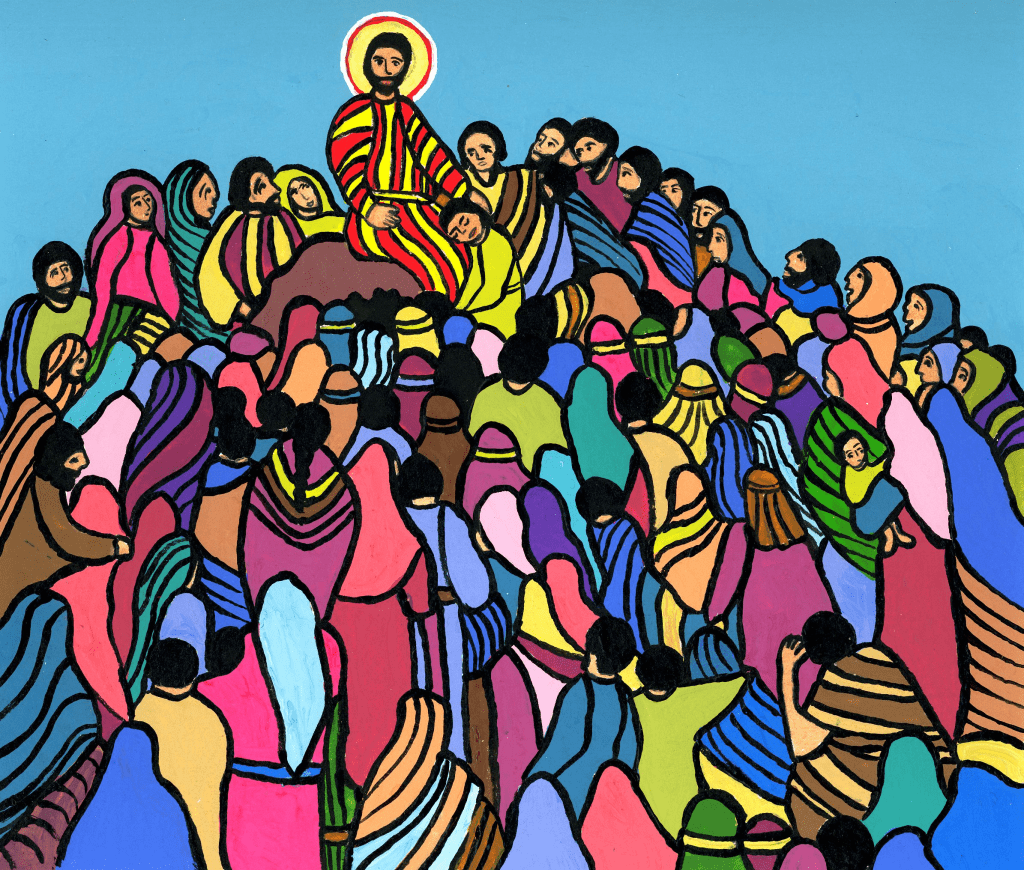
Sermon on the Mount by Gisele Bauche

When Jesus saw the crowds, he went up the mountain, and after he sat down, his disciples came to him. And he began to speak and taught them, saying:

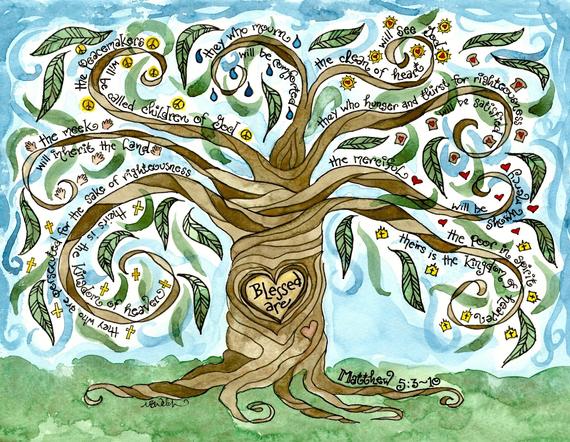
“Blessed are the poor in spirit, for theirs is the kingdom of heaven.

“Blessed are those who mourn, for they will be comforted.

“Blessed are the meek, for they will inherit the earth.

“Blessed are those who hunger and thirst for righteousness, for they will be filled.

“Blessed are the merciful, for they will receive mercy.

“Blessed are the pure in heart, for they will see God.

“Blessed are the peacemakers, for they will be called children of God.

“Blessed are those who are persecuted for the sake of righteousness, for theirs is the kingdom of heaven.

“Blessed are you when people revile you and persecute you and utter all kinds of evil against you falsely on my account. Rejoice and be glad, for your reward is great in heaven, for in the same way they persecuted the prophets who were before you. (New Revised Standard Version)

God’s Law (The Ten Commandments) was given on a mountain. That Law was restated and reframed on a mountain by Jesus in his Sermon on the Mount.

I believe that arguably one of the most important and impactful portions of Holy Scripture are the Beatitudes of Jesus, which serve as the foundation to all of Christ’s teaching.

Christ’s Beatitudes are not simply a random collection of pithy phrases from Jesus on what constitutes approval and blessing from God. They intentionally build upon each other and describe the nature of true righteousness.

The Poor in Spirit

Spiritual poverty, not wealth, is the spiritual base to the Christian life. Most of the original crowd listening to Jesus thought they were on the outside of the kingdom, on the margins of true religion. But Jesus told them they have a place in God’s reign as poor and pitiable people.

To be “poor in spirit” is to be a spiritual beggar who recognizes they have nothing to offer God. It is seeing oneself, one’s sin, and one’s life as spiritually bankrupt apart from God.

Beggars have neither the leverage nor the ability to strike deals with anybody; and so, they do one thing: beg continually.

The proud person would never be caught begging for anything. Yet, the humble spiritual beggar constantly prays because they need God. They discern that without God there is no hope. The kingdom of heaven belongs to the penitent and not to the proud.

The Mourners 

Mourning is the emotional response of acknowledging one’s spiritual poverty. 

Grief and lament have a central place in Christian theology and life. To avoid it, work around it, or short-circuit its process is to refuse Christ; there is no righteousness apart from mourning over sin. Crying, weeping, and even intense tears are important and necessary.

To experience personal grief over one’s sins and the sins of the church and the world is a Beatitude of Jesus. You neither need position, power, privilege, nor pedigree to be a mourner. All can mourn. This is the door by which we enter the kingdom of God.

The Meek

A meek and gentle spirit is the result of realizing poverty of spirit and practicing lament.

At the heart of what it means to be meek is a spirit of non-retaliation. Whenever we are flat on our backs before God, there is no place to look but up. Thus, there is no ability to look down on others.

To be meek is to be broken and moldable before God. A meek person takes personal responsibility for their attitudes and actions. The meek have no need to retaliate, even when egregiously wronged, because they fully entrust themselves to God alone who judges the living and the dead.

Ironically, brokenness is the path to righteous wholeness.

The Hungry and Thirsty

Only those who know their poverty of spirit, personally grieve over sin, and are gentle, end up longing for righteousness.

The desire for righteousness is a recognition that without God I will not make it. I cannot be righteous without Jesus. Simply put, righteousness is a right relationship with God and others.

Those who hunger and thirst for God’s righteousness know they cannot make things right by themselves; they need God’s help.

If we think we can live most days of our lives without God, we do not yet know true righteousness. People who understand their great need for Jesus are easy to spot. They crave and devour God’s Word as their daily food; and they cannot stop blabbering on about Jesus.

There are three practices of living that arise from being filled with God’s righteousness: mercy, purity, and peacemaking. These Beatitudes cannot be conjured up by our own will; instead, they organically grow within us and are freely expressed because of what God is doing in our lives.

You cannot force them any more than you can force a stalk of corn to grow on your terms. Rather, you work with the unforced rhythms of God’s grace and allow righteousness to take root in you.

Down below in the soil, spiritual poverty, mourning, and humility germinate. Then, when the plant breaks the soil and flowers, it produces mercy, purity, and peace-making.

The Merciful 

Mercy begins with a heart that seeks to be generous; it is a loving response to someone or a group of people in misery. We accept them and help them because we ourselves have been there.

The merciful person looks for ways to come alongside others and help, rather than pile expectations and burdens on others without mentoring them in the ways of God.

The Pure In Heart

Purity also results from true righteousness. A stalk of corn might look good, but if you shuck it and it’s filled with worms, it’s not worth much. Legalistic righteousness is concerned to look good; it’s obsessed with performance, perfection, and possessions.

Conversely, the righteousness of God fills our hungry hearts and makes us pure and holy, set apart for good use.

The Peacemakers 

Those who make peace intentionally put themselves in the middle of trouble because they want to live righteously with the mercy and purity that God has provided for them.

Peace is realized through peacemakers. It seems we all desire peace, and yet, peacemakers are hard to come by. It’s a tough gig. To achieve peace, one must first be at peace with God and self – which is why we need the cross of Jesus Christ.

The Persecuted 

Living righteously, as presented by Jesus, tends to bring persecution; and the persecuted consider it a small price to pay for realizing God’s justice in the world.

Folks who are offended by even slight criticisms are usually the ones who are privileged and in power. They have not yet learned the ways of Jesus. Pettiness is nothing more than a sign of unrighteousness.

Yoking up with Jesus, following him, and living into his words and ways has always been risky and dangerous. The Beatitudes of Jesus are not characteristics that lead to power, prestige, or possessions, but likely just the opposite.

“The Beatitudes, spoken with the community of Jesus’ disciples in view, are paradoxes – the standards of the world are turned upside down as soon as things are seen in their right perspective, which is to say, in terms of God’s values, so different from those of the world. It is precisely those who are poor in worldly terms, those thought of as lost souls, who are truly fortunate ones, the blessed, who have every reason to rejoice and exult in their suffering. The Beatitudes are promises resplendent with the new image of the world and humanity inaugurated by Jesus.”

Pope Benedict XVI

Truly righteous persons become living Beatitudes; they are walking, talking blessings to the world. They abide with Christ and are witnesses to a subversive, yet wonderful, way of life, where the last are first and the greatest are the least.

O Lamb of God, that takes away the sins of the world, have mercy upon me.

O Lamb of God, that takes away the sins of the world, have mercy upon me.

O Lamb of God, that takes away the sins of the world, grant me your peace.

Leading Is Serving (Micah 3:1-4)

Then I said:

“Listen, leaders of Jacob, leaders of Israel:
    Don’t you know anything of justice?
Haters of good, lovers of evil:
    Isn’t justice in your job description?
But you skin my people alive.
    You rip the meat off their bones.
You break up the bones, chop the meat,
    and throw it in a pot for cannibal stew.”

The time’s coming, though, when these same leaders
    will cry out for help to God, but he won’t listen.
He’ll turn his face the other way
    because of their history of evil. (The Message)

The prophet Micah wasn’t speaking to the general population; he was specifically addressing leaders. Those in authority – whether religious, political, educational, or corporate – can be sometimes rather hard on the people they lead. Yet, most things rise or fall because of leadership, and not because of the people being led.

It’s one thing to be a Pastor and preach an angry sermon; a politician who spins the truth for their own advantage; a teacher who one day berates the students; or a boss who uncharitably chastises an employee; and it’s quite another thing for these behaviors to be habitual. A daily dose of leaders who view people as dumb sheep to fleece are eventually in for big trouble… from God!

Most leaders ascended to their position because they know what’s up and how to go about their business. They know the difference between right and wrong. But instead of viewing themselves as servants to the people, some leaders believe the people ought to be serving them. This sort of attitude comes out in snarky phrases, such as:

  • “If these idiots would only listen to me, and do what I tell them, we wouldn’t be in this mess!”
  • “How many times do I have to repeat myself!?”
  • “Excuses, excuses. That’s all I hear. They’re nothing but a bunch of lazy ungrateful people!”
  • “Leave your problems at home where they belong. We don’t talk about that stuff here!”
  • “What makes you think you can talk to me that way!?”
  • “It’s out of my hands. Not my responsibility.”
  • “It wasn’t like this in my generation. These young people just don’t want to do anything that’s hard. Back in my day I had to….”

The real problem, however, are the leaders themselves; they haven’t gotten out their own way to let the justice of God flow powerfully in them and through them to the benefit of everyone.

Having a leader who is attentive to basic human kindness, generous with words, and concerned for all under their authority is like a kiss on the lips. But a leader who only thinks of themselves is like a bad dream that won’t go away.

A society cannot survive without justice, that is, a concern for the common good of all persons – and coupled with systemic practices which reinforce that basic conviction. Some leaders have good hearts but bad organizational systems. Other leaders administrate well but have a hard time relating to people. We need both for justice to occur.

Once leaders get in a groove of justice, society flourishes. Yet, leaders need to be continually vigilant; their leadership can easily devolve into struggles to obtain and maintain power so that they can feel important and in control of things.

The Old Testament prophets, like Micah, used imaginative metaphors to make their case that injustice needed to be done away with. And they nearly always laid the burden of change on leaders. Leadership is meant to make things right, not wrong, and to help a group of people become better, not worse.

Justice is in every leader’s job description. It’s written on both the conscience and the heart in permanent marker.

When things go sideways, godly leaders first look at themselves, rather than reflexively blaming others. Typically, there is plenty of guilt to go around; yet the leader needs to bear the onus of the problem and begin addressing it by first looking within themselves.

It’s a leader’s responsibility to ensure that justice and freedom are established – and that there are no obstacles to all the people living successfully. Leaders are to be learners so that they may do good and create systems of good for everyone.

Stop doing wrong
    and learn to live right.
See that justice is done.
Defend widows and orphans
    and help the oppressed. (Isaiah 1:16-17, CEV)

Those who held authority in Micah’s day had gotten drunk on power and privilege; they openly used their authority to consume the poor and needy. Rather than empowering the underprivileged, the leaders snatched what little autonomy and resources the people possessed.

The good news is that there is a greater power operative in the universe than earthly leaders. A hard life caused by insensitive leadership will eventually give way to the Lord’s gracious and benevolent reign over all the earth.

Until that time comes, we are to grow as leaders by seeking to be true and genuine servants.

Politicians are to pursue public service without prejudice and with a keen eye toward all classes of people;

Educators are to commit themselves to ensuring that learning happens with a variety of approaches, all pillowed with loving support;

Employers are to provide whatever is needed to make their employees successful at their jobs, including a safe and caring environment;

Religious leaders are to offer spiritual care and not spiritual judgment to all within their bounds of responsibility.

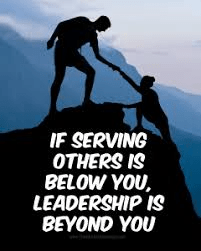
We all lead other people, whether or not we have the title or position as a leader. Therefore, we all must seek not to be served but to serve others. This is the way of justice and righteousness.

Gracious God and Leader of all: Help us to embrace the challenge and responsibility we have as leaders
to guide us to lead with integrity and common sense. Give us the wisdom to make intelligent decisions; the courage to make tough decisions; and the character to make right decisions. Embolden us to always be welcoming, inclusive, and open because of our Lord Jesus Christ, in whose name we pray. Amen.