Listen and See (Isaiah 42:14-21)

For a long time, I, the Lord,
    have held my temper;
now I will cry out and groan
    like a woman giving birth.
I will destroy the mountains
    and what grows on them;
I will dry up rivers and ponds.

I will lead the blind on roads
    they have never known;
I will guide them on paths
    they have never traveled.
Their road is dark and rough,
    but I will give light
to keep them from stumbling.
    This is my solemn promise.

Everyone who worships idols
as though they were gods
    will be terribly ashamed.

You people are deaf and blind,
but the Lord commands you
    to listen and to see.
No one is as blind or deaf
as his messenger,
    his chosen servant,
who sees and hears so much,
    but pays no attention.

The Lord always does right,
and so he wanted his Law
    to be greatly praised. (Contemporary English Version)

The Christian season of Lent serves to remind us that we must cultivate awareness by opening our eyes and unstopping our ears. Spiritual blindness and deafness are the result of failing to pay attention, ignoring the moral vision of God, and not listening to God’s voice.

It’s not unusual for people to complain about God being silent and ignoring them. But do we ever consider how the Lord feels about us living our lives as functional atheists? There may be expressions of belief, yet God doesn’t factor into the daily life of many. And the Lord is not okay with this.

At least we have assurances throughout Holy Scripture that the Lord is attentive to us, even when silent or seemingly not there. However, when it comes to us, our silence and lack of being present to the Lord is outright spiritual blindness and deafness on our part.
Today’s Old Testament lesson almost seems as if Yahweh is like the person trying to get your attention in a crowded place – jumping up and down, waving his arms, yelling our name – doing whatever it takes for us to see and hear, listen and look up. Yet, alas, we don’t.

Maybe we need to remember what God’s divine eyes and ears have already seen and heard. The Lord heard the awful groanings of the Israelites in Egypt under their harsh slavery. And God took notice of them and saw what was happening. (Exodus 2:24-25)

Perhaps we must recall all the times the Lord heard the cries of the people and sent a deliverer (Judges 2:16-19); and looked from heaven, saw those in bondage, and freed them. (Psalm 102:18-20)

If we put our fingers in our ears, and cover our eyes for too long, our hearts will become hard, and we shall be unable to turn from unhealthy ways of living. We’ll become so obtuse and clueless that we cannot repent and be healed.

Then I heard the voice of the Lord saying, “Whom shall I send? And who will go for us?” And I said, “Here am I. Send me!” He said, “Go and tell this people:

“‘Be ever hearing, but never understanding;
    be ever seeing, but never perceiving.’
Make the heart of this people calloused;
    make their ears dull
    and close their eyes.
Otherwise they might see with their eyes,
    hear with their ears,
    understand with their hearts,
and turn and be healed.” (Isaiah 6:8-10, NIV)

This might seem rather hard. And yet, none of us can truly know comfort and consolation apart from facing the hard truth in front of us and the hard heart inside us. Everyone wants happiness without pain. However, we cannot have a rainbow without a storm, and a resurrection without a cross.

We can have a different experience of God. It’s not too late. The message of Lent is that we can prepare ourselves for the Lord’s deliverance – and it is likely to come in the form of great sorrow and great joy of which we could not have anticipated.

The wisdom I proclaim is God’s secret wisdom, which is hidden from human beings, but which he had already chosen for our glory even before the world was made. None of the rulers of this world knew this wisdom. If they had known it, they would not have crucified the Lord of glory. However, as the scripture says,

“What no one ever saw or heard,
    what no one ever thought could happen,
    is the very thing God prepared for those who love him.” (1 Corinthians 2:7-9, GNT)

We humans struggle with the hard things of life. Yet, what we don’t always see or hear is how those adversities are shaping and forming us as a people.

For how would we ever know the Lord as our:

  • Deliverer unless we were in bondage?
  • Comforter unless we were in trouble?
  • Helper unless we were weak?
  • Healer unless we were broken?
  • Provider unless we were poor?
  • Protector unless we were in danger?
  • Warrior unless we were under attack?
  • Rock unless we were being tossed about?

Every day is a fresh opportunity to experience the presence, power, provision, and protection of a God who sees and hears us. Believers are to honor and respect the Lord by listening to God’s voice and obeying God’s words.

So, let us use this season to offer prayers of repentance and faith:

O God, whose glory it is always to have mercy: Be gracious to all who have gone astray from your ways,
and bring them again with penitent hearts and steadfast faith to embrace and hold fast the unchangeable truth of your Word, Jesus Christ your Son; who with you and the Holy Spirit lives and reigns, one God, forever and ever. Amen.

Anxiety In the System (Acts 9:1-20)

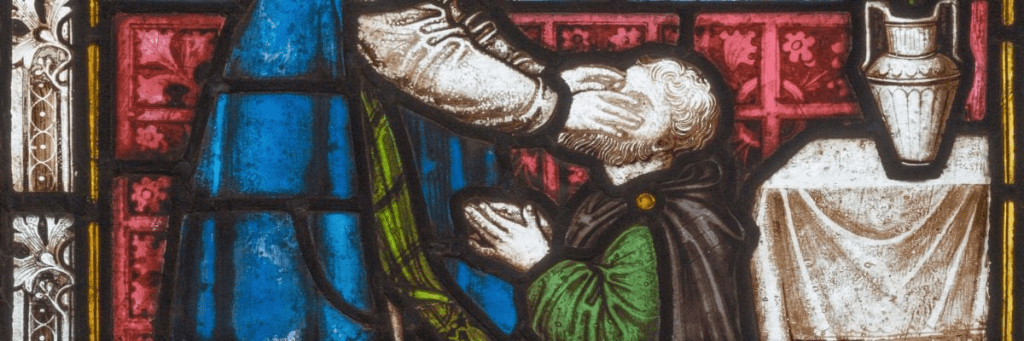
Ananias restoring sight to Saul, stained glass in St Mary Abbot`s Church, London, UK

Meanwhile, Saul was still spewing out murderous threats against the Lord’s disciples. He went to the high priest, seeking letters to the synagogues in Damascus. If he found persons who belonged to the Way, whether men or women, these letters would authorize him to take them as prisoners to Jerusalem. During the journey, as he approached Damascus, suddenly a light from heaven encircled him. He fell to the ground and heard a voice asking him, “Saul, Saul, why are you harassing me?”

Saul asked, “Who are you, Lord?”

“I am Jesus, whom you are harassing,” came the reply. “Now get up and enter the city. You will be told what you must do.”

Those traveling with him stood there speechless; they heard the voice but saw no one. After they picked Saul up from the ground, he opened his eyes but he couldn’t see. So they led him by the hand into Damascus. For three days he was blind and neither ate nor drank anything.

In Damascus there was a certain disciple named Ananias. The Lord spoke to him in a vision, “Ananias!”

He answered, “Yes, Lord.”

The Lord instructed him, “Go to Judas’ house on Straight Street and ask for a man from Tarsus named Saul. He is praying. In a vision he has seen a man named Ananias enter and put his hands on him to restore his sight.”

Ananias countered, “Lord, I have heard many reports about this man. People say he has done horrible things to your holy people in Jerusalem. He’s here with authority from the chief priests to arrest everyone who calls on your name.”

The Lord replied, “Go! This man is the agent I have chosen to carry my name before Gentiles, kings, and Israelites. I will show him how much he must suffer for the sake of my name.”

Ananias went to the house. He placed his hands on Saul and said, “Brother Saul, the Lord sent me—Jesus, who appeared to you on the way as you were coming here. He sent me so that you could see again and be filled with the Holy Spirit.” Instantly, flakes fell from Saul’s eyes and he could see again. He got up and was baptized. After eating, he regained his strength.

He stayed with the disciples in Damascus for several days. Right away, he began to preach about Jesus in the synagogues. “He is God’s Son,” he declared. (Common English Bible)

A telltale sign of spiritual blindness, a lack of awareness, and an unwillingness to change is to put all the focus on another person or group as the real problem of a society.

That’s exactly what Saul did. And that’s precisely why he needed a conversion.

Family Systems Theory

Murray Bowen was an influential psychiatrist of the twentieth century. His family systems theory, also known as Bowen theory, views a family (or any group of persons) as an emotional unit. Within this unit, a change in any of the individual persons results in the others compensating for the emotional functioning that’s been altered. 

Like touching one part of a spider web, the entire thing shakes. Bowen’s focus was that, rather than trying to change the other person, one can change themselves without becoming part of the problem. The theory states that if any family or group member can change their emotional functioning within the system, the whole family will improve its corporate functioning in response to that change. 

In short, we must learn to function in a healthy way within the group system. Personal transformation becomes the best approach to handling family crises and problems.

Saul the Pharisee to Paul the Apostle

Bowen’s statement of the human condition could be said of Saul and his conversion:

“The human is a narcissistic creature who lives in the present and who is more interested in his own square inch of real estate, and more devoted to fighting for his rights than in the multigenerational meaning of life itself. As the human throng becomes more violent and unruly, there will be those who survive it all….  I think the differentiation of self (remaining connected to others, yet separate from their problems) may well be one concept that lives into the future.”

Murray Bowen

Saul the Pharisee was an anxious soul. He was determined to keep the Christian sect from infecting his Jewish way of life. As the followers of Jesus grew, so did the anxiety of Saul and the Pharisees. Saul turned his attention to unhealthy ways of handling the situation – to the point that Christ himself showed up and let Saul know that his harassment needed to stop.

Our Need for Change

Whatever you think of Bowen’s theory, it’s easy to see that anxiety plays a major role in many individuals, families, and even churches. Whenever worry, fear, and anxiety take over a person or group of people, things become emotionally charged. 

The church is an emotional unit. Typically, the response to anything we don’t like is to try and change the other person who is rocking the boat or upsetting the status quo. The converted and changed Apostle Paul learned his lesson about the intricate web of anxious emotions: 

Don’t be anxious about anything; rather, bring up all of your requests to God in your prayers and petitions, along with giving thanks. Then the peace of God that exceeds all understanding will keep your hearts and minds safe in Christ Jesus. (Philippians 4:6-7, CEB)

Learning to manage our own anxiety, and cope with the incessant worry within ourselves, is imperative to dealing with relational problems in the group. The peace of God, not the peace of others, is what makes the difference. 

People are all for change, that is, we want others to change so that we don’t have to. The Christian, however, is to conform to Jesus, and not the other way around. Because the Lord is near to us, we have a consistent and continual presence to anchor ourselves, no matter whether the circumstances are to my liking, or not. 

Prayer becomes the means of casting anxiety away so that peace can take its place. Sounds easy – it’s anything but.

It’s only human to want everyone else to change when there are problems, adversity, or challenge. Yet the change most needed is quite personal, perhaps even an outright conversion.

Our focus must be on finding ways to remain connected to God and others without resorting to passive-aggressive tactics, cutting-off relationships altogether, or bullying others into changing with our violent or manipulative words.

Faced with unwanted change and/or difficult circumstances, rather than looking for others to alter their lives, try asking yourself one of these questions: 

  • What is one small step I can take to improve my situation?
  • If I were guaranteed not to make the situation worse, what would I do differently?
  • Is there a person in my life whose voice and input I haven’t heard in a long time?
  • What is one positive trait I possess that can serve me well in this situation?

Are there other questions you could ask that would be helpful? A journey that seems a thousand miles must begin with one step. What will that step be?

Dealing with Spiritual Blindness (John 9:1-41)

Coptic Church depiction of Jesus healing the man born blind

As he went along, he saw a man blind from birth. His disciples asked him, “Rabbi, who sinned, this man or his parents, that he was born blind?”

“Neither this man nor his parents sinned,” said Jesus, “but this happened so that the works of God might be displayed in him. As long as it is day, we must do the works of him who sent me. Night is coming when no one can work. While I am in the world, I am the light of the world.”

After saying this, he spit on the ground, made some mud with the saliva, and put it on the man’s eyes. “Go,” he told him, “wash in the Pool of Siloam” (this word means “Sent”). So the man went and washed, and came home seeing.

His neighbors and those who had formerly seen him begging asked, “Isn’t this the same man who used to sit and beg?” Some claimed that he was.

Others said, “No, he only looks like him.”

But he himself insisted, “I am the man.”

“How then were your eyes opened?” they asked.

He replied, “The man they call Jesus made some mud and put it on my eyes. He told me to go to Siloam and wash. So I went and washed, and then I could see.”

“Where is this man?” they asked him.

“I don’t know,” he said.

They brought to the Pharisees the man who had been blind. Now the day on which Jesus had made the mud and opened the man’s eyes was a Sabbath. Therefore the Pharisees also asked him how he had received his sight. “He put mud on my eyes,” the man replied, “and I washed, and now I see.”

Some of the Pharisees said, “This man is not from God, for he does not keep the Sabbath.”

But others asked, “How can a sinner perform such signs?” So they were divided.

Then they turned again to the blind man, “What have you to say about him? It was your eyes he opened.”

The man replied, “He is a prophet.”

They still did not believe that he had been blind and had received his sight until they sent for the man’s parents. “Is this your son?” they asked. “Is this the one you say was born blind? How is it that now he can see?”

“We know he is our son,” the parents answered, “and we know he was born blind. But how he can see now, or who opened his eyes, we don’t know. Ask him. He is of age; he will speak for himself.” His parents said this because they were afraid of the Jewish leaders, who already had decided that anyone who acknowledged that Jesus was the Messiah would be put out of the synagogue. That was why his parents said, “He is of age; ask him.”

A second time they summoned the man who had been blind. “Give glory to God by telling the truth,” they said. “We know this man is a sinner.”

He replied, “Whether he is a sinner or not, I don’t know. One thing I do know. I was blind but now I see!”

Then they asked him, “What did he do to you? How did he open your eyes?”

He answered, “I have told you already and you did not listen. Why do you want to hear it again? Do you want to become his disciples too?”

Then they hurled insults at him and said, “You are this fellow’s disciple! We are disciples of Moses! We know that God spoke to Moses, but as for this fellow, we don’t even know where he comes from.”

The man answered, “Now that is remarkable! You don’t know where he comes from, yet he opened my eyes. We know that God does not listen to sinners. He listens to the godly person who does his will. Nobody has ever heard of opening the eyes of a man born blind. If this man were not from God, he could do nothing.”

To this they replied, “You were steeped in sin at birth; how dare you lecture us!” And they threw him out.

Jesus heard that they had thrown him out, and when he found him, he said, “Do you believe in the Son of Man?”

“Who is he, sir?” the man asked. “Tell me so that I may believe in him.”

Jesus said, “You have now seen him; in fact, he is the one speaking with you.”

Then the man said, “Lord, I believe,” and he worshiped him.

Jesus said] “For judgment I have come into this world, so that the blind will see and those who see will become blind.”

Some Pharisees, who were with him, heard him say this and asked, “What? Are we blind too?”

Jesus said, “If you were blind, you would not be guilty of sin; but now that you claim you can see, your guilt remains. (New International Version)

Jesus healing blind Bartimaeus by Johann Heinrich Stöver, 1861. St John’s Church, Hesse, Germany

Assuming Blindness

Behind everything we believe and talk about, there are pre-suppositions or assumptions. The disciples had an assumption about blindness: its sin – not just a result of living in a fallen world, but personal sin. That is, an individual sinner whom we can point the finger to. The disciples demonstrated they were just as blind as the physically blind man.

Jesus had a clear and concise response to that assumption: nobody is at fault here, nobody. Which, to me, begs the question:

Have you considered that your thoughts are subjective, not objective?

Too many people treat their thoughts, ideas, and beliefs as if they were pure gospel truth (which is probably why they feel justified in assuming they are always right and are arbiters of truth!). Reality check: You, nor I, have the corner on truth. Jesus is the truth, not anybody else.

Healing Blindness

Since Jesus is the way, the truth, and the life, he has the power and authority to heal, making the blind to see. Sin wasn’t the issue; the true issue was an opportunity to showcase the gracious work of God. So, Jesus healed the man’s eyes so that he could see again. Healing is not a one-size-fits-all, which is why Jesus did something unique with the blind man, and then gave specific instructions on what to do.

Therefore, we must not assume that we know how a healing is supposed to happen. There’s no codifying a particular process or prayer in order to leverage God into performing one.

Investigating Blindness

The religious leaders always seem to have a problem about something. They, like the disciples, assumed sin was at the core of the man’s blindness. The leaders were befuddled that a sinner like Jesus (who doesn’t keep the Sabbath properly) could ever heal another sinner (a blind man). That’s a conundrum they couldn’t live with, and so, the questions kept getting heaped on the poor guy who was healed.

The religious leaders were trying to make sense out of what they thought was a nonsensical situation. It’s only nonsensical to them because they didn’t have any good sense to begin with. Their interaction with the healed man, and then with Jesus, only demonstrated their profound lack of awareness resulting in spiritual blindness.

Remaining in Blindness 

Many of the religious leaders, heretics in the early church, and spiritual phonies of today are not deliberately trying to deceive or lead others astray; they think they are doing the right thing when they are actually not. 

An eye-opening reality I discovered when I first studied church history is that the early heresies, condemned at church councils, were doctrines promoted by men who were not evil – they were just sincerely misguided. The heretics believed they were helping the church better understand the nature of God and Christ. However, they were unaware and blind to the actual nature of their teachings. 

Back when I wrote my master’s thesis in nineteenth century American Religious History, I read hundreds of sermons from southern preachers before the American Civil War. They had a “biblical” defense of Black chattel slavery. Many of them were influential pastors of large churches who led many people to Christ, that is, white people. Yet, at the same time, they were blind to how they slammed the door of God’s kingdom in the faces of Black folk, were complicit in slaveholder abuse, and fueled antagonisms between North and South.

Churches and Christians may be unaware and blind to how they keep people out of God’s kingdom by saying God’s grace is for all, and then avoid certain people; by having explicit written statements or rules that exclude people from service; or by binding people to human traditions and practices instead of Holy Scripture.

Our Eyes

“The eye is the lamp of the body. If your eyes are healthy, your whole body will be full of light. But if your eyes are unhealthy, your whole body will be full of darkness. If then the light within you is darkness, how great is that darkness! (Matthew 6:22-23, NIV)

In the ancient world, the eye represented what you fixed your gaze on, or what your focus was. In our culture, we could replace the word “eye” with the word “goal.” The word “body” represents the entirety of one’s life.  So, we might interpret Christ’s words in this way: 

A goal is the focus of a life. If your goals are good, your whole life will be full of proper focus. But if your goals are bad, your whole life will be full of blindness. If then, the focus within you is only really blindness, how great is that darkness!

If goals and dreams are toward earthly treasure, one will blindly move in that direction and have misplaced values. Today’s Gospel story portrays the need to be self-aware as individual Christians and as a church. We can choose to:

  1. Be open to new information
  2. Entertain the notion that you might be wrong
  3. Embrace a full range of knowing (head, heart, and gut)
  4. Allow the light of Christ to shine on every person and each situation
  5. Stick to your experience of others and events
  6. Consider how your words and actions affect others
  7. Keep accountable to others and ask for feedback

Monitoring ourselves and our own emotional landscape will help us to become aware of what’s happening inside us. And then, in turn, having our eyes opened enables us to truly see others and be aware of their needs.

The Word Is Life and Light (John 1:1-9)

In the beginning was the Word
    and the Word was with God
    and the Word was God.
The Word was with God in the beginning.
Everything came into being through the Word,
    and without the Word
    nothing came into being.
What came into being
    through the Word was life,
    and the life was the light for all people.

The light shines in the darkness,
    and the darkness doesn’t extinguish the light.

A man named John was sent from God. He came as a witness to testify concerning the light, so that through him everyone would believe in the light. He himself wasn’t the light, but his mission was to testify concerning the light.

The true light that shines on all people
    was coming into the world. (Common English Bible)

Jesus lives here. And that’s because he chose to – so that we might have an abundant life out in the bright sunshine of grace.

The Word has always been and always will be. The Word decided to show up on this earth in an unexpected way, to bring light, illumination, and awareness to a dark world and the shadowy places of our hearts.

Frankly, my friends, Jesus abides with your every dream about life and happiness, hope and fulfillment, purpose and direction, emotional healing and wholeness. Christ is for you, to experience a thriving and flourishing daily life. And what’s more:

To live the Christian life, to center your entire life totally and completely around the person and work of Jesus Christ, is an act of rebellion against all that is dark, unjust, and broken in this world.

Jonathan Edwards, one of the greatest intellects in American history, was a pastor, theologian, and scholar. He insisted that the hope of humanity lies with turning to and dwelling with Jesus:

“Conversion to Jesus Christ is a great and glorious work of God’s power, at once changing the heart, and infusing life into the dead soul…. Jesus Christ is the highest good of the reasonable creature. The enjoyment of him is our proper focus; and is the only happiness with which our souls can be satisfied.”

Jonathan Edwards

St. Augustine lived centuries ago. A big chunk of his life was apart from Christianity. He knew what it felt like to be without Jesus. Yet, after his conversion, life with Jesus was so compelling for Augustine, that his vigorous intellect and spiritual devotion were put to work, leaving an enormous footprint that can be found even today, in both the church and the academy.

Reflecting upon his life, and all he had experienced and accomplished, Augustine uttered this simple prayer to God:

“You have made us for yourself, Lord Jesus, and our hearts are restless until they rest in you.”

St. Augustine

Arguably, Christianity’s greatest convert was the Apostle Paul. Once a vehement opponent to Christ and Christ’s followers, Paul had a dramatic encounter that left him completely undone. He gave his life to Jesus and became Christianity’s most influential missionary. Here is a smattering of his thoughts on Jesus:

Though he [Christ] was in the form of God,
        he did not consider being equal with God something to exploit.
But he emptied himself
        by taking the form of a slave
        and by becoming like human beings.
When he found himself in the form of a human,
        he humbled himself by becoming obedient to the point of death,
        even death on a cross. (Philippians 2:6-8, CEB)

His glorious power will make you patient and strong enough to endure anything, and you will be truly happy… For God has rescued us from the dark power of Satan and brought us into the kingdom of his dear Son, who forgives our sins and sets us free. (Colossians 1:11, 13, CEV)

Nothing is as wonderful as knowing Christ Jesus my Lord… God accepted me simply because of my faith in Christ. (Philippians 3:8-9, CEV)

We find ourselves standing where we always hoped we might stand—out in the wide open spaces of God’s grace and glory, standing tall and shouting our praise… Christ arrives right on time to make this happen. He didn’t, and doesn’t, wait for us to get ready. He presented himself for this sacrificial death when we were far too weak and rebellious to do anything to get ourselves ready. (Romans 5:2, 6, MSG)

Jesus is the One who fills our hearts with love, delivers our wayward souls from emptiness, and sets our feet on the solid rock of faith and hope in God. The love of God is found in Jesus. And Jesus so closely identifies with us, that we enjoy God’s peace and healing in our lives. Not just personal transformation, but systemic change in institutions and corporations, families and neighborhoods, is possible in Christ. 

To live for Jesus is an act of subversion against all that is evil, dark, and unjust. Imagine a world where love rules, not hate; where creativity and faith abound, and are not squelched; and, hope, not hurt, fuels progress into a bright future. It is a world where the light of Jesus brings life.

“I am the light for the world! Follow me, and you won’t be walking in the dark. You will have the light that gives life.”

Jesus (John 8:12, CEV)

The God who said, “Out of darkness the light shall shine!” is the same God who made his light shine in our hearts, to bring us the knowledge of God’s glory shining in the face of Christ. (2 Corinthians 4:6, GNT)

I am grateful that God so loved the world, loved me and loved you, that he gave his one and only Son – the Sun of Righteousness for our benefit so that we might have life.

Praise God from whom all blessings flow
Praise Him, all creatures here below
Praise Him above, ye heavenly host
Praise Father, Son, and Holy Ghost. Amen.