Dealing with Denial (Jeremiah 32:1-9, 36-41)

The Lord spoke to me in the tenth year that Zedekiah was king of Judah, which was the eighteenth year that Nebuchadnezzar was king of Babylonia. At that time, the Babylonian army had surrounded Jerusalem, and I was in the prison at the courtyard of the palace guards. Zedekiah had ordered me to be held there because I told everyone that the Lord had said:

I am the Lord, and I am about to let the king of Babylonia conquer Jerusalem. King Zedekiah will be captured and taken to King Nebuchadnezzar, who will speak with him face to face. Then Zedekiah will be led away to Babylonia, where he will stay until I am finished with him. So, if you people of Judah fight against the Babylonians, you will lose. I, the Lord, have spoken.

Later, when I was in prison, the Lord said:

Jeremiah, your cousin Hanamel, the son of your uncle Shallum, will visit you. He must sell his field near the town of Anathoth, and because you are his nearest relative, you have the right and the responsibility to buy it and keep it in the family.

Hanamel came, just as the Lord had promised. And he said, “Please buy my field near Anathoth in the territory of the Benjamin tribe. You have the right to buy it, and if you do, it will stay in our family.”

The Lord had told me to buy it from Hanamel, and so I did. The price was 17 pieces of silver, and I weighed out the full amount on a scale….

Jeremiah, what you said is true. The people of Jerusalem are suffering from hunger and disease, and so the king of Babylonia will be able to capture Jerusalem.

I am angry with the people of Jerusalem, and I will scatter them in foreign countries. But someday I will bring them back here and let them live in safety. They will be my people, and I will be their God. I will make their thoughts and desires pure. Then they will realize that, for their own good and the good of their children, they must worship only me. They will even be afraid to turn away from me. I will make an agreement with them that will never end, and I won’t ever stop doing good things for them. With all my heart I promise that they will be planted in this land once again. (Contemporary English Version)

Denial is a powerful mental force.

Disaster was about to befall Jerusalem and its inhabitants. Few were prepared for what was ahead. But they should have been ready. That’s because the prophet Jeremiah repeatedly told the king and the people about their need to live in justice and righteousness.

The dominant belief within the city was that judgment would never come to them. The people looked at their covenant with the Lord, and the presence of the temple, as some sort of rabbit’s foot or insurance policy that would keep invading armies at bay.

But they were in denial about what was actually occurring. The people lived as they wanted, giving Yahweh some temple time and a bit of worship, but then turned around and also worshiped other gods. Furthermore, they exploited the poor, took advantage of the needy, and engaged in unscrupulous business practices. So, the prophet Jeremiah was given a message by God to the people:

I brought you here to my land,
    where food is abundant,
but you made my land filthy
    with your sins.
The priests who teach my laws
    don’t care to know me.
Your leaders rebel against me;
your prophets
    give messages from Baal
    and worship false gods….

You, my people, have sinned
    in two ways—
you have rejected me, the source
    of life-giving water,
and you’ve tried to collect water
in cracked and leaking pits
    dug in the ground. (Jeremiah 2:7-8, 14, CEV)

The message was repeatedly ignored, along with warnings of judgment, if the people did not change their errant ways. The city’s denial was palpable, holding the false belief that the Babylonians could never take them, and that God was on their side.

Pay attention, people of Judah! Change your ways and start living right, then I will let you keep on living in your own country. Don’t fool yourselves! My temple is here in Jerusalem, but that doesn’t mean I will protect you. I will keep you safe only if you change your ways and are fair and honest with each other. Stop taking advantage of foreigners, orphans, and widows. Don’t kill innocent people. And stop worshiping other gods. Then I will let you enjoy a long life in this land I gave your ancestors. (Jeremiah 7:3-7, CEV)

The antidote to denial is acceptance – not necessarily accepting that a situation is okay, fine, or right – but that the situation is actually there; it’s true, and I’ve got to face it as it is, and not as I want it to be.

The Babylonians were at the city gate. Yet, even then, Jeremiah was getting the stiff arm from King Zedekiah and was in prison for preaching sedition. Nobody wanted to face the music – that a funeral dirge was about to play. But they needed to own up to what was happening and why they were in such a position.

It’s a sad scene. It’s hard to watch, whenever others refuse to listen, knowing what will happen if they keep to their denial. There were some things Jeremiah did and didn’t do when he was in this awkward and precarious position.

Jeremiah did not:

  • Give up and/or shut up. He didn’t give in to the temptation of being frustrated, throwing up his hands, and walking away; and he didn’t adopt their denial and stop talking.
  • Manipulate by resorting to shaming the people, or using Machiavellian tactics to force or leverage repentance out of them.
  • Say, “I told you so!” In fact, he did just the opposite; he grieved and lamented the unchanged hearts and the destruction which did happen.

Jeremiah did:

  • Connect with both God and the people. He was able to differentiate himself from the situation, while at the same time, remaining connected as a voice to the people.
  • Accept his role as prophet. He took responsibility for himself and his own particular calling – and nothing more than that. He focused on what needed to be said and done in the moment, and left the rest to God.
  • Kept living his life. He went and bought a relative’s field, keeping the land in the family, knowing he was still going to have a life after such devastation.

The Lord, as the Good Shepherd, isn’t going to herd cats – so we must follow as the sheep who trust in the Lord’s voice and actions, to say and do what we most need to hear and obey.

Just and right God, you invite us to give ourselves in service to others, equipped with justice and righteousness. Be with me as I choose each day to reflect your divine presence in our world. Give me the courage and generosity to respond to your love, and to your call. May all your people speak your message with bravery, humility, and skill. Open the minds and hearts of those in denial — that they may accept you and your words. Amen.


Guide Me By Your Good Spirit (Psalm 143)

Listen to my prayer, Lord!
    Because of your faithfulness, hear my requests for mercy!
    Because of your righteousness, answer me!
Please don’t bring your servant to judgment,
    because no living thing is righteous before you.

The enemy is chasing me,
    crushing my life in the dirt,
        forcing me to live in the dark
            like those who’ve been dead forever.
My spirit is weak inside me—
    inside, my mind is numb.

I remember the days long past;
    I meditate on all your deeds;
    I contemplate your handiwork.
I stretch out my hands to you;
    my whole being is like dry dirt, thirsting for you.

Answer me, Lord—and quickly! My breath is fading.
    Don’t hide your face from me
        or I’ll be like those going down to the pit!
Tell me all about your faithful love come morning time,
    because I trust you.
Show me the way I should go,
    because I offer my life up to you.
Deliver me from my enemies, Lord!
    I seek protection from you.
Teach me to do what pleases you,
    because you are my God.
Guide me by your good spirit
        into good land.
Make me live again, Lord, for your name’s sake.
    Bring me out of distress because of your righteousness.
Wipe out my enemies because of your faithful love.
    Destroy everyone who attacks me,
        because I am your servant. (Common English Bible)

Many Westerners tend to think about sin as bad individual actions which are quite personal. However, sin is much bigger than that. Primarily, sin is a force, a power in this universe which weighs on every molecule within it. None of us can escape having to deal with it.

For persons like the psalmist, they strive to be good and live a just life, yet they are continually dogged by others who have given into the “dark side.” The wicked discern the force of sin in the world, and then decide to move with it – believing that good guys finish last.

Yet, there is another powerful force in the universe – and it’s a greater power than sin.

Everywhere we look, we see a bad spirit. And that sinful spirit is behind the injustice, oppression, war, conflict, ignorance, and avarice which exists in every nation, community, and even home. Entrenched opinions, yelling at each other, the refusal to consider evidence, and narrow thinking have permeated our societies and pitted people against one another.

This evil spirit of the age is captured in the Apostle Paul’s words as he reflected on this and other psalms:

As it is written:

“There is no one righteous, not even one;
    there is no one who understands;
    there is no one who seeks God.
All have turned away,
    they have together become worthless;
there is no one who does good,
    not even one.”
“Their throats are open graves;
    their tongues practice deceit.”
“The poison of vipers is on their lips.”
    “Their mouths are full of cursing and bitterness.”
“Their feet are swift to shed blood;
    ruin and misery mark their ways,
and the way of peace they do not know.”
    “There is no fear of God before their eyes.”

Now we know that whatever the law says, it says to those who are under the law, so that every mouth may be silenced and the whole world held accountable to God. Therefore no one will be declared righteous in God’s sight by the works of the law; rather, through the law we become conscious of our sin. (Romans 3:10-20, NIV)

The psalmist doesn’t want to be a part of the sinful force and the bad spirit. He, instead, knows that sometimes he’s part of the problem, along with being a victim of sin, and thus, knows he needs deliverance from this awful power.

Promises to do better and personal willpower won’t cut it, when it comes to changing a life and a society. Rather, we must tap into a good spirit, which is ultimately, the Spirit.

Even though all have been both victim and victimizer, and fall short of God’s glory, all are justified freely by God’s grace through the redemption that came by Christ Jesus. (Romans 3:23-24)

Once we were blocked from prayer because of obstacles existing unaware among us and within us. But now we see the world for how it’s been touched by foulness and degradation, so we pray.

The spirit of the age will fail us. Our own spirit will be fickle. God’s Spirit, however, is continually living and active with the force of grace and mercy.

In our fear, it’s okay, even good, to flee from evil. Yet, we must complete the process by not only fleeing from the bad spirit, but also fleeing to God’s Spirit.

Prayer, then, becomes our lifeline. It’s our connection to what is right, just, and good. In Christianity, the Spirit is the one who conforms us to the glory of God and the image of Jesus. The Spirit is our Teacher, Guide, and Advocate, keeping us on God’s good path.

We need to live according to the Spirit – which is a continual journey of removing obstacles to faith and allowing God’s good gifts to awaken within us.

My counsel is this: Live freely, animated and motivated by God’s Spirit. Then you won’t feed the compulsions of selfishness. For there is a root of sinful self-interest in us that is at odds with a free spirit, just as the free spirit is incompatible with selfishness. These two ways of life are contrary to each other, so that you cannot live at times one way and at times another way according to how you feel on any given day. Why don’t you choose to be led by the Spirit and so escape the erratic compulsions of a law-dominated existence? (Galatians 5:16-18, MSG)

Yes, sin is a powerful force, manifesting itself in a host of bad spirits all around us. But grace is greater than all sin, and God’s good Spirit shall overwhelm and overcome all evil.

Visit this place, O Lord, we pray, and drive far from it the snares of the enemy; may your holy angels dwell with us and guard us in peace, and may your blessing be always upon us, through Jesus Christ our Lord. Amen.

Bored To Death (Acts 20:7-12)

On Sunday we met to break bread. Paul was discussing Scripture with the people. Since he intended to leave the next day, he kept talking until midnight. (Many lamps were lit in the upstairs room where we were meeting.)

A young man named Eutychus was sitting in a window. As Paul was talking on and on, Eutychus was gradually falling asleep. Finally, overcome by sleep, he fell from the third story and was dead when they picked him up. Paul went to him, took him into his arms, and said, “Don’t worry! He’s alive!” Then Eutychus went upstairs again, broke the bread, and ate. Paul talked with the people for a long time, until sunrise, and then left.

The people took the boy home. They were greatly relieved that he was alive. (God’s Word Translation)

I’m bored

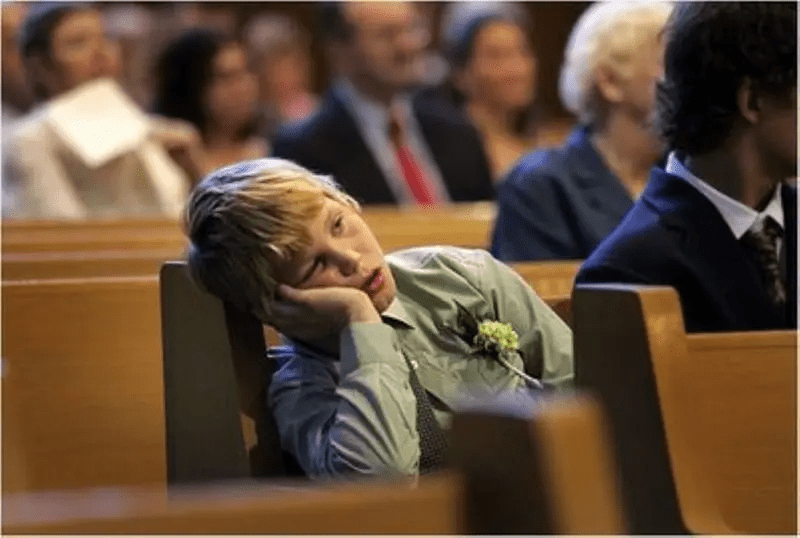
When I was a kid, the church worship service on Sunday was the longest hour of my week. I wanted to play in the pew, but my mom wouldn’t let me. I asked to go the bathroom, but my dad wasn’t having it. I tried to draw in the hymnal, but my sister always took everything around me ought of sight. My only relief was to sleep and drool on whatever I could lay my head on.

I’ve come a long way since then. But my experience taught me something. God isn’t boring, so I’m not going to be boring, either. Maybe I could have taught the Apostle Paul a thing or two.

In our New Testament lesson for today, the lateness of the hour (past midnight) and the ambiance of the room (all those burning oil lamps, presumably to keep people awake without any coffee) clues a church-going person immediately that something bad is about to go down. A long-winded preacher only serves to make for a combustible situation.

Uh-oh

In all fairness to Paul, if the congregants were bored out of their minds, the text doesn’t tell us. My guess is that the author, Luke, doesn’t want to go there. Yet, we have evidence of a bored person in the form of none other than a young person, a kid named Eutychus.  

He’s over by the open window, propped up on the ledge, and can’t keep his eyes open. Heck, for all we know, everyone was starting to doze off. And, as every preacher has experienced, as somebody slips into sleep, we just talk even longer.

The young man’s precipitous position leads to disaster: he falls out the third floor window. And, as one might expect, he fell to his death. Now, instead of some slap-stick comedic set up, we have a genuine tragedy: a young person literally bored to death by preaching.

The Apostle Paul raises Eutychus to life, by Gerard Hoet, 1728

All of a sudden, the story is no laughing matter. So, what might we learn from the preacher who bored Eutychus to death?

He finally stops preaching

The sermon is interrupted (as it turns out, of course, only momentarily) in order to attend to the tragedy. Sometimes, the sermon has to stop. Everything has to stop. We have to take a good, hard look at what’s going on. There are questions to ask, things to notice, conversations to begin. We have to get particular about where we are, and what we’re doing, before we can keep going with anything.

Maybe, just maybe, if Eutychus was part of the communion service, he wouldn’t have been on the margins and at risk of falling. As for many churches today, it could be there’s no young people around because they all fell out the window. Never underestimate the power of participation. Most youth just need to be asked to help out. But most adults don’t ask. And most kids aren’t going to volunteer.

He threw himself on him

Paul went down to Eutychus, and bending over him, took him in his arms in an emotional embrace – similar to what the father did when the prodigal son came home. (Luke 15:11-32)

In both cases – the prodigal son and Eutychus – they each needed a new life. The prodigal fell asleep to who he was, in a living death, and woke to his condition and went home. Eutychus literally fell asleep to an actual death and was woke to a resurrected life – returning back to the congregation (and even more preaching! *sheesh* leave it alone, Paul).

Each was found. Each had someone care about them by throwing their arms around them and giving them new life. That’s what grace is. Grace is giving the gift of seeing another person and embracing them – no matter whether they’re worthy of it, or not.

He’s alive

“He’s alive” is a statement of fact, of reality. It puts all the attention on what is true, right now, in this moment – and deflects attention away from who’s around the living person. In other words, Paul doesn’t take credit for Eutychus coming to life or restoring breath to him.

Implicitly, we know where the power comes from to raise Eutychus to life. It doesn’t come from the preacher. However, there is an important task that every preacher can do: witness a new life and bring the announcement of that life to the community. Preaching can (and ought to) bear witness to the activity of God in raising the dead and granting life.

The preacher can encourage the congregation to celebrate life around the Lord’s Table, notice the people on the margins of the community, and stay awake to the possibilities of what God can do amongst us.

Turns out, neither the length of a sermon nor the level of boredom is the issue. What’s most important is proclaming the gospel of grace in word and sacrament. And that’s something we all can participate in together and celebrate.

God of life, may we learn how to live from the mercy which was brought to us through the mission of your Son – whose saving love extends to every person, whose presence reaches into every place, Jesus Christ, who makes all things new, who lives and reigns with you and the Holy Spirit, one God, now and forever. Amen.

What Does God Want? (John 11:1-45)

The Raising of Lazarus, by Rembrandt, c.1632

Now a man named Lazarus was sick. He was from Bethany, the village of Mary and her sister Martha. (This Mary, whose brother Lazarus now lay sick, was the same one who poured perfume on the Lord and wiped his feet with her hair.) So the sisters sent word to Jesus, “Lord, the one you love is sick.”

When he heard this, Jesus said, “This sickness will not end in death. No, it is for God’s glory so that God’s Son may be glorified through it.” Now Jesus loved Martha and her sister and Lazarus. So when he heard that Lazarus was sick, he stayed where he was two more days, and then he said to his disciples, “Let us go back to Judea.”

“But Rabbi,” they said, “a short while ago the Jews there tried to stone you, and yet you are going back?”

Jesus answered, “Are there not twelve hours of daylight? Anyone who walks in the daytime will not stumble, for they see by this world’s light. It is when a person walks at night that they stumble, for they have no light.”

After he had said this, he went on to tell them, “Our friend Lazarus has fallen asleep; but I am going there to wake him up.”

His disciples replied, “Lord, if he sleeps, he will get better.” Jesus had been speaking of his death, but his disciples thought he meant natural sleep.

So then he told them plainly, “Lazarus is dead, and for your sake I am glad I was not there, so that you may believe. But let us go to him.”

Then Thomas (also known as Didymus) said to the rest of the disciples, “Let us also go, that we may die with him.”

On his arrival, Jesus found that Lazarus had already been in the tomb for four days. Now Bethany was less than two miles from Jerusalem, and many Jews had come to Martha and Mary to comfort them in the loss of their brother. When Martha heard that Jesus was coming, she went out to meet him, but Mary stayed at home.

“Lord,” Martha said to Jesus, “if you had been here, my brother would not have died. But I know that even now God will give you whatever you ask.”

Jesus said to her, “Your brother will rise again.”

Martha answered, “I know he will rise again in the resurrection at the last day.”

Jesus said to her, “I am the resurrection and the life. The one who believes in me will live, even though they die; and whoever lives by believing in me will never die. Do you believe this?”

“Yes, Lord,” she replied, “I believe that you are the Messiah, the Son of God, who is to come into the world.”

After she had said this, she went back and called her sister Mary aside. “The Teacher is here,” she said, “and is asking for you.” When Mary heard this, she got up quickly and went to him. Now Jesus had not yet entered the village, but was still at the place where Martha had met him. When the Jews who had been with Mary in the house, comforting her, noticed how quickly she got up and went out, they followed her, supposing she was going to the tomb to mourn there.

When Mary reached the place where Jesus was and saw him, she fell at his feet and said, “Lord, if you had been here, my brother would not have died.”

When Jesus saw her weeping, and the Jews who had come along with her also weeping, he was deeply moved in spirit and troubled. “Where have you laid him?” he asked.

“Come and see, Lord,” they replied.

Jesus wept.

Then the Jews said, “See how he loved him!”

But some of them said, “Could not he who opened the eyes of the blind man have kept this man from dying?”

Jesus, once more deeply moved, came to the tomb. It was a cave with a stone laid across the entrance. “Take away the stone,” he said.

“But, Lord,” said Martha, the sister of the dead man, “by this time there is a bad odor, for he has been there four days.”

Then Jesus said, “Did I not tell you that if you believe, you will see the glory of God?”

So they took away the stone. Then Jesus looked up and said, “Father, I thank you that you have heard me. I knew that you always hear me, but I said this for the benefit of the people standing here, that they may believe that you sent me.”

When he had said this, Jesus called in a loud voice, “Lazarus, come out!” The dead man came out, his hands and feet wrapped with strips of linen, and a cloth around his face.

Jesus said to them, “Take off the grave clothes and let him go.”

Therefore many of the Jews who had come to visit Mary, and had seen what Jesus did, believed in him. (New International Version)

The Raising of Lazarus, by Vincent Van Gogh, 1890

Here’s a Captain Obvious observation:

what God wants, and what we want, is not always the same thing. 

Today’s Gospel story centers around a man named Lazarus, the brother of Mary and Martha. The disciples were familiar with them since they were committed followers of Jesus. 

Their friend Lazarus became deathly ill. Christ and the disciples caught wind of it. Everyone believed Jesus could do something about this. But Jesus stayed put. He didn’t make a move to go to his sick friend. 

After a few days, Lazarus died. It was only then, that Jesus made his move.

The religious authorities in Jerusalem had it out for Jesus. But Jesus decided to go to Bethany and Jerusalem anyway. This made no sense to the disciples. Lazarus was lying dead in Bethany. Going there would put everyone at risk – which is why Thomas uttered the defeatist and dramatic statement, “Let us also go, that we may die with him.”

Yet, they all went. And once they arrived, Christ and his disciples found the grieving sisters. Mary and Martha believed that Jesus was the promised Messiah who would come and save the people. They didn’t understand why Jesus stayed away and didn’t come sooner. 

If Jesus had been there, he could have healed Lazarus. He healed other people, so why not a friend and a brother?

The death of Lazarus seemed to be the end. No one was happy with how things shook-out. Lazarus died. The disciples’ plans were dead. Mary and Martha’s expectations died…

but death is exactly what it takes in to have resurrection.

There’s no such thing as a painless miracle. Death isn’t a pleasant affair. I have been with countless people at the end of life, and I will tell you that, although it’s possible for a death to be peaceful, it’s still ugly business. 

It’s also painful to watch carefully laid and prayed over plans die. It hurts to see a long sought after dream just go up in smoke and die. To see anything or anyone we deeply care about die is gut-wrenching. Yet, in order for a resurrection to occur, there must first be a death.

There cannot be a new life unless there’s an old one. 

Jesus did the impossible by raising Lazarus from death and giving him new life. And the resurrection of Lazarus pointed to an even greater truth: Christ’s own death and resurrection was coming, and it will change everything.

Whenever what we want dies, then we are in a position to ask: So, what does God want? 

God wanted something better than what everybody else wanted. By allowing ourselves to be consumed with what God wants, it turns out to be the very best thing for us, even if it does not quite jive with what I want.

Everyone’s expectations needed to die, along with Lazarus, for the resurrection to become reality. Only then did Jesus act by rising Lazarus from death.

Jesus pointed to himself as the one able to bring life to all that is dead among us. Sometimes:

  • dreams must die so that Jesus can resurrect them to new life, with outcomes far more glorious than you and I could ever imagine
  • plans have to be dead and buried before Jesus will breathe new life into them, making those plans so much more than they could ever have been in our hands.
  • ministries, even churches, need to be dead as a doorknob so that Jesus can resurrect them and give them new life, invigorated with spiritual resurrection power.

If we desire to see the miracle of resurrection, we must die to ourselves – take up our crosses and follow Jesus into the grave so that he can transform our lowly expectations into a glorious new existence. Death does not have the last word because Christ’s resurrection makes it possible for us to have new life. Again, I ask:

What does God want? God wants to raise the dead to life.

Do you believe this? Yes, I believe. Help me in my unbelief.

Follow the path of what God wants and watch what the Lord will do for you.