Who Is Running from God? (Jonah 1:1-17)

The Lord gave this message to Jonah son of Amittai: “Get up and go to the great city of Nineveh. Announce my judgment against it because I have seen how wicked its people are.”

But Jonah got up and went in the opposite direction to get away from the Lord. He went down to the port of Joppa, where he found a ship leaving for Tarshish. He bought a ticket and went on board, hoping to escape from the Lord by sailing to Tarshish.

But the Lord hurled a powerful wind over the sea, causing a violent storm that threatened to break the ship apart. Fearing for their lives, the desperate sailors shouted to their gods for help and threw the cargo overboard to lighten the ship.

But all this time Jonah was sound asleep down in the hold. So the captain went down after him. “How can you sleep at a time like this?” he shouted. “Get up and pray to your god! Maybe he will pay attention to us and spare our lives.”

Then the crew cast lots to see which of them had offended the gods and caused the terrible storm. When they did this, the lots identified Jonah as the culprit. “Why has this awful storm come down on us?” they demanded. “Who are you? What is your line of work? What country are you from? What is your nationality?”

Jonah answered, “I am a Hebrew, and I worship the Lord, the God of heaven, who made the sea and the land.”

The sailors were terrified when they heard this, for he had already told them he was running away from the Lord. “Oh, why did you do it?” they groaned. And since the storm was getting worse all the time, they asked him, “What should we do to you to stop this storm?”

“Throw me into the sea,” Jonah said, “and it will become calm again. I know that this terrible storm is all my fault.”

Instead, the sailors rowed even harder to get the ship to the land. But the stormy sea was too violent for them, and they couldn’t make it. Then they cried out to the Lord, Jonah’s God. “O Lord,” they pleaded, “don’t make us die for this man’s sin. And don’t hold us responsible for his death. O Lord, you have sent this storm upon him for your own good reasons.”

Then the sailors picked Jonah up and threw him into the raging sea, and the storm stopped at once! The sailors were awestruck by the Lord’s great power, and they offered him a sacrifice and vowed to serve him.

Now the Lord had arranged for a great fish to swallow Jonah. And Jonah was inside the fish for three days and three nights. (New Living Translation)

God said, “Go!”

Jonah said, “No!”

And, God said, “Oh!?”

Jonah did a complete turn-and-run from God’s clear instructions to go to the city of Nineveh. That doesn’t sound like a good idea. So, why did Jonah run? And why do we run?

Who were the Assyrians?

Nineveh was a large city in the ancient world, and the capital of Assyria. The Assyrians had a reputation as fierce soldiers and conquered the Middle East. They are mentioned many times in the Old Testament. It was Assyria that God used to judge the northern kingdom of Israel.

The typical military practice of the Assyrians was to attack a city and completely subjugate it by deporting most of the people and repopulating it with some of their own people. They did this so that the conquered people could not mount a revolt or resistance to their rule.

The Assyrians, the Ninevites, were notorious in the ancient world for their brutality toward conquered peoples. Many forms of torture that we are aware of today were invented by the Assyrians. Their methods were awful and inhumane. The Assyrians were experts at thinking up and executing extreme forms of torture on everyone who resisted their power. It was a very violent culture.

Who is God?

God isn’t at all like the Ninevites. The ways of the Assyrians caught the notice of God, who was ready to pronounce judgment on the heart of the Assyrian Empire, the capital city of Nineveh. So, as God typically did in the Old Testament, he told one of his prophets to go and give a message.

The message was simple: “Go to the great city of Nineveh and preach against it, because its wickedness has come up before me.” Lest we think God was determined to wipe Nineveh off the map, think again. Jonah confesses later in the book, “I knew that you are a gracious and compassionate God, slow to anger and abounding in love, a God who relents from sending calamity.” (Jonah 4:2)

Who was Jonah?

Jonah did not like the Assyrians. More than that, he hated their guts. They killed, maimed, executed, and deported Jonah’s fellow Israelites. The last thing Jonah wanted was to have effective preaching and see Nineveh repent of their violent ways. Jonah wanted judgment, not grace.

In this little four-chapter prophetic book of the Old Testament, it is Jonah who needs divine deliverance as much as the Ninevites do. In fact, Jonah’s need for rescue gets more attention than the evil Assyrians. The message of Jonah comes down to this:

Racism and hatred, however much perceived to be legitimate, have no part whatsoever in the kingdom of God.

Who are we?

Christians are the community of the redeemed. New life in Jesus Christ involves a wholesale jettison of bigotry and the manure pile of hatred directed toward any ethnic and/or religious group of people, period. New life means adopting the love of God. It involves becoming a dispenser of grace and mercy with all people, not just the ones we feel deserve it.

What does God want us to learn?

To share the same heart as God has – a heart that beats for people to know and live by a better way – a heart that has grace and compassion even in the face of flat-out evil. We are meant to think twice about pointing the finger at others. Instead, we are to take the plank out of our own eye before we address the splinter in another’s eye.

It wasn’t the Assyrians who were running from God; it was Jonah. In God’s upside-down realm, the wicked become the righteous, and the righteous are exposed as wicked. The unrighteous run to God, whereas the religious run from God. Nineveh eventually turned from their evil ways.

So, let’s keep to the side of mercy, not judgment.

O God, you created all people in your image. We thank you for the astonishing variety of races and cultures in this world. Enrich our lives by ever-widening circles of friendship, and show us your presence in those who differ most from us, until our knowledge of your love is made perfect in our love for all your children; through your Son, Jesus Christ our Lord. Amen.

Assurance for the Next Step in Life (Judges 6:36-40)

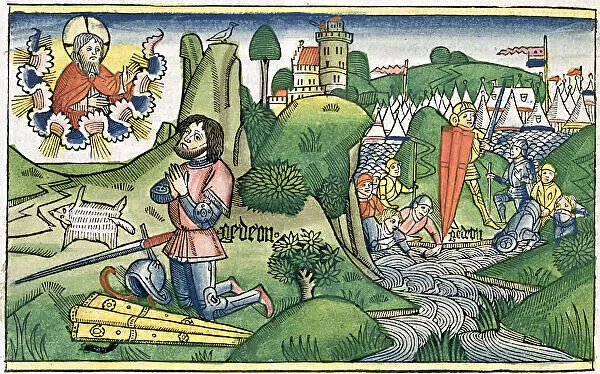
15th century German artist depiction of Gideon putting out the fleece

Gideon prayed to God, “I know that you promised to help me rescue Israel, but I need proof. Tonight I’ll spread a sheep skin on the stone floor of that threshing place over there. If you really will help me rescue Israel, then tomorrow morning let there be dew on the skin, but let the stone floor be dry.”

And that’s just what happened. Early the next morning, Gideon got up and checked the sheep skin. He squeezed out enough water to fill a bowl. But Gideon prayed to God again. “Don’t be angry with me,” Gideon said. “Let me try this just one more time, so I’ll really be sure you’ll help me. Only this time, let the skin be dry and the stone floor be wet.”

That night, God made the stone floor wet with dew, but he kept the sheep skin dry. (Contemporary English Version)

It’s only human to want assurances. And since humanity requires some sort of affirmation that they’re hearing things right, or are on the right track, God graciously accommodates to our need. Much like the disciple of Jesus, Thomas, who desired an assurance that Christ is alive and was victorious over the grave, so Gideon needed clarification that victory was truly at hand.

In both cases of doubting Thomas and anxious Gideon, the Lord does not chide them for needing such assurances. Rather, God immediately responds to their requests. You and I might feel ourselves weak or confused in needing such support, yet God doesn’t feel this way about us.

Sometimes, in our disorientation and our dismay, we try and put feelings aside and stoically attempt to do whatever must be done with complete dispassion and lack of emotion. But that’s to try and be somebody we are not; humans simply aren’t wired that way. There’s no need to try and stir up the courage and confidence on our own.

To navigate this life with any success, we’ll need to pay attention to the inner person, to what’s going on inside us, whenever we are in stressful or confusing times. Then we can connect with the God who mercifully awaits hearing our request. It’s good to be equipped and ready for what’s ahead by having a few convictions….

It’s not the destination that’s important; it’s the journey

Gideon needed to come around to seeing that getting from Point A to Point B as quickly and as efficiently as possible was not the goal. The process of getting from one place to another is the very opportunity needed to connect with the Lord and with others around us. God’s instructions may seem, at times, nonsensical – which is why we often look for assurances that we’ve heard them correctly!

Gideon and the fleece, in the Frauenkirche, Esslingen, Germany

For us modern folk, the Lord doesn’t want us getting lost in the race to become ever more streamlined and productive, only looking at the end goal. If relationships, human connection, justice, love and respect of others is our highest value, then we really need to pay a lot more attention to the process of what we’re doing, and not just the product and outcomes.

Focusing solely on a final outcome turns factory workers into extensions of the machines they are using to churn out a quality product; it turns families at church into giving units with potential to support all the programs and ministries; it turns adversity into an unwanted obstacle to achieving victory; and turns needy people into problems we can fix.

Life is a pilgrimage to walk; it’s not a race to run

At the end of life, folks don’t reminisce about how much they produced, how many places they’ve been, or how much money they made. Instead, they talk about people, both the relationships that were rich and full, as well as the broken or lapsed relationships which cause them regret.

This is why, daily, I purpose to saunter, walk slowly, and observe the people and places around me. This practice allows me to take the time to greet others, connect with some, and even have a sit down conversation with another person – all on the way to doing something else.

Frankly, from a goal-oriented perspective of achievement and accomplishment, this practice does nothing to help whittle down my massive checklist for the day. But I do it, anyway, because human connection our real purpose in life.

Humanity is our business

It doesn’t matter what we do for a living, or where we live. Relationships are the only reality we take with us in the end – both with God and other people.

Dead with ball and chain, the ghost of Jacob Marley responded to Ebenezer Scrooge’s accolade that he was such a good man of business:

“Mankind was my business. The common welfare was my business; charity, mercy, forbearance, benevolence, were all my business. The dealings of my trade were but a drop of water in the comprehensive ocean of my business!” 

Jacob Marley, in Charles Dickens, A Christmas Carol

Marley had discovered this insight too late. 

All of life is a gift given by God, meant for us to be stewards toward the benefit and welfare of humanity. All our abilities, skills, intellectual acumen, possessions, and even the lack thereof – literally everything – is meant to be used in the betterment of our fellow human beings.

We all share the common human condition of needing our stories told and heard by one another, so that we can have some assurance and comfort through what we’re facing.

Will I be there to hear another? Will another be there to hear me? Will I listen to God? Will God listen to me?

Be fully present to others; avoid thinking about the past or focusing on the future

If you think about it, Jesus was perhaps the most productive person to ever walk this earth. In just three short years his ministry completely changed the world and continues to do so. Perhaps our Lord’s “secret” was no secret at all. 

Christ was fully present to the Father, and to the people right in front of him. He was never hurried, and didn’t capitulate to the anxiety of others who wanted him to pick up the pace of being a kickass Messiah.

So, my friends, may you slow down enough to observe, see, hear, smell, and witness the incredible and deep humanity that is present next door to you, down the hall from you, and sitting across the table with you. 

May you experience the wide mercy of God and graciously extend the same love to others. 

May you embrace the process of whatever you are doing to include the space of others and their unique humanity.

For this is how we gain our assurance that God is with us and that we are on the right track for that next step in life.

Jesus Shows Up (John 20:19-31)

Jesus shows himself to Thomas, by Rowan and Irene LeCompte

On the evening of that first day of the week, when the disciples were together, with the doors locked for fear of the Jewish leaders, Jesus came and stood among them and said, “Peace be with you!” After he said this, he showed them his hands and side. The disciples were overjoyed when they saw the Lord.

Again Jesus said, “Peace be with you! As the Father has sent me, I am sending you.” And with that he breathed on them and said, “Receive the Holy Spirit. If you forgive anyone’s sins, their sins are forgiven; if you do not forgive them, they are not forgiven.”

Now Thomas (also known as Didymus), one of the Twelve, was not with the disciples when Jesus came. So the other disciples told him, “We have seen the Lord!”

But he said to them, “Unless I see the nail marks in his hands and put my finger where the nails were, and put my hand into his side, I will not believe.”

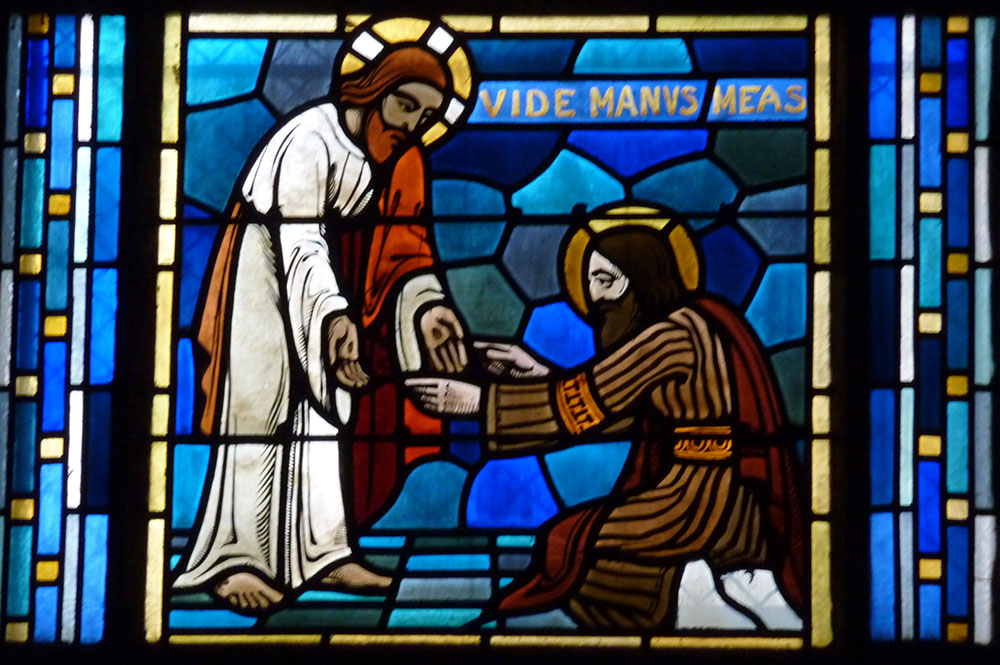
A week later his disciples were in the house again, and Thomas was with them. Though the doors were locked, Jesus came and stood among them and said, “Peace be with you!” Then he said to Thomas, “Put your finger here; see my hands. Reach out your hand and put it into my side. Stop doubting and believe.”

Thomas said to him, “My Lord and my God!”

Then Jesus told him, “Because you have seen me, you have believed; blessed are those who have not seen and yet have believed.”

Jesus performed many other signs in the presence of his disciples, which are not recorded in this book. But these are written that you may believe that Jesus is the Messiah, the Son of God, and that by believing you may have life in his name. (New International Version)

When Jesus shows up, there is peace. Wherever Jesus goes, the Spirit of God is there. When Jesus appears, people believe.

The Meeting

After the crucifixion of Christ, the disciples were huddled together, mostly in fear of being found out and put out by the religious authorities. Out of nowhere, Jesus showed up, smack in the middle of the anxious group of men.

Christ in the center makes all the difference. From this central place, Jesus bestowed to the disciples his peace. The very first word the risen Christ spoke to his disciples was neither a command to stop being afraid, nor a rebuke for sitting around and doing nothing, or disappointment that they all ran away in the final hour of need at the crucifixion; instead, the first word of Christ was a gift of peace.

The presence and peace of Christ melted the disciples’ fear. Christ-centered peace is graciously given; so let us gratefully receive it.

The Reality

Jesus showed up, then showed off his hands and his side. He was not fabricated out of the disciples’ imagination; he was not some ghostly apparition. Rather, Christ was standing in the middle of them, very real, very physical, and very alive.

Christ gave his disciples real truth: actual wounded hands and side on a real body. Christ is risen and alive – not just spiritually, but physically. Since the resurrection of Jesus really happened, then nothing else matters; our joy is complete. We have what we need.

The Mission

As Jesus was sent by the Father, so Jesus sent his disciples; and is still sending us out into the world. And as Jesus came not to condemn the world but to save it, so we go out with words of grace and peace. The church exists for the life of the world – to bless it with the presence and peace of Christ.

“Whoever believes in me does not believe in me only, but in the one who sent me. The one who looks at me is seeing the one who sent me. I have come into the world as a light, so that no one who believes in me should stay in darkness.” (John 12:44-46, NIV)

Our spiritual DNA makes us little Christ’s walking around, doing the will of God, for the benefit of a world in darkness. We bear the name of Christ: Christians, proclaiming a message of life, delighting in God and creation; and not destroying the earth and its inhabitants.

The Gift

Right now, we are not alone. The Holy Spirit has been graciously given to us by Jesus. Although our mission is a big one, our resource for accomplishing it is even bigger. Jesus gives the Spirit in the same way he gives himself – as a sheer gift with no strings attached. Just as God breathed life into the very first people on earth, so Jesus breathes on the disciples and gives them new life and a new heart.

I will give you a new heart and put a new spirit in you; I will remove from you your heart of stone and give you a heart of flesh. And I will put my Spirit in you and move you to follow my decrees and be careful to keep my laws… and you will be my people, and I will be your God. (Ezekiel 36:26-28, NIV)

The Privilege

Christ has redeemed us, forgave us of our guilt and shame. Now, we have the privilege of passing the forgiveness to others. The special mission of the Church is giving Jesus to others with grace and peace, so that they may believe he is truly the risen Lord; and so, receive Jesus, the Spirit, forgiveness, and purpose in life, with Christ at the center of all things.

For the one whom God has sent speaks the words of God, for God gives the Spirit without limit. The Father loves the Son and has placed everything in his hands. Whoever believes in the Son has eternal life, but whoever rejects the Son will not see life, for God’s wrath remains on them.” (John 3:34-36, NIV)

The Risen Lord, by He Qi

The Appearance

When Jesus appears, its good if we also show up to see him. It seems Thomas was late for church and missed the beginning of the service. He wasn’t with the other gathered disciples. Nobody knows where he was or what he was doing. But the important thing is that he did eventually show up, because showing up is the beginning of a changed life.

The Witness

After Jesus showed up, the disciples bore witness to what they saw and heard to Thomas. Yet Thomas, bless his doubting heart, wasn’t having it. He’s a realist. He wants proof, some actual physical evidence. Thomas was clearly a tactile learner because he needs some touch to believe any of this crazy talk of his disciple brothers.

Sometimes Thomas gets a bad rap, but he is really our Everyman. Doubt and skepticism are an important part of a full-orbed and honest faith. Jesus gave Thomas some space, time, and respect to begin wrapping his head and heart around this new reality of resurrection. I wonder if we all can do the same with others.

The Middle

A second time, Jesus shows up in the middle of the disciples. The Word became flesh and dwelt among us – and didn’t become a ghost and hang out in secret places. Once again, peace is given by Jesus to his followers.

Both appearances happen on a Sunday (which is why Christians have always worshiped on Sundays); and both meetings are literally Christ-centered (which every Christian meeting is supposed to be). Every Sunday. Christ always in the middle. Keep those two, and keep them together, and you can’t go wrong.

Jesus appears to Thomas with the Latin words, “See my hands,” in Notre-Dame-du-Rosaire Church, Saint-Ouen, France 

The Invitation

There’s no beating around the bush with Jesus. He immediately engaged Thomas and invited him to touch the wounds on his very real body. Christ knew Thomas’ hang-up, and went right to it. Thomas wanted evidence; Jesus offered it. If we get anything out of this encounter, it is that risen Christ honors honest doubt.

The evidence is here. Now believe it, and stop disbelieving. We have documentary evidence of the Old and New Testaments; the Church’s witness in Creeds, Confessions, and contemporary narratives of changed lives; and the internal testimony of the Holy Spirit. Therefore, look into them carefully and draw a sound conclusion.

The Confession

“My Lord and my God!” That’s the confession and the conclusion Thomas drew from the evidence – not only that Jesus is real, alive, existed, a good teacher; or other people’s Lord and God – but that he is my Lord and my God.

Jesus cared enough for Thomas to specifically meet him personally at his point of need. The grace of God keeps coming and never runs out. Jesus is filled up to the full in both grace and truth.

The Believer

Thomas had the physical evidence. But it doesn’t take that to truly believe. God blesses those who’ve never seen nor touched, but still believe. Jesus was thinking of you and me, and not only the people in front of him at the time. The Lord Jesus blesses us with the gift of peace, grace, and faith.

Though you have not seen him, you love him; and even though you do not see him now, you believe in him and are filled with an inexpressible and glorious joy, for you are receiving the end result of your faith, the salvation of your souls. (1 Peter 1:8-9, NIV)

The Conclusion

All this is for our benefit, so that we, too, may believe that Jesus is the Christ, the Son of the living God. Since Jesus is alive, he continues to bless us with his presence, power, and peace.

Jesus is with us:

  • through the Word of God, giving us his peace, showing up and meeting needs people.
  • at the Table in the sacrament of communion, bringing grace and forgiveness
  • in the person of the Holy Spirit, enabling and energizing us for mission and ministry to the world

It’s a life worth living, a Christ-centered life, full of God’s blessing.

O God and Father of our Lord Jesus Christ, in whom we receive the legacy of a living hope, born again not only from his death but also from his resurrection. May we who have received forgiveness of sins, set others free, until we enter the inheritance that is imperishable and unfading, where Christ lives and reigns with you and the Holy Spirit, one God, now and forever. Amen.

The Love of God for You (Song of Songs 8:6-7)

God Is Love, by Voss Creative

Place me like a seal over your heart,
    like a seal on your arm;
for love is as strong as death,
    its jealousy unyielding as the grave.
It burns like blazing fire,
    like a mighty flame.
Many waters cannot quench love;
    rivers cannot sweep it away.
If one were to give
    all the wealth of one’s house for love,
    it would be utterly scorned. (New International Version)

Throughout most of church history, the Old Testament poem of Solomon’s Song of Songs has been interpreted allegorically as the love between God and God’s people.

A more literal hermeneutic views the Song as an actual relationship between a man and woman – which has it’s merits in that it acknowledges and affirms our bodily nature.

Yet, no matter what interpretive grid one uses for the Song, this wondrous and unique biblical book is an Ode to Love, lifting the centrality and power of Love as the greatest force in the world.

As for me, I believe it’s likely that the Song purposely has both the literal and allegorical in view. There are many places throughout Holy Scripture which have intended double and even triple meanings to the text. However one chooses to see the Song, love begins with God, and gives shape to our own human love for God, one another, and one’s lover.

“God carries your picture in his wallet.”

Tony Campolo

We learn a great deal of love from God. The Lord is a jealous God. That doesn’t mean the Lord is some weird stalker deity with insecurities about losing the devotion of worshipers. No, instead, divine jealousy is the positive quality of showing steadfast love and commitment, being completely devoted to following through with divine promises and presence.

The Song is far from the only place in Scripture which likens the relationship between God and God’s people as a marriage of lovers. In fact, God’s covenant relationship with people is at the heart of understanding the whole of Scripture.

In the prophecy of Hosea, God expressed a longing for Israel to remain faithful, because the Lord loves her. Hosea had an unfaithful wife, and throughout the book of Hosea the relationship between him and his wife Gomer mirrored the relationship between God and Israel. Just as Hosea kept showing faithful love to Gomer, even though she was brazenly unfaithful, so too, God looked at Israel with affection and steadfast love, not bearing to give her up.

“If you have never known the power of God’s love, then maybe it is because you have never asked to know it – I mean really asked, expecting an answer.”

Frederick Buechner, The Magnificent Defeat

The love of God shall always win the day, despite our own human love, which can wax and wane according to mood or circumstance. Grace, mercy, and love are deep in the nature of God; Love is who God is, not just what God does.

The one marrying you is the one who made you—
    the Lord of heavenly forces is his name.
The one redeeming you is the holy one of Israel,
    the one called the God of all the earth.
As an abandoned and dejected woman the Lord has summoned you;
    as a young wife when she is rejected,
        says your God.
For a brief moment I abandoned you,
    but with great mercy I will bring you back.
    In an outburst of rage,
    I hid my face from you for a moment,
    but with everlasting love I have consoled you,
    says your redeemer, the Lord.

These are like the days of Noah for me,
    when I promised that Noah’s waters would never again cover the earth.
    Likewise I promise not to rage against you or rebuke you.
The mountains may shift,
    and the hills may be shaken,
    but my faithful love won’t shift from you,
    and my covenant of peace won’t be shaken,
    says the Lord, the one who pities you. (Isaiah 54:5-10, CEB)

As the Old Testament draws toward the end, God’s love remains constant, desiring the people to hold fast to their Lord:

This is what the Lord All-Powerful says: “I have a very strong love for Jerusalem. My strong love for her is like a fire burning in me.” (Zechariah 8:2, NCV) 

Into the New Testament, the love of God continues to burn for God’s people. In the Gospels, Jesus showed committed love to all sorts of people, going so far as to be the ultimate martyr, giving himself as sacrifice of atonement on behalf of a world who mostly rejected him.

“Do you see this woman? I came into your house. You did not give me any water for my feet, but she wet my feet with her tears and wiped them with her hair. You did not give me a kiss, but this woman, from the time I entered, has not stopped kissing my feet. You did not put oil on my head, but she poured perfume on my feet. Therefore, I tell you, her many sins have been forgiven—as her great love has shown. But whoever has been forgiven little loves little.” (Luke 7:44-47, NIV)

One of Christ’s disciples, the Apostle John, learned to channel his passionate anger into passionate love. John knew that people’s needs are supremely and fully met through the Lord who loves them – and not through alternate avenues of love:

Do not love this world nor the things it offers you, for when you love the world, you do not have the love of the Father in you. For the world offers only a craving for physical pleasure, a craving for everything we see, and pride in our achievements and possessions. These are not from the Father, but are from this world. And this world is fading away, along with everything that people crave. But anyone who does what pleases God will live forever. (1 John 2:15-17, NLT)

God knows that going elsewhere to satisfy our needs, ultimately gets us nowhere, especially our need for love. God yearns, passionately, for us to find our pleasure and enjoyment in him. God waits with loving patience to show grace and compassion.

“The Love of God” by Frederick M. Lehman, 1917

The love of God is greater far
than tongue or pen can ever tell;
it goes beyond the highest star,
and reaches to the lowest hell.
The wand’ring child is reconciled
by God’s beloved Son.
The aching soul again made whole,
and priceless pardon won.


O love of God, how rich and pure!
How measureless and strong!
It shall forevermore endure—
the saints’ and angels’ song.