The Truth About You (John 8:21-30)

Once more Jesus said to them, “I am going away, and you will look for me, and you will die in your sin. Where I go, you cannot come.”

This made the Jews ask, “Will he kill himself? Is that why he says, ‘Where I go, you cannot come’?”

But he continued, “You are from below; I am from above. You are of this world; I am not of this world. I told you that you would die in your sins; if you do not believe that I am he, you will indeed die in your sins.”

“Who are you?” they asked.

“Just what I have been telling you from the beginning,” Jesus replied. “I have much to say in judgment of you. But he who sent me is trustworthy, and what I have heard from him I tell the world.”

They did not understand that he was telling them about his Father. So Jesus said, “When you have lifted up the Son of Man, then you will know that I am he and that I do nothing on my own but speak just what the Father has taught me. The one who sent me is with me; he has not left me alone, for I always do what pleases him.” Even as he spoke, many believed in him. (New International Version)

Jesus was an interesting guy – both cagey and confrontational at the same time. He had a way (the way, in fact) that left those who longed for mercy and encouragement to receive it, while also giving rebuke to those satisfied with being stuck in their misguided lives.

This made Christ one of those persons whom you either loved or hated. The people that loved him, adored him; and those that hated him, sought to kill him.
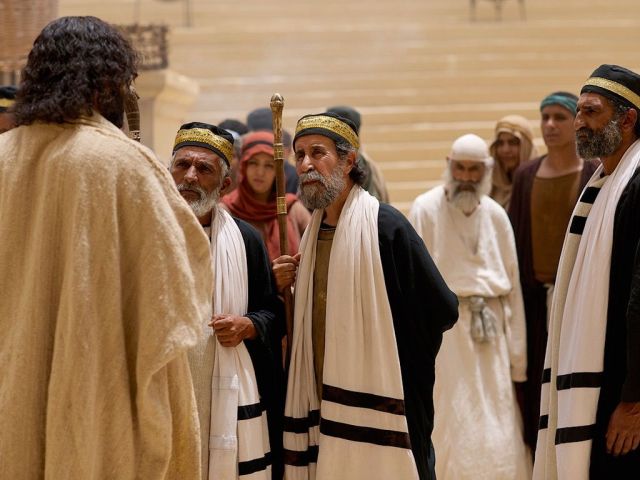
It’s really a matter of self-perception. The ones who tend to self-loathe and wonder if they’re accepted, or not, are the ones who feel on the outside. These are the folks who discover themselves on the inside, accepted by God. And Jesus made it happen for them.

On the other hand, the ones who are enamored with themselves and their superior religion, looking down at others and feeling secure as insiders, are the people who will find they’re actually on the outside looking in; indeed, they will die in their self-delusion.

Our self-identification matters. If identity is tied to what we’re able to do for God, and/or how pious we look for others to see, then our inflated egos will eventually be popped with the pinprick of divine judgment. But if identity is tethered to belonging to God by divine grace and mercy, then we shall know true acceptance.

We need to know the truth about ourselves. Both truth and error are powerful. If we have misguided notions of self, we are like empty wells with no water to draw from. Many of our problems, failures, and shame are largely due to a misunderstanding of the kind of person we are. 

A profound result of this misunderstanding is a lack of self-worth. When we are in error about who we really are, we are severely limited in what we can do in our lives. We can neither solve the problem by comparing ourselves with others nor by trying to generate good feelings about ourselves. Only through accepting what the Holy Scriptures say about us, and responding in faith, can we be truly helped.

So, here are some bedrock truths about us:

  1. We are created in the image and likeness of God. (Genesis 1:16-17)  We begin to understand ourselves by beginning with the creation of the world. Since God is a Person of infinite perfection and goodness, to be created in God’s image means we are persons of great potential and value.
  2. We are special to God. The Lord treats us as persons; therefore, we may not treat ourselves any less than that. To be a person means that we are self-conscious and can make decisions. We also have inherent rights to know, to be heard, to feel, to have an opinion, to be honored, to develop potential, to assume responsibility, and to enjoy life and all creation.
  3. We are loved by God (John 15:9; 17:23) God recognizes us as persons, gives us our rightful place in the divine life, and will do what is right by us. In other words, God has our back. The Lord will not gaslight us.
  4. We are called to a relationship with the loving God (1 Corinthians 1:9) No greater honor could be bestowed on us than to be invited to interact with the Living God. As we do, the door is open so God can minister to us and lead us into the knowledge and practice of a good life.
  5. We are the recipients of divine revelation (Hebrews 1:1-3) Having the Holy Scriptures available to us is the greatest possession we could ever receive. There is nothing more powerful than the truth about God and God’s design for our daily life. Therefore, we commit a profound sin when we neglect and disobey what God has so graciously given us.
  6. We are the objects of divine redemption (Romans 5:8-9) The great evidence of our human worth is the reality that Jesus Christ has secured our redemption from sin, death, and hell. Jesus, the Son of God, has loved us and gave himself for us. (Galatians 2:20)
  7. We are the temple of the Holy Spirit (1 Corinthians 6:19-20) The actual physical temple of the Old Testament was filled with the glory of God. Today, through Christ’s redeeming love on the cross, every believer in Jesus is God’s temple. Therefore, God wants to work in us and through us for to bless and serve the world.

The conclusion to the matter is that the only way we will know true self-worth is to accept what God says about us and respond by faith and love to this loving and redeeming message. You are a person of infinite worth to God, so live into this wonderful truth.

Gracious Creator, blessed all-knowing God, be merciful to upgrade my opinion of myself and my vision for the future so I never feel the need to protect and preserve the past. Show me how to be a faithful steward of the greatness you have placed within me.

Loving Lord, you know everything about me and love me anyway! As I accept and experience your grace and mercy, help me to grasp the depth and perfection of your love as demonstrated by the sacrifice of your only Son, Jesus Christ my Lord, who with you and the Holy Spirit are one God, now and forever. Amen.


Slow Down (2 Kings 2:1-12)

Not long before the Lord took Elijah up into heaven in a strong wind, Elijah and Elisha were leaving Gilgal. Elijah said to Elisha, “The Lord wants me to go to Bethel, but you must stay here.”

Elisha replied, “I swear by the living Lord and by your own life that I will stay with you no matter what!” And he went with Elijah to Bethel.

A group of prophets who lived there asked Elisha, “Do you know that today the Lord is going to take away your master?”

“Yes, I do,” Elisha answered. “But don’t remind me of it.”

Elijah then said, “Elisha, now the Lord wants me to go to Jericho, but you must stay here.”

Elisha replied, “I swear by the living Lord and by your own life, that I will stay with you no matter what!” And he went with Elijah to Jericho.

A group of prophets who lived there asked Elisha, “Do you know that today the Lord is going to take away your master?”

“Yes, I do,” Elisha answered. “But don’t remind me of it.”

Elijah then said to Elisha, “Now the Lord wants me to go to the Jordan River, but you must stay here.”

Elisha replied, “I swear by the living Lord and by your own life that I will never leave you!” So the two of them walked on together.

Fifty prophets followed Elijah and Elisha from Jericho, then stood at a distance and watched as the two men walked toward the river. When they got there, Elijah took off his coat, then he rolled it up and struck the water with it. At once a path opened up through the river, and the two of them walked across on dry ground.

After they had reached the other side, Elijah said, “Elisha, the Lord will soon take me away. What can I do for you before that happens?”

Elisha answered, “Please give me twice as much of your power as you give the other prophets, so I can be the one who takes your place as their leader.”

“It won’t be easy,” Elijah answered. “It can happen only if you see me as I am being taken away.”

Elijah and Elisha were walking along and talking, when suddenly there appeared between them a flaming chariot pulled by fiery horses. At once, a strong wind took Elijah up into heaven. Elisha saw this and shouted, “Israel’s cavalry and chariots have taken my master away!” After Elijah had gone, Elisha tore his clothes in sorrow. (Contemporary English Version)

“For fast-acting relief from stress, try slowing down.”

Lily Tomlin

In placing today’s Old Testament lesson of Elijah ascending to heaven in a whirlwind next to yesterday’s New Testament lesson of Christ’s ascension, the Revised Common Lectionary wants us to consider the relationship between the two.

What goes up, must come down. Two people ascending to heaven will eventually descend back to the earth.

But why all this elapsed time? If there’s something left yet to be done, why not just do it then? Or right now?

Ah, but there’s the issue. In asking such questions, I (we) betray our modern Western mindset of being governed by the god of speed.

The archenemy of faster is to be slow. And, believe me, slow is seen as a sin by most Westerners. For example, because I have a bum back, I tend to walk slow. More than once, I’ve walked from the parking lot into a store and had cars honk at me, and even some drivers swear and flip the bird at me – just for not hurrying along and making them wait a precious few seconds.

Or take the case of the stereotypical boss who is ready to pounce on an employee who shows up a minute late for work (of which I’ve observed a hundred times over my career). I’m sure you have your own examples.

In God’s kingdom, the slow will inherit the earth – not the speedy ones. That’s because God, at least from a human perspective, is slow. Yet, that’s more of a subjective matter and an issue of perspective. Christ ascended to heaven two thousand years ago. And still no Jesus, no Second Coming. What’s “up” with that? Because many people aren’t “down” with it.

But do not forget this one thing, dear friends: With the Lord a day is like a thousand years, and a thousand years are like a day. The Lord is not slow in keeping his promise, as some understand slowness. Instead he is patient with you, not wanting anyone to perish, but everyone to come to repentance. (2 Peter 3:8-9, NIV)

Far from being a sin, slowness is actually a virtue. Spiritual maturity can only result with the element of time – lots of it. There’s no quick way to becoming whole and integrated. Bible Cliff’s Notes aren’t going to get you very far. Most things cannot be rushed – especially when it comes to our words. Running our mouths never ends well.

You must understand this, my beloved brothers and sisters: let everyone be quick to listen, slow to speak, slow to anger, for human anger does not produce God’s righteousness. (James 1:19-20, NRSV)

Elijah will come. So will Jesus. In the meantime, we need to embrace being an Elisha character who learns the unforced rhythms of grace and discerns the power in slowness.

We are to take time in learning from a trusted mentor… time in sitting with difficult emotions, like sorrow, and time in allowing God to be God so that untimely shenanigans like pulling up the wheat when trying to rid the field of weeds doesn’t happen.

People have a job to do while we wait – to bear witness of the things we have seen and heard. Power is given to those who await God’s gracious gift. Pentecost is just around the corner. Be patient.

Gracious and patient God, slow me down so that I may see you in this fast paced life. Give us all a listening heart and contemplative eyes, so that we might hear your voice may see you in our active world, through Christ our Lord. Amen.

Ascension of the Lord (Acts 1:1-11)

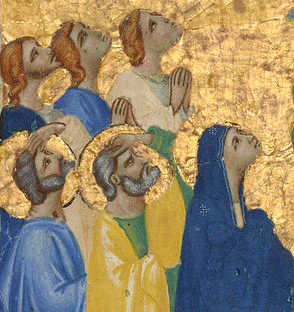
The Ascension of Christ, by Pacino di Bonaguida, c.1340

Theophilus, the first scroll I wrote concerned everything Jesus did and taught from the beginning, right up to the day when he was taken up into heaven. Before he was taken up, working in the power of the Holy Spirit, Jesus instructed the apostles he had chosen. After his suffering, he showed them that he was alive with many convincing proofs. He appeared to them over a period of forty days, speaking to them about God’s kingdom. While they were eating together, he ordered them not to leave Jerusalem but to wait for what the Father had promised. He said, “This is what you heard from me: John baptized with water, but in only a few days you will be baptized with the Holy Spirit.”

As a result, those who had gathered together asked Jesus, “Lord, are you going to restore the kingdom to Israel now?”

Jesus replied, “It isn’t for you to know the times or seasons that the Father has set by his own authority. Rather, you will receive power when the Holy Spirit has come upon you, and you will be my witnesses in Jerusalem, in all Judea and Samaria, and to the end of the earth.”

After Jesus said these things, as they were watching, he was lifted up and a cloud took him out of their sight. While he was going away and as they were staring toward heaven, suddenly two men in white robes stood next to them. They said, “Galileans, why are you standing here, looking toward heaven? This Jesus, who was taken up from you into heaven, will come in the same way that you saw him go into heaven.” (Common English Bible)

It’s been two-millennia since Jesus Christ ascended to heaven. Since then, a lot has changed.

Yet, on the other hand, we’re still in the same situation as the early church: Jesus is still up there; and we are still down here. That means, because we are still awaiting Christ’s return, the original call and practice of the church is still in effect.

As far as experiences go, it’s hard to top being one of the original disciples and seeing Jesus ascend into the clouds to heaven. Now what? How do you go about your life after that?

In the spiritual life, we move back and forth between moments of genuine inspiration and the sheer routine of our daily mundane lives. The uplifting mountain-top experience and the hard slog of walking through the valley are both important. The trick is to channel the energy from one into the other. For that to happen, we need to work out rhythms of grace that connect expectant prayer with the action of being witnesses.

Prayer and witness – both are necessary for the church; and they are closely tied to the risen and ascended Christ. The ascension of the Lord Jesus means Christ is exalted above everything; he’s in charge. By his authority he has made us prayerful witnesses and given us the means of carrying out that job.

Jesus and the disciples, even after forty days together, post-resurrection, were not on the same page. The disciples were anticipating a restoration of David’s kingdom. Their vision for the future was a great apocalypse in which Jesus, as the ultimate mixed martial arts champion, would beat up all their enemies. Then, set up a political kingdom just like King David of old. 

But Jesus had a different agenda. Instead of creating an immediate utopia, where the disciples would be in charge and in control, Jesus bluntly told them that knowing God’s timetable is not in their pay grade. Instead, the disciples were commissioned for a job, which didn’t include gawking at the sky and trying to figure out when the end of the world was happening.

Christ’s Ascension, by Scott Rayl

Although we (understandably and deservedly) want peace and justice now, Jesus avoided handing out prophecy charts detailing when that would happen. He essentially said to quit thinking about that stuff because it’s really none of our business.

Rather, our business is being witnesses of Jesus. The angels came along immediately after Jesus ascended and said to the disciples to stop standing there slack jawed. Jesus is coming back and, meanwhile, there is a job to do – to be witnesses of Christ’s redemptive events. And, the strength of that witness will come from the Holy Spirit. So, hang tight in prayer.

So, what does it mean to be a “witness?” A few years back, I was called to the bedside of an actively dying patient. The patient’s spouse and parents were present. In the space of two hours I watched them in the throes of grief. And I provided all the spiritual support I could. 

The situation had similarities to many emergencies I have attended, with one exception: I noticed that I was different. I did not “do” or “say” a lot. Mostly, I was present. I remember, at times during my encounter, feeling helpless. In some ways I was. I certainly couldn’t fix a thing. Yet, this time, I saw my role in a new way. 

I distinctly remember the sense of bearing witness to this sacred event. There was an entire world outside the patient room that knew nothing of this family’s intense grief. But I knew. I watched the whole thing. I was present for all the struggles of the medical team, the tears of the husband, the grief of a Dad, the angry questions of a mother toward a God that she didn’t know how to approach – who seemed aloof and capricious.  I was there for it all. Even now, I still carry those folks and their story in my heart.

And it was enough. 

Yes, it was enough. This was the first time I ever said that after such a situation. I had a settled sense that the role of witnessing the events in front of me was a blessed and sacred responsibility. Billions of people on planet earth didn’t know the grief of these people. I did. Because I was there. 

There is something both mystical and necessary about this understanding of being a witness with active prayerful observation.

I wonder if that’s how the disciples felt after Christ’s ascension. Perhaps my experience is what Jesus meant when he said, “You shall be my witnesses.” Maybe a witness is one who has the special role of observing the suffering of Christ, his resurrection of the dead, and the ongoing work of the Spirit. 

God is, I believe, the ultimate witness. When no one else sees, God sees. Where there is grief, God is present. Wherever pain, hurt, and brokenness exists, God is there bearing witness to it all. 

And, once in a while, the Lord is gracious to invite me into the scene to witness it along with him. Jesus is our Immanuel – God with us. And that is enough for me. 

In the book of Acts, praying and witnessing was a consistent pattern that the early church practiced. They prayed about whom to choose as leaders and bore witness to the Spirit setting individuals apart for the work of gospel proclamation and service to the church. They prayed for the Holy Spirit to come on people and bore witness to miraculous signs of the Spirit’s work. They prayed for the courage to preach and heal and bore witness to the saving work of God.

As the book of Acts unfolds, we see Peter imprisoned for being a witness. So, the church went to prayer. Peter was released, and when he showed up at the prayer meeting, the believers at first did not believe it was him.  Even with their little faith they were able to witness God answer their prayers. (Acts 12:1-18)

It was at a prayer meeting where Paul and Barnabas were set apart by the Spirit to bear witness in other locations. (Acts 13:1-3)

While traveling from city to city, Paul constantly devoted himself to prayer and listened to the Spirit. (Acts 16:1-35)

People came to Christ because of prayerfully listening to the Spirit and the obedient action that followed by Peter, Paul, and the other believers giving witness to how the risen Christ saved their lives. This was possible because of the risen and ascended Christ.

There is not one square inch of this earth that Jesus is not Lord. This means we can be alive with devotion to prayer and to being witnesses in this world for Jesus. Just as a cup of coffee needs a warm-up, so our prayers need to be refreshed so that God’s purposes will be accomplished. And his purposes are that all of creation comes, in a real and practical way, under Christ’s lordship.

What does the ascension of Jesus Christ mean for us today? That we belong to God and have the wondrous privilege of prayer and witness in a world that so desperately needs to connect with the transcendent and divine.

Be Brave, Not Afraid (Deuteronomy 31:1-13)

Then Moses went out and spoke these words to all Israel: “I am now a hundred and twenty years old and I am no longer able to lead you. The Lord has said to me, ‘You shall not cross the Jordan.’ The Lord your God himself will cross over ahead of you. He will destroy these nations before you, and you will take possession of their land. Joshua also will cross over ahead of you, as the Lord said. And the Lord will do to them what he did to Sihon and Og, the kings of the Amorites, whom he destroyed along with their land. The Lord will deliver them to you, and you must do to them all that I have commanded you. Be strong and courageous. Do not be afraid or terrified because of them, for the Lord your God goes with you; he will never leave you nor forsake you.”

Then Moses summoned Joshua and said to him in the presence of all Israel, “Be strong and courageous, for you must go with this people into the land that the Lord swore to their ancestors to give them, and you must divide it among them as their inheritance. The Lord himself goes before you and will be with you; he will never leave you nor forsake you. Do not be afraid; do not be discouraged.”

So Moses wrote down this law and gave it to the Levitical priests, who carried the ark of the covenant of the Lord, and to all the elders of Israel. Then Moses commanded them: “At the end of every seven years, in the year for canceling debts, during the Festival of Tabernacles, when all Israel comes to appear before the Lord your God at the place he will choose, you shall read this law before them in their hearing. Assemble the people—men, women and children, and the foreigners residing in your towns—so they can listen and learn to fear the Lord your God and follow carefully all the words of this law. Their children, who do not know this law, must hear it and learn to fear the Lord your God as long as you live in the land you are crossing the Jordan to possess.” (New International Version)

The Old Testament book of Deuteronomy is all about remembering and being reminded of what we already know. There’s really nothing new under the sun. So, our task as people is mostly to recall and bring to our minds and heart those things which we need to remember.

We humans have this tendency to remember the things we need to forget, and to forget the things we must remember. And what is to be continually remembered and recalled is that there is no basis to be afraid when God is with us and will fulfill divine promises.

For Christians, the resurrection of Christ from death has changed everything – especially when it comes to fear. In this Christian season of Eastertide, we discover and explore the vast implications of what it means to possess a new life. 

Because Christians serve a risen Savior, this newfound reality brings courage and confidence. Fear isn’t something we simply dismiss with willpower. Rather, fear begins to loosen and diminish whenever there is an awareness of God’s presence among us. Consider just a few of the many references to this in Holy Scripture, in addition to the statements in today’s Old Testament lesson:

Remember, I commanded you to be strong and brave. Don’t be afraid because the Lord your God will be with you wherever you go.” (Joshua 1:9, ERV)

 Don’t fear, because I am with you;
    don’t be afraid, for I am your God.
    I will strengthen you,
    I will surely help you;
    I will hold you
    with my righteous strong hand. (Isaiah 41:10, CEB)

Be happy with what you have because God has said, “I will never abandon you or leave you.” So we can confidently say,

“The Lord is my helper.
I will not be afraid.
What can mortals do to me?” (Hebrews 13:5-6, GW)

Believe it, or not, the Bible tells us 365 times to not be afraid. Maybe that’s not a coincidence that we can quote a verse every day of the year about our own fearfulness in the face of all life’s challenges.

When it comes to fear and bravery, God does not so much command us to be courageous, as he wants us to draw from the great reservoir of bravery within. That is, God has already created us strong, as creatures in the divine image. We just need to get in touch with what is already there. And, for the Christian, the reality of Easter awakens and calls forth that life.

We can act with boldness and overcome fear because Jesus is the pioneer of our salvation. Christ is the One who enables us to draw from the deep well of courage:

So then, since we have a great High Priest who has entered heaven, Jesus the Son of God, let us hold firmly to what we believe. This High Priest of ours understands our weaknesses, for he faced all the same testing we do, yet he did not sin. So, let us come boldly to the throne of our gracious God. There we will receive his mercy, and we will find grace to help us when we need it most. (Hebrews 4:14-16, NLT)

You and I can do this; we can do hard things. We really can face the fears in front of us. You can surmount the adversity you are in the middle of – not because of some words I say, but because Christ has risen from death. He’s alive, and his presence makes all the difference.

Ever-present God: Give me strength to live another day;
Let me not turn coward before its difficulties or prove recreant to its duties;
Let me not lose faith in other people;
Keep me sweet and sound of heart, in spite of ingratitude, treachery or meanness;
Help me to keep my heart clean and to live so honestly and fearlessly that no outward failure can dishearten me or take away the joy of conscious integrity;
Open wide the eyes of my soul that I may see good in all things;
Grant me this day some new vision of your truth;
Inspire me with the spirit of joy and gladness and make me the cup of strength to suffering souls; in the name of the strong Deliverer, our only Lord and Savior, Jesus Christ. Amen.