Generosity and Thanksgiving (2 Corinthians 9:6-15)

Remember this: Whoever sows sparingly will also reap sparingly, and whoever sows generously will also reap generously. Each of you should give what you have decided in your heart to give, not reluctantly or under compulsion, for God loves a cheerful giver. And God is able to bless you abundantly, so that in all things at all times, having all that you need, you will abound in every good work. As it is written:

“They have freely scattered their gifts to the poor;
    their righteousness endures forever.”

Now he who supplies seed to the sower and bread for food will also supply and increase your store of seed and will enlarge the harvest of your righteousness. You will be enriched in every way so that you can be generous on every occasion, and through us your generosity will result in thanksgiving to God.

This service that you perform is not only supplying the needs of the Lord’s people but is also overflowing in many expressions of thanks to God. Because of the service by which you have proved yourselves, others will praise God for the obedience that accompanies your confession of the gospel of Christ, and for your generosity in sharing with them and with everyone else. And in their prayers for you their hearts will go out to you, because of the surpassing grace God has given you. Thanks be to God for his indescribable gift! (New International Version)

Generosity is at the heart of any good family, neighborhood, workplace, organization, church, and individual. To be generous is to reflect the image of God, who is wildly generous, giving freely and liberally on our behalf.

We often associate being generous with giving a handout or money to someone or some organization in need. It is that, but much more. Generosity doesn’t have to do with the size of our check or the amount of our contribution. 

We can be generous with our time, abilities, words, and with what little or much we have of money, as well. Generosity means to go above expectations – to give with magnanimity, to go out of your way to do good when no one is looking – and experience giving as its own reward.

Jesus, for whom the Apostle Paul learned about the true nature of being generous, embraced generosity as a way of life while he was here on this earth. No one expected Christ to go out of his way to call the least, the lowly, the lost, and the last of society. The people on the margins of respectable culture had no expectations that the Messiah would head their way. But he did. 

Christ the Lord even went so far as to hang out with the despised tax collectors, and freely talk with sexual deviants. The high brows of society couldn’t raise their eyebrows high enough for Jesus. It was just too much for them. Not only was Jesus making them look bad with his generosity as a way of life, but he was also, in their minds, generous to the wrong sort of people.

The follower of Jesus does so by surveying the landscape of human need and giving to people in places where no one expects a handout. 

It’s interesting that Christ lived a simple life with little to no money. He largely depended on the generosity of others. Yes, my friend, generosity is a two-way street. Being generous to others is the easy part for many people; receiving the generosity of other people is often much harder.  Yet, Jesus did both – he gave and received.

Jesus was generous in ways which were consistent with the Father’s will. Christ gave of his time, and of his divine ability to heal and forgive. He was perhaps the most magnanimous person of all-time, due to his generosity of compassion, kindness, love, and humble service to others. 

And the height of Christ’s generosity was in giving his life so that you and I could live a life free from the power of guilt and shame. Such deliverance, through the cross, is offered and given, free of charge. That’s over-the-top generous.

Money is merely a barometer of one’s generosity, that is, of our stance and approach toward money. You don’t need to be rich to be generous. A large and expansive heart always finds ways to have a generosity of spirit wherever it goes.

Jesus warned against using generosity in order to be noticed:

“When you do good deeds, don’t try to show off. If you do, you won’t get a reward from your Father in heaven. When you give to the poor, don’t blow a loud horn. That’s what show-offs do in the meeting places and on the street corners because they are always looking for praise. I can assure you that they already have their reward. When you give to the poor, don’t let anyone know about it. Then your gift will be given in secret. Your Father knows what is done in secret, and he will reward you.” (Matthew 6:1-4, CEV)

A generous heart is a heart of gratitude. Giving thanks is the logical and organic way of expressing generosity.

Consider just a few biblical verses that encourage us toward thanksgiving: 

Let us come before him with thanksgiving and sing joyful songs of praise. (Psalm 95:2, GNT) 

Enter his gates with a song of thanksgiving.
Come into his courtyards with a song of praise.
Give thanks to him; praise his name. (Psalm 100:4, GW)

O give thanks to the Lord, for he is good; his steadfast love endures forever! (Psalm 118:1, NRSV)

In the Gospel of Luke, a story is told of ten men with leprosy who were miraculously healed by Jesus. A Samaritan, the lowliest of the low, was the lone person who came and fell at Christ’s feet with intense gratitude. While the other nine went about their lives free from disease and glad for it, only one guy took the time to thank Jesus. (Luke 17:11-19) 

Indeed, sometimes we must be reminded to give thanks and to show gratitude for the ways in which God has provided for us. Yet, if our hearts are abundantly full of generosity, no reminder is needed; it just comes pouring forth.

Those who have small hearts will only realize small blessings. But those who plant many seeds of generosity and gratitude will see abundant blessings.

May it be so, to the glory of God.

The Trouble Is Turned (Esther 7:1-10)

The Coronation of Queen Esther, from the 1617 Scroll of Esther, Ferrara, Italy.

So the king and Haman came to have dinner with Queen Esther. On the second day, while they were drinking wine, the king asked Esther, “What is your request, Queen Esther? It will be granted to you. And what would you like? Even if it is up to half of the kingdom, it will be granted.”

Then Queen Esther answered, “If I have found favor with you, Your Majesty, and if it pleases you, Your Majesty, spare my life. That is my request. And spare the life of my people. That is what I ask for. You see, we—my people and I—have been sold so that we can be wiped out, killed, and destroyed. If our men and women had only been sold as slaves, I would have kept silent because the enemy is not worth troubling you about, Your Majesty.”

Then King Xerxes interrupted Queen Esther and said, “Who is this person? Where is the person who has dared to do this?”

Esther answered, “Our vicious enemy is this wicked man Haman!” Then Haman became panic-stricken in the presence of the king and queen.

The king was furious as he got up from dinner and went into the palace garden. But Haman stayed to beg Queen Esther for his life, because he saw that the king had a terrible end in mind for him. When the king returned from the palace garden to the palace dining room, Haman was falling on the couch where Esther was lying. The king thought, “Is he even going to rape the queen while I’m in the palace?” Then the king passed sentence on him, and servants covered Haman’s face.

Harbona, one of the eunuchs present with the king, said, “What a coincidence! The 75-foot pole Haman made for Mordecai, who spoke up for the well-being of the king, is still standing at Haman’s house.”

The king responded, “Hang him on it!” So servants hung Haman’s dead body on the very pole he had prepared for Mordecai. Then the king got over his raging anger. (God’s Word Translation)

“Let nothing disturb you, let nothing frighten you. All things are passing away: God never changes. Patience obtains all things. Whoever has God lacks nothing; God alone suffices.”

Saint Teresa of Ávila (1515-1582)

I sometimes half-jokingly say to people that it’s important for me to keep busy so that I stay out of trouble. The truth is, however, that I tend to find myself in trouble a lot – whether I’m busy, or not. The same could be said for the Jewish people.

If you are anything like me, you have experienced, on more than one occasion, of feeling like you are in a circumstance that’s like quicksand. It’s as if you are stuck with no way out. Queen Esther found herself in such a situation. Through no fault of her own, she was thrust upon the stage of being the intercessor between life and death, salvation and elimination. 

The wicked Haman, a high official to the king of Persia, had it out for the Jews. So, he orchestrated a devious plan to do away with them once and for all – even building a gallows on his own property in the anticipation of hanging one of them on it. That’s how much the guy hated Jews.

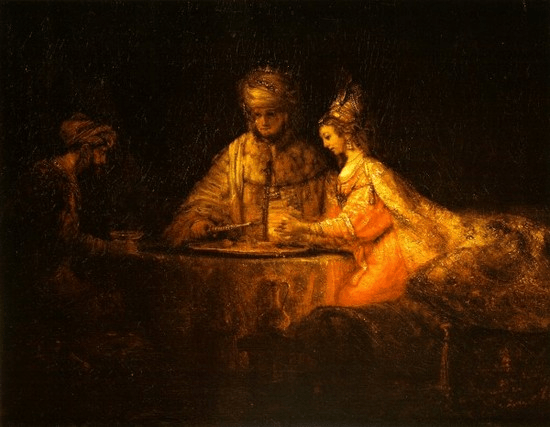
The King, Haman, and Esther, by Rembrandt van Rijn, 1660

But God, who is always awake and alert to whatever is happening in this world, had their backs. Even though the book of Esther does not once pronounce the name of God, the Lord’s influence and divine sovereignty are evident throughout the entirety of the story. 

God seems to specialize in hard cases, and in people who keep getting into trouble, despite their good intentions. And through providential means, the Lord inevitably gains the glory, and God’s people are wonderfully saved from circumstances well beyond their ability to save themselves.

Esther, a Jewish girl who became part of the king’s harem, and then the king’s wife and queen, humbly and prayerfully entered the king’s presence on behalf of her people, the Jews. Even though she was exalted to such a status, there was still the very real possibility that taking such an initiative would get Esther into deep trouble.

Yet, because of divine providence superintending the whole affair, the tables were turned, with the Jews being joyously delivered; and Haman literally finding himself at the end of his rope, on his own gallows. 

Prayer, sensitivity to God, and the humility to listen, undergirded Esther’s decision and courage to step out and act on behalf of her people. 

Especially when it comes to trouble, prayer is not optional equipment for the believer, but absolutely essential to facing each and every difficult situation. That’s because it is God, not us, nor any of our skill or ingenuity, that ultimately brings deliverance. 

Saving ourselves from impossible situations and dire circumstances is way above our pay grade; only God can bring true deliverance – the kind that genuinely changes people so that divine purposes are accomplished.

Our discouraging situations, hard cases, difficult people problems, and vexing trouble – whatever the situation – God has your back, and delights to answer our desperate pleas for help and deliverance. 

Like me, you may find yourself in trouble. But you can also find yourself with all the power of heaven behind you; and with an answer to your prayer that is beyond what you can even think or imagine.

Loving God, your Son Jesus Christ came that we might have life and have it abundantly. We humbly ask that you pour out your blessing upon our nation. Where there is illness, bring your healing touch; where there is fear, strengthen us with the knowledge of your presence; where there is uncertainty, build us up in faith; where there is dishonesty, lead us into truth; where there is discord, may we know the harmony of your love. This we are to bold to pray through Jesus Christ our Lord, who with you and the Holy Spirit are one God, now and forever. Amen.

God Will Make a Way (Exodus 2:1-10)

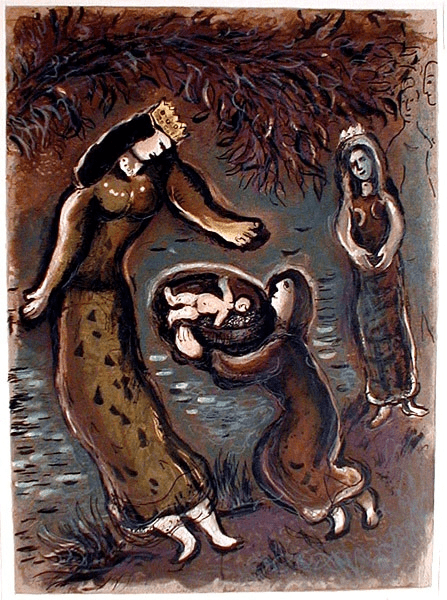
Moses is saved from the water by Pharaoh’s daughter, by Marc Chagall, 1966

Now a man from Levi’s household married a Levite woman. The woman became pregnant and gave birth to a son. She saw that the baby was healthy and beautiful, so she hid him for three months. When she couldn’t hide him any longer, she took a reed basket and sealed it up with black tar. She put the child in the basket and set the basket among the reeds at the riverbank. The baby’s older sister stood watch nearby to see what would happen to him.

Pharaoh’s daughter came down to bathe in the river, while her women servants walked along beside the river. She saw the basket among the reeds, and she sent one of her servants to bring it to her. When she opened it, she saw the child. The boy was crying, and she felt sorry for him. She said, “This must be one of the Hebrews’ children.”

Then the baby’s sister said to Pharaoh’s daughter, “Would you like me to go and find one of the Hebrew women to nurse the child for you?”

Pharaoh’s daughter agreed, “Yes, do that.” So the girl went and called the child’s mother. Pharaoh’s daughter said to her, “Take this child and nurse it for me, and I’ll pay you for your work.” So the woman took the child and nursed it. After the child had grown up, she brought him back to Pharaoh’s daughter, who adopted him as her son. She named him Moses, “because,” she said, “I pulled him out of the water.” (Common English Bible)

A new Pharaoh was enthroned in Egypt. Enough time had gone by that the legacy of Joseph as the administrator in saving many Egyptian people was lost. So, because the Israelites had grown to such large numbers, Pharaoh was afraid.

The politics of fear typically results in somebody getting oppressed. Indeed, fear became the driving force to a series of escalating oppressive policies initiated by Pharaoh, even to the point of planned infanticide. The Jewish midwives were instructed toward this end.

But the midwives did not fear the Egyptian Pharaoh. Instead they had a healthy fear of God (Exodus 1:17, 21). With such rightly ordered fear, the Jewish midwives defied the order of Pharaoh and openly disobeyed the royal command to murder Hebrew boys.

Here then, we have the setting for a special Hebrew baby to be born named Moses. He is the healthy child of two devout Levites. And although God’s name is not referenced in the verses for today, we can nonetheless see the providence and protection of the Lord within the narrative.

Through a complex chain of events, both the birth mother and the royal daughter care for this baby, protecting his life, with a divine provision for the needs of the infant Moses. Most stories in the Old Testament have contrasting characters within them, and today’s is no exception.

Pharaoh was the ruler over all of Egypt, and yet, he feared a loss of power and the status quo because of the Israelites – even though he reigned during a time of political peace, with hegemony reaching into the Middle East. As Pharaoh’s paranoid fear rose, so did God’s response of divine sovereignty over him, by providing protection against his diabolical intentions.

In contrast to Pharaoh, a powerless and non-descript Hebrew couple were married, conceived and bore a family of a daughter and two sons – Moses being the youngest. They had nothing, yet everything; whereas Pharaoh had everything, yet nothing. Thriving and flourishing has to do with a lot more than wealth and material resources.

Maternal care is powerful. And it finds a way to win the day and not only save a baby, but also to ensure that the baby grows, lives, and thrives. No royal edict can defeat the resilient strength of maternal compassion.

Despite Pharaoh’s increasing oppression, the compassion of several women ends up raising the very one who will lead the Israelites into liberation from this oppression.

With the Lord, a way will be found where there is no way. God + nothing = everything.

For us today, there is often a tendency to look back on the good old days when God did great things, and to look ahead when the Lord will return and make all things new and right. Yet we too often neglect to be mindful and live in the present moment, and know the God who is present with us right now.

We may remember the awesome deeds that God once did; and rejoice in biblical stories which demonstrate the Lord’s power, provision, and protection. We may look forward to the fulfillment of God’s promises in the person of Jesus when he returns, and gain hope from that.

Now, in this present evil age, and in this messed up world, we also have the God of the present tense. God will make a way, in this present time, where there seems to be no way. God is doing something new and amazing for us today.

And that way will be clear enough for us to know – and incredible enough for us to not predict or imagine. For God’s watch-care and deliverance can (and does) take many forms. When the Lord fulfills divine plans, it sometimes comes in the most creative and incredible way possible, so that we will have no doubt where it came from.

“God Will Make a Way” by Don Moen

God will make a way, Where there seems to be no way
He works in ways we cannot see, He will make a way for me
He will be my guide, Hold me closely to His side
With love and strength, For each new day
He will make a way He will make a way

By a roadway in the wilderness, He’ll lead me
And rivers in the desert will I see
Heaven and earth will fade
But His Word will still remain
He will do something new today

Deborah the Prophet and Judge (Judges 4:8-24)

Illustration from “Woman in Sacred History, A Series of Sketches Drawn from Scriptural, Historical, and Legendary Sources” by Harriet Beecher Stowe, 1873

“I’m not going unless you go!” Barak told her.

“All right, I’ll go!” she replied. “But I’m warning you that the Lord is going to let a woman defeat Sisera, and no one will honor you for winning the battle.”

Deborah and Barak left for Kedesh, where Barak called together the troops from Zebulun and Naphtali. Ten thousand soldiers gathered there, and Barak led them out from Kedesh. Deborah went too.

At this time, Heber of the Kenite clan was living near the village of Oak in Zaanannim, not far from Kedesh. The Kenites were descendants of Hobab, the father-in-law of Moses, but Heber had moved and had set up his tents away from the rest of the clan.

When Sisera learned that Barak had led an army to Mount Tabor, he called his troops together and got all 900 iron chariots ready. Then he led his army away from Harosheth-Ha-Goiim to the Kishon River.

Deborah shouted, “Barak, it’s time to attack Sisera! Because today the Lord is going to help you defeat him. In fact, the Lord has already gone on ahead to fight for you.”

Barak led his 10,000 troops down from Mount Tabor. And during the battle, the Lord confused Sisera, his chariot drivers, and his whole army. Everyone was so afraid of Barak and his army, that even Sisera jumped down from his chariot and tried to escape. Barak’s forces went after Sisera’s chariots and army as far as Harosheth-Ha-Goiim.

Sisera’s entire army was wiped out. Only Sisera escaped. He ran to Heber’s camp, because Heber and his family had a peace treaty with the king of Hazor. Sisera went to the tent that belonged to Jael, Heber’s wife. She came out to greet him and said, “Come in, sir! Please come on in. Don’t be afraid.”

After they had gone inside, Sisera lay down, and Jael covered him with a blanket. “Could I have a little water?” he asked. “I’m thirsty.”

Jael opened a leather bottle and poured him some milk, then she covered him back up.

“Stand at the entrance to the tent,” Sisera told her. “If someone comes by and asks if anyone is inside, tell them ‘No.’ ”

Sisera was exhausted and soon fell fast asleep. Jael took a hammer and drove a tent-peg through his head into the ground, and he died.

Meanwhile, Barak had been following Sisera, and Jael went out to meet him. “The man you’re looking for is inside,” she said. “Come in and I’ll show him to you.”

They went inside, and there was Sisera—dead and stretched out with a tent-peg through his skull.

That same day God defeated the Canaanite King Jabin while the Israelites looked on, and his army was no longer powerful enough to attack the Israelites. Jabin grew weaker while the Israelites kept growing stronger, until at last the Israelites destroyed him. (Contemporary English Version)

The biblical book of the Judges is a sad account of Israel’s downward spiral into ignorance and wickedness. Because of this situation, God would occasionally raise up leaders, or judges, to help the people whenever they cried out in their distress.

Deborah was one of those judges, and the only woman leader during the time of the judges. She was recognized in Israel as both a judge and a prophet. In the time of Deborah, the Israelites had once again become oppressed by Canaanites who had not been dislodged from the land.

Having both legal and prophetic authority, Deborah called for a holy war and became the leader. Her army general, Barak, mustered the troops and led them into battle. The opposing general, Sisera, drew up his forces to attack, but God got involved. The Lord threw Sisera’s soldiers into a panic, and the general ended up fleeing for his life, his army defeated.

Sisera had a safe place in mind to go. Heber, an ally and friend, was in the area with his tents. So, Sisera believed he would find hospitality and protection. Heber’s wife, Jael, however, was no friend of Sisera. She took care of him, lulled him to sleep, and then proceeded to kill him with some surprisingly skilled precision.

Eventually, Barak came along, and Jael showed him the dead general. Deborah’s prophecy that a woman would prevail was realized. We are not told in the text why Jael sided with the Israelites and deliberately brought an end to Sisera. Yet, by killing him, Jael clearly proved sympathetic to Israel.

Whatever was really going on there, it’s illustrative of a prominent theme in the book of Judges. Since the Canaanites were not expelled completely from the land, they would continue to exert religious and ethical influence on the Israelites.

Judges is a book that, as you read it, becomes progressively mixed between Israelite and Canaanite – piety with the Lord and pagan practices were more and more synchronized, so that an odd religious amalgam happened. The people claimed to follow the Lord, and yet, they became increasingly violent and adoptive of the surrounding nations with their bloody practices.

We have, dramatized before us in today’s lesson, the effects and consequences of only a partial obedience to God. Like putting one bad apple into the pie, it causes the whole thing to become rotten.

In our own day, it will not do to dedicate a Sunday or a specific time to the Lord, then walk away and do whatever you want the rest of the time, without any concern to the words and ways of Jesus. We will only please the Lord if we engraft God’s universal law into our entire lives, and not just the religious parts.

Eventually a life only partially attentive to God will crack and then crumble to pieces. We must plan to live the spiritual life with perseverance, endurance, and consistency, each and every day of our lives.

The foundation of our life is built on the cornerstones of the body, mind, emotions, and spirit. A whole and healthy life pays attention to all four with equal consideration, energy, and focus. It won’t do to have any one cornerstone a different size than the others; a life cannot be constructed on such an uneven foundation.

This is why the Israelites in the time of the judges found themselves in such dire straits, time and time again. And it is also a testament to the infinite patience and grace of God, that the Lord continued to respond with mercy whenever the people cried out.

What’s more, today’s story points to the necessity for gender equity and inclusion, as well. We must pay attention to everyone in the community, and not put limitations on particular individuals because they are different. Deborah and Jael, the women, were the heroes of the story – and not just because the men didn’t step up – but because they were the divinely ordained people for the job.

We have enough on our plate in dealing with issues of obedience and disobedience, without adding to it by defining which people can be used of God, or not. Commit yourself to the Lord with your whole life, and the rest will mostly work itself out.

I thank you, Lord, that you love to do extraordinary things through ordinary people like me. Release me from any limitations I, others, or the enemy have put on my life that have kept me from the great plans you have for me, so that I might wake up and arise to shine the glory of the Lord! Amen.