Our Place in the World (Psalm 8)

Lord, our Lord,
    how majestic is your name in all the earth!

You have set your glory
    in the heavens.
Through the praise of children and infants
    you have established a stronghold against your enemies,
    to silence the foe and the avenger.
When I consider your heavens,
    the work of your fingers,
the moon and the stars,
    which you have set in place,
what is mankind that you are mindful of them,
    human beings that you care for them?

You have made them a little lower than the angels
    and crowned them with glory and honor.
You made them rulers over the works of your hands;
    you put everything under their feet:
all flocks and herds,
    and the animals of the wild,
the birds in the sky,
    and the fish in the sea,
    all that swim the paths of the seas.

Lord, our Lord,
    how majestic is your name in all the earth! (New International Version)

I adore the psalms. Many years ago, it was the biblical psalter which helped me come to faith. This little psalm for today is illustrative of why I was moved toward embracing a life with God. Psalm 8 grounds us by dealing with the ultimate questions of human existence:

  • Who am I?
  • Why do I exist?
  • What is the purpose of life?

The answers to those questions are supremely important because people throughout history, and now across the world, are asking what meaning their lives really have.

For example, depression is pervasive throughout the world, as well as the church. It’s a huge issue. Peeling back the layers of a person’s life, many have a deep sense of not truly belonging, and of being profoundly misunderstood by others. Many depressed persons are very aware of their own mortality and have a disconnected sense of their personal role in the world.

Put another way, some folks have lost their original purpose of being a person, that they belong to the human family in a way that makes a significant contribution to the world.

Living on such a big planet causes some people to feel small and wonder how they fit in. With such a large universe, which may at times seem cold and capricious, we may ask, along with psalmist, “What is humanity that you are mindful of them?”

That question forms the center of the psalm. Hebrew poetry is typically set up to have the front and the end of the poem point to the middle where the chief focus is found. So then, the psalmist purposely wrote this psalm so we would consider this great question of what God thinks of humanity within the scope of this immense universe.

And it is a staggeringly huge universe! To put it in perspective, if our galaxy, the Milky Way, were the size of the entire continent of North America, our solar system would fit in a coffee cup.

Even now, two Voyager spacecraft are hurtling toward the edge of the solar system at a rate of 100,000 miles per hour. For decades they have been speeding away from Earth, having now traveled billions of miles. When engineers beam a command to the spacecraft at the speed of light, it takes over half a day to arrive.

Yet this vast neighborhood of our sun—in truth, the size of a coffee cup—fits along with several hundred billion other stars and their planets in the Milky Way, one of perhaps 100 billion such galaxies in the universe. To send a light-speed message to the edge of that universe would take 15 billion years.

Out of the billions of galaxies in the universe, what is the planet Earth that God should care about it? 

Even on our planet there are billions of creatures. Yet, of all those bugs, animals, fish, and birds, God has a special relationship with us, humanity, and cares for us deeply. We know that God cares for us, according to this psalm, because he has entrusted us with the responsibility to care for creation.

We are the only creatures who have the charge to steward all that God has created. As people created in the image of God, we have a job that is befitting of a king. We are God’s vice-regents, in charge of tending and caring for all creation. This incredible job is both a duty and a delight.

God has us playing a crucial role in governing and caring for the world he created. Like a parent or grandparent patiently working with a child to teach them responsibility for all that is around them, God teaches us, and has entrusted to us, this large expansive world we live in. Literally everything in all creation is under our stewardship.

People alone have the self-awareness and perspective of the world that is needed to govern the world. Therefore, we can only find our true purpose and belonging in the stewardship of creation. Caregiving is at the heart of being a person.

The only glitch to all this, and why so many lose their way, is that the world is still living under a curse due to the original fall of humanity.

When we allow other dominions to supersede God’s dominion, then we have issues. Whenever the power of money or the significance of a position, job title, or the ability to do certain tasks is our basic identity and place of belonging, then we will likely succumb to anxiety. That’s because other dominions cannot help us find our true God-given majesty as people created in God’s image.

Living a way other than being a proper steward of the world is beneath us because we have inherent dignity as God’s vice-regents over creation.

Mother Teresa once said that there is no such thing as a small thing – only small things which are done with big love. Her sentiment perfectly captures the vision of the psalmist – that all people are crowned with glory and honor and rule with God to do all the small things of life with a love that comes from our Creator.

We continually have possibilities of engaging in good stewardship of all that God has given us. We have the chance to be attentive to all the little things of life, whether gardening, building a bird house, working with diligence and care at our jobs, or keeping our community clean and its citizens healthy and happy – it’s all important. It brings meaning to our existence as human beings.

People, like all creation, are meant for growth. Putting effort into developing our skills and honing our craft, whatever that may be, is what helps us tap into our God-given purpose for being in this big world.

So, may we continually improve what we do, no matter what it is, so that it befits us as God’s people crowned with honor. May we realize joy and contentment – knowing the majesty we share with God in his wondrous world. 

Almighty God, Creator of the heavens and the earth, words are not enough to express your awesome majesty. Our highest expressions of theology are but baby talk next to you.

Grant us awareness through your Spirit that you are here with us. May this awareness lead us to approach life carefully. The words we speak, the songs we sing, the thoughts we think, the joy and sadness we feel – may it all be pleasing to you, O Lord.

For, despite the inadequacy of our words and actions, our life and worship are addressed to you alone. May you make that life complete, whole, and full to overflowing through Jesus Christ, your Son, our Lord, who with you and the Holy Spirit lives and reigns forever.  Amen.

Do You Really Know? Probably Not (Job 38:22-38)

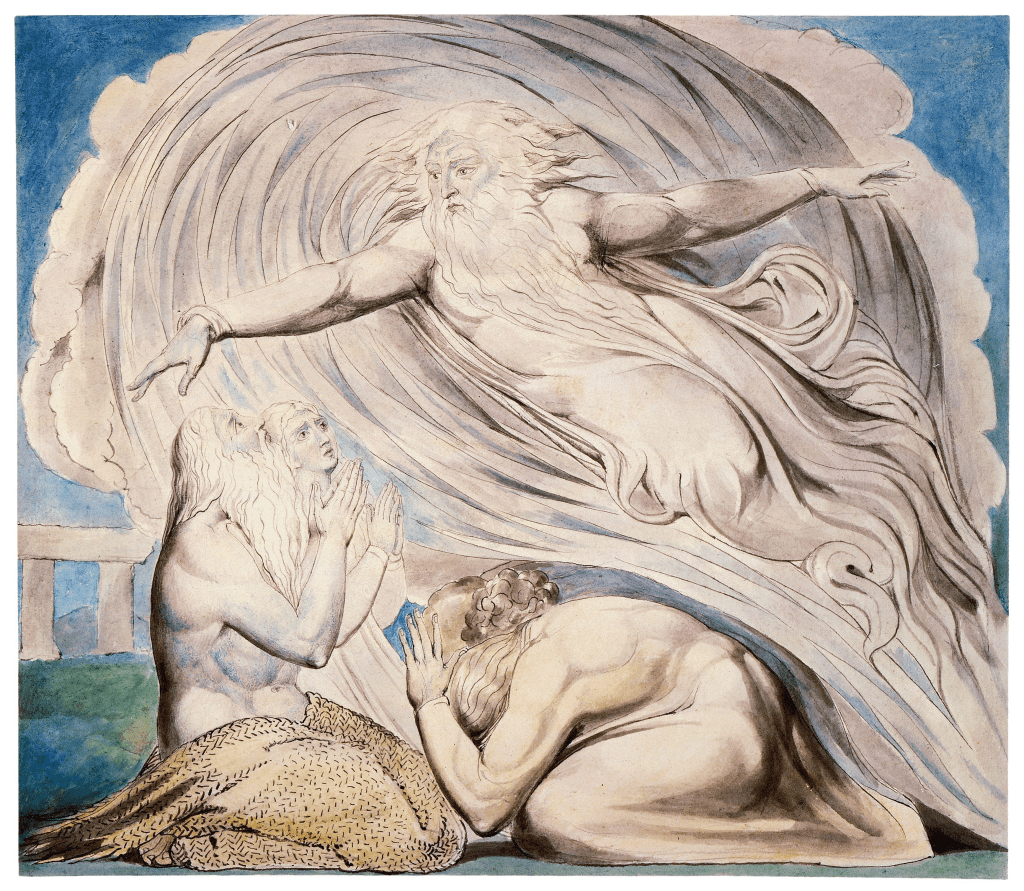
God Answers Job Out of the Whirlwind, by William Blake, 1826

“Have you entered the storehouses of the snow
    or seen the storehouses of the hail,
which I reserve for times of trouble,
    for days of war and battle?
What is the way to the place where the lightning is dispersed,
    or the place where the east winds are scattered over the earth?
Who cuts a channel for the torrents of rain,
    and a path for the thunderstorm,
to water a land where no one lives,
    an uninhabited desert,
to satisfy a desolate wasteland
    and make it sprout with grass?
Does the rain have a father?
    Who fathers the drops of dew?
From whose womb comes the ice?
    Who gives birth to the frost from the heavens
when the waters become hard as stone,
    when the surface of the deep is frozen?

“Can you bind the chains of the Pleiades?
    Can you loosen Orion’s belt?
Can you bring forth the constellations in their seasons
    or lead out the Bear with its cubs?
Do you know the laws of the heavens?
    Can you set up God’s dominion over the earth?

“Can you raise your voice to the clouds
    and cover yourself with a flood of water?
Do you send the lightning bolts on their way?
    Do they report to you, ‘Here we are’?
Who gives the ibis wisdom
    or gives the rooster understanding?
Who has the wisdom to count the clouds?
    Who can tip over the water jars of the heavens
when the dust becomes hard
    and the clods of earth stick together? (New International Version)

The older I get, and the more understanding I gain, the more I realize how little knowledge I truly possess.

When I was eighteen years old, I thought I had the world pretty much figured out. Since then, it’s all been downhill. With each passing year, my ignorance seems to grow. I suppose this all really makes some sense when talking about God’s upside-down kingdom.

There’s so much of life that is a mystery; and as we accumulate our life experiences, it seems all, not just some, of life is a mystical encounter. In other words, the more discernment I gain, I discover I know a lot less than I thought I did.

God Answers Job from the Whirlwind, by William Blake, c.1804

It seems as if the biblical character of Job found this out the hard way. If there is any person in Holy Scripture that would be wise and understanding, its him. God speaks highly of Job in the Bible.

Regarding the upcoming destruction of Jerusalem, God said, “even if these three men—Noah, Daniel and Job—were in it, they could save only themselves by their righteousness, declares the Sovereign Lord.” (Ezekiel 14:14)

Job is held up as the model of patience under suffering: “As you know, we count as blessed those who have persevered. You have heard of Job’s perseverance and have seen what the Lord finally brought about. The Lord is full of compassion and mercy.” (James 5:11)

Yet, with all of Job’s integrity, patience, and righteousness, his understanding barely moves the Richter Scale of God’s expansive knowledge.

We might be somewhat familiar with the story of Job. Being a conscientious follower of God, Job is careful to live uprightly. He acknowledges God in all things and worships him alone. Yet, suffering befell him – for no other reason than that God allowed it. Job knew fully well that there was no personal sin behind his awful ordeal of grief and grinding pain.

So, Job contended with God. For an agonizing thirty-five chapters (Job 3:1-37:24) Job questions God and respectfully takes him to task – as Job’s supposed friends questioned him and assume his guilt. Through it all God is there… silent… saying nothing.

The Desperation of Job, by William Blake, 1821

Then, just when we think God is paying no attention whatsoever, the Lord suddenly speaks.

And what is so remarkable about God’s speech is that for four chapters (Job 38:1-41:34) the Lord gives no answers. It’s all rhetorical questions. God said, “Brace yourself like a man; I will question you and you shall answer me.” (Job 38:3)

It becomes abundantly clear after just a few questions that it would be impossible for any human being to even come close to having the understanding God has. And that was the whole point.

God is God, and we are not. Our questions, however legitimate, real, and raw they are, come from a very puny perspective. Turns out, we just don’t know as much as we think we do.

To Job’s credit, he keeps his mouth shut and listens. At the end of the questioning, Job responds in the only wise way one could, after such an encounter: “Surely I spoke of things I did not understand, things too wonderful for me to know.” (Job 42:3)

None of this means that, for us, we need to face our hardships and our sufferings with a stoic keep-a-stiff-upper-lip approach. Trapped grief will inevitably come out sideways and only cause more hurt. I believe God allowed Job to express his terrible physical, emotional, and spiritual pain for chapter after chapter because he needed to.

Only when God sensed it was the proper timing did he jump in and bring the perspective Job then needed. And even after being challenged by God about his vantage point, Job still did not receive answers as to why he had to endure the awfulness of loss beyond what most of us could comprehend.

Maybe we lack being able to understand, even if God directly answered all our questions. Most likely, God protects us from knowing things that might bring irreparable damage to our human psyches. Again, this is all pure conjecture. Which leaves us with perhaps one of our greatest challenges as human beings:

We must eventually come to the place of being comfortable with mystery – and even embracing it. We simply will not have all things revealed to us that we want to know. And that’s okay.

There is yet one more comment to observe about God’s questioning of Job: God is sarcastic. Sarcasm often gets a bad rap, much like anger does, because it is so often associated with unacknowledged emotions and/or expressing our feelings in an unhelpful way.

Yet, there the sarcasm is, with the God of the universe. I take some odd comfort in knowing that God can be snarky at times – in a good way.

Anytime we try to pin God down to some tidy understandable categories, the Lord typically colors outside our human contrived lines and demonstrates to us that the divine cannot be contained in our ramshackle box.

I like it that God is playful, wild, and free to be God – even if there are times it may bug me.

God is unbound by any human knowledge, understanding, ideas, or plans. God will do what God will do. God will be who God will be. “I AM who I AM.” Now that’s a God I can put my trust in.

O Lamb of God that takes away the sins of the world, have mercy upon me.

O Lamb of God that takes away the sins of the world, have mercy upon me.

O Lamb of God that takes away the sins of the world, grant me your peace. Amen.

Follow My Example (2 Timothy 1:12-14)

This is why I am suffering now. But I am not ashamed! I know the one I have faith in, and I am sure he can guard until the last day what he has trusted me with. Now follow the example of the correct teaching I gave you, and let the faith and love of Christ Jesus be your model. You have been trusted with a wonderful treasure. Guard it with the help of the Holy Spirit, who lives within us. (Contemporary English Version)

Offense and defense are both equally important in sports. And the same is true for Christianity. A good offense includes confident proclamation of the gospel in word and deed. And a solid defense involves holding our ground through following the example of apostolic teaching passed down to us.

The Apostle Paul set himself up as a both a model of Christian character and an example of Christian action. That isn’t pride or arrogance; it’s the confidence of knowing you have something of value to offer the church and the world.

Everyone needs training and mentoring – and that is especially true for the Christian life. Christianity is a team sport. Believers must work together to survive, thrive, flourish, and be faithful in daily life. We all need good models of faith to learn from. Paul was just such an example for Timothy. And the essence of spiritual formation and maturity is found in imitating sound teaching through trusted leaders.

Brothers, join in imitating me, and keep your eyes on those who walk according to the example you have in us.

The Apostle Paul (Philippians 3:17, NIV)

We do not want you to become lazy, but to imitate those who through faith and patience inherit what was promised. (Hebrews 6:12, NIV)

Remember your leaders, who spoke the word of God to you. Consider the outcome of their way of life and imitate their faith. (Hebrews 13:7, NIV)

It’s wise and necessary to imitate Christian leaders who have a proven character. They’ve demonstrated persevering in the faith through suffering; and have done it with great humility. Such leaders also have a track record of preserving the faith through consistent teaching of sound doctrine.

This does not necessarily mean that we emulate those who are erudite speakers, have superior gifts and abilities, and enjoy ministry success. What it does mean is that we ought to have as mentors in the faith those persons who imitate Christ and are not self-promoting peacocks who go after being admired and praised.

Paul chose Timothy as a mentee, and eventually as the leader of the Ephesian Church, because he had proven himself as being genuinely concerned for others, and not for making decisions that would simply further his ministry career. (Philippians 2:19-23)

Timothy learned from his mentor, Paul, how to cultivate a life of service to others rather than to be self-serving; and to teach others with sound instruction in love.

We are to imitate those who have proved themselves in hardship. A Christian leader who has not undergone the purgative fires of trials in this life may more easily become seduced by their own importance.

However, leaders who have seen their share of hard circumstances, pain, and suffering, and have come through it loving God and serving others out of grace and humility, are leaders worth imitating and listening to. 

Put in this light, the choosing and electing of church deacons and elders is important. Simply getting a warm body willing to serve is not really an option. Perhaps it could be that many young people are leaving the church, and even the faith, because they have not seen genuine Christianity lived-out with passion and integrity among those who hold leadership positions in the church.

No matter who we are, people are watching; they see what you do, what you say, how you act, and your attitude toward most things. Maybe you don’t think of yourself as an example to others, or believe that ordinary people have much influence. Yet leadership isn’t really about having a position or possessing power; it’s about the actions and/or inactions you take.

All this is to say that we have to take responsibility for the quality of our Christian life. We need to be careful about which post we’ll hitch our horse to – which leaders we’ll follow – and what sort of teaching we will learn from.

It takes time and effort to learn anything, including how to live the Christian life. That life must be developed and honed. We can only guard the message and a particular way of life if we know what it is and how to communicate it to others. We’ve got to put the work in.

We don’t just get zapped by the Spirit like some divine magic trick and become automatically great Christians and church leaders. God calls, molds, develops, mentors, and shapes individuals of all kinds for his purposes. That’s why there are so many exhortations in Scripture to be an example, follow godly examples, and mimic sound doctrine. 

Making disciples isn’t like making microwave popcorn. It’s much more like the outdoor smoker; go low and slow and let the meat cook just right.

The Christian message of good news, and the Christian life, are learned. And living this life is both a skill and an art. Because of that, failure is inevitable. 

We practice anything to get better at it. That’s why we work on engrafting spiritual practices into our lives. We do it, blow it, learn from our mistakes then try it again – over and over and over again. Grace comes into the equation because we must allow people the freedom to try and fail without beating them up over their mistakes. 

No one wants to even try if they know they’ll get slapped if they fail. Of all the places on planet earth, the church really ought to be a place where folks can experiment, try, implement ideas, and learn from their failures. The fact that we don’t typically think of the church this way says a lot.

Intelligence is helpful; talking a good line never hurts; confidence is beneficial; but taking the time to practice the skill and art of Christian living takes having a model, a mentor, an example – and being an example to others.

Gracious God, you prepared your disciples for the coming of the Spirit through the teaching of your Son Jesus Christ: Make the hearts and minds of your people ready to receive the blessing of the Holy Spirit so that they may be filled with the strength of his presence, and empowered for service to the church and the world, through Jesus Christ our Lord. Amen.

Not Ashamed (2 Timothy 1:8-12)

So never be ashamed to tell others about our Lord. And don’t be ashamed of me, either, even though I’m in prison for him. With the strength God gives you, be ready to suffer with me for the sake of the Good News. 

For God saved us and called us to live a holy life. He did this, not because we deserved it, but because that was his plan from before the beginning of time—to show us his grace through Christ Jesus. 

And now he has made all of this plain to us by the appearing of Christ Jesus, our Savior. He broke the power of death and illuminated the way to life and immortality through the Good News. And God chose me to be a preacher, an apostle, and a teacher of this Good News.

That is why I am suffering here in prison. But I am not ashamed of it, for I know the one in whom I trust, and I am sure that he is able to guard what I have entrusted to him until the day of his return. (New Living Translation)

Guilt and Shame

Shame is a nasty feeling. Whereas guilt is a function of the conscience, and helps steer us toward making things right with others, shame lays an unnecessary heavy burden on the soul. Guilt says that I did or said something that wasn’t good. But shame says we did or said something because I am a failure.

The Apostle Paul insisted to his young protégé, Timothy, that there’s no basis for shame when it comes to proclamation of the gospel. In fact, the Good News confronts shame by putting a wooden stake through its heart.

Shame is a vampire that lives in the shadows and feeds on secrets. But the light of the Gospel penetrates life, disintegrating shame and putting it to death.

God’s word is alive and powerful! It is sharper than any double-edged sword. God’s word can cut through our spirits and souls and through our joints and marrow, until it discovers the desires and thoughts of our hearts. Nothing is hidden from God! He sees through everything, and we will have to tell him the truth. (Hebrews 4:12-13, CEV)

Not a Failure

From a particular perspective, Paul would seem like a failure to many. He was an up and coming star in Judaic circles, but gave it all up to follow Jesus. And then, his life was marked by continual hardship, even persecution. To top it off, he landed in prison. Ironically, Paul found himself in a bad place just for being a preacher of good. He never left his imprisonment, and was eventually killed.

Yet Paul had no shame about any of it. Rather, he embraced the suffering, the difficulty, and all the circumstances that went sideways. Why? Because he had complete faith in who he was serving and what he was doing.

A lot of people, especially church pastors, struggle with shame. Most of them don’t have “successful” ministries when looked at from a certain angle. They see themselves as failures, and end up leaving the ministry and never going back.

Our strength and our help, however, no matter whether we’re clergy or laity, is in the name of the Lord who made heaven and earth; our assistance is found in the Good News we proclaim, in Jesus Christ, who himself was not ashamed of being tortured and killed.

Let us also lay aside every weight and the sin that clings so closely, and let us run with perseverance the race that is set before us, looking to Jesus, the pioneer and perfecter of faith, who for the sake of the joy that was set before him endured the cross, disregarding its shame, and has taken his seat at the right hand of the throne of God. (Hebrews 12:1-3, NLT)

No More Shame

Christ has defanged the vampire of shame. And because of the work achieved on the Cross, we can now live in confidence, knowing who we believe, and trusting that the shame-busting Good News of grace will have it’s penetrating way in the world.

Salvation entails being delivered from something so that we can live for something else. We have been saved from the terrible grip of shame – which then allows us to live a vulnerable and confident faith in Jesus through the power of the Spirit.

Deliverance from shame enables us to respond to our holy calling from God.

For he chose us in him before the creation of the world to be holy and blameless in his sight. (Ephesians 1:4, NIV)

God chose us to be holy. He does not want us to live in sin. (1 Thessalonians 4:7, ERV)

“Salvation” is a wonderful word which needs to be reclaimed as so much more than going to heaven someday. In reality, it is the divine purpose by which God makes us just, right, and holy, forgiving our offenses and transforming us by the Spirit into the image of Christ.

Christ, in his incarnation, life, ministry, death, burial, resurrection, and ascension has redeemed us. Jesus has torn down every wall, removed each barrier, and built bridges in connecting us to a life without shame and with everything we need to live well.

Christians embody the life of Christ within them by living a holy life, free of the weight of shame, and boldly proclaiming a message of grace, forgiveness, and freedom from the dark secrets we all carry.

This isn’t merely an ethereal gospel; it is Good News of great joy that has real impact for the nitty-gritty of our everyday lives.

O God, the author of peace and lover of harmony, to know you is eternal life and to serve you is deliverance and freedom: Defend us, your humble servants, in all assaults of our enemies; that we, surely trusting in your defense, may not fear the power of any adversaries, through the might of Jesus Christ our Lord. Amen