Spiritual Support (Ezekiel 29:3-7)

Speak and say, The Lord God proclaims:

I’m against you, Pharaoh, Egypt’s king,
    great crocodile lurking
    in the Nile’s canals,
        who says, “The Nile is all mine;
        I made it for myself!”
I will set hooks in your jaws;
    I will make the fish from the Nile’s canals cling to your scales.
I will drag you out of the Nile’s canals,
    and also all the fish from the Nile’s canals
    clinging to your scales.
        I will fling you out into the desert,
        and also all the fish from the Nile’s canals.
You will fall on the open ground,
    and won’t be gathered or retrieved.

I’ve given you to the beasts of the earth
        and the birds in the sky for food.
Everyone living in Egypt will know that I am the Lord.

Because they were a flimsy crutch for the house of Israel—when they took you in hand, you would splinter and make their shoulders sore; when they leaned on you, you would break, bringing them to their knees. (Common English Bible)

“Relying on God has to begin all over again every day as if nothing yet had been done.”

C.S. Lewis

From where, and to whom, do we look to for support?

The Pharaoh of Egypt could open his mouth as wide as a crocodile, but he had no real strength – only talk and no bite – and talk is cheap, especially in the face of a sovereign God.

The Lord had little tolerance for Pharaoh’s bombast, so God decided to don the divine crocodile hunter hat and pull the old creature out of the Nile River.

The reeds that grow along the Nile in Egypt look something like bamboo. They appear as if they might make a decent staff or crutch, but the reeds are not good for that, and if used so, would shatter and put some significant splinters into your hand.

God was warning the Israelites against sizing up Egypt as a significant means of support, and then putting weight on them for help. The leadership of Jerusalem was trusting in Pharaoh and his Egyptian troops to rescue them from the Babylonian army.

But, as we know from history, the Babylonians soundly defeated the Egyptian soldiers. Pharaoh was no support, at all, and became a shattered crutch to Judah, just as God had warned.

We need to be careful about choosing our sources of support. There are a lot of unreliable means of help out there, that people turn to in life.

When going through tough times, we may believe that popularity and power, or alcohol and drugs, or wealth and position will help support us and get us through the hard situation. Yet, they all prove too weak and inadequate in the end.

God is able to carry a person through a crisis, so that we do not just survive it, but grow and thrive through it. We must continually be vigilant and wise to resist the temptation toward the shiny things in life which may draw us to depend upon unreliable things and people. We need God working through God’s people to help support us in a time of need.

Our help is in the name of the Lord,
    who made heaven and earth. (Psalm 124:8, NRSV)

One of the great Christian theologians of the twentieth century, the Protestant Swiss professor Karl Barth, believed that we are not fully human and fully supporting one another apart from:

  • mutual seeing and being seen
  • reciprocal speaking and listening
  • granting one another mutual assistance
  • doing everything with gratitude and gratefulness

Barth used the German term Mitmenschlichkeit (co-humanity) to communicate that we are human and supported with a trusted other person alongside us. In other words, human flourishing requires mutual giving and receiving. Only in relation to each other, including those in need, do we thrive as people.

Christianity is a dependence upon God and an inter-dependence on one another; it’s not an isolated independent venture. Adversity, hardship, and difficulty can become a symbiotic relationship between the care-seeker and the caregiver, within the foundation of Trinitarian love, expressed with grace and hope given by Jesus in the power of the Holy Spirit.

So, when we talk about spiritual support of another, it includes the following alliterated points:

  • Struggle. Enter another’s spiritual and emotional wrestling along with them, without succumbing to the impetus to change or fix, but to empathize, affirm, and validate emotions and experiences.
  • Share. Seek to be emotionally available and aware – to be present in another’s pain and wonderment, understanding that a person cannot go any deeper with me than I have gone with myself.
  • Story. Listen to the story that a person weaves about their own situation, background, family, support, religious milieu, as well as their personal spiritual and emotional world.
  • Salvation. Allow and give permission to the person to name and resolve their own struggle; because I am neither the Savior nor in the saving business, as if deliverance and freedom depended upon me.

“Do not let your hearts be troubled. Believe in God; believe also in me.”

Jesus to his disciples (John 14:1, NRSV)

Trust of another must be given carefully and wisely, not flippantly or thoughtlessly. And becoming a trusting person involves not only a willingness to do so, but also the presence to listen, the place to care, and the passion and commitment to do what is helpful, not hurtful.

Blessed God of support and strength, you have given me the shield of your salvation, and your right hand has supported me. Your divine help has gotten me through, and given me a wide place for my steps under me, so that my fee do not slip.

Gracious God, you have given me an example through the Lord Jesus that we must support the weak, remembering his words, “It is more blessed to give than to receive.” May it be so, in the strength given by the Holy Spirit, to your glory and honor. Amen.

Communicate with Clarity and Care (Genesis 35:1-4)

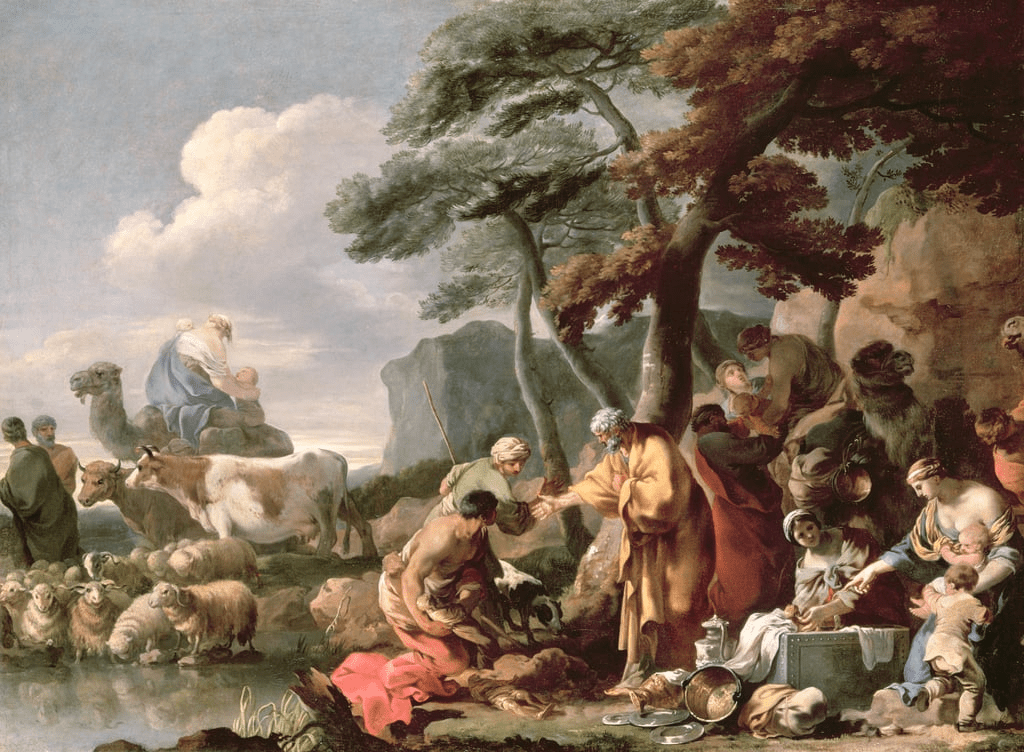
Jacob burying the false gods under the oak by Shechem, by Sébastien Bourdon (1616-1671)

Then God said to Jacob, “Go to Bethel and live there. Make an altar there. I am the God who appeared to you when you were fleeing from your brother Esau.”

So Jacob said to his family and those who were with him, “Get rid of the foreign gods which you have, wash yourselves until you are ritually clean, and change your clothes. Then let’s go to Bethel. I will make an altar there to God, who answered me when I was troubled and who has been with me wherever I’ve gone.” So they gave Jacob all the foreign gods that they had in their possession as well as the earrings that they had on. Jacob buried these things under the oak tree near Shechem. (God’s Word Translation)

Christianity has existed for 2,000 years; Judaism for 4,000 years or more. That’s a long time. On the one hand, this is a tremendous legacy of faith, grounded in several millennia of solid religious tradition. And on the other hand, something existing for so long is bound to accumulate some barnacles that get encrusted on the faith.

And if those barnacles are there for too long, it becomes assumed that they’re just part of the ship of faith. But they’re not; they need to be removed so we can see the real thing and move through life unencumbered and not dragged by extraneous stuff.

The familiar, over time, is taken for granted. And when that happens, we lose sight of what is most important, of what is most needed.

God helped Jacob – the son of Isaac, the son of Abraham – to reconnect with a seminal experience from earlier in his life. That experience was a vison of God, and an assurance that God was with Jacob. He was not alone.

But, years later, after accumulating two wives, twelve sons, and many flocks of sheep and other animals, it was time to move and make a home and an altar elsewhere. Instead of taking the Lord for granted, and forgetting the difficulties of the past, God intervened and called the whole crew to go and live in another place.

The communication from God brought Jacob to a spiritual place of realizing what had happened over the years; slowly and perhaps imperceptibly, the barnacles of idolatry had become encrusted amongst his family. And they were obstacles which needed to be jettisoned before they could move on.

Jacob needed to hear from God. Jacob’s family needed to hear from him. And that communication had to be a helpful way of scraping the barnacles off from decades of misplaced living.

Our world today is marked by unfeeling meanness to strangers, a profound lack of empathy, respect, and basic human kindness toward one another. Individuals, groups, communities, and entire nations don’t know how to talk to each other in a way that is helpful and life-giving.

We need a process which helps us have a way of being with others that is compassionate. It is imperative that we have communication that guides us in both expressing ourselves and listening to others. And that process must focus on what we are observing, feeling, and needing.

It is essential that humanity creates deeper personal relationships and maintains them. If not, we will be overcome by the barnacles of suspicion, hate, distrust of others, as well as distance from God.

Unless we are with each other in helpful ways, we will devolve into judgmental and critical speech directed toward others or even ourselves. Violent words are the main obstacle to having compassion on others.

Comparisons and classifications of people, denial of responsibility for words and behaviors, and making demands, leads to estranged relationships. Instead, we can do better. We can be with one another and talk to each other by communicating observations, feelings, needs, and requests.

Observation

  • Observe, rather than evaluate. Whenever we observe something, and then quickly evaluate it, the other person will tend to hear criticism and resist what we are saying.
  • Be specific, not general. It’s helpful to make a specific observation instead of a general one. For example, God was specific about what Jacob was to do. And Jacob was quite specific about the situation of idolatry and what to do about it before the family could move to Bethel.

Feeling

  • Acknowledge and express your emotion. Clearly and specifically identify and name your emotions because this is the way we connect more easily with others. Jacob told his family of feeling troubled in the past and that God helped him deal with it.
  • Be vulnerable. Expressing our feelings can help resolve conflicts. The old adage is true: People don’t care how much you know until they know how much you care.

Need

  • What do you need? Take responsibility for your feelings. Connect your feeling with your need. Jacob was devoted to God because his emotions were tethered with how God had met his needs throughout his life.
  • Others do not cause our feelings, and they are not responsible for our emotions. Jacob’s family did exactly what Jacob told them to do – and did not buck him or resist him – mainly because he let them know how he was feeling, and why he was telling them to rid themselves of idols and move on with him to Bethel.
  • Listen to yourself. Judgments of others are projections of our own unmet needs; and conversely, being kind to ourselves, listening to our thoughts, and paying attention to how we carry stress in our bodies, allows us to be helpful to others and present to them in whatever they are going through.
  • We are not responsible for other people’s feelings. We can never meet our own needs by trying to make others feel guilt or shame.

Request

  • Ask for what you need and want. We honor ourselves by making requests in clear, positive, and concrete language of what we really need. The clearer we are about what we want, the more likely it is that we’ll get it.
  • The message we send is not always the message which is received by another. Be clear about the response you want so that there is no confusion about what we truly need.

The objective of communication is not to change people and their behavior in order to get our way. Rather, it is to establish relationships based on honesty and empathy that will eventually fulfill everyone’s needs.

There is a need to express honestly and clearly our observations, feelings, needs, and requests, as well as receive another’s communication with focused attention and empathy.

So then, how we talk to and about God, and how we talk to ourselves, becomes a template for how we talk to others. A lack of clear communication is a surefire way of allowing the barnacles of displeasure and disappointment to attach to our souls.

However, clear communication is life-giving and even lifesaving. It’s worth putting significant effort into it.

Blessed Lord, in your infinite wisdom, you created us with the gift of communication. May we use this gift to foster love, understanding, and unity amongst ourselves and with you.

Guide our hearts to speak words of kindness and encouragement. May our tongues be instruments of love, grace and compassion to those around us.

Open our ears, so that we may truly listen and understand the needs and desires of our fellow humanity. Grant us the patience to hear their stories and the wisdom to respond with love and empathy.

Enlighten our minds to be clear and thoughtful in our affect and speech. As we share our thoughts and ideas, may we be ever mindful of your presence, seeking your holy and good will in all we say and do.

Fill our conversations with honesty and vulnerability. May we find the strength and courage to speak our truth while always remaining respectful and considerate of the feelings of others.

Bind us together in unity and love through our shared communication. May our words build bridges and forge bonds that reflect your divine love and mercy. Amen.

What Is Your View of God? (Psalm 86:1-10)

God’s Love… by Hope G. Smith

Incline your ear, O Lord, and answer me,
    for I am poor and needy.
Preserve my life, for I am devoted to you;
    save your servant who trusts in you.
You are my God; be gracious to me, O Lord,
    for to you do I cry all day long.
Gladden the soul of your servant,
    for to you, O Lord, I lift up my soul.
For you, O Lord, are good and forgiving,
    abounding in steadfast love to all who call on you.
Give ear, O Lord, to my prayer;
    listen to my cry of supplication.
In the day of my trouble I call on you,
    for you will answer me.

There is none like you among the gods, O Lord,
    nor are there any works like yours.
All the nations you have made shall come
    and bow down before you, O Lord,
    and shall glorify your name.
For you are great and do wondrous things;
    you alone are God. (New Revised Standard Version)

What is your view of God? 

For some, God is up there, somewhere, like some white-bearded old guy who is aloof to what is going on down here – there is neither anything personal nor personable about him, at all. If he gets involved, at all, it’s just to get out his divine BB gun and shoot a few sinners in the backside.

For others, God is a force which binds all things together; God is there, but you’re never quite sure how to get in touch with him – it’s like a crap shoot trying to connect with God. So, you might do all sorts of things to get God’s attention, like be especially good – and if that doesn’t work, maybe you’ll go the other way and be especially bad, just to get any sort of attention.

For yet others, God is perpetually perturbed about something; he’s got a bee in his divine bonnet and it’s our job to figure out what he’s sullen and upset about all the time, that we might appease God in some way. So, you might double-down on being self-sacrificial, try not to swear in front of the Pastor, and help others so that God will, in turn, help you.

The psalmist David, however, sees God in a very different way than all the aforementioned. God is not aloof and distant, nor angry. Instead, David understands and views God as personal, knowable, and reachable.

What characterizes God?

Reading today’s psalm tells us a great deal of how David thought and felt about God. Notice what we learn about God from David’s description: good and forgiving; abounding in steadfast love; listens and answers; and, does great and wondrous things.

Now this is a God you can sink your teeth into. This God is attentive, engaged, and is anything but upset all the time – which is why David has no problem asking God to listen and answer his prayer.

David put his trust in God to save him and make his heart glad. With this kind of God, David can willingly affirm his devotion. With a God of steadfast love and support, the worshiping and praying person’s heart forever belongs to the Lord.

If your view of God cannot support and bear the weight of your life’s hardest circumstances, then you need a different view of God!

Rather than God being the problem, it could be that your understanding of God is off. And if your understanding of God is off, then it’s likely that your own understanding of yourself is skewed – which is why many persons who have darker views of God are down on themselves and possess little self-worth.

I invite you to see the God of David. This God has both the ability and the willingness to satisfy your life’s greatest needs.

What will you do with your view of God?

In humility and brokenness, we call out in our misery. God responds in steadfast love and abundant mercy. With God, we can move from trouble to confidence.

And sometimes, we discover that our troubles and our circumstances change very little. But we ourselves have changed a great deal. Our compulsions for solid answers to our questions give way to a settled confidence in divine mystery. And our obsessions with a pain-free and problem-free life are replaced with a curiosity for what the hard situations in our lives will teach us.

The poor and needy cry out to God, knowing that grace and mercy characterizes the Lord. Life on this earth may not treat us well, but God gives us much more than we deserve.

The faithful trust in the Lord, fully confident that their preservation and protection are in God’s hands – and not in political leaders or padded bank accounts.

The miserable pray, constantly persevering in prayer, because their hope is in the name of the Lord who made heaven and earth. They have learned to pray expectantly, understanding that sometimes the greatest miracle of all is being delivered from the need to have a miracle.

Those who lift their faces to heaven, looking for the bright sunshine of grace, will know joy, down deep in their soul – and not simply a fleeting happiness from temporary reprieve of trouble.

The ones calling on the name of the Lord, banking their lives on God’s love, discover forgiveness and a good peaceful life of peace – rather than the anxiety of constantly worrying about tomorrow.

The spiritually devoted are confident that God will answer in their day of trouble – and they are patient, knowing full well that God’s sense of timing is much better than their own. So, they learn to hold all things loosely, knowing that God gives and God takes away. Blessed be the name of the Lord.

All those taking the time and effort to find the God who is truly characterized by kindness and compassion know in their gut, without a shadow of a doubt, that there is no one like the Lord – a God who does wondrous things and is attentive to justice and righteousness.

What is your view of God? Listen closely to the psalmist, and he will tell you what the Lord has done for him because of God’s basic nature of love and goodness.

Great God of David, you are above all things and beside all things and with all things. You are uniquely positioned and powerful to walk with me through all the situations of my life. Thank you for sending the Son of David to make your promises real to me. Amen.

A Lot of Hurting, Touching, and Healing (Luke 6:12-19)

Jesus calls his twelve disciples, by Sadao Watanabe

One of those days Jesus went out to a mountainside to pray, and spent the night praying to God. When morning came, he called his disciples to him and chose twelve of them, whom he also designated apostles: Simon (whom he named Peter), his brother Andrew, James, John, Philip, Bartholomew, Matthew, Thomas, James son of Alphaeus, Simon who was called the Zealot, Judas son of James, and Judas Iscariot, who became a traitor.

He went down with them and stood on a level place. A large crowd of his disciples was there and a great number of people from all over Judea, from Jerusalem, and from the coastal region around Tyre and Sidon, who had come to hear him and to be healed of their diseases. Those troubled by impure spirits were cured, and the people all tried to touch him, because power was coming from him and healing them all. (New International Version)

Pain is a lot

Touch is important. Humanity needs touch. It’s also one of those things that we likely take for granted. 

Philip Yancey and Dr. Paul Brand co-authored a book, originally published in 1982, entitled “Pain: The Gift Nobody Wants.” It’s largely a biography of Dr. Brand, who pioneered both the diagnosis and prognosis of leprosy. 

He discovered that leprosy occurs because of a lack of feeling – an inability to sense touch. The delicate nerve endings we all have in our fingers and toes are numb to the leper. The lack of sensing pain in the extremities leads to small cuts or injuries, which would be immediately treated by someone who feels pain, becoming gangrene with the losing of fingers and toes.

The ability to feel, to reach out and touch another person, is vitally important to our spiritual and emotional lives. Without touch, the calloused heart and unfeeling soul does not realize the damage that is being done to it.           

One of the gifts we have as people is the ability to feel guilt, sorrow, disappointment, and pain – to be touched mentally, emotionally, and spiritually – as well as physically. And in our ability to feel pain, it brings about attention to prayer and addressing the situation.

Many people are troubled in either mind or spirit, or experience chronic ailments of the body, day in and day out. They just want relief, to be at peace in both body and soul.

Jesus prays… a lot

In today’s Gospel lesson, Luke puts together two stories: one of Jesus choosing and calling his twelve disciples; and then one of Jesus being among the people and healing them of their diseases and their troubles. Let’s observe the relationship between them.

Jesus often withdrew to lonely, isolated places in order to pray (Luke 5:16). On this particular occasion, he went out and spent the entire night in prayer to God. When morning came, we discover the reason for the all-night prayer meeting: Christ chose the people who would be closest to him in his earthly ministry. He called the twelve to follow him and be his disciples.

I find it highly instructive that Jesus spent so much time in prayer before making such big decisions about his ministry. If anyone could size up somebody as a potential follower, it seems to me it would be Jesus. And yet, there was a lot of deliberation and interaction with the Father. Since the Lord Jesus found it necessary to pray with an extending time, and consult with the heavenly Father, I would say that our own prayer life and reaching out to consult and collaborate could probably use an upgrade.

Jesus heals… a lot of people

Then, Jesus and his disciples, together enter the fray of the crowd. And the disciples get their first lesson in following Jesus: Christ-centered ministry is about healing – it’s about restoring people to physical, mental, emotional, and spiritual health.

Healing is at the heart of all real Christian ministry. And healing is really what everyone is to be about, whether they identify as Christian, or not. To be healed is to experience a holistic restoration of body, mind, emotions, and spirit.

Touch is a big part of healing. Physical touch is important, and it’s powerful. Sometimes, bodily healing is needed because a person has been physically abused, or experienced some sort of physical trauma. And it can be very difficult to have others touch them, after such experiences. Yet, part of the healing will be in experiencing redemptive touch – either by surgeons, family, friends, or trusted others. The answer to bad touch and bad pain is to experience good touch and the good pain of healing.

Non-physical touch is no less important. And, I believe, Jesus understood this perhaps more than most. He routinely “touched” people in ways that changed their lives. Christ sought to not only bring physical healing, but also to heal the mental, emotional, and spiritual wounds.

Jesus touches… a lot of lives

Jesus touched a lot of lives through his healing ministry:

  • In healing lepers of their disease, Christ made sure that they were no longer ostracized from the community but were restored to full function in society.
  • In curing persons demonized and tormented by evil spirits, Jesus was concerned to restore them to their right mind and ensure they were included as members of society, as well as restored to their families.
  • In bringing salvation from guilt and shame, Jesus brought reconciliation and restoration between God and sinners.
  • In all his relational interactions, Jesus was intentional about making connections to the lonely and the lost, to those who were emotionally cut off from the mass of society.

So, whenever we feel pain – whether in body, mind, emotion, or spirit – this experience lets us know that we need to pay attention to something. As we do that, it can drive us to the source of healing, wholeness, and restoration. We go to prayer – not out of duty – but because we are convinced that there are divine resources only God can provide.

And we can come, again and again, finding the grace to help us in our time of need. For God’s mercy is inexhaustible; the grace of God will never run out or run dry.

Therefore, let followers of Jesus everywhere be aqueducts of grace, angels of mercy, and agents of healing in a world which so desperately needs the love, care, and attention we can give them.

May God the Father bless you; God the Son heal you; and God the Holy Spirit give you strength. May God the holy and undivided Trinity guard your body, save your soul, protect your mind, and bring you safely to his heavenly country; where he lives and reigns for ever and ever. Amen.