On a Time Out (Exodus 2:11-15)

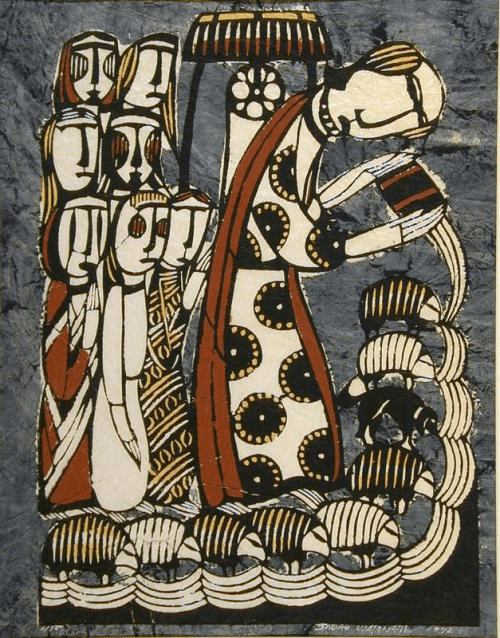
Moses in Midian, by Japanese artist Sadao Watanabe, 1972

One day, after Moses had grown up, he went out to where his own people were and watched them at their hard labor. He saw an Egyptian beating a Hebrew, one of his own people. Looking this way and that and seeing no one, he killed the Egyptian and hid him in the sand. The next day he went out and saw two Hebrews fighting. He asked the one in the wrong, “Why are you hitting your fellow Hebrew?”

The man said, “Who made you ruler and judge over us? Are you thinking of killing me as you killed the Egyptian?” Then Moses was afraid and thought, “What I did must have become known.”

When Pharaoh heard of this, he tried to kill Moses, but Moses fled from Pharaoh and went to live in Midian, where he sat down by a well. (New International Version)

Faith is dynamic, not static. It flows and moves, waxes and wanes, strengthens and weakens. Faith isn’t like a kitschy trinket you buy in a quaint downtown shop, and then place it as a nice object in a prominent place of your house or office. Rather, faith is much more subjective, like taking an adventure down some whitewater rapids, not quite knowing what’s going to happen.

Moses needed to learn how to make healthy decisions of faith, just like the rest of us. Just because we stand at this point in history and can look back at what a religious titan he was, doesn’t mean that Moses was always a paragon of faith and patience. In fact, quite the opposite.

An eighty year old Moses became the human agent of God’s deliverance of the Israelites from the Egyptians, after a forty year stint in the backside of the desert. This tells us that it took him awhile to mature into being the sort of leader God wanted to bring God’s people out of slavery. 

Even though the forty year old Moses may have had a sense that the Israelites needed freedom from slavery and acted on that sense by killing a ruthless Egyptian, his method, maturity, and misplaced timing were off.

There is a time for everything, said the Teacher of wisdom (Ecclesiastes 3:1). Wisdom – the ability to apply faith to concrete situations with appropriate forms – is often in the timing of things. To know when to speak and when to listen, when to act and when to wait, is an important facet of faith. 

The ancient Israelites were slaves in Egypt for a long time, 400 years. Moses knew they were suffering, and he acted in “good faith.” Yet, it was not yet time, and it was a rash action, in killing the Egyptian. Eventually, the Jewish cry of suffering arose to God, and God heard them, remembering the divine covenant. 

Questions of why God did not act sooner, or use Moses earlier, is information that is only privy within God, and likely will not be answered satisfactorily for us, this side of heaven.

In order to develop a strong and wise faith – with an opportune sense of timing – we need to rely on God. Trusting in ourselves, our own efforts, and our own gauge of how things ought to proceed, will usually not end well. We may, like Moses, find ourselves taking a “time out” from God in obscurity until we learn to wait on him.

Some might think of a “time out” as being negative, even punitive, such as giving a time out to a toddler because of naughtiness, or calling a time out in sports because the team is playing poorly. However, a time out can also be a positive experience. The following are some advantages of the “time out:”

Reflect

Little did Moses know at the time, but he would have the next 40 years to reflect on his life and actions in Egypt. Reflection is important. It gives us a chance to step back, learn from what happened, and adjust for the next time we experience a similar situation. Taking this time acts like a mirror, enabling us to gain some clarity on what we’ve said and done.

So I reflected on all this and concluded that the righteous and the wise and what they do are in God’s hands, but no one knows whether love or hate awaits them. All share a common destiny—the righteous and the wicked, the good and the bad, the clean and the unclean, those who offer sacrifices and those who do not. (Ecclesiastes 9:1-2, NIV)

Refocus

Upon taking the time to reflect, it then provides us with the opportunity to refocus our efforts with wisdom. To refocus means to come back around in giving close attention and concentration on what’s most important to us. The desire of Moses was admirable in being concerned about his fellow Israelites. He just went too far and needed to fix his eyes on the Lord and how to best go about freeing them.

We must focus on Jesus, the source and goal of our faith. He saw the joy ahead of him, so he endured death on the cross and ignored the disgrace it brought him. (Hebrews 12:2, GW)

Renew

Reflecting on the past and refocusing in the present are not quite enough to get us back in the game of life. We also need renewal. To be renewed involves fresh commitment to the things we have learned. I believe it’s best to renew our commitments with some sort of ritual, because rituals help us psychologically and spiritually to launch into the focused endeavors ahead of us. That’s why athletes always have a short ritual of breaking their huddle before returning to the contest.

Don’t be conformed to this world, but be transformed by the renewing of your mind, so that you may prove what is the good, well-pleasing, and perfect will of God. (Romans 12:2, WEB)

Return

A “time out” is designed to be temporary. Eventually, a “time in” happens. We get back in the game. We return to what we were doing, hopefully with a better understanding and grasp of what needs to happen and how to go about it.

In the fullness of time, the Apostle Paul said to the Galatians, Jesus came, born of a woman, born under law, to redeem those under the law (Galatians 4:4-5). God knows what he’s doing, even though it might seem like the Lord is sometimes slow to act. Yet, God sees, and God delivers – and does it according to divine timing.

If we live, we live for the Lord; and if we die, we die for the Lord. So, whether we live or die, we belong to the Lord. For this very reason, Christ died and returned to life so that he might be the Lord of both the dead and the living. (Romans 14:8-9, NIV)

Redeeming God, you control all things, including the clock. Give me wisdom so that my sense of timing might reflect your will and your way, through Jesus Christ, your Son, who with you and the Holy Spirit reign supremely as one God, now and forever. Amen.

Hold It Loosely (Exodus 1:1-7)

When Jacob went to Egypt, his son Joseph was already there. So Jacob took his eleven other sons and their families. They were: Reuben, Simeon, Levi, Judah, Issachar, Zebulun, Benjamin, Dan, Naphtali, Gad, and Asher. Altogether, Jacob had 70 children, grandchildren, and great-grandchildren who went with him.

After Joseph, his brothers, and everyone else in that generation had died, the people of Israel became so numerous that the whole region of Goshen was full of them. (Contemporary English Version)

Exodus is the second book of the Bible, and the second of five books known as the “Pentateuch” by Christians, and the “Torah” by Jews. The first book, Genesis, ended with the story of Joseph – who was one of the 12 patriarchs. God established a covenant with Abraham, the father of Judaism, and promised him land and descendants – even though he did not have a son. God miraculously gave Abraham and Sarah a biological son, Isaac, who grew up to be the father of Jacob, or Israel, Joseph’s father.

The stories in Genesis surrounding Abraham, Isaac, Jacob, and Joseph were filled with wonderings of whether God’s promise would ever survive, or not. Yet, it did. Joseph, in the ultimate reversal of fortunes, went from the lowest person in Egypt to it’s highest official. Through Joseph, the brothers and their families ended up relocating to Egypt because of a severe famine.

Present-day land of Goshen, Egypt

As time moved on, Joseph, his brothers, and all that generation died. In contrast to the extended family of Jacob, 70 of them, who initially went to Egypt, the opening of of Exodus relays an exponential growth in numbers of Israelites.

God was faithfully and tirelessly preserving the covenant and the promise for Israel. When the people went to Egypt, God assured them they need not be afraid. The Lord will make them a great nation, will be with them, and shall lead them back out again. (Genesis 46:1-4)

The opening of Exodus not only connects us with events in the latter part of Genesis, but also hearkens back to it’s very beginning, when God spoke to the first human couple. The Lord gave them a five-fold blessing, consisting of commands to 1) be fruitful 2) multiply 3) fill the earth 4) subdue it, and 5) have dominion over it. (Genesis 1:28)

Following the Flood, God blessed Noah, repeating the commands to be fruitful, multiply, and fill the earth (Genesis 9:1). Later, God spoke to Abraham, promisingto make him fruitful (Genesis 17:5-9). Moving into Exodus, we see a fulfillment of the commands and the promise taking shape, stating that the descendants of Israel were fruitful and multiplying, so that the land was filled with them.

It was this very blessing of progeny, and the fertile increase of descendants, which sets up the entire book of Exodus. The great and growing numbers of Israelites became a source of concern and fear amongst the Egyptians. It wasn’t long before the Jews were seen as another source of slave labor.

Sometimes, we must bear in mind and remember that great blessing also has an underbelly of great blight. Only God and relationships last forever; everything else is temporary, including our earthly blessings.

Therefore, it is wise to hold all things loosely, with open hands, and not with clenched fists that believes possessing things in this moment will be permanent. The following are some things to remember:

Remember who is in control

When things are going well, it may create the illusion that I am in charge of the blessing. But, in reality, it was given to you, and it can be taken away, as well.

The only thing you can control are your thoughts, feelings, emotions, choices, actions and the story you are telling yourself about what happened in the past, is happening now, and will happen tomorrow.

We all have our personal invisible backpacks to carry. That backpack is ours, and nobody else’s. Others have their own burdens to carry, which are individual to them. They aren’t yours to carry. Their stories aren’t yours to tell.

God is the Sovereign of the universe, and controls all things. That is God’s burden to carry. Not yours. Carrying the world on your shoulders isn’t your job. So, hold loosely whatever happens on this earth, whether for good or ill. 

Remember that life is both planning and improvisation

We have an agenda, make our plans, and put things in place. Yet, in the execution of doing it, we have to move with whatever circumstances and conditions arise – with whatever life throws our way – and then adjust our expectations.

Remember it’s both in planning and in improvising. The Israelites laid plans to go to Egypt, went there, and then had to deal with changing conditions once they were there. All planning and no improvising is unrealistic; and all improvisation with no plan is flying by the seat of your pants and living in a dream world which doesn’t exist.

What’s more, it might be your plan, or your group’s plan, but it’s not everybody’s plan. They have the freedom to say, “No thank you.” So, be careful to not marry yourself to a particular outcome. Release the urge to cling or obsess about certain expectations. Hold your plans loosely, and plan to improvise.

Remember to cooperate with God

In reality, there is a divine/human cooperative which exists on the earth. Ideally, we are to work together, me doing my part, and God handling the rest. And the both of us constantly must be in dialogue with each other.

When we align with this truth, and participate with God and integrate this cooperative into daily life, then we begin to relax, breathe, move with confidence, and speak with purpose. Head, heart, and gut are no longer disparate parts within me, but work together in a harmonious sync with the Lord.

If this is a challenge for you, set aside some time and be in nature. Look around you and observe all the life thriving right in front of you. Connecting with what is alive connects us to the universal Love which exists everywhere. And that Love can help us and heal us – if we will but let it.

I can hold things loosely because I know the internal pressure of “getting it right” isn’t mine to carry. I can cooperate with God, relax, do my best, and trust.

Blessings are wonderful and abound everywhere. Yet, adversity, acrimony, and even abuse still lurk about in this old fallen world. So, may you learn to hold all things loosely, and live as you know you can, and ought. Amen.

The Church that Makes a Difference (Matthew 16:13-20)

Photo by Felix Mittermeier on Pexels.com

When Jesus came to the region of Caesarea Philippi, he asked his disciples, “Who do people say the Son of Man is?”

They replied, “Some say John the Baptist; others say Elijah; and still others, Jeremiah or one of the prophets.”

“But what about you?” he asked. “Who do you say I am?”

Simon Peter answered, “You are the Messiah, the Son of the living God.”

Jesus replied, “Blessed are you, Simon son of Jonah, for this was not revealed to you by flesh and blood, but by my Father in heaven. And I tell you that you are Peter, and on this rock I will build my church, and the gates of Hades will not overcome it. I will give you the keys of the kingdom of heaven; whatever you bind on earth will be bound in heaven, and whatever you loose on earth will be loosed in heaven.” Then he ordered his disciples not to tell anyone that he was the Messiah. (New International Version)

A lot of research studies have come out in the past 20 years demonstrating that legions of adults, especially between the ages of 18-29, are leaving the Church in droves. This confirms my own anecdotal evidence over the years that about 80% of twenty-somethings drop out of church altogether. So, why are people leaving? Can anything be done about it?

Most of the studies can be boiled down to three major reasons: 

  1. The Church is irrelevant to my life and doesn’t talk about things important to me
  2. The Church is judgmental toward others not like themselves
  3. The Church is hypocritical by saying one thing and yet living another way

A good, right, and real confession of Jesus will speak a relevant word into the culture and into various generations, will proclaim the gospel of grace (not judgment), and will live what it believes.

In today’s Gospel lesson, Jesus and his disciples are in the Gentile (non-Jewish) territory of Caesarea Philippi, a city 25 miles north of the Sea of Galilee. Up to this point, the disciples encountered a lot of people and heard a lot of things said. So, Jesus asked them two questions: 

Who do people say the Son of Man is?

The disciples gave a variety of answers, which is to be expected, with some of them being a bit esoteric. John the Baptist raised from the dead is a stretch. Elijah was a man who never died, but was just taken to heaven; maybe he’s back. Maybe Jeremiah or one of the other prophets got sent back. 

When asking this question to folks today, you will also get a variety of answers as to whom Jesus is – a good teacher, a model humanitarian, a myth or a legend who didn’t really exist. A few times I have been told that Jesus was an alien from another planet. My personal favorite when I asked who Jesus, a guy answered that he was a nudist, and that if we all just took off our clothes, there would be peace in the world.

Who do you say I am?

Peter acted as the spokesperson for the group. Given the disciples’ track record of scratching their heads over nearly everything Jesus said or did, one might expect to hear another crazy answer. But Peter got it right by confessing, “You are the Christ, the Son of the Living God.” 

“Christ” is another way of saying “Messiah,” or “Savior.” It literally means, in the Greek language, “Answer.”  Peter confessed Jesus as being The Answer, the person for whom everything comes down to. Peter may not have fully understood what he was saying, but he said it.

The reason that craziness didn’t come out of Peter’s mouth is that “The Answer” was divinely revealed to him.  Faith in Jesus Christ is a gift given to us by God. 

“All things have been committed to me by my Father. No one knows the Son except the Father, and no one knows the Father except the Son and those to whom the Son chooses to reveal him.” Jesus (Matthew 11:27, NIV)

Peter was blessed – not necessarily because of sincerity, openness, or deserving it – but because of God’s grace which revealed to him that Jesus is the “Answer.”

The Apostle Peter put himself in a position to know by obeying the voice of Jesus to follow him. It took him and the other disciples a while to “get it,” but eventually they did. And if it took years of being with Jesus for the disciples to make a right and good confession of faith, then it’s important that we have a great deal of patience for our friends and relatives.

Jesus proclaimed Peter (which means “rock”) the immovable object from which the Church would be built.  The Apostle Paul framed it this way:

You are no longer foreigners and strangers, but fellow citizens with God’s people and also members of his household, built on the foundation of the apostles and prophets, with Christ Jesus himself as the chief cornerstone. In him the whole building is joined together and rises to become a holy temple in the Lord. (Ephesians 2:19-21, NIV)

Christ is the one who builds the Church – and not me,  nor you. This reality is encouraging and comforting to me. If it was up to me to build the Church, I would screw it up so badly that it would actually be overcome by hell. But I can’t screw it up, because it’s Christ’s Church, not mine. 

So, we can move forward and storm the gates of hell, we can move and work and act and call others to confess, all with the confidence and security of knowing that Jesus is building his Church. There’s no need to worry whether we’re getting it right, or not, because we aren’t the ones in control of the project.

However, I admit what Jesus says next isn’t very comforting to me. Christ told Peter that he will give him the “keys of the kingdom of heaven,” and that whatever he binds on earth will be bound in heaven, and whatever he lets loose on earth will be loosed in heaven.

Giving Peter the keys of the kingdom seems akin to giving an 8 year old the keys to the car and saying, “Go ahead, take it for a spin, you can drive it!” 

What are the keys of the kingdom? 

The preaching of the holy gospel and Christian discipline toward repentance. Both preaching and discipline open the kingdom of heaven to believers and close it to unbelievers. 

How does the preaching of the gospel open and close the kingdom of heaven? 

The kingdom of heaven is opened by proclaiming and publicly declaring to all believers, each and every one, that, as often as they accept the gospel promise in true faith, God, because of what Christ has done, truly forgives all their sins. The kingdom of heaven is closed, however, by proclaiming and publicly declaring to unbelievers and hypocrites that, as long as they do not repent, the anger of God and eternal condemnation rest on them. (The Heidelberg Catechism, Q&A 83, 84 )

The Church is true to its mission when it proclaims the good news of God’s grace in Christ. We possess the keys of the kingdom. Jesus knew exactly what he was doing, that is, the risks and the problems of letting people do the task of proclaiming the gospel. Yet, Christ still tossed us the keys to his Mercedes.

Conclusion

A Church that makes a difference is made up of people who confess Jesus, are called by God, and call others to confess Jesus, too. The de-churched and the disaffected want to see a Church that seeks to understand the world, to provide relevant ministry to others, and to tackle the injustice that exists everywhere.

We must use the power given us with the keys of the kingdom to bestow mercy to the weak, the oppressed, and the lost. We need to live what we believe with a passionate heart and an unashamed faith.

Together, as God’s people, we can extend the hospitality and the kindness to make a difference in the church and the world. 

May our confession of Christ shape our words and our actions. And may it give us the confidence and boldness to live as Jesus did, and to enjoy him forever. Amen.

To Forgive Is Divine (Genesis 50:15-26)

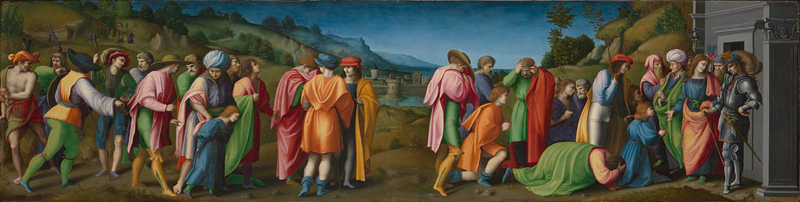
Joseph pardons his brothers, by Bacchiacca (1495-1557) http://www.nationalgallery.org.uk/paintings/NG1219

When Joseph’s brothers realized that their father was now dead, they said, “What if Joseph bears a grudge against us, and wants to pay us back seriously for all of the terrible things we did to him?” So they approached Joseph and said, “Your father gave orders before he died, telling us, ‘This is what you should say to Joseph. “Please, forgive your brothers’ sins and misdeeds, for they did terrible things to you. Now, please forgive the sins of the servants of your father’s God.”’” Joseph wept when they spoke to him.

His brothers wept too, fell down in front of him, and said, “We’re here as your slaves.”

But Joseph said to them, “Don’t be afraid. Am I God? You planned something bad for me, but God produced something good from it, in order to save the lives of many people, just as he’s doing today. Now, don’t be afraid. I will take care of you and your children.” So he put them at ease and spoke reassuringly to them.

Thus Joseph lived in Egypt, he and his father’s household. Joseph lived 110 years and saw Ephraim’s grandchildren. The children of Machir, Manasseh’s son, were also born on Joseph’s knees. Joseph said to his brothers, “I’m about to die. God will certainly take care of you and bring you out of this land to the land he promised to Abraham, to Isaac, and to Jacob.” Joseph made Israel’s sons promise, “When God takes care of you, you must bring up my bones out of here.” Joseph died when he was 110 years old. They embalmed him and placed him in a coffin in Egypt. (Common English Bible)

“All people commit sins and make mistakes. God forgives them, and people are acting in a divine way when they forgive.”

Alexander Pope, “An Essay on Criticism”

If there was anyone who had a supposed right to be bitter and unforgiving, it would be Joseph. His brothers had hated him, left him for dead, sold him into slavery, and lied to their father Jacob about him. For years, Joseph languished in servitude and prison – for no fault of his own.

And yet, Joseph was able to discern that it wasn’t his place to be the judge. At the end of his life, he had the perspective and the insight to understand that all the hardship earlier in his life was noticed by God, and then bent for good and divine purposes in the saving of many lives.

If we can keep in mind that it is God’s business to run the world, and our business to forgive others, then life will go a lot better for everyone.

Many people live discontented lives because they say to themselves, “I will not forget what you did, and I will not forgive.” Persistent thoughts of revenge only serve as a cancer that destroys the mind’s thoughts, erodes the soul, and hinders the heart’s ability to love. 

But people who practice forgiveness are much less likely to be hateful, hostile, and belligerent toward others. They are healthier and happier, and more at peace.

I’ve had many people tell me over the years, “But you don’t know what I’ve been through.” My typical response is, “You don’t know what I’ve been through, either. You may not even believe some of the things I have experienced, and some of the things that have happened to me and were said to me. So, can I tell you what I have done to forgive those who have sinned against me?”

1. When I am trying to forgive someone, I pray for them.

It’s hard to keep resenting someone and wish them ill, whenever you are praying for them on a regular basis. Joseph was the victim of his brothers’ abuse. If there was ever a dysfunctional family to grow up in, it was Joseph’s. Being sold into slavery by your own brothers and being the target of their derision would cause anyone to be upset. But, many years later, Joseph chose to forgive his brothers. He acted with their best interests at mind. He prayed for them and did not actively work against them. What’s more, he saw the hand of God in it all.

2. I write a letter of forgiveness (which I may or may not send).

In the letter I write in full detail how the person hurt me. I leave nothing out. I express exactly how it made me feel, and how it affected my life. Then, I express forgiveness and say that I will not hold the offense over their head. The following is a five-step process for forgiving others using the acrostic REACH:

Recall 

Name the hurt, and name it squarely. Don’t fudge by saying it’s not that bad, or as bad as others have experienced. Call it what it is: deceit, stealing, harassment, assault, abuse, adultery, verbal shaming, murder, etc. 

The Truth and Reconciliation Commission in South Africa after apartheid was based on providing full disclosure of all crimes. Those that stepped forward, giving a complete account of their actions, were offered a full pardon. 

Archbishop Desmond Tutu, who led the commission, was most struck by how many people wanted to hear what had happened to their loved ones from the perpetrators themselves so that they could know whom to forgive. Methinks we have much to learn from our African brothers and sisters.

Empathize

Try and see the offense from the other person’s perspective. Attempt to put yourself in the other’s shoes. This does not mean we paper over the offense; it just means we don’t demonize another as a monster. That only feeds and fuels our own lack of forgiveness. When we view others as non-human, then we feel no responsibility to forgive.

Altruistic

Choose to do the right thing and treat the other person well, not necessarily because they deserve it, but because it is within your control to extend grace. Again, this is what Joseph chose to do with his brothers. He gave them words of assurance, and promises of taking care of them and their children.

Commit

Commit to practicing forgiveness. Make the decision to do it. Don’t wait too long for your feelings to catch up to you.  

Bear with each other and forgive one another if any of you has a grievance against someone. Forgive as the Lord forgave you.

The Apostle Paul (Colossians 3:13, NIV)

Hold

Hold on to your forgiveness. Just because you make the decision to forgive does not mean you’ll never have to do it again. Once you have forgiven, let it be a stake in the ground in which you look back to it again and again, saying, “I forgave him/her, and I will not let the enemy of my soul keep trying to make me bitter about it all over again.” 

One of the reasons we repeat the Lord’s Prayer Sunday after Sunday in my church is to keep forgiving those who have sinned against us.

3. I talk to a trusted friend, mentor, or counselor about my effort to forgive.

Many people get stuck and have an inability to forgive because they don’t seek a wise person to help them walk through the process of forgiving. 

The easy path is to complain about the offense to someone we know who will react with the same level of disgust and spirit of revenge that we ourselves have in our hearts. But that only reinforces the bitterness. We must have someone who can offer us what we need to hear, and not only what we want to hear.

Forgiveness is at the heart of the gospel, and, so, ought to be at the core of a healthy spiritual life. It is always open season on offering grace, forgiveness, and reconciliation. To see all of life from a divine perspective is to forgive.

Pray like this:

Our Father who is in heaven,

uphold the holiness of your name.

Bring in your kingdom

so that your will is done on earth as it’s done in heaven.

Give us the bread we need for today.

Forgive us for the ways we have wronged you,

just as we also forgive those who have wronged us.

And don’t lead us into temptation,

but rescue us from the evil one.

If you forgive others their sins, your heavenly Father will also forgive you. But if you don’t forgive others, neither will your Father forgive your sins. (Matthew 6:9-15, CEB)