There Are Consequences to Injustice (Exodus 12:29-42)

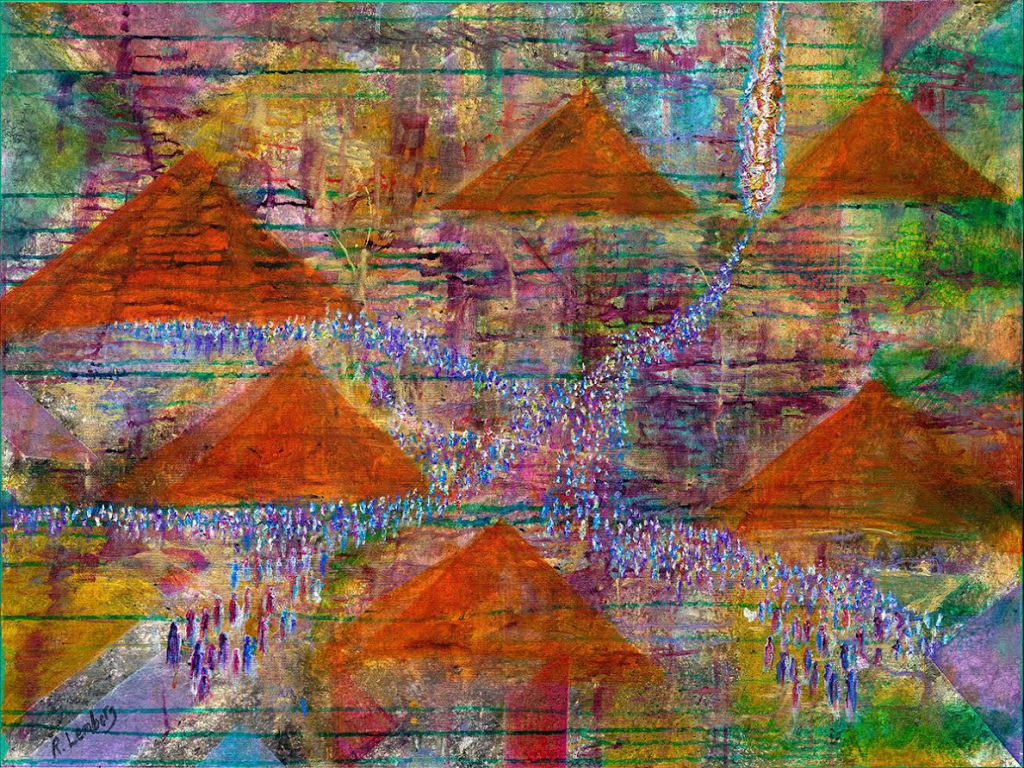
Exodus Out of Egypt, by Rivka Lemberg

At midnight the Lord struck down all the firstborn in Egypt, from the firstborn of Pharaoh, who sat on the throne, to the firstborn of the prisoner, who was in the dungeon, and the firstborn of all the livestock as well. Pharaoh and all his officials and all the Egyptians got up during the night, and there was loud wailing in Egypt, for there was not a house without someone dead.

During the night Pharaoh summoned Moses and Aaron and said, “Up! Leave my people, you and the Israelites! Go, worship the Lord as you have requested. Take your flocks and herds, as you have said, and go. And also bless me.”

The Egyptians urged the people to hurry and leave the country. “For otherwise,” they said, “we will all die!” So the people took their dough before the yeast was added, and carried it on their shoulders in kneading troughs wrapped in clothing. The Israelites did as Moses instructed and asked the Egyptians for articles of silver and gold and for clothing. The Lord had made the Egyptians favorably disposed toward the people, and they gave them what they asked for; so they plundered the Egyptians.

The Israelites journeyed from Rameses to Sukkoth. There were about six hundred thousand men on foot, besides women and children. Many other people went up with them, and also large droves of livestock, both flocks and herds. With the dough the Israelites had brought from Egypt, they baked loaves of unleavened bread. The dough was without yeast because they had been driven out of Egypt and did not have time to prepare food for themselves.

Now the length of time the Israelite people lived in Egypt was 430 years. At the end of the 430 years, to the very day, all the Lord’s divisions left Egypt. Because the Lord kept vigil that night to bring them out of Egypt, on this night all the Israelites are to keep vigil to honor the Lord for the generations to come. (New International Version)

“A horse may run quickly but it cannot escape its tail.”

Russian proverb

The ancient Israelites were in bondage to the Egyptians for hundreds of years. Their oppression finally came to and end with the Lord’s dramatic deliverance of them in the tenth and final plague directed against Egypt.

The actions of the Egyptians eventually and finally caught up with them. Their making slaves of the Israelites was not going to last forever. Even though it took a while, Egypt was held accountable and experienced divine judgment. The empire’s internal moral emptiness would not be able to hold up under the justice of God.

“Empty sacks will never stand upright.”

Italian proverb

Pharaoh was a hard man. The more Moses talked to him the more stubborn Pharaoh got. Eventually, Pharaoh’s heart became like stone; he and his empire fell because they were bent toward the way of injustice. Oppression had been Pharaoh’s proclivity by instructing the Jewish midwifes to kill firstborn sons of Israelite mothers. Now the Egyptians would fall into the very trouble they created for others.

The death of so many on one night, all at once, was too much for Pharaoh and the Egyptians. In such a grief, Pharaoh’s dogged resolve in holding onto Israelite slavery and ostracizing Moses was loosened. He summoned Moses in the middle of the night and commanded the Israelite slaves to be gone – without any conditions or strings attached to it.

The Egyptians wanted them gone, and so, urged them to leave in a hurry – just as God had predicted. All sorts of articles – including silver and gold – were willingly given to the fleeing Israelites by the lamenting Egyptians. No matter how hard and stubborn any earthly ruler is, the plans and purposes of a sovereign God cannot be thwarted.

Finally, the deliverance out of Egyptian bondage happened. The Israelites were free. It was a hasty departure. It was as if the Hebrew people had become so upsetting to the great Egyptian empire, that they vomited them out of their land, projecting the former slaves as far away as they could.

Sometimes people get the notion that if they do something bad, they will be struck by lightning or have some sort of tragedy occur. And when it doesn’t happen, they might reason further in their misguided notions by believing they can get away with bad behavior. So, they keep doing it. But, eventually, this all has a terrible effect.

“Those who lie down with the dogs, rise with the fleas.” English proverb

Actions and inactions have consequences. Those consequences may not happen immediately. However, all of us shall someday harvest the fruit of decisions that were made months, even years or decades, ago.

Make no mistake, God is not mocked. A person will harvest what they plant. Those who plant only for their own benefit will harvest devastation from their selfishness, but those who plant for the benefit of the Spirit will harvest eternal life from the Spirit. Let’s not get tired of doing good, because in time we’ll have a harvest if we don’t give up. (Galatians 6:7-9, CEB)

Almighty God, Creator and Preserver of all humanity, we humbly ask that you make your ways known to people everywhere, and bring saving help to all nations. We pray for Christ’s Church, and all faith communities across the earth, that they be guided and governed by your good, gracious, and benevolent Spirit; and that all who profess and call themselves Christians may be led into truth, and hold the faith in unity, peace, and righteousness.

Blessed Lord, we pray for all who are afflicted or distressed in mind, body, or spirit. May your divine mercy bring them comfort and relief, according to their need. Give them patience through their sufferings, and a joyful outcome from their distress. This we pray through Jesus Christ our Savior and Lord. Amen.

From Where Will Our Help Come? (Psalm 121)

I lift up my eyes to the hills—
    from where will my help come?
My help comes from the Lord,
    who made heaven and earth.

He will not let your foot be moved;
    he who keeps you will not slumber.
He who keeps Israel
    will neither slumber nor sleep.

The Lord is your keeper;
    the Lord is your shade at your right hand.
The sun shall not strike you by day
    nor the moon by night.

The Lord will keep you from all evil;
    he will keep your life.
The Lord will keep
    your going out and your coming in
    from this time on and forevermore. (New Revised Standard Version)

One of the rituals my family does when leaving on a long road trip is to pray. It’s in those special times of traveling, and anticipating the destination, that we can be especially cognizant of both the blessings and the dangers which may lie ahead.

When the Israelites set out together from places all over Israel to go to Jerusalem and ascend the temple mount for a special festival, they also prayed. Specifically, they prayed many of the psalms and sang them together.

One never knows what lies ahead. We trust the Lord to protect us by being our divine keeper and guardian, to help us and watch out for us. This is why today’s psalm reading is alongside the Old Testament lesson of the Passover. (Exodus 12:14-28)

In Exodus, God was readying the people for deliverance from Egypt. The ancient Israelites were about to leave the land of slavery and travel to the Promised Land. They would be vulnerable to all sorts of dangers and obstacles on their way. The people needed Yahweh’s oversight and protection on their long journey.

Will we arrive safely? Can we get where we need to go without an accident or trouble? Those are questions people ask in any age with any significant trip.

Throughout the psalms of ascent (or the pilgrimage psalms) there are some fundamental convictions about God through them all:

  1. The Lord is a mighty God, the Creator and Sustainer of the universe
  2. The Lord is a caring God, the people’s Helper and Deliverer
  3. The Lord is near, an imminent God who is close to us as our Immanuel
  4. The Lord is an attentive God, always watching and never sleeping on the job in order to guard us
  5. The Lord is far above, a transcendent God who is able watch over everything and always see us

If you think about it, life itself is one long extended pilgrimage from birth to death. Life is an earthly sojourn, continually moving about the earth from one place to the next. Even if we stay put and never move, the world itself is continually spinning on it’s axis and furthermore circling in space around the sun. In other words, no matter what we do, life is always risky.

We need the consistent and continual divine presence to go before us, with us, and after us wherever we are and wherever we go. There is a constant need for God’s watching and caring for us. What’s more, we are invited to move and participate in the Lord’s dealings in this world. The call of every Christian is Christ’s call to “follow me.”

The life of the believer is a call to a life of pilgrimage and discipleship. It is to step out in faith and live life to the full, knowing that God has your back. We need not run for the hills whenever there is trouble; we can look beyond the mountains to the God of heaven who is our divine helper.

At the end of the day, we can lay our head on the pillow to sleep with trust that the non-slumbering God keeps watch over us during the dark night hours. Unlike the gods who need to be stirred from their rest, Yahweh is never absent and always alert to whatever is happening.

In the morning, we can rise with confidence knowing that our going out and coming home again will be watched with vigilance and care from the Lord who is our keeper. Nothing escapes the God who is both far and near, able to see the big picture of our lives, as well as notice every little nuance by being up close and personal.

We exist in a day and age where God is looked upon with askance – as if the universe’s Sovereign has neither the ability nor the will to impact our daily lives and positively govern the world’s affairs. This is not the God of the Psalms – a grand Being who knows the score of everything going on, cares about the intimate details of life, and has the power to bring about a good outcome for humanity.

Even though God may at times be silent, and although the Lord rarely acts quickly, we ultimately know down deep in our soul that we matter and that Yahweh is there. The real issue is whether we will take the time and effort to connect with this incredible benevolent Being and take a walk, that is, a pilgrimage of faith and encounter God.

When all is said and done, from where will our help come? It will ultimately come from the Lord, the maker of heaven and earth.

Eternal God, in whose benevolent realm there is no weapon drawn except the sword of righteousness, and there is no strength known but the strength of love: Mightily spread abroad your gracious and powerful Spirit, so that all people everywhere may be gathered under the banner of the Prince of Peace, as children of one God and Father of all, to whom belongs dominion and glory, now and forever. Amen.

Love for Others (Romans 13:8-14)

Let no debt remain outstanding, except the continuing debt to love one another, for whoever loves others has fulfilled the law. The commandments, “You shall not commit adultery,” “You shall not murder,” “You shall not steal,” “You shall not covet,” and whatever other command there may be, are summed up in this one command: “Love your neighbor as yourself.”Love does no harm to a neighbor. Therefore love is the fulfillment of the law.

And do this, understanding the present time: The hour has already come for you to wake up from your slumber, because our salvation is nearer now than when we first believed. The night is nearly over; the day is almost here. So let us put aside the deeds of darkness and put on the armor of light. Let us behave decently, as in the daytime, not in carousing and drunkenness, not in sexual immorality and debauchery, not in dissension and jealousy. Rather, clothe yourselves with the Lord Jesus Christ, and do not think about how to gratify the desires of the flesh. (New International Version)

The first eleven chapters of Paul’s letter to the Roman Church focuses on the nature of the gospel, that is, the good news of God’s unconditional love for us in Christ.  In order to love others, we must first grasp the truth that God loves you as if you were the only person on earth. 

The Father’s mercy and kindness reached to such a length as to send the Son to woo people in love back to God. It is through Christ’s life, death, resurrection, ascension and glorification that there is forgiveness of sins and new life for those who, by faith, trust in Jesus for deliverance.

This is what the Bible calls “grace.”  It is a steadfast committed love that seeks out others for no other reason than that they need help.  And this is both the foundation and the motivation for Christian love. It is always open season on love.

Whenever you see the phrase “one another” in the New Testament, it is talking about fellow Christians. And whenever there is the phrase “the other,” “others,” or “fellowman,” the Bible is talking about outsiders, that is, non-believers. 

Therefore, Paul’s vision for the church is that it should love all people, without exception.  So, we need to do away with any kind of notion of the church being like a country club that caters to members who pay their dues. Instead, let’s stick with biblical metaphors for Christians such as being light instead of dark; or wearing clean clothes instead of dirty clothes, meaning to live holy lives in order to exhibit a holy love toward outsiders.

We know we are supposed to love; this is not a new message. None of us will walk away saying, “Well, that was new! I’ll be! The Bible actually says I am supposed to love other people!” Yet, at the same time, we all know there is a lack of love in this old fallen world, and sometimes even in Christ’s church. 

When author John Shore did research for a book titled, I’m OK – You’re Not: The Message We’re Sending Non-Believers Toward Christianity, to his surprise the over-and-above response he got from those outside of the faith was, “Why do Christians hate us so much?”

Over the past several years I have actually “de-friended” several of my brothers and sisters in the faith from Facebook because their postings were so often filled with hate toward “the other.” Feeling justified to hate another person does not come from the New Testament Scriptures. We, as Christians, owe the world our love, not our hate. 

Everyone needs a friend. Everybody needs relationships. All people are created in the image of God and, therefore, deserve the dignity of conversation and relationship rather than being looked at as a “project” or overlooked just because they are different or don’t fit in. 

According to Paul’s message, we cannot really love one another in the church or love the other if we continually indulge our old sinful nature. Like wearing a set of dirty clothes, we are to take off our selfish sinful desires, and put on the new clean clothes of God’s love in Christ. If we are giving love, then there is no room to give dissension or jealousy. If we commit to exercising our spiritual gifts, given by God, there is not enough time in the day to think about how to gratify our sinful impulses.

In loving our neighbor, we won’t break any commandments concerning murder, theft, adultery, coveting, lying, or dishonoring anyone. In other words, we won’t do anything unloving. This is not a matter of gritting our teeth and pushing ourselves to accomplish love by trying harder. Rather, it’s a matter of receiving love so that we can give love. 

We are to be in a continual rhythm of life that receives and gives. Giving without receiving is a one way road to burnout and leads to an inability to love; receiving without giving is to stockpile grace and results in unloving words and actions.

Another potential hindrance to a life of love has to do with the law or keeping the rules. The law is good; yet, law has its limits – it cannot change a life; only love can do that. The law must serve love of God and neighbor, and not the other way around. The law must bow to the demands of love. 

In Charles Dickens’ classic, A Christmas Carol, Ebeneezer Scrooge was a law-abiding citizen, and when faced with the needs of those less fortunate, old Scrooge appealed to the law. He saw no need for loving actions or loving words when there were already poor houses, relief organizations, and prisons in operation. It’s like saying today that I am a tax-paying, law-abiding citizen and have no obligation to the other. 

This brings us back to relationships. It’s easy to say people need to work harder and not be lazy when we are not in a relationship with anyone who is in need. Furthermore, it can be easy to indulge our sinful nature when we believe that we have earned the right through our law-abiding selves to speak ill of “the other,” and even to a brother or sister in Christ.

Paul’s response to this attitude is instilling a sense of urgency to love. The Day of the Lord is much nearer now than it was when Paul penned these words! God will not settle for anything less than the transformation of the world. Instead of giving us a three-ring binder full of organizational charts for how to change the world, Paul saw that nothing will ever change without basic human kindness and a concern of relating in love to others. 

Our task, as followers of Christ, is to engage in the tedious and patient construction of souls through loving words and actions over an extended period of time. We need to take a sort of Christian Hippocratic Oath: To do no harm to our neighbor, but to do everything within our power to love them. Paul’s vision for us is to love one another in the church; and, to love others in the world.

Within the Roman church, there were both Jews and Gentiles. They were to love one another. Paul wanted the Jews to get out of their exclusive Jewish-only group and love Gentiles; he wanted Gentiles to get out of their Gentile-only ghetto and love Jews. They were to have a shared vision together of loving each other so that they could collectively love others in the city of Rome. 

One of the reasons this was so hard for them, is that they had differing understandings of how to live the Christian life and how to worship together. The only way they could overcome their obstacles was by understanding each other by interacting and listening to one another. More than that, Paul wanted them to champion each other, to encourage one another by letting go of their personal preferences. In this way, they had a better chance at loving each other, and thus, loving the surrounding culture.

Genuine love does not meet needs in order to get something back from the other. True Christian love seeks the other’s best interests, just because God has shown unconditional love to us. Whenever we keep thinking about what others can do for us, we are not operating out of the reserves of grace that God first showed us. But if we consistently receive love from God, we can then give love to others.

When growing up, our moms would say to us that if there is a kid on the playground playing by him/herself, go play with that kid; and, if you see a kid getting bullied or picked on, stand up for that kid. Those two pieces of parental wisdom can serve the church well. When we see lonely people, or even groups who are by themselves, go interact with them and love them. When we see individuals or particular groups of people getting bullied, stand up for them.

Our guiding principle is love. The hour has come to wake up and have eyes to see the people all around us in need of grace so that we can be long on the love of God, deep in our love for each other, and wide on love for others in the world.

Lord God, make us instruments of your love. Help us see every circumstance as an opportunity to grow in love. May we then take this love to others through being patient, kind, gentle, blessing instead of cursing, and quick to forgive. May we take no pleasure in criticizing others, but in being gracious, as is our Lord Jesus Christ, in whose name we pray. Amen.

Let Go (Exodus 11:1-10)

Now the Lord had said to Moses, “I will bring one more plague on Pharaoh and on Egypt. After that, he will let you go from here, and when he does, he will drive you out completely. Tell the people that men and women alike are to ask their neighbors for articles of silver and gold.” (The Lord made the Egyptians favorably disposed toward the people, and Moses himself was highly regarded in Egypt by Pharaoh’s officials and by the people.)

So Moses said, “This is what the Lord says: ‘About midnight I will go throughout Egypt. Every firstborn son in Egypt will die, from the firstborn son of Pharaoh, who sits on the throne, to the firstborn son of the female slave, who is at her hand mill, and all the firstborn of the cattle as well. There will be loud wailing throughout Egypt—worse than there has ever been or ever will be again. But among the Israelites not a dog will bark at any person or animal.’ Then you will know that the Lord makes a distinction between Egypt and Israel. All these officials of yours will come to me, bowing down before me and saying, ‘Go, you and all the people who follow you!’ After that I will leave.” Then Moses, hot with anger, left Pharaoh.

The Lord had said to Moses, “Pharaoh will refuse to listen to you—so that my wonders may be multiplied in Egypt.” Moses and Aaron performed all these wonders before Pharaoh, but the Lord hardened Pharaoh’s heart, and he would not let the Israelites go out of his country. (New International Version)

It takes a lot for the status quo to die, to let go of something that has been relied on for centuries. In the case of ancient Egypt, it took the deaths of every Egyptian first born son.

The Israelites had been slaves in Egypt for 400 years. The vast Egyptian Empire was literally built on the backs of Jews. After so long, their cry about being in bondage was heard by God – who sent Moses to deliver them. But Pharaoh, the King of Egypt, was not about to let go of this large labor force.

So, a series of 10 plagues came upon the Egyptians from God. Today’s Old Testament lesson is the tenth and final plague – the one most devastating to Egypt. Although Pharaoh was determined to keep the Israelites in bondage, not even mighty Egypt could keep it’s grip on the people when God was determined to free them and bring them to the Promised Land.

God graciously informed Moses that this was the final plague. After nine others, and hearing Pharaoh say he would let the people go multiple times, it must have been a relief to hear that this would not keep going any longer.

Moses and Aaron debating with Pharaoh, by He Qi

What’s more, the Lord added that not only would Pharaoh finally change and not hinder the people from leaving, but also that they should ask the Egyptians for what they needed when going. Indeed, the people of Egypt became so eager to have the Israelites away from them that they would give them anything to get them out.

The Israelites had worked hard and labored intensely for hundreds of years without any compensation. Now, they would leave the world of slavery and receive the riches of Egypt from which they were defrauded. Whereas Pharaoh’s heart became exceedingly hard, the Egyptians hearts became disposed to give – even though it was to be rid of the Israelites once and for all.

And so, God would deliver the Jews from their bondage and enrich them with many needed possessions, as if they were carrying away plunder from an enemy. The Lord both frees and empowers; God delivers from one situation and enables for another. When God closes a door, then another door is opened.

Indeed, the first will be last, and the last shall be first. In God’s upside-down kingdom, the oppressors eventually become the oppressed, and the poor become rich.

With this last and final plague, there would be no next generation to rise up and take back the Israelites into slavery again. A distinction was made between the first born of the Egyptians and the Israelites. Only the Egyptians experienced the awful deaths of so many.

After four centuries of keeping the Jews enslaved, maybe the Egyptians thought it would always be this way. Perhaps they even believed what they were doing was perfectly acceptable and right. So, when Moses comes along, speaking on behalf of God to Pharaoh, the great king of the empire thought things will not change; the Israelites ought to always be in subservience to Egyptians.

Why is it so hard to let go? Why do people keep holding on, even when it costs them nearly everything?

Whenever we cannot envision a different world or an alternative to what we are currently experiencing, then we hold on – even if it hurts to keep grasping it. Just because there was no divine judgment in hundreds of years, does not mean that God was okay with the situation in ancient Egypt. So, when the Egyptians experienced the judgment, it was absolutely devastating.

If ever we need to control other people in order to realize or maintain our own happiness or contentment, then we are in a very unhealthy place and need immediate help – before the providence of God steps in and pries that control from your clenched fists.

Conversely, if we have been in a place of oppression for a long time, it will not last forever. God sees the injustice. And God hears the cries which are uttered to heaven. A time is coming when all things will be made right.

Also, there are various sorts of traumas that people have endured. Sometimes, people don’t want to talk about any of it, and never do. But eventually, it overwhelms them. Without help, they will be in bondage. None of us can change on our own. We need others. Not everyone is going to harm us or shame us. There are people that God is ready to use in order to extend hope, healing, wholeness, and help. We should let them in, and keep the slave masters out.

Gracious and merciful God, help us to overcome the menace of evil in this world, and to be a part of freeing those weighed down with sinful oppression to realize a future of health and hope.

From famine and war, deliver us.

From hatred and from the demeaning of the dignity of others, deliver us.

From every kind of injustice in the life of society, both national and international, deliver us.

From the loss of awareness of good and evil, deliver us.

Accept our cry on behalf of the sufferings of all humanity, and of entire societies of people.

Empower us by your Spirit to resist evil in all its insidious manifestations.

May the saving grace and the redemption of Jesus put a stop to cruel bondage everywhere; and may hope be kindled in every heart. Amen.