A New Outlook on Life (2 Corinthians 5:17-22)

Therefore, if anyone is in Christ, the new creation has come: The old has gone, the new is here! All this is from God, who reconciled us to himself through Christ and gave us the ministry of reconciliation: that God was reconciling the world to himself in Christ, not counting people’s sins against them. And he has committed to us the message of reconciliation. We are therefore Christ’s ambassadors, as though God were making his appeal through us. We implore you on Christ’s behalf: Be reconciled to God. God made him who had no sin to be sin for us, so that in him we might become the righteousness of God. (New International Version)

Everyone sees things (and people) only in part. We all have our own unique perspective and take on life. And we interpret life from that particular angle.

God has brought us new life, and with it, a new outlook on life, made possible by the person and work of Jesus Christ.

The Apostle Paul gained a new orientation on his life because he encountered God’s love through Jesus Christ. And his experience of love caused Paul to live for Christ and not for himself. He gained a new perspective.

Conversion to Christ and following Jesus brings a new outlook on life that enables us to live a good and beautiful existence on this earth for the sake of the church and the world.

God brings a new outlook to us in three major ways. The way we look at ourselves, others, and God:

  • No longer do we need to compulsively demean ourselves, nor think of ourselves as better than we really are. Instead, encountering a new life in Christ, we see that we are truly loved by God and worthy of giving and receiving love. See what great love the Father has lavished on us, that we should be called children of God! And that is what we are!… This is how we know what love is: Jesus Christ laid down his life for us. (1 John 3:1, 16, NIV)
  • No longer do we view others as tools to take advantage of; and neither do we look merely at one’s outward appearance. Instead, experiencing new life helps us to see other people as spiritual persons, important to God and needing divine love, just like us. This is love: not that we loved God, but that he loved us and sent his Son as an atoning sacrifice for our sins. Dear friends, since God so loved us, we also ought to love one another. No one has ever seen God; but if we love one another, God lives in us and his love is made complete in us. (1 John 4:10-12, NIV)
  • No longer do we view Christ as merely a good teacher or a moral man. Instead, our new life gives us the lenses of seeing Jesus as Savior and Lord. This is how we know that we live in him and he in us: He has given us of his Spirit. And we have seen and testify that the Father has sent his Son to be the Savior of the world. If anyone acknowledges that Jesus is the Son of God, God lives in them and they in God. And so we know and rely on the love God has for us. God is love. Whoever lives in love lives in God, and God in them. This is how love is made complete among us so that we will have confidence on the day of judgment: In this world we are like Jesus. There is no fear in love. But perfect love drives out fear because fear has to do with punishment. The one who fears is not made perfect in love. (1 John 4:13-18, NIV)

With new life comes a new perspective that results in a new way of life. I was once walking with my late mother-in-law through an art museum. We came upon a piece of art that didn’t necessarily speak to me; and I really didn’t understand it. But my mother-in-law happened to know the artist who painted the picture. And she told me about the person, why she painted it, and what she was trying to convey with her art. This information completely changed the way I saw the painting.

As we progressively get to know God, it really ought to transform how we view the Lord and look at Holy Scripture. And when we discover God in Christ, we see a caring Lord who went out of the way to become one of us, become the pioneer of our salvation, and bring about redemption and reconciliation through an ignominious death on a cross.

God has deliberately sought us and brought us back into the divine dance through Christ – which is why we celebrate. And the highest form of celebration is imitation, that is, becoming ambassadors representing who Jesus is by being just like him.

We imitate Christ through our relationships. Whenever we act with humility, mourn over the world’s sin, deal with others according to grace and gentleness, seek right relationships and keep everything above board, are pure, merciful, and peacemaking in all our dealings, and love and pray for our enemies – then we are encountering God, imitating Christ, and living a new life from a new vantagepoint.

Because Christians have been reconciled to God through Jesus, it transforms how we see people and our desires in our relationships with them; and it changes our stance and perspective on the God who initiated and brought salvation and reconciliation to us. I want to:

  • Grow in a relationship with God through worship, prayer, and scripture reading
  • Grow in relationships with other Christians in fellowship, service, and love
  • Grow in relationships with my neighbors and everyone I encounter, to be an ambassador for Jesus, as if God were working through me to accomplish the compassionate loving of the world and demonstrating how to live a blessed and peaceful life.

In finding our true spiritual home, we find life. There’s nothing quite like being able to live a peaceful existence because of God’s reconciling work in Christ on our behalf.

Lord God, bring us together as one, reconciled with you and reconciled with each other. You made us in your likeness, and you gave us your Son, Jesus Christ. Enable us to know you and one another in the spirit of grace and love. Amen.

Living Stones (1 Peter 2:4-10)

As you come to him, the living Stone—rejected by humans but chosen by God and precious to him—you also, like living stones, are being built into a spiritual house to be a holy priesthood, offering spiritual sacrifices acceptable to God through Jesus Christ. For in Scripture it says:

“See, I lay a stone in Zion,
    a chosen and precious cornerstone,
and the one who trusts in him
    will never be put to shame.”

Now to you who believe, this stone is precious. But to those who do not believe,

“The stone the builders rejected
    has become the cornerstone,”

and,

“A stone that causes people to stumble
    and a rock that makes them fall.”

They stumble because they disobey the message—which is also what they were destined for.

But you are a chosen people, a royal priesthood, a holy nation, God’s special possession, that you may declare the praises of him who called you out of darkness into his wonderful light. Once you were not a people, but now you are the people of God; once you had not received mercy, but now you have received mercy. (New International Version)

The Apostle Peter describes Christians as “living stones” that form the temple of the Lord. In our worship we are like priests, carrying the sacrifices of praise and thanksgiving into the presence of God.

This is who we are; it is our identity. Christians belong to God in Jesus Christ through the power of the Holy Spirit. We have been formed – and continue to be formed – into the people of God as one, holy, catholic, and apostolic Church.

The word for stones in today’s text (Greek λίθος) specifically refers to large stones that have been hewn into shape. So Christians, as God’s holy people, have been set apart and shaped for the purpose of worshiping Jesus Christ. Instead of offering the blood of bulls and goats, like the select group of Old Testament priests did, we are all priests who now offer spiritual sacrifices because Jesus has taken care of the sin issue once for all. 

Christians continually offer to God the worship of Christ, and a holy life, in grateful response to Christ’s sacrificial death on our behalf. Jesus Christ is the Christian’s cornerstone and center, and is to be the Church’s passion and priority. In worship, God builds us into a community of faith who dedicate ourselves to knowing Jesus and making him known.

All of life (and not just a Sunday worship service) is to be a daily rhythm of God’s revelation to us, and our response to God in faith, thanksgiving, and an obedient life.

We were chosen to serve God, and to exist for worship. Worship is grounded in the triune God and centered in Christ. Worship is the heart and life response to the revelation of God in Christ. Genuine encounters of God’s revelation to us, and our response to those experiences, form us into disciples of Jesus.

For those who refuse God’s perspective, Jesus Christ is experienced as an obstacle. He becomes the rock which causes them to stumble and fall. Although the early Christians for whom the Apostle Peter addressed were often humiliated and ostracized, they are nevertheless God’s elect, honored, and precious people.

Peter, who was named “Rock” by the Lord himself, wanted his audience to know that they, too, are known by God as rocks, as precious living stones. So, he explained their identity by pointing out the parallels between them and Christ:

  • Christ is the living cornerstone—Christians are living stones
  • Christ was rejected by humans—Christians are strangers in the world
  • Christ is God’s chosen One—Christians are God’s elect
  • Christ is venerated by God—Christians are esteemed by God

Jesus has so closely identified with us, God’s people, that we are in a vital union with him. On account of Christ’s rising from death, Christians are like living stones who are acceptable to God through Christ.

As the late salesman on television from decades ago, Ron Popeil, used to say, “But wait, there’s more!” Christians have been born again, experiencing rebirth into a new life. Our identity has given us great privilege as building blocks into the following:

  • Incorporation into a new community, a temple that shares in God’s honor and symbolizes God’s presence and power
  • Membership in a holy and royal priesthood, offering spiritual sacrifices of holiness and love (1 Peter 1:15, 22)
  • Inclusion into the chosen people—a disparate people who share together in common values, patterns of living, and redemption
  • Citizens of a holy nation who enjoy a covenant relationship with God and worship the Lord who brought them out of darkness and into light

God has created a community of people in Christ who did not previously exist. Together as Christians and people of God, we celebrate Jesus in worship and revel in his saving mercy, which has given us fresh hope and new life.

Therefore, I humbly and proudly adopt the identification of “Christian.” I am here because of Jesus Christ and all the faithful believers who came before me on the firm foundation of the apostles and prophets. I am part of the great stone structure called the Church. I know who I am. I know who my people are. And that sense of belonging no one can ever take from me.

Soli Deo Gloria

Lord of heaven and earth, we pray that you will bring justice, faith and salvation to all peoples. You chose us in Christ to be your people and to be the temple of your Holy Spirit; we pray that you will fill your Church with vision and hope. In the baptism and birth of Jesus, you have opened heaven to us and enabled us to share in your glory: the joy of the Father, the Son, and the Holy Spirit. May your whole Church, living and departed,

come to a joyful resurrection in your city of light. Amen.

The Parable of the Tenants (Matthew 21:33-46)

Illustration of the parable of the vineyard workers, in the Codex Aureus of Echternach, c.1040 C.E.

“Listen to another parable: There was a landowner who planted a vineyard. He put a wall around it, dug a winepress in it and built a watchtower. Then he rented the vineyard to some farmers and moved to another place. When the harvest time approached, he sent his servants to the tenants to collect his fruit.

“The tenants seized his servants; they beat one, killed another, and stoned a third.Then he sent other servants to them, more than the first time, and the tenants treated them the same way. Last of all, he sent his son to them. ‘They will respect my son,’ he said.

“But when the tenants saw the son, they said to each other, ‘This is the heir. Come, let’s kill him and take his inheritance.’ So they took him and threw him out of the vineyard and killed him.

“Therefore, when the owner of the vineyard comes, what will he do to those tenants?”

“He will bring those wretches to a wretched end,” they replied, “and he will rent the vineyard to other tenants, who will give him his share of the crop at harvest time.”

Jesus said to them, “Have you never read in the Scriptures:

“‘The stone the builders rejected
    has become the cornerstone;
the Lord has done this,
    and it is marvelous in our eyes’?

“Therefore I tell you that the kingdom of God will be taken away from you and given to a people who will produce its fruit. Anyone who falls on this stone will be broken to pieces; anyone on whom it falls will be crushed.”

When the chief priests and the Pharisees heard Jesus’ parables, they knew he was talking about them. They looked for a way to arrest him, but they were afraid of the crowd because the people held that he was a prophet. (New International Version)

I once saw a guide dog gently pressing on his blind owner to go a certain way. But the man didn’t go that way. The dog kept pressing until the blind man kicked his dog. And then, the guy walked smack into a parked car on the street.

We can sometimes think too much of ourselves; and tend to believe that what we say and do and think are right – until we walk into a parked car, looking like a fool.  We need, of course, to listen to God. Yet, because we cannot see God, it’s too easy to treat the Lord as if he were an absentee landowner.

Today’s parable is about who will inherit the kingdom of God. The religious establishment of Christ’s day were not characterized by Christ’s Beatitudes. They thought they were okay. But they were really like a blind man kicking the guide dog, believing their way was right.

There are five truths illustrated in this parable that we need to grasp. The point of the parable is that Christ is looking for people who do God’s will and produce righteous fruit. Before we get into those truths, let’s get the cast of characters straight:

  • the landowner is God
  • the vineyard is Israel, God’s people
  • the tenants that the landowner put in charge are the religious leaders
  • the servants are the Old Testament prophets of God
  • the Son is Jesus

God is patient and longsuffering

God is like the guide dog who gently and lovingly keeps nudging, trying to get the person’s attention. In the parable, God’s people are likened to a vineyard. Jesus drew much of his teaching from the prophet Isaiah.

In Isaiah chapter 5, Israel is likened to a vineyard that God carefully takes care of, looking for fruit, but not getting any. For Jesus to tell the parable about a vineyard, gained the attention of people who knew the Scriptures.

Like Isaiah, Jesus pictured God as having a persistent, patient love for people, even when the tenants rebel and try and throw God out. The landowner, God, has:

  • planted
  • put in a wall
  • dug a winepress
  • built a watchtower
  • rented it out
  • sent the servants 

All these verbs describe a God who put a lot of time and energy into the vineyard. Even today, God still fusses over the vineyard and is looking for people to produce fruit in keeping with a genuine sense of righteousness. 

Humanity, especially the religious insiders, are sinful

In contrast to God’s love and care, is humanity’s persistent rebellion. The picture is of people who are hell-bent on rejecting the love of God. God’s patient love is met each time with a heightened hardness of heart on the part of the tenants. Jesus wanted the crowd to feel the situation of the landowner who goes beyond normal conventions in continuing to send servants; and the tenants’ violence in response.

God feels the weight of human sinfulness. Because the landowner is absent and we cannot see him, we may forget or not realize that God feels the full range of emotions. Each person who goes their own way and refuses God’s love; does not respond to God’s efforts to see fruit produced; and any system that is imposed contrary to God’s good order and care, all grieves God. Jesus later expressed his own grief and longing:

“Jerusalem, Jerusalem, you who kill the prophets and stone those sent to you, how often I have longed to gather your children together, as a hen gathers her chicks under her wings, and you were not willing.” (Matthew 23:37, NIV)

The Son was sent as the final act

Any “normal” landowner would throw the tenants out after the first sending of servants that didn’t go well. Yet God the landowner knew what he was doing. Jesus actually summarized the plot line of the Old Testament, and of our lives, as well. The history of salvation moves like this through Scripture:

  • God loves people
  • people keep rebelling against that love
  • God keeps pursuing peoiple
  • then, God does the unthinkable by becoming one of us 

Jesus, stepped into this messy, bloody and violent world, full of hatred and hardness of heart. Then, the Son was killed and thrown outside.

God’s judgment is awful

Jesus drew his listeners into the story, and invited a response to what the landowner would do after all of the overtures to the tenants. The listeners responded that “he will bring those wretches to a wretched end.” And in a sense Jesus says, “You are them.” 

Jesus invited them to remember and realize the Scripture by looking at it as the Son who was killed. He let the crowd know that rejection of the Son results in the Son becoming the most prominent person. Jesus wanted them to look at their bibles and see Christ. He was rejected by his own – which will result in a pulverizing judgment, like a stone falling on a person.

God replaces the whole crew

God is transferring the kingdom of God from the proud and hard-hearted religious insiders to the repentant, soft-hearted outsiders. The self-righteous people failed to accept Jesus because of their insistence on being right; the spiritual beggars accept Jesus and God’s love and are the true subjects of the kingdom. The supposedly spiritual people who had all the religious traditions failed to see what those traditions really point to. 

We don’t own the kingdom; God does. God calls the shots, and has every right to expect people to produce the fruit of mercy, purity, and peacemaking in keeping with a humble heart that desires genuine righteousness.

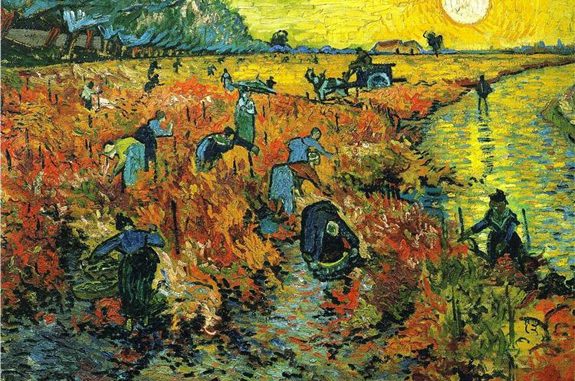
The Red Vineyard by Vincent Van Gogh, 1888

Maybe this parable seems a bit distant from us. To help us hear the story of Jesus as his original hearers heard it, I now restate the parable in a contemporary form:

Listen to another story about who is really a Christian. There was a landlord who built an upscale apartment building. The landlord spared no expense in creating apartments that were comfortable and homey. Everything he designed and built was with the care of someone who thought about what people would need and like most about a place to live. He included a host of amenities to his apartments because he really wanted the people to have as much joy living there as he did designing and building them. 

The owner put a gate around the complex so that the apartment community would be safe and secure. He hired a security firm to keep watch over the apartment complex. Then, when every detail was in place, the landlord rented out his apartments. But he didn’t just rent them out; he wanted to see the joy on the faces of the renters when he made a contract with them that included an entire year’s free rent. After that first year, when it came time for the first rent to be due, the landlord did not receive a single rent check. He was puzzled about this, so he decided to send some of his employees to collect the rent in person.

While the renters were in one of the large common lounges enjoying being together, they saw the landlord’s employees coming from a distance. So, they hatched a devious plan. Over their year of living in the beautiful apartments, they began to think they were especially special, and not like other people who lived in places that weren’t as nice as where they lived.  They gained such a twisted idea of their own importance that they believed they didn’t need to pay rent; and no one was going to tell them what to do. After all, they deserved to live where they did. They have a right to it. They don’t need to answer to anyone, including this supposed landlord who they have never seen in this last year, anyway.

Then the renters took the landlord’s employees and beat one, killed another, and took a baseball bat to a third. They took the bodies and threw them in the dumpster behind the building. Then the landlord, not wanting to evict his renters even after such a terrible experience, sent some other employees, more than the first time. But the renters had no guilt about what they had done, and did the very same thing to the second group of employees.  Even after this, the landlord was reluctant to let the law take over and decided to send his own son to collect the rent so that the renters could keep living in his apartments.

But when the renters saw the son, they said to each other. “Look! The guy sent his son. If we kill him, then we can forget about the old man and claim the whole apartment complex for ourselves.” 

After telling this story, Jesus asked all the church people listening, “When the owner of the apartment complex comes, what do you think he will do to those renters?” The crowd was into the story and replied, “He’s going to judge those ungrateful murderers, and replace the whole bunch of them with all new renters.” 

Jesus then said to them, “Have you never read in your bibles that the son who was rejected and killed has become the most important person of all? The Scriptures are all about the Son.”

“So, I am telling you that even though you have been in the Church all your life, it isn’t yours. I’m going to replace the whole lot of you with people who are humble and sensitive to sin; people who know they don’t deserve the nicest place to live in the world. If you persist in ignoring the Son, all you have to look forward to is God’s judgment.”

When all the important church people heard Jesus’ stories, they knew he was talking about them. And, even though they saw themselves in the story, they still wanted to do their own thing. They didn’t change one bit. Instead, they decided to be sneaky and try and do away with Jesus in their lives without getting in trouble. 

The kingdom of God and Christ’s Church is not an entitlement. And it does not inoculate us from God’s judgment. We must produce fruit in keeping with repentance. God is gently nudging us, like a guide dog. Will we respond in humility and turn where the Lord wants us to turn?

Who Is Jesus? (John 7:40-52)

The Light of the World, by William Holman Hunt, c.1853

On hearing his words, some of the people said, “Surely this man is the Prophet.”

Others said, “He is the Messiah.”

Still others asked, “How can the Messiah come from Galilee? Does not Scripture say that the Messiah will come from David’s descendants and from Bethlehem, the town where David lived?” Thus the people were divided because of Jesus. Some wanted to seize him, but no one laid a hand on him.

Finally the temple guards went back to the chief priests and the Pharisees, who asked them, “Why didn’t you bring him in?”

“No one ever spoke the way this man does,” the guards replied.

“You mean he has deceived you also?” the Pharisees retorted. “Have any of the rulers or of the Pharisees believed in him? No! But this mob that knows nothing of the law—there is a curse on them.”

Nicodemus, who had gone to Jesus earlier and who was one of their own number, asked, “Does our law condemn a man without first hearing him to find out what he has been doing?”

They replied, “Are you from Galilee, too? Look into it, and you will find that a prophet does not come out of Galilee.” (New International Version)

Orthodox Christian icon of Jesus Christ

There was a lot of buzz in Christ’s day of who Jesus really was. Prophet? Messiah? And, if Jesus really is a big deal, would he really come from Hicksville Nazareth? What about his credentials? His class? His pedigree?

Opinions on Jesus haven’t really changed all that much from the ancient world. They are still just as diverse now as when he was on this earth.

Unlike today, ancient people could not simply “Google” Jesus and find out where he was born and grew up. And they had no access to doing background checks in a matter of minutes to find out all kinds of things about him. Had the religious authorities bothered to do their homework and investigated Jesus, they would have found that, indeed, he was born of the Davidic line and in Bethlehem.

The short of it is that a chunk of the people simply assumed they knew Jesus wasn’t of proper Messiah credentials. They assumed and did not investigate because they did not want to know. No one can be faulted for ignorance. However, purposeful ignorance is perhaps the greatest of all sins, betraying a deep egoism of pride and prejudice.

In their hubris, the religious leaders sent the temple guards to bring Jesus in. Yet, in a clear demonstration of heavenly authority, the guards actually listened to Jesus and saw for themselves who he really is. Their simple confession testifies to Christ’s credibility. If one would but just see and listen for themselves, and engage in a genuine investigation, they could walk away finding truth.

6th-Century Byzantine mosaic of Jesus

Opponents of Jesus for the past two thousand years assume that Christians have been duped into taking the opiate of the people. Many think that followers of Christ were manipulated by religious hacks trying to gain power over others. But that’s a curious opinion, considering Jesus continually did just the opposite of that and was a champion for the poor, the powerless, and the marginalized persons of society.

When professional people with recognized degrees and competence do not believe you, nor take your own experience and learning seriously, what do you do?

Well, you could listen to them, or you could listen to your own gut telling you that you’re being gaslighted by a bunch of highly intelligent simpletons who are unfamiliar – are ignorant – of the faith you are familiar with.

What’s more, there are always smart and experienced people in the room who know better. Nicodemus was such a person. He was a serious scholar, and chose to speak up about these things. Authorities and credentials matter, yet of first importance is to know how to go about any sort of inquiry – rather than just passing over an objective investigation and assuming you know better.

Ethiopian artist depiction of Jesus teaching

For decades, I have (graciously) challenged others who do not believe in Jesus to actually read the Gospel accounts and at least engage in some minimal investigation – rather than giving opinions based on limited knowledge and secondary sources.

After all, as Nicodemus pointed out so long ago, shouldn’t we first give Jesus a fair hearing before we start dismissing him as nothing more than a religious figure that a bunch of people follow?

And I must also point out that this applies to us Christians, as well. Rather than waving aside Buddha or Muhammad or any other religious figure as false, don’t you owe their followers the basic respect of hearing them out before you dismiss them as fake, or in some cases, worse than that?

If you accuse another point of view, which is different than your own, as wrong or not real, without first hearing the accused and gathering objective evidence, then we really have no business getting uppity when another person accuses or dismisses our own faith.

Sadly, the colleagues of Nicodemus chose not to answer him but to instead engage in the age old practice of ad hominem argumentation by attacking the person, thereby deflecting having to give an answer.

People attack other people out of fear. And, in this case, it seems to me the religious leaders were downright afraid of investigating Jesus and giving him an honest hearing. Because if they did, they just might have their world turned upside-down; and they wanted the status quo to be maintained, at all costs, even if it meant ignoring the truth.

Jesus Washing the Feet of His Disciple, by Japanese artist Sadao Watanabe (1913-1996)

You don’t have to take my word on any of these things about Christ or Christianity. Read the Gospel of John for yourself – in one sitting if possible. Ingest the words. Drink in the experiences. Then, come and have a conversation with me.

Jesus, Lamb of God, have mercy on us.

Jesus, Bearer of our sins, have mercy on us.

Jesus, Redeemer of the world, give us your peace.

Jesus, Light of the world, shine in our hearts.

Jesus, Hope of all, be our companion on our way.

Jesus, Great Physician, heal our broken lives.

Jesus, Beloved Son of God, kindle within us the fire of your love. Amen.