Psalm 130

landscape photography of green mountains
Photo by Gareth Davies on Pexels.com

I cry out to you from the depths, Lord—

my Lord, listen to my voice!
    Let your ears pay close attention to my request for mercy!
If you kept track of sins, Lord—
    my Lord, who would stand a chance?
But forgiveness is with you—
    that’s why you are honored.

I hope, Lord.
My whole being hopes,
    and I wait for God’s promise.
My whole being waits for my Lord—
    more than the night watch waits for morning;
    yes, more than the night watch waits for morning!

Israel, wait for the Lord!
    Because faithful love is with the Lord;
    because great redemption is with our God!
He is the one who will redeem Israel
    from all its sin. (CEB)

Throughout church history, the book of Psalms has been used and understood as the Church’s prayer book.  Indeed, the psalms are much more than a collection of beautiful poems, words of assurance, and songs of praise – they are designed for regular and ongoing use as prayers.  And I’m not just talking about the psalms being somebody else’s prayers; they are my prayers and your prayers.

There are times when words fail us – where we find ourselves between a rock and a hard place and want to pray.  Yet, our stress and/or anxiety is so high that we can neither think straight nor form anything coherent with our mouths.  It is in such times that the psalms present themselves to us as the path forward.

What’s more, psalms are meant to be spoken out loud and more than once.  And I’m not talking about saying them with a quiet mumble or a flat monotone.  No! These precious prayers of Holy Scripture are meant to be declared with full voice and a large amount of flavor!  They are to repeatedly roll off our lips with all the emotional and spiritual gusto which resides within us!  Tears and yelling are both appropriate and encouraged.  For we do not possess merely a heady faith of thoughts and ideas; we possess a faith that is robustly heartfelt, and dwells down deep in the gut where our bowels of compassion have their abode.

Even with a cursory reading of today’s psalm, we easily observe that there’s more going on here than cognitive beliefs of faith, hope, and love.  The psalmist is expressive, clinging to faith with a patient longing for God to make good on his promises.  It is chocked full of emotion, a prayer coming from the depths of the gut.  The whole being is involved, and rightly so, because our faith affects the entirety of a person and everyone in the community of the redeemed.

If this psalm resonates with you in any way, let your proclamation of it be with the expanse of feeling inside you.  After all, as people created in the image of God, we share God’s own deep sense of love – and love is truly love when it is outwardly expressed with a sacred combination of words, actions, and feelings.

Click Psalm 130 and enjoy the psalm set to song by Keith and Kristyn Getty.

May the Lord be with you, my friends.

Matthew 9:18-34 – Faith

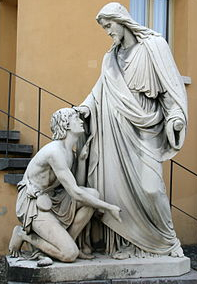
Jesus healing the blind
Jesus Healing the Blind by Johann Heinrich Stöver, 1861

As Jesus went on from there, two blind men followed him, crying loudly, “Have mercy on us, Son of David!” When he entered the house, the blind men came to him; and Jesus said to them, “Do you believe that I am able to do this?” They said to him, “Yes, Lord.” Then he touched their eyes and said, “According to your faith let it be done to you.” And their eyes were opened. Then Jesus sternly ordered them, “See that no one knows of this.” But they went away and spread the news about him throughout that district.

After they had gone away, a demoniac who was mute was brought to him. And when the demon had been cast out, the one who had been mute spoke; and the crowds were amazed and said, “Never has anything like this been seen in Israel.” But the Pharisees said, “By the ruler of the demons he casts out the demons.” (NRSV)

In these days of staring into the face of pandemic, I often find myself uttering the ancient prayer of the Church: “Lord have mercy.  Christ have mercy.  Lord have mercy and grant us your peace.”  For me, the COVID-19 virus is getting real, real fast.  I feel the heaviness of hospital staff, and of families experiencing the weight of concern for loved ones with the virus.

It is in such topsy-turvy times as these that I come back again and again to deep spiritual convictions which inform what I do each day.  One of those underlying creeds is this:

Jesus is trustworthy, no matter whether my faith or the faith of others is small or great.

In our Gospel lesson for today, two blind men were healed according to their faith in Jesus.  The diverse healing accounts of Jesus in the New Testament, whether the faith was large or small in those healed, leads me to the conclusion that:

It isn’t faith itself that heals, saves, or transforms – it is Jesus.

What the healing accounts have in common in the Gospels is that they are directed to Jesus as the object of faith.  It isn’t about the level of faith, but about where the faith is placed.  For the Christian, faith itself doesn’t mean much if it isn’t in Jesus.  If I place a large and sincere faith in an inanimate object such as money; in a position of power; or, even in my own independence, my faith isn’t worth much.  If I have a huge faith in a doctor or a psychiatrist to heal my body or my mind, I will quickly discover there are limits to their abilities.  If I have a confident faith that my family will meet all my needs, my faith will eventually run into failure when they let me down.  That’s because the ultimate object of my faith is Jesus.  If all my faith eggs are in the church basket, my faith will eventually face a crisis because it is a misplaced faith.  Furthermore, the answer I provide for others is not simply getting them to attend church or to adopt my moral code. I believe Jesus heals, transforms, and delivers people from sickness, sin, trouble, and overwhelming circumstances in his own good time.

Jesus is the same yesterday, today, and forever.  (Hebrews 13:8)

We know with certainty that circumstances change, as everyday seems to bring new levels and permutations of unprecedented alterations to our lives – and through it all, Jesus remains as the ever-present Savior, seated at the right hand of God ceaselessly interceding on behalf of those who offer even the slightest mustard seed of faith.

Almighty God, you know that we have no power in ourselves to help ourselves: Keep me both outwardly in my body and inwardly in my soul, that I may be defended from all adversities which may happen to the body, and from all evil thoughts which may assault and hurt the soul; through Jesus Christ our Lord, who lives and reigns with you and the Holy Spirit, one God, forever and ever.  Amen.

Colossians 1:9-14 – Developing the Skill of Wisdom

wisdom quote

Be assured that from the first day we heard of you, we haven’t stopped praying for you, asking God to give you wise minds and spirits attuned to his will, and so acquire a thorough understanding of the ways in which God works.

 We pray that you’ll live well for the Master, making him proud of you as you work hard in his orchard. As you learn more and more how God works, you will learn how to do your work.

 We pray that you’ll have the strength to stick it out over the long haul—not the grim strength of gritting your teeth but the glory-strength God gives. It is strength that endures the unendurable and spills over into joy, thanking the Father who makes us strong enough to take part in everything bright and beautiful that he has for us.

 God rescued us from dead-end alleys and dark dungeons. He’s set us up in the kingdom of the Son he loves so much, the Son who got us out of the pit we were in, got rid of the sins we were doomed to keep repeating. (The Message)

 When I was younger, I played a lot of ping-pong.  I got good at it.  In fact, during a several months stretch back-in-the-day I had a record of 156-2.  Not bad, Tim.  That kind of record was only possible because of the two reasons that make any skill an accomplishment: knowledge and experience.  I learned the game of ping-pong and eventually knew it inside and out; and, I had hundreds (if not thousands) of hours playing and developing my technique.

When it comes to prayer, there isn’t a need to invent a new game; we just need to learn the one we’ve got.  Today’s New Testament reading is a prayer from the Apostle Paul to the Colossian Church.  His prayer for them was singular: To have wise minds and spirits, that is, to have knowledge of God – an understanding of his ways and how he operates.

Paul prayed this for a reason: so that we might live our lives in a way which pleases God and enables us to sustain a lifetime of spiritual growth.  As people created in God’s image and likeness, we are hard-wired with a spirit which needs strengthening and exercise.  That happens as we put in the constant repetitions of connecting with the divine and putting in the time on our knees – praying daily for ourselves and others to mature in faith so that we might all together act wisely and justly in this world, for the life of the world.

A good place to start is to use Paul’s prayer as our own.  Never has there been such a need than now for us to know how to apply wisdom in places and circumstances we’ve never been before.  For wisdom to happen, we must grow in our knowledge and put in the hours of prayer.  The skill of wisdom doesn’t magically happen; it is the culmination of acquired understanding and much practice putting knowledge into loving use.

Direct me, O Lord, in all my doings with your most gracious will and wisdom.  Further in me your continual help – that in all my work and in all I do and say, I may glorify your holy name; and, by your mercy, obtain the life that is truly life; through Jesus Christ, my Lord.  Amen.

Psalm 146 – “Underdog”

d046c-underdog

Praise the Lord!
Praise the Lord, O my soul!
I will praise the Lord as long as I live;
I will sing praises to my God all my life long.

Do not put your trust in princes,
in mortals, in whom there is no help.
When their breath departs, they return to the earth;
on that very day their plans perish.

Happy are those whose help is the God of Jacob,
whose hope is in the Lord their God,
who made heaven and earth,
the sea, and all that is in them;
who keeps faith forever;
     who executes justice for the oppressed;
who gives food to the hungry.

The Lord sets the prisoners free;
the Lord opens the eyes of the blind.
The Lord lifts up those who are bowed down;
the Lord loves the righteous.
The Lord watches over the strangers;
he upholds the orphan and the widow,
but the way of the wicked he brings to ruin.

The Lord will reign forever,
your God, O Zion, for all generations.
Praise the Lord! (NRSV)

I admit that I am a classic cartoon connoisseur.  I was told when I was a kid that I would outgrow watching them – I’m still waiting for that day.  One of the cartoons I enjoyed (and still do!) watching is “Underdog.”  There is something deep within the human psyche that cheers for the underdog.  Wally Cox was the perfect voice for the mild-mannered shoe-shine boy to take his underdog super energy pill and fly through the sky to rescue Sweet Polly Purebread.

That “something” within us which identifies with the underdog is the justice of God.  It is important to understand that when the term “justice” is used, it isn’t meant primarily in punitive terms, as we might typically think of it.  Justice is providing people with what they need to survive, thrive, and flourish in life.  Withholding things from individuals or groups of people, or folks not possessing the things they need to function as humans in this world is an “injustice.”

Today’s psalm from the Revised Common Lectionary lets us know that God cares about the underdog – the one for whom may be lacking in basic material and spiritual provisions for living.  There ought to be no doubt that God is deeply concerned for those who are powerless, defenseless, and on the margins of society.  The psalmist identifies such persons: those who are hungry; the prisoners; the blind; those bowed down; the orphan; and, the widow.  All these people represent individuals without the ability to be movers and shakers in their society.  In short, they need God; they deserve justice.

And God delights to use his power to champion them and lift them up.  What is more, truth be told, it turns out that all of us are underdogs.  We all need God.  We all are meant to both receive and provide justice.  Every altruistic decision we make and just action we take is really God’s gracious empowerment to do it.  We owe it all to God.  Thus, the logical and reasonable response to such a God is praise – to declare our hallelujahs to the One who reigns forever and always sees humanity’s great need.  How will you praise God today for who he is and for what he has done?  Let such praise shape your soul and lift your spirit as you intentionally connect with the merciful God who gives the underdog what they need.

Eternal God, you reign forever and ever.  I praise you for as long as I live.  I put my trust in you, and not in those in who wield their apparent power and influence for personal gain.  Let them wallow in their delusions while I declare the mighty Name of Jesus Christ.  Amen.