1 Peter 4:1-8 – Holy Saturday

Empty Tomb

Christ suffered here on earth. Now you must be ready to suffer as he did, because suffering shows that you have stopped sinning. It means you have turned from your own desires and want to obey God for the rest of your life. You have already lived long enough like people who don’t know God. You were immoral and followed your evil desires. You went around drinking and partying and carrying on. In fact, you even worshiped disgusting idols. Now your former friends wonder why you have stopped running around with them, and they curse you for it. But they will have to answer to God, who judges the living and the dead. The good news has even been preached to the dead, so that after they have been judged for what they have done in this life, their spirits will live with God.  Everything will soon come to an end. So be serious and be sensible enough to pray.  Most important of all, you must sincerely love each other, because love wipes away many sins. (CEV)

I haven’t been a confessing Christian my entire life.  I can relate to Peter’s exhortation.  I still remember what it feels like to live my life without any thought to God or spiritual matters.  The thing about partying and immorality is that it’s a life filled with constant movement.  Slowing down only makes one come face-to-face with what is truly inside the soul.  And if someone has an empty vacuous soul, or a damaged spirit, or a broken heart, then attempting to drink or work away the inner pain makes sense when there’s no regard for God.  The last thing I ever wanted to do was suffer, yet before my own spiritual awakening it seemed I could never outrun the hurt no matter how hard I tried, even with all the constant locomotion.

Today is Holy Saturday – a quiet place sandwiched between the ignominy of the cross and the celebration of resurrection – a day of solitude, silence, and stillness.  This is something of a lost day for many folks.  In fact, many Christians haven’t had a thought that Holy Saturday could have any significance.  Yet, this very day has its place in the scheme of the Christian life.

There cannot be resurrection and new life without a death and dying to self.  There must be suffering before there can be glory.  Whenever Christians quickly jump to triumphal language about victory and speak little-to-nothing about suffering, then we are left with a cheap grace which has been purchased with the counterfeit currency of velocity.

Today is meant for us to get out of our heads and wrap our hearts around the important reality that Jesus Christ was in the grave.  It was real suffering on Good Friday, and it is a real death on Holy Saturday.  There is no movement.  All is silent and still.  Jesus is in the solitude of a dark tomb.  There’s no getting around it.  If we want a Resurrection Day with all its celebration and glory, then we cannot circumvent Holy Saturday.

To put this in the spirit of the Apostle Peter: Are we ready to follow Jesus and suffer as he did?  Are we willing to stop our striving, manifested through constant movement, and embrace the Holy Saturday of solitude, silence, stillness with its contemplation and embrace of suffering?  Will you and I have sense enough to pray?  Will we practice a Christian counter-cultural shift and face the ridicule of friends so that we might take some much-needed time to be with Jesus in the tomb?  Or, are we so antsy and anxious that we just want to leap into Easter with no solidarity with our Lord in the grave?

You may think I’m being a bit too hard or harsh or cold…. That’s because Jesus is cold.  He has a bona fide cold dead body.  It’s no fake death.  There’s no “swoon theory” here, as if Christ only passed-out and did a weird divine fainting spell.  Nope.  He’s dead.  And if you and I want to live with Jesus, we must die with Jesus.

Anyone who tries to promise a new life apart from journeying with Jesus into the grave is a spiritual charlatan.  Only through death can there be life.

On this Holy Saturday, let’s intentionally slow down, do less, give ourselves a large chunk of unstructured time, and put aside routine matters.  Fill the time with unfettered access to God in Christ.  Slowly read the Gospel accounts of Christ’s death and burial.  Read the book of 1 Peter.  Allow prayers to arise from the careful and mindful reading of Scripture.  Feel the solidarity with Jesus, journey with him along the way from life to death… so that there might be a truly glorious resurrection filled with abundant life and flourishing – a life that doesn’t need hedonism and workaholism to feel happy and significant.

May you die well so that you might live well.

Precious Lord Jesus, today all is silent.  You died a horrific death and gave incredible mercy from your wounded heart.  Now you rest in the tomb as the soldiers keep vigil.  I also keep vigil, although in a very different way.  I know this day doesn’t last forever; there is tremendous glory coming.  Yet, for now I sit quietly mourning your death.  Assist me, God Almighty, to enter the sorrow and the silence of this Holy Saturday.  Today, help me to wait patiently and to sit with this constellation of emotions swirling around my heart.  As I keep this sacred vigil, fill me with hope – not only looking forward to the celebration of your Resurrection – yet also to anticipate the hope of my own share in the new life you offer, as you lay lifeless and still.  May your rest transform the brokenness of my own soul, my weaknesses, and my sin.  I express my trust, O my Father God, in your mighty power to do all things through Jesus Christ, my Lord, your beloved Son, who lives and reigns with you and the Holy Spirit, one God, now and forever.  Amen.

And all is silent….

Isaiah 52:13-53:12 – Good Friday

CrossChrist
Depiction of Christ on the Cross at Holy Hill in Hubertus, Wisconsin

The Lord says, “See, my servant will act wisely.
People will greatly honor and respect him.
Many people were shocked when they saw him.
His appearance was so damaged he did not look like a man;
his form was so changed they could barely tell he was human.
But now he will surprise many nations.
Kings will be amazed and shut their mouths.
They will see things they had not been told about him,
and they will understand things they had not heard.”

Who would have believed what we heard?
Who saw the Lord’s power in this?
He grew up like a small plant before the Lord,
like a root growing in a dry land.
He had no special beauty or form to make us notice him;
there was nothing in his appearance to make us desire him.
He was hated and rejected by people.
He had much pain and suffering.
People would not even look at him.
He was hated, and we didn’t even notice him.

But he took our suffering on him
and felt our pain for us.
We saw his suffering
and thought God was punishing him.
But he was wounded for the wrong we did;
he was crushed for the evil we did.
The punishment, which made us well, was given to him,
and we are healed because of his wounds.
We all have wandered away like sheep;
each of us has gone his own way.
But the Lord has put on him the punishment
for all the evil we have done.

He was beaten down and punished,
but he didn’t say a word.
He was like a lamb being led to be killed.
He was quiet, as a sheep is quiet while its wool is being cut;
he never opened his mouth.
Men took him away roughly and unfairly.
He died without children to continue his family.
He was put to death;
he was punished for the sins of my people.
He was buried with wicked men,
and he died with the rich.
He had done nothing wrong,
and he had never lied.

But it was the Lord who decided
to crush him and make him suffer.
The Lord made his life a penalty offering,
but he will still see his descendants and live a long life.
He will complete the things the Lord wants him to do.
“After his soul suffers many things,
he will see life and be satisfied.
My good servant will make many people right with God;
he will carry away their sins.
For this reason I will make him a great man among people,
and he will share in all things with those who are strong.
He willingly gave his life
and was treated like a criminal.
But he carried away the sins of many people
and asked forgiveness for those who sinned.” (NCV)

We all suffer.  In some way, whether a chronic physical condition, emotional or moral distress, mental illness, or spiritual oppression, everyone faces living in a fallen world with its pain and heartache.  Presently, the entire world is suffering the scourge of the COVID-19 virus.  Every person in my neighborhood, city, state, and nation is impacted and affected.  Not only do many suffer because of disease and death itself, all are enduring either lost wages, limitations, loneliness or more.  Suffering that seems to have no reason, the senseless kind, the type where nothing good appears to be going on at all can be very troubling to our souls.

Perhaps it seems ironic, maybe even cruel, that Christians would observe a day called “Good” Friday.  Considering the hard circumstances of so many people, to call today “good” appears awkward, as if Christ’s followers have their heads in the sand.  Even for Christians, at first glance, “Good Friday” might seem a oxymoronic for a day observing the torture and death of an innocent man.  Some would argue that Christ is no longer on the cross and we need to give all our focus on the resurrected Jesus and the victory he achieved.  No need for all this suffering stuff.  Yet, the Resurrection only has meaning because of this very day, Good Friday.  Without the Suffering Servant of Isaiah, there is no King Jesus.  For Christians everywhere, this day is very good in the sense that the crucifixion of Jesus Christ means the redemption of the world.  On this day we remember and commemorate the events that led up to the cross; unpack those events and interpret them with profound meaning and significance; and, worship Jesus with heartfelt gratitude because of his redeeming work of the cross.

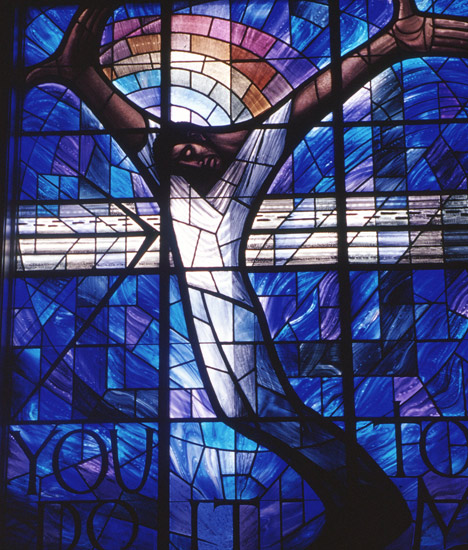
16th St Baptist Church Crucifixion Stained Glass Window
This stained-glass window was donated to the Sixteenth Street Baptist Church of Birmingham, Alabama by the people of Wales after the church was bombed in 1963.

The bulk of the New Testament Gospels of Matthew, Mark, Luke, and John are given over to the final week of Christ’s life, especially leading to the cross.  Good Friday observances often take a somber form due to the brevity of Christ’s experience on the cross.  Christians remember the last words of Christ, and recognize the significant impact his death had on the immediate persons around him.  Believers also contemplate the lasting results of that singular death as an atoning sacrifice; perfect love; reconciliation between God and humanity; victory over evil; and, redeeming all creation.

Sadness, then, is far from the only emotive expression on this day.  It is appropriate to feel wonder, gratitude, and deep satisfaction for the accomplishment of deliverance from the power of sin.  There is the recognition that something profound and meaningful has truly happened in the egregious suffering of Jesus.  Thus, we not only remember the anguish of Christ, but what that horrible torment accomplished.  In fact, the cross of Jesus is so significant that an eternity of considering its import and impact could never plumb the depths of its far-reaching effects.

With all that has been said, one would think that Good Friday is a hugely observed day on the Christian Calendar.  Yet, for a chunk of churches and Christians, it’s not.  The bottom line is that the cross is not popular.  Maybe it’s because neither Christian nor non-Christian wants to ponder something that appears so icky and bloody.

Episcopal priest Fleming Rutledge has adroitly put her finger on the issue: “Religious people want visionary experiences and spiritual uplift; secular people want proofs, arguments, demonstrations, philosophy, and science.  The striking fact is that neither one of these groups wants to hear about the cross.”  Indeed, as the Apostle Paul has said, the cross of Christ is “a stumbling block to Jews and folly to Gentiles” (1 Corinthians 1:23).

A personalized religion which leaves the cross out of the picture (too much blood and violence) might seem appealing yet will only leave us bereft of the communion of the saints both past and present.  Consider the ancient witness of the Church:

“I believe in Jesus Christ, his only Son, our Lord… he suffered under Pontius Pilate, was crucified, died, and was buried; he descended to hell.” –Apostles’ Creed

“For our sake he [Christ] was crucified under Pontius Pilate; he suffered death and was buried.” –Nicene Creed

Christ suffered “in both body and soul – in such a way that when he sensed the horrible punishment required by our sins ‘his sweat became like great drops of blood falling down on the ground.’  He cried, ‘My God, my God, why have you forsaken me?’  And he endured all this for the forgiveness of our sins.  Therefore, we rightly say with the Apostle Paul that we know nothing ‘except Jesus Christ, and him crucified;’ we ‘regard everything as loss because of the surpassing value of knowing Christ Jesus our Lord.’ We find all comforts in his wounds and have no need to seek or invent any other means than this one and only sacrifice, once made, which renders believers perfect forever.” –Belgic Confession, Article 21

And let us consider further the New Testament witness:

“Jesus suffered outside the gate in order to sanctify the people through his own blood.  Therefore, let us go forth to him outside the camp, and bear the abuse he endured.” (Hebrews 13:12-13, NIV)

“May I never boast of anything except the cross of our Lord Jesus Christ, by which the world has been crucified to me, and I to the world.” (Galatians 6:14, NRSV)

6a7f0-thecross

The extent of Good Friday goes far beyond just a day on the calendar; it is the fulcrum upon which all of Christianity hinges.  Because Christ suffered, our suffering has meaning.  Each situation of trauma; every case of disease; all adversity and wholesale hard circumstances make sense, in the Christian tradition, when they are viewed in solidarity with Jesus Christ crucified. So, today, let Christians everywhere contemplate the cross, observe the salvation accomplished through Christ’s death, and offer prayers and petitions for those who need deliverance from the power of evil.  In short, let us worship God in Jesus Christ because of the suffering on the cross.

Along with all believers everywhere we pray:

Jesus, Lamb of God, have mercy on us.

Jesus, Bearer of our sins, have mercy on us.

Jesus, Redeemer of the world, grant us your peace.  Amen.

Click Were You There performed by The Vigil Project as we station ourselves near the cross.

John 13:1-17, 31-35 – Maundy Thursday

Ethiopian Jesus washing feet
Ethiopian Orthodox Church icon of Jesus washing the disciples’ feet

It was before Passover, and Jesus knew that the time had come for him to leave this world and to return to the Father. He had always loved his followers in this world, and he loved them to the very end.

Even before the evening meal started, the devil had made Judas, the son of Simon Iscariot, decide to betray Jesus.

Jesus knew that he had come from God and would go back to God. He also knew that the Father had given him complete power. So, during the meal Jesus got up, removed his outer garment, and wrapped a towel around his waist.  He put some water into a large bowl. Then he began washing his disciples’ feet and drying them with the towel he was wearing.

But when he came to Simon Peter, that disciple asked, “Lord, are you going to wash my feet?”

Jesus answered, “You don’t really know what I am doing, but later you will understand.”

“You will never wash my feet!” Peter replied.

“If I don’t wash you,” Jesus told him, “you don’t really belong to me.”

Peter said, “Lord, don’t wash just my feet. Wash my hands and my head.”

Jesus answered, “People who have bathed and are clean all over need to wash just their feet. And you, my disciples, are clean, except for one of you.” Jesus knew who would betray him. That is why he said, “except for one of you.”

After Jesus had washed his disciples’ feet and had put his outer garment back on, he sat down again. Then he said:

Do you understand what I have done? You call me your teacher and Lord, and you should, because that is who I am. And if your Lord and teacher has washed your feet, you should do the same for each other. I have set the example, and you should do for each other exactly what I have done for you. I tell you for certain that servants are not greater than their master, and messengers are not greater than the one who sent them. You know these things, and God will bless you, if you do them….

Now the Son of Man will be given glory, and he will bring glory to God. Then, after God is given glory because of him, God will bring glory to him, and God will do it very soon.

My children, I will be with you for a little while longer. Then you will look for me, but you won’t find me. I tell you just as I told the people, “You cannot go where I am going.” But I am giving you a new command. You must love each other, just as I have loved you. If you love each other, everyone will know that you are my disciples. (CEV)

Love.  We need it.  Without love, relationships devolve into silent standoffs and destructive triangles. The world ceases to spin on its axis.  With love, however, all things are beautiful; personal relations have meaning and joy; and, all seems right and just in the world.

Yet, love comes with a cost.  Because we live in a broken world filled with pride and hubris, greed and avarice, hate and envy, we are victims of loveless and faceless systems doing unjust actions.  We need love to rescue us, to redeem us from the sheer muck of such an existence.  It’s as if we are constantly walking knee deep through sludge so thick we can barely get anywhere.  We need saving.  We need Jesus.

Christians everywhere around the world are journeying through Holy Week, the most sacred time of the year for followers of Christ.  When we think about Holy Week, we are familiar with Good Friday and certainly Easter; but Maundy Thursday?

On this day the church remembers the last evening that Jesus shared with his disciples in the upper room before his arrest and crucifixion.  The experiences in the upper room were highly significant because this was the last teaching, modeling, and instruction Jesus gave before facing the cross.  Jesus was careful and deliberate to communicate exactly what was important to him: to love one another.

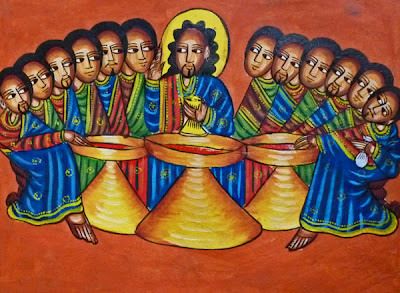
Ethiopian Jesus Last Supper
Ethiopian Orthodox Church icon of the Last Supper

Maundy Thursday marks three important events in Christ’s Last Supper with his disciples:

  • The washing of the disciples’ feet (the action of loving service)
  • The instituting of the Lord’s Supper (the remembrance of loving sacrifice)
  • The giving of a “new” commandment to love one another (the mandate of a loving system).

For Jesus, the last night with his disciples was all about love, God’s love.  On that fateful night, having loved his disciples for the past three years, Jesus showed them the full extent of his love by taking the posture of a servant and washing each and every one of the disciples’ feet, including Judas.  After demonstrating for them a totally humble service, Jesus said,

“I have set you an example that you should do as I have done for you.”  Jesus Christ loves me just as I am, and not as I should be.

He loves me even with my dirty stinky feet, my herky-jerky commitment to him, and my pre-meditated sin.

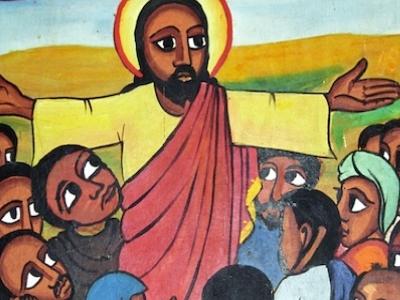
Ethiopian Jesus
Ethiopian artist depiction of Jesus teaching

Not only did Jesus wash the disciples’ feet; he also lifted the cup of wine and boldly asserted:

“Take this and divide it among you.  For I tell you I will not drink again of the fruit of the vine until the kingdom of God comes.”  And he took the bread, gave thanks and broke it, and gave it to them, saying, “This is my body given for you, do this in remembrance of me.”  In the same way, after the supper he took the cup saying, “This cup is the new covenant in my blood, which is poured out for you” (Luke 22:17-20, NIV). 

Because of these words from Jesus, the church throughout the world, for two millennia, have practiced this communion, this supper so that we might have the redemptive events of Jesus pressed firmly into both our minds and our hearts by means of the visceral and common elements of bread and wine.  We are to not just know about Jesus – we are to experience being united with him.

Having washed the disciples’ feet, and proclaimed to them the meaning of his impending death, Jesus gave them a clear commandment:

“A new command I give you: Love one another. As I have loved you, so you must love one another.  By this everyone will know that you are my disciples, if you love one another.”

Love one another, insisted Jesus, through imitation of his humble service.  We represent Christ on this earth when we carefully, diligently, and persistently practice love.  Although love was by no means a new concept for the disciples, in the form and teaching of Jesus love was shown with four distinctions:

  1. Jesus is the new model of love
  2. A new motive of love, that Christ first loved me
  3. A new motivator to help us love, the Holy Spirit
  4. A new mission, the evangelization of the world, utilizing the power of Christ’s love to accomplish it

Maundy Thursday is a highly significant day on the Church Calendar – one which deserves to be observed, and an opportunity to remember the important words and actions of Jesus on our behalf.  Through Jesus Christ we are to live always in love, modeling our life and church ministry after him.

In Christ we are to allow love to characterize our life together as we proclaim God’s love in words and deeds.  A watching world will only take notice and desire to be a part of our fellowship if we are deeply and profoundly centered in the love of God in Christ.  This is the reality that Maundy Thursday brings to us.

God of love, you have given us a new command to love each other.  Help us to show that love in our care of creation, to all nations and ethnic peoples, in our communities and neighborhoods, through the Church everywhere, and with the persons closet to us and their needs.  In all our thoughts, words, and actions may we be your servants and reflect your love; through our loving Savior, Jesus Christ, your Son, who lives and reigns with you and the Holy Spirit, one God, now and forever.  Amen.

To continue our remembrance of Christ’s loving service, click As I Have Done For You written by Dan Schutte.

Hebrews 12:1-3 – Wednesday of Holy Week

“If there is a meaning in life at all, then there must be a meaning in suffering. Suffering is an ineradicable part of life, even as fate and death. Without suffering and death, human life cannot be complete.” –Man’s Search for Meaning by Viktor Frankl

842b0-crucifixion

Therefore, since we are surrounded by such a great cloud of witnesses, let us throw off everything that hinders and the sin that so easily entangles. And let us run with perseverance the race marked out for us, fixing our eyes on Jesus, the pioneer and perfecter of faith. For the joy set before him he endured the cross, scorning its shame, and sat down at the right hand of the throne of God. Consider him who endured such opposition from sinners, so that you will not grow weary and lose heart. (NIV)

We are moving inexorably to the cross of Christ.  Along the way we face opposition, ridicule, misunderstanding, and betrayal.  And, yet, today’s New Testament reading informs us that this is initiated, motivated, and animated because of joy.  The path leading to the cross and the cross of Christ itself was painful in every sense of the word.  This doesn’t sound joyful at all.  There’s no definition in any dictionary which includes  suffering and shame with the word joy.

Jesus did not relish in being hurt by others because pain with no purpose is nothing but tragic despair.  Rather, Jesus clearly understood what the end of his suffering would accomplish: the saving of many lives.

Trying to make sense of this great sacrifice on our behalf can be mind-blowing.  No earthly illustration or word-picture can begin to adequately capture the idea.  Yet, maybe we can understand focusing the necessary discipline, effort, endurance, and pain in order to accomplish a goal.  In other words, the most significant and important goals of our lives require a great deal of blood, sweat, and tears to realize.  In a former life I was a cross country runner (back far enough for Sherman to set the way-back machine).  When I was running on a road or a golf course, I would sometimes get that very nasty and sharp pain in my side while running.  It is called a side cramp, or side stitch.  If you have never experienced it, the pain feels like an intense stabbing, as if someone were taking a knife and twisting it inside you.  Runners know there’s only one thing to do when this occurs: Keep running through the pain and it will subside in a few minutes.  To stop running only exacerbates and prolongs the hurt, not to mention losing a race.

Jesus endured the cross knowing he was going to experience terrible excruciating pain.  He also knew that not facing the shame of it and avoiding the agony would only make things worse; it wouldn’t take care of the problem of sin.  Jesus persevered through the foulness and degradation of the cross for you and me.  The pain was worth it to him.  Christ did not circumvent the cross; he embraced it so that the result would be people’s deliverance from death and hell.  The end game of his redemptive work was joy over deposing the ruler of this dark world and obliterating obstacles to people’s faith.

Suffering often does not fit into our equation of the Christian life; and, yet, it needs to.  Since Jesus bled and died for us, it is our privilege to follow him along the way of suffering.  Holy Week is a time to reflect and remember on such a great sacrifice, and to consider our Christian lives in the face of such great love.

Gracious Lord Jesus, I give you eternal thanks for your mercy toward me through the cross.  It is a small thing for me to follow you even it means great suffering on my part.  My life is yours.  Use it as you will, through the power of the Holy Spirit.  Amen.

Click There Is A Redeemer by Crossings Worship to continue the contemplation on the redemptive events of Jesus.