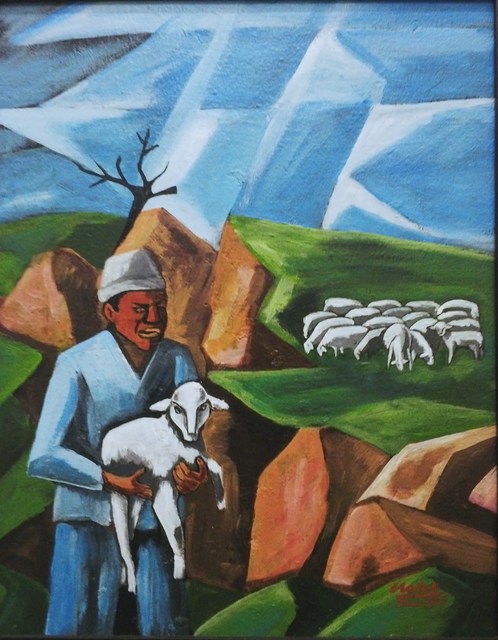
Luke 15:1-7 – One Lost Sheep

The Shepherd and the Lost Sheep
“The Shepherd and the Lost Sheep.” By Peter Clarke, 1969

A lot of men and women of doubtful reputation were hanging around Jesus, listening intently. The Pharisees and religion scholars were not pleased, not at all pleased. They grumbled, “He takes in sinners and eats meals with them, treating them like old friends.” Their complaining triggered this story:

“Suppose one of you had a hundred sheep and lost one. Wouldn’t you leave the ninety-nine in the wilderness and go after the lost one until you found it? When found, you can be sure you would put it across your shoulders, rejoicing, and when you got home call in your friends and neighbors, saying, ‘Celebrate with me! I’ve found my lost sheep!’ Count on it—there’s more joy in heaven over one sinner’s rescued life than over ninety-nine good people in no need of rescue. (MSG)

Lost people matter to God.  They matter so much to him that one lost soul found is the grounds for a big celestial party.  Please note this simple observation of today’s Gospel reading: If there is rejoicing in the presence of angels in heaven over one sinner who repents, then who is doing the rejoicing?  God!  God himself is crazy giddy with joy over one lost person being found.

Celebration is an important activity for the Christian. God throws the best parties, filled with plenty of joy and recognition of persons restored to fellowship. As people created in the image and likeness of God, we are hardwired for celebration. If God can go uncorked with joy and celebration, I’m going to say with confidence that open unabashed blowouts rejoicing over people’s transformation and new life is welcome and expected. Folks baptized in pickle juice can join the grumbling of all the high mucky-muck dudes who smugly look down on the marginal persons among us. Hopefully, the party-poopers won’t be heard because of all the noise at God’s party.

This parable of Jesus is meant to give us a glimpse of God’s own heart.  He would do anything to find a lost person, to restore and reconcile a person back to himself.  God would go dumpster diving and wade through the stinky nasty garbage to find that one lost valuable person.

Why should reaching out to marginal people with the grace and love of Jesus Christ be a high priority?  Because restoring lost people is a high priority for God.  God has placed the highest of priorities on recovering those who are spiritually lost and wandering around life without a purpose or a place to call home. Such people matter so much to him that God sent his Son, the Lord Jesus, to this earth.  Jesus went to the greatest lengths possible through enduring a cruel death on a cross in order to reconcile a broken lost relationship between people and God.

I can still remember what it felt like to be separated from God and estranged from the church – it was lonely and sad, like being in a deep black hole with no way of getting out and no one around to help.  But God, in his great mercy, sent spiritual commandos to extract me from my captivity of the soul. So, my greatest desire is to live my life basking in the grace shown to me, grateful for new mercies which come every day, and giving that same grace to others – especially those considered as the lost, the least, and the lonely in society.

In leaving the ninety-nine and going after the one sheep, God gave preferential attention to the lost. So, because of this, I ask a sincere and probing question which I believe needs to be asked:  Can you live with that?  My own answer is: “I sure can, because I was once that lone lost sheep!”

Jesus, you are the Good Shepherd.  Thank you for going after me when I was lost.  Help me to remember that you will often leave my pasture to go after others. I’ll be willing and happy to go with you when you do. Let’s also take the Spirit with us.  Amen.

Click Compassion Hymn by Keith and Kristyn Getty to remember the lengths of love God went to in restoring us.


Psalm 23 – Trust and Rest

Rest

In this sacred season of Eastertide on the Church Calendar, Christians deliberately spotlight on what new life is and how it can bring transformation from fearing adversity to believing God through the adversity; from wondering where the heck my needs are going to be met to trusting in God’s willingness to provide; from worrying about the future to resting in the present.  Psalm 23 is just the right message for both the season and our world circumstances of pandemic and hardship.

Because of the psalm’s familiarity, some might only associate it with funerals and miss its relevance for the here-and-now. That would be quite unfortunate because this is a beautiful poem of trust which is prescient for us to face the vicissitudes of faith and life on this earth and be able to rest in the field of God’s benevolent kingdom.

Therefore, I am offering here my contemporary version of this most famous of psalms for the Church:

Jesus is my Pastor, and I lack absolutely nothing because of it.

My merciful overseer is watching me while I rest secure on a nice soft bed of grace;

             he leads me into an unhurried life; he is thawing out my cold anxious soul.

He leads me in all the right ways for the sake of his great name.

Even though I get lost and find myself in a dark alley,

             I really have no fear of evil;

for I know God is with me,

             his Word and Sacrament – they are more than sufficient to comfort me.

I have a big ol’ appetite and hunger for you, God,

             and you satisfy it,

             even though I have enemies within arm’s length;

you encourage my mind with joyous thoughts,

             so that my heart overflows with hope.

I am quite sure that goodness and mercy will follow me for a lifetime,

             and I will live in peace despite any adverse circumstances my whole life long. Amen.

Click The Lord’s My Shepherd by Stuart Townsend as we find rest for our souls.

1 Peter 2:9-12 – Chosen by God

ChosenByGod

You are chosen people, a royal priesthood, a holy nation, people who belong to God. You were chosen to tell about the excellent qualities of God, who called you out of darkness into his marvelous light. Once you were not God’s people, but now you are. Once you were not shown mercy, but now you have been shown mercy.

Dear friends, since you are foreigners and temporary residents in the world, I’m encouraging you to keep away from the desires of your corrupt nature. These desires constantly attack you. Live decent lives among unbelievers. Then, although they ridicule you as if you were doing wrong while they are watching you do good things, they will praise God on the day he comes to help you. (GW)

The Apostle Peter wrote his letter to a group of believers struggling in the middle of suffering. He sought to encourage them with who they are in Christ, as well as exhort them to not go back to old ways of dealing with hard circumstances. And this is darned good instruction for us, as well, when we feel beat down in tough situations:

Remember who you are and to whom you belong; and, let that new identity, not the old one, determine how you will respond and what choices you will make when the going gets rough.

We are chosen people (Greek ἐκλεκτόν which is literally “elected”). We have royal blood. We belong to God – called by him and set apart for a life of proclaiming his great mercy. Peter simply encouraged and exhorted with the very same mercy he himself had been shown. Peter was chosen by Jesus despite his credentials. He had no formal training and was impulsive, random, headstrong, and likely had some first-century version of adult attention deficit disorder. Yet, Jesus elected him because God’s choice always nullifies human pride and ingenuity.

God chooses people for deliverance from sin, chooses to bestow royalty upon them, and chooses them as his own to be his ambassadors to the world. God’s choice of us is not based on our ability, but on God’s call and the Spirit’s presence and power working in and through us so that we might not boast in anything but the cross.

These chosen people Peter addressed were not full citizens. They were considered as foreigners by the Roman Empire in which they lived. The believers had limited rights in a Roman society which valued wealth, power, status, prestige, and pedigree. The Christians, along with Peter, had none of this privilege. Peter was letting them know that they have a status as God’s chosen people, distinct from the values of their surrounding culture.

The Christians were equipped for royal greatness through being set apart for Christ, with the Spirit of God to help make them holy in an unholy society.

It is from this firm standing and status of belonging to God and having their identity in Jesus Christ that the struggling believers could, then, firmly resist turning to the dark side. A strong sense of place and purpose is what helps us all to live decent lives, even when those who misunderstand and mistreat seem to be having the day over us. More than once in my own life I have been ridiculed and mocked only years later to have those very same persons say, “I noticed how you responded and watched how you handled situations and it made a deep impression on me.” Indeed, they went from parody to praise because of the mercy of God.

We are encouraged by Peter to take the long view of our circumstances. The Scriptures invite us to a more expansive view of our lives, a bigger picture of those around us, and a broader perspective of our society as a royal priesthood of believers. Any old fool can criticize others from afar, play armchair quarterback about things they know nothing about, and expect everyone else to bend to their way of thinking. It is, however, the wise person, instructed through deep suffering, who chooses to walk in the way of mercy, day after day, week after week, year after year, even though the pain is persistent and relentless. Such persons belong to God and have no need to rely on unmerciful and corrupt practices to live a full and satisfying life.

Sovereign God, thank you that you accept us as we are: vulnerable, flawed and in need of love. Feed us and fill us with the certainty of your love, the power of your Spirit, and the joy of your Kingdom as we open ourselves to your choice and your call upon us. Because you have chosen us, we declare your glory to the world. We no longer walk in the uncertainty of the darkness but in the certainty of your glorious light through Jesus Christ our Lord. Amen.

Click Who You Say I Am by Hillsong Worship as together we seek to live in the light of our glorious identity.

John 21:1-14 – Breakfast in the Liminal Space

BreakfastAtDawn MikeMoyers
“Breakfast at Dawn” by Mike Moyers

Later, Jesus himself appeared again to his disciples at the Sea of Tiberias. This is how it happened: Simon Peter, Thomas (called Didymus), Nathanael from Cana in Galilee, Zebedee’s sons, and two other disciples were together. Simon Peter told them, “I’m going fishing.”

They said, “We’ll go with you.” They set out in a boat, but throughout the night they caught nothing. Early in the morning, Jesus stood on the shore, but the disciples didn’t realize it was Jesus.

Jesus called to them, “Children, have you caught anything to eat?”

They answered him, “No.”

He said, “Cast your net on the right side of the boat and you will find some.”

So, they did, and there were so many fish that they couldn’t haul in the net. Then the disciple whom Jesus loved said to Peter, “It’s the Lord!” When Simon Peter heard it was the Lord, he wrapped his coat around himself (for he was naked) and jumped into the water. The other disciples followed in the boat, dragging the net full of fish, for they weren’t far from shore, only about one hundred yards.

When they landed, they saw a fire there, with fish on it, and some bread. Jesus said to them, “Bring some of the fish that you’ve just caught.” Simon Peter got up and pulled the net to shore. It was full of large fish, one hundred fifty-three of them. Yet the net hadn’t torn, even with so many fish. Jesus said to them, “Come and have breakfast.” None of the disciples could bring themselves to ask him, “Who are you?” They knew it was the Lord. Jesus came, took the bread, and gave it to them. He did the same with the fish. This was now the third time Jesus appeared to his disciples after he was raised from the dead. (CEB)

Sometimes, maybe oftentimes, it takes a bit of time to wrap our heads and our hearts around a new reality. After all, if you’ve been used to operating a particular way for a long time, it can be hard to come around to embracing difference – even if that change is really good.

Good ol’ Peter, you’ve got to love him. Bless his heart, the Lord Jesus is risen from death and he, along with some of the other disciple fishermen, are not quite up to speed on resurrection. Christ is alive, the disciples have already seen him on two separate occasions, yet they seem like a dog who has chased a rabbit and now don’t know what to do with it once they’ve surprisingly gotten it.

So, Peter goes fishing. Yep, when all else seems upside-down and topsy-turvy, just go fishing. The problem is: Peter and the boys are going back to a life that doesn’t exist anymore. And that’s pretty much what we all tend to do when we are stuck in a liminal space, caught in a situation of uncertainty without much of a clue what to do. We simply go back to what we’ve always done and hope we catch some fish.

But we can’t catch fish. It isn’t the same anymore. The resurrection of Jesus has completely upended the world. There’s no going back to any sort of pre-resurrection days. All has changed. I’m not sure if the disciples believed they were going to catch any fish, or not. Seems they just had to go do something familiar.

Unknown to them, the rules changed. The old way of fishing won’t work. While they’re off trying to live from the old life, Jesus shows up on shore. The disciples don’t realize its him. So, they don’t anticipate that when Jesus calls out and encourages them that they’ll end up with a nice haul of fish. While the old life yields nothing, the new life with Christ brings abundance, blessing, and fellowship. After the big catch of fish, here are the disciples now eating breakfast with the King of Kings, yet they’re still scratching their heads. What’s going on? Who is it? Well, of course, it’s Jesus, but is it? What’s the plan? I’m so confused.

In the passage and the journey from one reality to another, from a place of familiarity to a place of a future we’ve never seen, from an old life to a new life, there is both the shadow of doubt which makes everything feel so uncertain and the confidence of faith which keeps us going forward. In this middle space there is a continual vacillating between doubt and faith. Rarely is there ever a black-and-white existence. No, instead its wise to become friends with the gray because most lessons we learn come while inhabiting this weird in-between space.

When the disciples encountered Jesus in today’s Gospel story, it was an experience of Jesus in the middle – a six-week time between resurrection and ascension. It was also an experience of the disciples in the middle. There was no going back to a pre-resurrection time of walking and talking with Jesus as they had done before. And there is also no future where they can live in the past or pick up the fishing business just like before.

Although we have the advantage of knowing how the story shakes-out with Christ’s ascension, the giving of the Spirit, and a robustly bold group of disciples going out to change the world – the disciples cannot picture that future in their liminal space on the beach.

We, too, inhabit a middle space. We are in-between the two advents of Christ. This truly is an awkward time in which we, along with disciples, experience a mix of belief and doubt because we aren’t at the end of the story. So, a combination of worship and wondering exists in the here-and-now. Jesus doesn’t chide the disciples for sometimes believing and sometimes not; and, our Lord isn’t exasperated with us because one of the certainties for the Christian is that grace overcomes everything. Sitting down with Word and Meal creates a new space where we can begin to make sense of our sometimes very nonsensical lives.

Great God of Resurrection, help me to embrace both the meaning and the mystery of faith as I negotiate and interpret every situation in my life through the light of Jesus Christ, your Son, my Lord, who lives and reigns with you and the Holy Spirit, one God, now and forever. Amen.

Click There Is a Hope by Stuart Townsend for encouragement through your liminal space.