2 Thessalonians 2:13-3:5 – A Life-Giving Message

OakTreeUnknownArtist
“Grow in the grace and knowledge of our Lord and Savior Jesus Christ.” (2 Peter 3:18)

We ought always to thank God for you, brothers and sisters loved by the Lord, because God chose you as first-fruits to be saved through the sanctifying work of the Spirit and through belief in the truth. He called you to this through our gospel, that you might share in the glory of our Lord Jesus Christ.

So then, brothers and sisters, stand firm and hold fast to the teachings we passed on to you, whether by word of mouth or by letter.

May our Lord Jesus Christ himself and God our Father, who loved us and by his grace gave us eternal encouragement and good hope, encourage your hearts, and strengthen you in every good deed and word.

As for other matters brothers and sisters, pray for us that the message of the Lord may spread rapidly and be honored, just as it was with you. And pray that we may be delivered from wicked and evil people, for not everyone has faith. But the Lord is faithful, and he will strengthen you and protect you from the evil one. We have confidence in the Lord that you are doing and will continue to do the things we command. May the Lord direct your hearts into God’s love and Christ’s perseverance. (NIV)

As with most sections of Holy Scripture, if we merely focus on this singular passage from the Bible and seek daily to live into its message, it is likely we would live a consistently rich and full spiritual life. As the Apostle Paul said to the Thessalonians, and indeed to us, standing firm and holding a solid grip on apostolic teaching will mean a daily life of loving words and actions.

Notice the many elements of this Scripture for us to spotlight for our spiritual lives: gratitude; salvation; sanctification; truth; spiritual calling; sharing in God’s glory; love; grace; hope; encouragement; prayer; faithfulness; perseverance; and, deliverance. We could even highlight just one of these words and, if seeking to do a deep dive with it, could spend unending days learning and living into its multi-faceted dimensions.

I want to pause here and do a bit of a check-in with you. How we approach this passage of Scripture, as well as any other verses which encourage us to hold onto sound teaching and living, will likely determine our level of joy, satisfaction, confidence, and success. It all begins with our view of self. If we come at the Christian life and Holy Scripture with a view of self as a mere tool or object for God’s use – then we are truly objectifying ourselves.

The key point of awareness to realizing whether we have such an objectifying view is if we continually “should” ourselves. The word “should,” brings self-hatred. We primarily see only shortcomings and original sin – and are blind to the majesty of being in God’s image. In such a view there is typically boat loads of shame for not living up to the ideal form of a devoted Christian. Belittling ourselves inwardly only transfers outwardly to looking down on others for their failures. Any exhortation from me or anybody else would be seen in this view as a demanding duty.

OakTreeTomBrown
“The gospel is bearing fruit and growing throughout the whole world—just as it has been doing among you since the day you heard it and truly understood God’s grace.” (Colossians 1:6)

Instead, we can come to Scripture’s admonitions, encouragements, and exhortations with the glasses of grace. After all, our text for today says that God loved us and by his grace gave us this teaching. The dense amount of Christian living in such a few verses, when viewed through the lenses of grace, are merciful words communicating support. God wants to strengthen us with grace just because he loves us. God does not objectify us by seeing us as pawns in some twisted divine game for his own cosmic pleasure. Rather, God is looking to direct our hearts toward a delight in his love. Because it is only with love and grace that we can really persevere throughout our Christian lives.

Not everyone has faith, and that saddens the heart of God. It also puts us, at times, in awkward situations. Again, the love of God does not leave us alone. Divine love will strengthen and protect us. The Apostle Paul never wags his finger and levels the “should” on us like some uptight legalist. Paul expresses confidence, knowing that we most certainly have the capacity to live the will of God. The Scriptures are given to engender strengthening of faith and spiritual growth rather than self-hatred, which has a nasty tendency to come out sideways in a lack of compassion and grace toward others.

This letter was written by Paul to the church because they were finding it difficult to endure their hard circumstances. The Thessalonian Christians began longing for heaven to such a degree that they were losing their grip on living presently in the moment of now. This is part of the reason why Paul encouraged them to pray for him and his colleagues. The people needed to put some focus on the now of spreading the message of God’s grace.

To be rather frank, truth be told, the chief reason I write these daily reflections on Scripture is because I need God’s Word. Yes, I do write for the reader. I want to contribute to people’s growth in grace and I have a deep desire to make the message known. Yet, honestly, I write more for myself. This is a way for me to remind myself of God’s love and grace and utilize it every day.

When I hear Paul talking in biblical texts like these, I detect some of the same reason – Paul himself wants to continue growing in grace, and when writing to and for others he is very much writing to himself. The reading of the Bible and the dedication to living its message is meant to be life-giving, or rather, eternally life-giving.

So, today, I leave with this blessing:

May you take refuge in the wondrous grace of God, and all the little miracles of mercy which he bestows each day.

May you always be inclined to rush into God’s Holy Word and discover its life working within you.

May you imitate the flower as it opens to the day’s sunshine in receiving all that God has for you this day.

May you be in solidarity with brother stone, who sits in silence, calm and secure, and be excessively gentle with yourself.

May you wisely steer clear of those vexed in spirit with only God knows what; and, when in that space of others walking all over your boundaries, may your confidence surge and God’s protection deliver you.

May you return to the glory that is yourself, learning a new respect for your heart, and the joy that has always been there, given graciously to you by a God who has invited you to share in Jesus Christ.

Amen.

Psalm 126 – Spiritual Farming

farming

When the Lord restored the fortunes of Zion,
we were like those who dreamed.
Our mouths were filled with laughter,
our tongues with songs of joy.
Then it was said among the nations,
“The Lord has done great things for them.”
The Lord has done great things for us,
and we are filled with joy.

Restore our fortunes, Lord,
like streams in the Negev.
Those who sow with tears
will reap with songs of joy.
Those who go out weeping,
carrying seed to sow,
will return with songs of joy,
carrying sheaves with them. (NIV)

A biblical phrase many people are familiar with is, “You reap what you sow.” Although the saying is typically referred to in the context of avoiding poor decisions (Galatians 6:7) the principle is woven throughout Holy Scripture in other scenarios, as well, as it is here in today’s psalm.

Sowing and reaping are, of course, agricultural terms. Farmers and gardeners tend to the soil through tilling, planting, cultivating, weeding, and eventually harvesting. The images of farming and the growth of plants serve as fitting metaphors for the spiritual life. Growth does not occur quickly. Instead, constant and vigilant attention to spirituality eventually brings a harvest of good works and godly attitudes.

Jesus said, “My food is to do what the one who sent me wants me to do. My food is to finish the work that he gave me to do.” (John 4:34, ERV)

In our Western society of wanting everything immediately, this is a difficult principle to grasp. We may think that when we sin, and lightning does not strike us right away, that what we did must not have been so bad. However, eventually our implanted seeds will sprout and become visible to all.  Conversely, we might believe that when we dedicate ourselves to service and see no immediate results that we must be doing something wrong. So, we easily become discouraged and give up.

Sow for yourselves righteousness; reap steadfast love. Break up your fallow ground; for it is time to seek the Lord, that he may come and rain righteousness upon you. (Hosea 10:12, NRSV)

Yet, the psalmist reminds us of the necessity of patience.  Just as it takes continual watering to reap a harvest in the field, so the Christian’s life of weeping and tears, of tilling deeply into the things of God, is necessary to spot a sprout, see growth, and finally bear fruit.  Thus, the tedious cultivating and weeding of our souls is the task before us. If we are patient and consistent, we will realize a harvest of righteousness.

Jesus taught his Beatitudes to help us understand that righteousness, peace, and joy come through being in touch with our poverty of spirit; mourning over personal and corporate sin; becoming humble and meek; hungering and thirsting after righteousness. Only through the blood, sweat, and tears of spiritual agony will we come through to the deep happiness of seeing the Lord accomplish great things in our lives.  In other words, joy is neither cheap nor easy.  It is the fruit of many tears.

Spiritual farming involves sound practices of sowing and reaping. There is suffering before glory, tears before joy, lament before healing. Just as a farmer cannot take short-cuts in the planting and cultivating process if he wants to have a bounteous and delicious harvest, so there is no getting around the painful work of grieving our changes and losses. Avoiding the hard work of spiritual farming leads to a bogus harvest where we bite into a fresh ear of sweet corn only to discover a mouthful of worms.

Remember this: The person who plants a little will have a small harvest, but the person who plants a lot will have a big harvest. (2 Corinthians 9:6, NCV)

The bulk of our lives are played out in the space between sowing and reaping. Just as the farmer plants and waits, attentive to the land and the weather until the time of harvest, so we exist mostly in a time of patience. So, we pray, recalling past harvests and anticipating that with God’s good help we will enjoy abundance. This in-between time is often characterized by tears.

As she stood behind him at his feet weeping, she began to wet his feet with her tears. Then she wiped them with her hair, kissed them and poured perfume on them. (Luke 7:38, NIV)

I grew up on an Iowa farm. I only saw my father cry twice in my life. The first time, I was just a boy, two days after my eighth birthday – a devastating hailstorm destroyed the crops that had been planted just six weeks before. Despite farm equipment and technological savvy, the farmer is still at the mercy of the weather.

And we will always be at the mercy of God. Because he is good, just, and fair, the Lord does great and benevolent things. To be blessed, we need to embrace the dog days of summer in all its banality and its tears until we reach the time of reaping. There is joy, and it is coming, if we do the work of spiritual farming and wait patiently.

Blessed are you, Lord God, King of the universe. Your word brings on the dusk of evening. Your wisdom creates both night and day. You determine the cycles of time. You arrange the succession of seasons and establish the stars in their heavenly courses. Living and eternal God, rule over us always by your mercy and grace. As the source of all goodness and growth, pour your blessing upon all things created, and upon you his children, that we may use all you have given us for the welfare of all people. God of the harvest, plant yourself so firmly in my soul that life and joy will result. Let my mouth be filled with laughter. I shout aloud the deep satisfaction that comes from having great things in my life, through Jesus my Lord. Amen.

Mark 7:1-13 – Unmasking Hypocrisy

09781-mask2

One day some Pharisees and teachers of religious law arrived from Jerusalem to see Jesus. They noticed that some of his disciples failed to follow the Jewish ritual of hand washing before eating. (The Jews, especially the Pharisees, do not eat until they have poured water over their cupped hands, as required by their ancient traditions. Similarly, they don’t eat anything from the market until they immerse their hands in water. This is but one of many traditions they have clung to—such as their ceremonial washing of cups, pitchers, and kettles.)

So the Pharisees and teachers of religious law asked him, “Why don’t your disciples follow our age-old tradition? They eat without first performing the hand-washing ceremony.”

Jesus replied, “You hypocrites! Isaiah was right when he prophesied about you, for he wrote,

‘These people honor me with their lips,
but their hearts are far from me.
Their worship is a farce,
for they teach man-made ideas as commands from God.’

For you ignore God’s law and substitute your own tradition.”

Then he said, “You skillfully sidestep God’s law in order to hold on to your own tradition. For instance, Moses gave you this law from God: ‘Honor your father and mother,’ and ‘Anyone who speaks disrespectfully of father or mother must be put to death.’ But you say it is all right for people to say to their parents, ‘Sorry, I can’t help you. For I have vowed to give to God what I would have given to you. ’In this way, you let them disregard their needy parents. And so you cancel the word of God in order to hand down your own tradition. And this is only one example among many others.” (NLT)

As I read this Gospel text for today, I tried to imagine what emotions Jesus might have experienced when confronted about the lack of attention to tradition from his disciples concerning ritual hand washings – maybe frustration, anger, sadness, exasperation, disappointment, irritation, aggravation, or discouragement. Perhaps Christ felt all those emotions. Whatever Jesus was feeling at the time, I can easily see him taking a deep breath and exhaling a great big *sigh* over the religious leaders’ hypocrisy.

Hypocrisy is a disconnect between the values we espouse and our behavior. When there is incongruity between what we say is important and how we really live, this is being two-faced and duplicitous. The men who came to see Jesus were plain old insincere hacks who practiced religious quackery. And Jesus saw right through their fake pretension of righteousness.

First off, this narrative is not a dig on rituals themselves but on using ritual to leverage an appearance of religious superiority over others. This type of motivation for engaging ritual ignores the ethical and moral intention of those rituals.

Sometimes folks can get so doggone wrapped up in how faith is represented that they lose sight of the faith itself.

Hypocrisy has to do with our motives – not so much what we do but why we do it. Rituals are good. Why we do them or not, or how we go about doing them, gets at the heart of our objectives for engaging religious practices. Are they truly a worship offering to God, or are they merely mechanisms for keeping up appearances of holiness?

Hypocrisy is acting a part which is not truly us. It is to live from the false self through the attempt of providing an idealized perfect person to the public instead of embracing the true self and realizing our common humanity with one another in genuine devotion to God and service to others. Religious hypocrisy is particularly insidious because it uses what is sacred for selfish purposes. It damages the credibility of the religion, creates idolatry, and covers hate with a veneer of pretentious piety.

The hypocrite is one who is a bundle of disparate parts in massive need of integration to a whole and real self. The cost to facing this is vulnerably exposing oneself as flawed, imperfect, even ugly. Many persons have no willingness to be viewed by others as such, so they maintain their play-acting and continue to seek the attention and accolades as a model religious person.

We all must come to grips with the reality that God cares a whole lot about why we do what we do.

When the forms of faith become tools of oppression and crushing burdens upon others backs, then those forms have supplanted the faith itself. Out of the overflow of the heart the mouth speaks, and from the heart the hands and feet move. Whenever we care more about being and appearing right than getting it right and becoming better, then we have a heart problem. The heart of the issue is the heart itself. Clean up the heart, and everything else follows – not the other way around.

The probity of today’s Gospel lesson is that we might misinterpret what is important to God. We may be playing the hypocrite yet have the belief we are genuine. The capacity for our hearts to enlarge with love is in direct relation to an awareness of the hidden motives buried within those hearts. Evil intentions and motivations are what separate us from God – not our race, class, age, gender, religion, ethnicity, behavior, rituals, or anything else on the outside.


log
“You can see the speck in your friend’s eye, but you don’t notice the log in your own eye. How can you say, ‘My friend, let me take the speck out of your eye,’ when you don’t see the log in your own eye? You’re nothing but show-offs! First, take the log out of your own eye. Then you can see how to take the speck out of your friend’s eye.” –Jesus (Matthew 7:3-5)

If we find ourselves being nit-picky of others, this is usually a clue that the unconscious self is trying to protect us from facing the pain of our own sins by projecting and focusing on another’s supposed missteps with tradition or ritual.

Fortunately, Jesus came to this earth full of grace and truth. Christ sometimes, maybe oftentimes, set aside niceness and decorum to go for the heart. In shining light on the motives behind the deeds of people, some repented and received the good news of the kingdom of God; and, others resisted to maintain their illusion of control and superiority. None could ride the fence with Jesus around. You either loved him or hated him.

The beauty of grace is that when we squarely and uncompromisingly face our sins and let go of things we consider so important, and turn to God with authenticity, we are welcome at his Table.

Most holy and merciful Father, we acknowledge and confess before you our sinful nature, prone to evil and slow to do good, and all our shortcomings, offenses, and malevolent motives. You alone know how often we have sinned in wandering from Christ’s way of grace and truth, in wasting your gifts of compassion and justice, and in forgetting your love. O Lord have mercy on us. We are ashamed and sorry for all the ways we have displeased you. Teach us to hate our errors; cleanse us from our secret faults; and forgive us our sins; for the sake of your dear Son, our Lord. Most holy and loving God help us to live in your light and to walk in your ways according to the commandment of Jesus Christ, our Savior, in the enabling of your blessed Holy Spirit. Amen.

Psalm 116:1-2, 12-19 – A Testimony of Deliverance

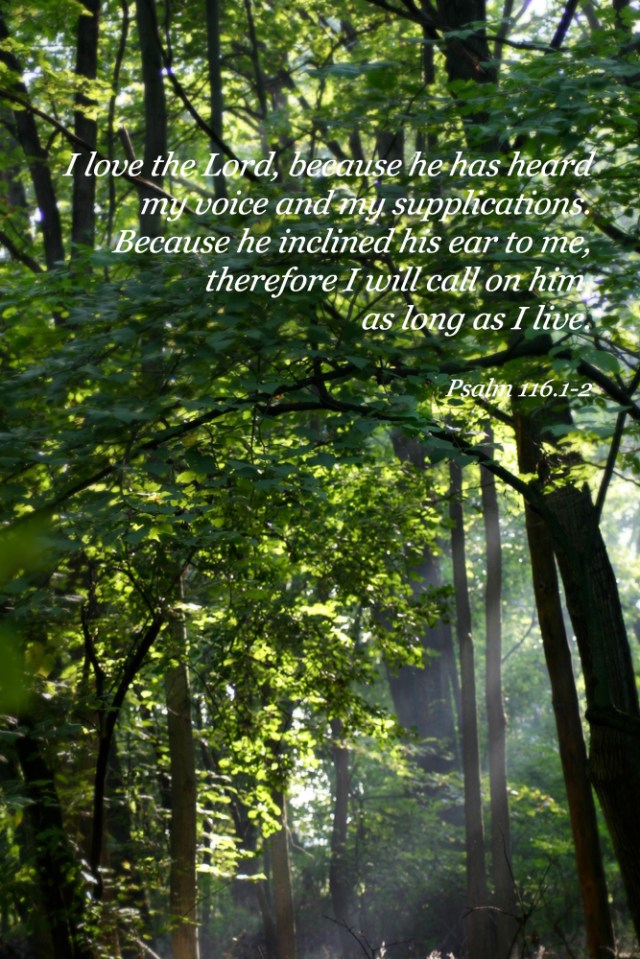
psalm 116.1-2 pic

I love the Lord because he hears
my requests for mercy.
I’ll call out to him as long as I live,
because he listens closely to me….

What can I give back to the Lord
for all the good things he has done for me?
I’ll lift up the cup of salvation.
I’ll call on the Lord’s name.
I’ll keep the promises I made to the Lord
in the presence of all God’s people.
The death of the Lord’s faithful
is a costly loss in his eyes.

Oh yes, Lord, I am definitely your servant!
I am your servant and the son of your female servant—
you’ve freed me from my chains.
So I’ll offer a sacrifice of thanksgiving to you,
and I’ll call on the Lord’s name.
I’ll keep the promises I made to the Lord
in the presence of all God’s people,
     in the courtyards of the Lord’s house,
which is in the center of Jerusalem.

Praise the Lord! (CEB)

As the Church’s Prayer Book, the Psalms were originally crafted for public as well as personal use. The Psalter is meant to be prayed, sung, and spoken out loud. The Psalms address the human condition and encompass the full range of human emotion. There are times when we are so distressed that we are unable to form words – and the psalms help us say what is in our heart. There are also times when we are so elated that we have no words to express our joy. The psalms assist us with this, as well. Today’s psalm is such a response.

The psalmist is beside himself with appreciation and praise because of answered prayer. Although the he does not provide what that answer was, this psalm is a staple for the Jewish people at Passover to specifically thank the Lord for the deliverance from Egyptian slavery. The event appears less important than the reality that God listens.

The Lord hears the cry of the oppressed and bends his ear to catch our prayers.

Because of such mercy, the psalmist pledges fealty to the Lord and commits to following through with promises to God. “I love the Lord,” is the cry of his thankful heart. The psalmist gave public testimony that prayer does indeed change things. At times when our own prayers seem to just bounce off the ceiling, it is good to hear from another that the Lord still answers prayer – that life can be different than its present confusion.

When my dear wife had a spine surgery six years ago and awoke from it unable to move her legs, I prayed. I asked for mercy. I pleaded for grace. And I did it for hours at the foot of her hospital bed. I remember that I stubbornly would not accept the fact that she could not move her lower body.  And I decided to stand there and pray until I got an answer from God.

Eventually, I prayed myself asleep. My wife woke me up sometime in the early morning the next day. She told me to pull back the covers and look at her right big toe…. She could give it an ever-small twitch. We called the nurse, who was so excited that she called everyone she could get a hold of. With a dozen hospital staff huddled around the hospital bed, my wife proceeded to give that big toe a hearty move. The staff erupted with clapping, and I am not kidding when I say that we had a party with noise and shouts in a hospital room at 4am. Nobody cared we were going nuts. I certainly did not.

Yes, God is still in the business of answering prayer.

Through the hard times, the good times, and the confusing times, the Lord is our constant ballast for all seasons of life, whether good or bad. And I love God for that abiding presence. I can also give testimony that through all of the adverse situations my wife and I have faced, we have learned to stop, be still, and find that all we ever wanted we already have, even when everything changes.

Perhaps you are reading this today and feel some desperation, maybe some wondering, if God pays any attention to your plight. Yes, the Lord does. You are not alone. We all have times of needing freedom from whatever chains are keeping us in bondage. So, I offer this prayer for you….

O God, who in Jesus Christ called us out of the darkness and into your marvelous light; enable us always to declare your wonderful deeds, offer thanksgiving for your steadfast love, and eternally praise you with heart, soul, mind, and strength.

Eternal God, for the sake of Jesus, send your Holy Spirit to the person(s) praying along with me now who need healing of body and soul, or who seek deliverance from a difficult and debilitating situation. Be gracious to drive away all that is unjust and crippling and mercifully make whole that which is broken. Grant deliverance from the power of evil and provide true faith in Jesus Christ our Lord, who suffered on our behalf and rose from death so that we too can live with joy and peace in the Holy Spirit.

Merciful God, you are the source of all healing and wholeness. We give thanks to you for your love. As we wait in expectation for the coming of the day when Jesus shall return, when suffering and pain shall be no more, please reassure us by your Spirit of your mighty power and help us to trust in your great love.

May your unending compassion be poured out to these your people who long for your hope to explode within them – to the glory of Jesus Christ, your Son, our Savior, who with you and the Holy Spirit live and reign together, one God, now and forever. Amen.