On the Importance of Hospitality (3 John 9-12)

A mosaic of the Apostle John, at the Monastery of St. John the Theologian, in Patmos, Greece

I have written something to the church, but Diotrephes, who likes to put himself first, does not welcome us. So if I come, I will call attention to what he is doing in spreading false charges against us. And not content with those charges, he refuses to welcome the brothers and sisters and even prevents those who want to do so and expels them from the church.

Beloved, do not imitate what is evil, but imitate what is good. Whoever does good is from God; whoever does evil has not seen God. Everyone has testified favorably about Demetrius, and so has the truth itself. We also testify for him, and you know that our testimony is true. (New Revised Standard Version)

I believe in an egalitarian world. Ideally, humanity is meant to live in equity with one another. Humility, meekness, and gentleness are to be the inner dispositions of a person’s life.

These virtues work themselves out in being concerned for the common good of all, laboring toward just and righteous ways of living for everyone and sharing our lives, as well as our resources, with each other. Viewing one another as equals inevitably leads to gracious hospitality.

However, in a world of power disparities, and privileged inequities, are attitudes of seeking attention, a perceived need to always win and be first, and tight-fisted control of authority and money. The common good of all persons is scaled back to be the concern for the common good of some. There is a failure to regard the weak, poor, and vulnerable as legitimate members of the community.

The Apostle John wrote his short succinct letter in a concern that the church may be following a leader who was taking them down a bad path – a road leading to injustice where power and privilege remain with a few, and perhaps even one. John’s plainspoken exhortation was to judge rightly between what is good and bad, and then imitate the good while forsaking the bad.

Hospitality is the true litmus test between the good and the bad.

An openness to the stranger, the immigrant, the migrant, the alien, the foreigner, the newcomer, and the outsider characterizes authentic fellowship.

Being closed to such persons and having a xenophobic bent to others who are different is the mark of unwelcoming and inhospitable people.

Hospitality serves others, whereas being inhospitable cajoles others to serve our needs.

Jesus, the Lord of all, did not come to this earth for people to serve him. Christ came to serve others, and to give his life to save many people (Matthew 20:28; Mark 10:45; John 13:1-17). We are to imitate the loving service and radical hospitality of the Lord Jesus. He is our example. We are to imitate Christ.

We must have both orthodoxy (right belief) and orthopraxy (right practice). Both go together like a hand in a glove. Good actions are the result of good and proper beliefs. The following are some thoughts about this nexus between belief and practice:

  • Hospitality (literally “love of the stranger”) is a way of life fundamental to orthodox Christianity, based in the person and work of Jesus
  • God is hospitable and loves the outsider, welcoming them into the dance of the Trinity, and provides for them; our human hospitality is to reflect this divine welcome
  • Hospitality means extending to another a kindness typically reserved for family or friends
  • The teaching of the New Testament emphasizes the practice of hospitality (Luke 14:12-14; Matthew 25:31-46)
  • The consistent witness of church history is to lift up and hold Christian hospitality.

“Whatever person you meet who needs your aid, you have no reason to refuse to help them.”

John Calvin

This was no mere theoretical advice for Calvin, whose ministry center of Geneva, Switzerland swelled with French Huguenot refugees fleeing persecution. Calvin, always the theologian, grounded his understanding of hospitality in the divine:

“We should not regard what a person is and what they deserve but we should go higher – that it is God who has placed us in the world for such a purpose that we be united and joined together. God has impressed the divine image in us and has given us a common nature, which should incite us to provide one for the other.”

John Calvin
  • Hospitality is a practice which integrates both respect and care. St. John Chrysostom warned his congregation to show “excessive joy” when offering hospitality to avoid shaming the recipient of care.
  • Biblical hospitality does not need to know all the details of someone’s life before extending care. If Christ forgave and healed those who injured him, how could we neglect even a starving murderer? 
  • True hospitality involves a face-to-face relationship of encouragement and respect – not just a distant giving of alms. Hospitable persons pay attention to others and share life with them.
  • The great twin concerns of hospitality are universalizing the neighbor and personalizing the stranger. One reason why many of the rich have little sympathy for the poor is because they seldom visit them. Hospitality depends on us recognizing our commonalities with strangers rather than our differences.
  • This is how we evaluate our hospitality: Did we see Christ in them? Did they see Christ in me?

Hospitable God:

Give us eyes to see the deepest needs of people.

Give us hearts full of love for our neighbors as well as for the strangers we meet.

Help us understand what it means to love others as we love ourselves.

Teach us to care in a way that strengthens those who are sick.

Fill us with generosity so we feed the hungry, clothe the naked, and give drink to the thirsty.

Let us be a healing balm to those who are weak and lonely and weary by offering our kindness to them.

May we remember to listen, smile, and offer a helping hand each time the opportunity presents itself. And may we conspire to create opportunities to do so.

Give us hearts of courage to risk loving our enemy.

Inspire us to go out of our way to include outsiders.

Help us to be welcoming and include all whom you send our way.

Let us be God’s hospitality in the world. Amen.

God Is Good, Idols Are Bad (2 Kings 17:7-20)

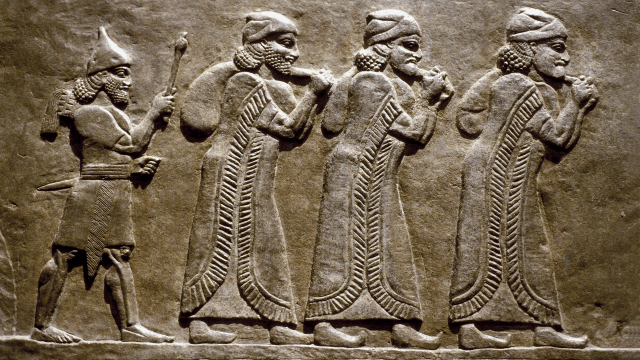
 An Assyrian solider deporting people from their land (From the Southwest Palace of Tiglath-Pileser III at Nimrud, ca. 730-727 B.C.E.; British Museum.)

The Israelites sinned against the Lord their God, who brought them out of Egypt and rescued them from the power of Pharaoh (the king of Egypt). They worshiped other gods and lived by the customs of the nations that the Lord had forced out of the Israelites’ way. They also did what their kings wanted them to do.The Israelites secretly did things against the Lord their God that weren’t right:

They built for themselves illegal places of worship in all of their cities, from the smallest watchtower to the largest fortified city.

They set up sacred stones and poles dedicated to the goddess Asherah on every high hill and under every large tree.

At all the illegal places of worship, they sacrificed in the same way as the nations that the Lord had removed from the land ahead of them.

They did evil things and made the Lord furious.

They served idols, although the Lord had said, “Never do this.”

The Lord had warned Israel and Judah through every kind of prophet and seer, “Turn from your evil ways, and obey my commands and decrees as I commanded your ancestors in all my teachings, the commands I sent to you through my servants the prophets.” But they refused to listen. They became as impossible to deal with as their ancestors who refused to trust the Lord their God. They rejected his decrees, the promise he made to their ancestors, and the warnings he had given them. They went after worthless idols and became as worthless as the idols. They behaved like the nations around them, although the Lord had commanded them not to do that. They abandoned all the commands of the Lord their God:

They made two calves out of cast metal.

They made a pole dedicated to the goddess Asherah.

They prayed to the entire army of heaven.

They worshiped Baal.

They sacrificed their sons and daughters by burning them alive.

They practiced black magic and cast evil spells.

They sold themselves by doing what the Lord considered evil, and they made him furious.

The Lord became so angry with Israel that he removed them from his sight. Only the tribe of Judah was left. Even Judah didn’t obey the commands of the Lord their God but lived according to Israel’s customs. So the Lord rejected all of Israel’s descendants, made them suffer, handed them over to those who looted their property, and finally turned away from Israel. (God’s Word Translation)

The Flight of the Prisoners, by James Tissot, 1898, depicting the Babylonian exile from Jerusalem

The prophets had warned the northern kingdom of Israel; but they did not listen, nor did they heed the prophetic utterance. Israel then stood as an example and a warning to the southern kingdom of Judah; yet they, too, refused to learn from their brother’s downfall.

And even before the kingdom was split between Israel in the north and Judah in the south, the ancient Israelites had a troubling tendency to buck the Lord’s instructions and find other more and creative ways of expressing themselves spiritually.

Every generation of people are responsible for their own spirituality and their own actions in life. We, in our contemporary time and place, need to learn the lessons of the past – for we also are not an exception in history, as if we can do whatever we want without attending to the common good of all persons and worshiping in any sort of way we want.

The trouble with the ancient worshipers of Yahweh is that they decided to pick and choose whatever commands they wanted to follow, or not. They went through continual times of idolatry and forgot about God and God’s Word to them.

To respect and revere the Lord is to obey God’s instructions. To worship Yahweh is to have an undivided allegiance to God and God’s commands. The failure to obey is really a failure of faith.

The prophets Amos, Hosea, Micah, and Isaiah specifically called out the sinful practices of the people and their negligence in upholding basic social and economic justice for everyone. They condemned violence and oppression of the poor; and expressed the divine displeasure with taking advantage of the disadvantaged.

How to treat people and live well were explicitly spelled out in the entirety of God’s Law. Yet, the leaders and the people, as a whole, decided to go another way. They kept introducing idolatrous and unhealthy forms of worship and living. And it led to their ruin.

The ancient people were continually offered grace if they would only accept it. They could return to the Lord and come back to the true worship and obedience of the God who had rescued them from trouble again and again. Turning from their unholy practices, and turning back to Yahweh, would reverse God’s impending judgment. Yet, tragically, the people did not listen.

Idolatry is a failure to trust God, and to rely instead on something else which is not able to sustain a life. Unfortunately, those who create a god according to their own liking end up becoming like the thing they worship, that is, worthless.

The tragedy of the Israelites is that they were to be God’s people, the Lord’s treasured possession, a kingdom of priests, and a holy nation which brings blessing to the earth. Instead, they traded their meaning and purpose in life to imitate everyone else around them.

Sadly, people have felt throughout history, and even we ourselves today, that there is something else, other than God, that we need in order to be happy – something more important to your heart than the Lord – whether it is human acceptance and approval, social reputation, political power and control, or financial advantage and privilege.

Idolatry creates an ignoring of the divine in our life. We might even have the chutzpah to think we can challenge God, like some small yippee pup who growls and takes on the big dog, who knows that with an effortless paw across the body, could toss the prideful pup away.

Like a mother bird who scours the land for food to sustain the babies, and brings it back to their gaping mouths, God longs to provide us with a good and beautiful life – if we will but only receive it.

Listen, my people, I’m warning you!
    If only you would listen to me, Israel.
There must be no foreign god among you.
    You must not bow down to any strange deity.
I am the Lord your God,
    who brought you up from Egypt’s land.
    Open your mouth wide—I will fill it up! (Psalm 81:8-10, CEB)

O Lord, as you gave us the greatest commandment, to love you with all our heart, soul, strength and mind, help us to love you above all else, putting you above the potential idols in our lives, including success, fame and wealth. May your benevolent kingdom come, and your moral and ethical will be done, here on this earth for this time, as it is always done in your heaven. Amen.

Use Your Freedom For Good (Exodus 33:1-6)

Then the Lord said to Moses, “You and the people you brought out of Egypt must leave this place. Go to the land I promised to Abraham, Isaac, and Jacob with an oath, saying, ‘I will give it to your descendants.’ I will send a Messenger ahead of you, and I will force out the Canaanites, Amorites, Hittites, Perizzites, Hivites, and Jebusites. Go to that land flowing with milk and honey. But I will not be with you, because you are impossible to deal with, and I would destroy you on the way.”

When the people heard this bad news, they acted as if someone had died. No one wore any jewelry. The Lord had said to Moses, “Tell the Israelites, ‘You are impossible to deal with. If I were with you, I might destroy you at any time. Now take off your jewelry, and I’ll decide what to do with you.’” After they left Mount Horeb, the Israelites no longer wore their jewelry. (God’s Word Translation)

It took little time for the covenant between God and the Israelites to be violated. The relationship between the Lord and the people was meant to be cemented through a special covenant in which Yahweh makes promises to them and gives them instructions and commandments; and the Israelites pledge their fealty and promise to obey.

But the people quickly reneged on the relationship. While Moses was up on Mount Sinai, receiving the Law from God, the Israelite grumbles and complaints came to full flower. They went their own way and made a calf idol out of gold.

So, the Lord’s judgment broke out amongst them. The Levites, to their credit, rallied around Moses and the Lord, and took out the rabble rousers in the camp. What’s more, God sent a plague that killed many.

In the aftermath of the rebellion against Moses and the Lord, God ordered the people to leave Mount Sinai – the place where everyone was to have a positive experience of Yahweh’s presence. God’s anger and wrath were so aroused that it became impossible for the divine presence to go with the people. Only Moses, as God’s emissary, would be able to guide the Israelites so that they are not completely eradicated.

Mount Sinai, by Sefira Lightstone

Yet, even after all the bad attitudes, rebellious actions, and an idolatrous spirit among the Israelites, Yahweh will still keep the divine promise to Abraham, Isaac, and Jacob to deliver them and bring them to the Promised Land.

Today’s story has the feel of a chastened child sitting in the corner, having to think about what they just did to raise the ire of the parent. The Israelites moved from Sinai in a somber mood, realizing more clearly than ever how much their lives are tied and linked to God’s divine presence.

At God’s command, the people removed their jewelry and took off their party clothes from the celebration that got them into so much trouble. It began to sink in, that the Lord departed from them because of their great sin. They started to realize, albeit too late, that they really screwed up their relationship with God.

The Israelites didn’t know how good they had it with the divine pillar of cloud by day and fire by night to lead them – and how much they actually depended on the God-given manna for their sustenance and existence.

It’s all too typical for us humans that we fail to realize what we have, until it’s gone. The ancient Israelites were freed from a cruel slavery in Egypt. They clearly did not handle their freedom well, at all. Perhaps the people were so used to being in bondage that, when they go their freedom, they just adopted a different sort of slavery – to their sinful passions.

Let’s handle our freedom with some responsibility and accountability, so that we do not go down the same rebellious path as the ancient people of God. You and I are free to choose what we do, what we think, and how we spend our time. It’s easy to blame outside forces when circumstances are hard; and to grumble whenever we don’t like something.

Freedom is a spiritual discipline; we must learn how to intentionally practice it and use it for good. The following are four areas to purposefully work on with our freedom by making good choices:

Choose your words carefully. What comes out of your own mouth is up to you. Let those words reflect who you truly are; and let your speech impact others around you for good, and not evil.

Choose your attitude with some self-awareness. With awareness comes choices. For example, if we are not aware of our own anger, it will eventually come out sideways on another person. Our sullen attitude and jaded perspective will color our relational interactions. But if we are aware of our emotions, we can choose to effectively work through them, and then decide what sort of attitude we’re going to have.

Choose your actions before you do them. Seemingly insignificant choices turn into small actions. The small actions become habits. And habits shape character and create a life. We make choices every day about what we’ll do and not do. In every sort of situation we have choices to act, such as: Will I let go, or will I try and control others? Will I walk, or drive? Will I spend, or save? Shall I prepare, or procrastinate? Be fit, or be fat? Talk or listen?… and a thousand other choices of action.

Choose your beliefs with care. Our beliefs and our faith determines how we act and behave. If we believe in a good God who has our best interests at heart, we will freely trust such a God. But if we believe God to be a capricious Being who is aloof from my concerns, then we will make choices to watch out for number one and view others with suspect.

If you are behaving in ways that aren’t working for you, examine what belief is causing that behavior. Then decide whether that’s a belief you really need to have, or not, then change it, if necessary.

Every choice we make, contributes to the person we want to become, and sets us on the path to where we want to be in life. Maybe if the ancient Israelites had more awareness of this, they might have chosen very differently.

Gracious God, grant me clarity and awareness to make wise decisions. Enlighten my heart and mind, as I seek to follow your divine guidance. In the face of uncertainty, give me the courage to trust your promises. Help me embrace the path set before me, with a spirit of love and grace. Amen.

Who Is On the Lord’s Side? (Exodus 32:15-35)

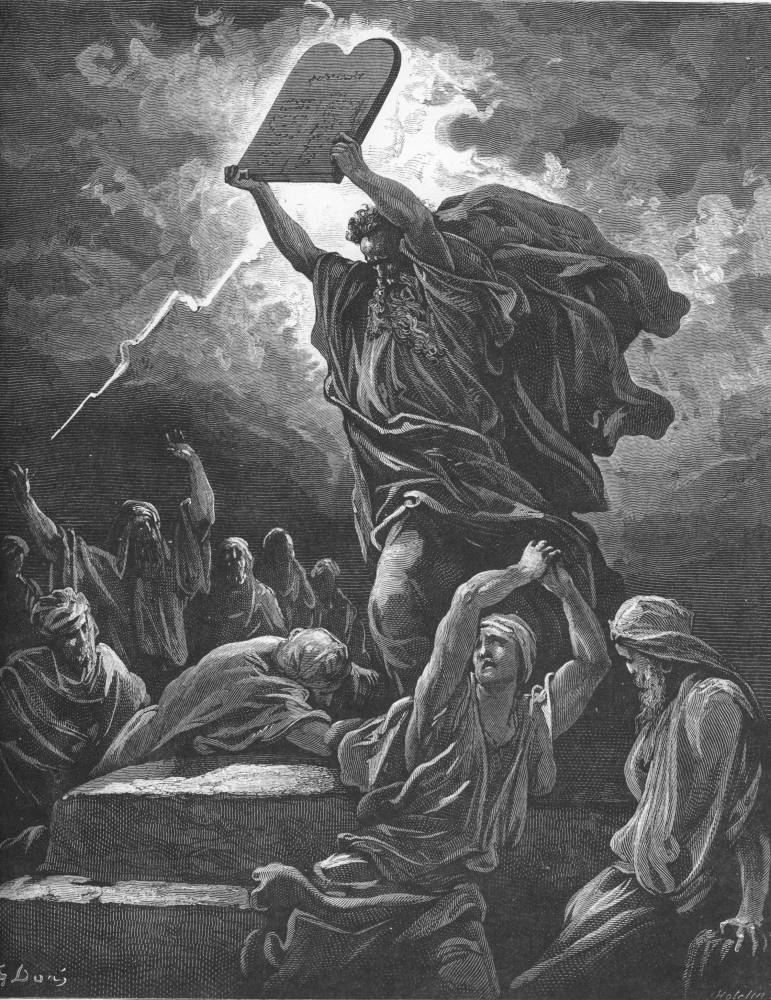
Moses breaks the tablets of the Law, by Gustave Doré (1832-1883)

Then Moses turned and went down from the mountain, carrying the two tablets of the covenant in his hands, tablets that were written on both sides, written on the front and on the back. The tablets were the work of God, and the writing was the writing of God, engraved upon the tablets. When Joshua heard the noise of the people as they shouted, he said to Moses, “There is a noise of war in the camp.” But he said,

“It is not the sound made by victors
or the sound made by losers;
it is the sound of singing that I hear.”

As soon as he came near the camp and saw the calf and the dancing, Moses’s anger burned hot, and he threw the tablets from his hands and broke them at the foot of the mountain.He took the calf that they had made, burned it with fire, ground it to powder, scattered it on the water, and made the Israelites drink it.

Moses said to Aaron, “What did this people do to you that you have brought so great a sin upon them?” And Aaron said, “Do not let the anger of my lord burn hot; you know the people, that they are wicked. They said to me, ‘Make gods for us, who shall go before us; as for this Moses, the man who brought us up out of the land of Egypt, we do not know what has become of him.’ So I said to them, ‘Whoever has gold, take it off’; so they gave it to me, and I threw it into the fire, and out came this calf!”

When Moses saw that the people were out of control (for Aaron had lost control of them, prompting derision among their enemies), then Moses stood in the gate of the camp and said, “Who is on the Lord’s side? Come to me!” And all the sons of Levi gathered around him.He said to them, “Thus says the Lord, the God of Israel: Put your sword on your side, each of you! Go back and forth from gate to gate throughout the camp, and each of you kill your brother, your friend, and your neighbor.” 

The sons of Levi did as Moses commanded, and about three thousand of the people fell on that day. Moses said, “Today you have been ordained for the service of the Lord, each one at the cost of a son or a brother, and so have brought a blessing on yourselves this day.”

On the next day Moses said to the people, “You have sinned a great sin. But now I will go up to the Lord; perhaps I can make atonement for your sin.” So Moses returned to the Lord and said, “Alas, this people has sinned a great sin; they have made for themselves gods of gold. But now, if you will only forgive their sin—but if not, please blot me out of the book that you have written.” 

But the Lord said to Moses, “Whoever has sinned against me I will blot out of my book. But now go, lead the people to the place about which I have spoken to you; see, my angel shall go in front of you. Nevertheless, when the day for punishment comes, I will punish them for their sin.”

Then the Lord sent a plague on the people because they made the calf—the one that Aaron had made. (New Revised Standard Version)

Honestly, this is just a sad story. The ancient Israelites were certainly not at their best. With Moses up on the mountain for about six weeks, there was a large leadership vacuum. Aaron, along with Hur, were to fill that space, keeping things on the straight and narrow while Moses was occupied receiving the commandments of God. That clearly didn’t happen.

Part of the reason for the people getting so out of hand with their sin was the absence of good solid leadership. There is a big contrast between Moses as leader and his brother Aaron as the interim leader.

Moses exhibited himself as a self-differentiated leader. That means, in short, that a leader cannot be overly identified with the group they lead; or else they will not have the needed perspective to make hard decisions. In other words, leaders need to have clearly defined boundaries.

Good leaders need to be in touch with the ideas and emotions of others but not dominated by them. The opposite of being a self-differentiated leader is one who tries to make everyone happy and has a hard time making unpopular decisions. Hence, the difference between the leadership of Moses and that of Aaron.

Who is on the Lord’s side? Which leader is following God’s words and ways? Notice the following distinctions between Moses the self-differentiated leader, and Aaron the leader without boundaries between himself and the people, as evidenced in today’s Old Testament lesson:

  • Moses maintained relational connections with the Levites and others who sought to uphold God’s covenant, when making decisions of conviction.
  • Aaron threw personal convictions aside in order to avoid conflict and keep everyone happy (which, by the way, isn’t even possible).
  • Moses avoided blame-shifting when dealing with the problem, but took ownership of what was going on when speaking with God.
  • Aaron just gave some lame excuses for why things went sideways.
  • Moses faced trouble and walked into the difficulty to make a difference and make things right.
  • Aaron put on a gas mask in the toxic culture and avoided dealing with the people’s sin.
  • Moses was a responsible leader who sought healthy honest relationships with God and others.
  • Aaron was an irresponsible leader who tried to create an unhealthy triangle in order to take the focus off of his poor decisions and actions.
  • Moses directly confronted the sinful situation when confronted with it.
  • Aaron procrastinated dealing with the people’s sin by simply giving them what they wanted.
  • Moses immediately acted when he saw there was a group of saboteurs in the camp.
  • Aaron hesitated in dealing with the unruly persons among the Israelites, with disastrous consequences.

By removing all the rabble rousers in the camp, Moses saved the people. Yet, even then, there was a devastating consequence from God; a divine plague was sent because of the golden calf which Aaron had made.

“Apis” was the most important and highly regarded bull deity of ancient Egypt. The Lord had judged the bull god – along with the other Egyptians gods – within the series of ten plagues which led to Israel’s deliverance. By making a detestable image that looked a lot like Apis, the Israelites, too, experienced a plague of divine judgment. The God who shows no favoritism deals with sin no matter who it is.

Maybe this awful scene could have been avoided – if there was some competent self-differentiated leadership in the absence of Moses. But we will, sadly, never know.

Holy God, forgive us for our idolatry, and help us to stop divinizing and revering creatures and created things in place of you, instead of your actual self and presence which is among us, through Jesus Christ our Lord in the power of the Holy Spirit. Amen.