Genesis 22:15-18 – Faith, Obedience, and Blessing

Blessing to Abraham

The angel of the Lord called to Abraham from heaven a second time and said, “I swear by myself, declares the Lord, that because you have done this and have not withheld your son, your only son, I will surely bless you and make your descendants as numerous as the stars in the sky and as the sand on the seashore. Your descendants will take possession of the cities of their enemies, and through your offspring all nations on earth will be blessed, because you have obeyed me.” (NIV)

The biblical character of Abraham is synonymous with faith. And for good reason. God had told Abraham that he would have a son with his wife Sarah. This was especially unusual because the couple were well advanced in age, and Sarah was incapable of having children. Infertility is not just a modern problem; it has always existed.  Yet, despite all the contrary evidence of age and ability, Abraham believed God. Years later and with a mix of patience and impatience from the would-be parents, the promise from God was realized.  Abraham and Sarah had a son, Isaac.

“The child of the promise.” This was Isaac’s moniker – which made the command from God so perplexing: “Take your son, your only son, whom you love—Isaac—and go to the region of Moriah. Sacrifice him there as a burnt offering on a mountain I will show you.” (Genesis 22:2). Huh? I can easily imagine Abraham saying to himself, perhaps not out loud, “What the [insert favorite expletive]!”  But it only seems strange and super-weird to us. We get no reaction from Abraham, no questioning, no talk back.  He just goes about the business of saddling up the donkey, chopping some wood for the sacrifice, and takes his only son with him on the journey to the mountain.

While you and I might try and figure out if we really heard God or not, Abraham had a history of talking with God. He knew God’s voice as well as he knew his own. Abraham was well down the road of relationship with the God he served. We get an insight from the author of Hebrews into Abraham’s thought process, a line of thinking that is consistent with a person who has a regular habit of talking with God:

“Abraham had been promised that Isaac, his only son, would continue his family. But when Abraham was tested, he had faith and was willing to sacrifice Isaac, because he was sure that God could raise people to life. This was just like getting Isaac back from death.” (Hebrews 11:17-18, CEV)

Abraham did not try and figure out God’s mind. He picked no fights and chose not to debate with God about the contradiction of ethics he was being asked to do.

Abraham simply obeyed.

He reasoned that it did not matter if Isaac were killed because God could raise him from death. This, of course, is not what happened. It was all a test of faith. Abraham knew beyond a shadow of a doubt that God is the Lord who provides. After God stepped in and provided a ram for the sacrifice instead of Isaac, Abraham named that place “The Lord Will Provide.” (Genesis 22:14)

You and I most certainly do not always know why we are facing the circumstances we must endure. We very much are rarely privy to know what in the world God is thinking. Yet, like Abraham, if we have a spiritual history of walking with God and hearing his voice, there is no hesitation to respond with obedience. We are convinced that God will provide. Obedience for the follower of Christ is not a burden; it is a privilege, even when we are being tested beyond our seeming emotional ability to do it.

Blessings come through obedience. They are not willy-nilly thrown into a crowd like some cheap stadium trinket between innings of a baseball game. When the Israelites were about to enter the Promised Land, this very connection between obedience and blessing was re-emphasized:

If you fully obey the Lord your God and carefully follow all his commands I give you today, the Lord your God will set you high above all the nations on earth. All these blessings will come on you and accompany you if you obey the Lord your God…. The Lord will establish you as his holy people, as he promised you on oath, if you keep the commands of the Lord your God and walk in obedience to him. (Deuteronomy 28:1-2, 9, NIV)

A simple observation about the blessing of Abraham: It took nearly five-hundred years before that blessing was realized. Furthermore, in the Christian tradition, it then took another fifteen-hundred years before the blessing was fulfilled in the person of Jesus. And, I might add, all the promises of God to his people will be fully consummated at the end of the age when Christ returns. For a contemporary society which prides itself on timeliness and efficiency, taking the much broader scope of all history might seem unacceptable.

So, we come back around again to trust. Just as Abraham trusted God, even when it seemed like nonsense fraught with major moral implications, so we are to exhibit patient and persevering faith. Although the scope of history is massively large, the only moment we have is the now. It is now, today, in which we put one foot in front of the other and toddle forward into the next moment – by faith.

We simply obey.

Then, we obey again… and, again. It is in such continual small steps of faith and obedience that we will discover the blessings of God in the middle of our path.

Sovereign Lord, your ways are sometimes strange.  Yet, I know that everything you do is always right, just, and good.  It is to your gracious and merciful character that I know you will guide and provide. My allegiance is to you as I anticipate your divine blessings in my life through the Name of Jesus Christ, in the power of the Holy Spirit. Amen.

Romans 6:12-23 – Who Is Your Master?

Welcome, friends. Simply click the video below and let us enjoy a time together around the Word of God.

You may also view this video at TimEhrhardtYouTube

Click Amazing Grace (My Chains Are Gone) by Chris Tomlin as we celebrate the wonderful reality that Christ has set us free from the realm of sin, death, and hell.

May you take up the easy yoke of Jesus and find rest for you souls. Amen.

Luke 17:1-4 – A Person Is a Person, No Matter How Small

Horton Hears a Who

Jesus said to his disciples: “Things that cause people to stumble are bound to come, but woe to anyone through whom they come. It would be better for them to be thrown into the sea with a millstone tied around their neck than to cause one of these little ones to stumble. So, watch yourselves.

“If your brother or sister sins against you, rebuke them; and if they repent, forgive them. Even if they sin against you seven times in a day and seven times come back to you saying, ‘I repent,’ you must forgive them.” (NIV)

“A person’s a person no matter how small” said Horton the elephant to all the people that were completely unconcerned for the residents of Whoville living on a clover. The people were uninterested because the Who’s were invisible to them. Dr. Seuss chose to make Horton an elephant, a large creature able to hear with big ears and be attentive to the small.

Largeness can only come through becoming small.

“Little ones,” people who no one sees or notices, matter to Jesus, and so they ought to matter to us, too. Invisible people need to become visible to us. They need to become visible to us because Jesus sees them – they are not invisible to him. Jesus often mingled with little people – children, women who had no rights, social misfits like lepers, the chronically ill, religious outsiders, tax collectors, and prostitutes. Our world is filled with similar people – angry adolescents, unwanted babies, forgotten old people, the mentally ill, moral failures, immigrants and refugees, and, if we have eyes to see and big ears to hear, lots of underprivileged people who reside on the dark underbelly of society. They are around us, even if they are invisible to us.

Jesus envisioned a community that sees, honors, and protects little people. Truth be told, we are all little people before God, and he notices us. And, so, we are to become humble enough to see the little people around us. The only way to become great in the kingdom of God is to descend, not ascend, into greatness. The chief enemy of any community is a desire to be prominent, to be the Big Cheese – it is called “pride” and it will separate us from God if we hold onto it.  Which is why we must do all we can to radically cut it out of our lives.

This is a big deal to Jesus. So, here’s the deal: We are not to welcome people because they are great, wise, rich, powerful, good-looking, and look like you and me – we are to welcome others because they are noticed by Jesus. Like Horton the elephant,

Christ the Lord hears the cry from the place of smallness and is determined to do something about it.

The proud person who seeks prominence is always looking for greener pastures and impressing others. The proud connect with people who will help advance them up the ladder of success. Through that process of advancement, the proud do not care who they step on along the way. The Christ follower, however, is to be different. Christians are to give small, insignificant people of society the time of day, treat them as important, and advocate for their needs.

It was the Apostle Peter, a guy who learned the hard way about paying attention to those different from himself, who quoted the Old Testament in saying, “love covers over a multitude of sins.” (1 Peter 4:9) That is, basic love for another prevents them from committing the sins they would have if they were unloved. If we do not love, it would be better for us to be killed in a tragic millstone death. Jesus does not want people acting like leeches, just sucking the life out of others to get what they want.

So, what do we do about it? How shall we then live? A person’s a person no matter how small. We need humility. We need to lower our sights and our bodies to see little people. We cannot truly see a two-year-old toddler unless we lower ourselves to view them as equal and important.

The way to see another requires slowing down, observing, and stooping or sitting to look them in the eye and give them the dignity of attention they deserve.

The danger of reading a post like this is the thought that all this stuff is really for someone else. After all, I don’t want to hurt anyone or see anybody deprived, so maybe the experts and professionals ought to handle it all. Yet, the fact remains that we do no one any good when we neglect getting on the floor. When we assume blessing for ourselves without the intent of giving it to others, we have come under the judgment of Christ. Perhaps we fear forgiveness – either accepting an apology from another or offering one to someone we have wronged. Out of sight, out of mind, is the approach of the one who causes others to stumble and make them fall.

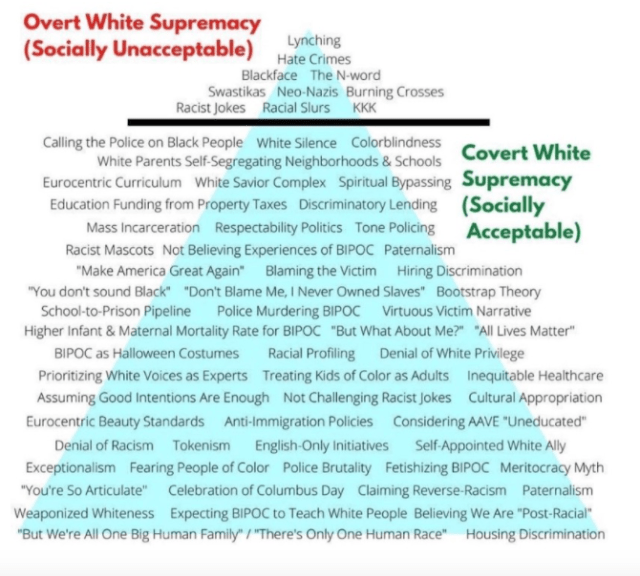
Christ’s admonition is to watch ourselves, to be vigilant of both overt and covert sins against the unseen and forgotten among us. The pyramid below concerning racism is just one example of many other forms of causing others to stumble and fall:

white supremacy pyramid

Even though I write this warning, dear friends, I am confident of better things in your case—the things that have to do with salvation, deliverance, and liberation for all persons. God is not unjust; he will not forget your work and the love you have shown him as you have helped others and continue to help them. Continue to show this same diligence so that what you hope for may be fully realized; and, imitate those who through faith and patience are doing good work. May the Lord be with you.

For those deprived of their human needs and their human rights: Just God, may they may be given the dignity by others which you confer on all his people.

For all who are forgotten and unseen, especially the poor, the sick, and the aged: All-seeing God, may you move us to love them as the image of Christ.

For all who are lonely or afraid, for teenagers on the street, the elderly in nursing homes, prisoners with no one to visit them, and all whom the world has forgotten: Lord Christ, may you lead us to them.

For those who suffer mental illness or disorder: Attentive God, may we cherish the gifts you have given them, and in their lives hear the voice of your love.

For each human life: Creator God, may we value every person as you do. We pray in the name of Jesus Christ, our Savior. Amen.

Psalm 13 – How Long, O Lord?

The Scream by Edvard Munch
“The Scream” by Edvard Munch, 1893.

How long, O Lord? Will you forget me forever?
How long will you hide your face from me?
How long must I make decisions alone
with sorrow in my heart day after day?
How long will my enemy triumph over me?

Look at me! Answer me, O Lord my God!
Light up my eyes,
or else I will die
and my enemy will say, “I have overpowered him.”
My opponents will rejoice because I have been shaken.

But I trust your mercy.
My heart finds joy in your salvation.
I will sing to the Lord because he has been good to me. (GW)

Faith is more than the mind’s affirmation of theological beliefs. Faith is also visceral, an expression from deep in the gut about what is going on around us. For faith to be truly faith it needs to hold the whole person, not merely the brain.

Today’s psalm is the reaction of a person of faith to God when the world as they knew it was crumbling and broken. This is a psalm of lament which moves and deepens the faith of the worshiper.

When the world around us changes and all seems horribly awry, we understandably become disoriented – we lose our normal bearings and feel confused and lost.

One of the simplest observations we can make about this psalm, along with all psalms of lament, is that, whether the content is ethically pure or not, the words of the psalmist directed toward God reflect the pain and agony of  people in the middle of world-shattering circumstances. In such dire situations, there are no simplistic answers or easy diagnoses of problems. Complicated layers of grief exist, and mere cerebral responses will always fall short of adequately being in the present moment, sitting with emotions, and getting in touch with the gut.

I am leery of folks who quickly affirm trust in God when a terrible event has just occurred. Bypassing the gut and the heart cannot bring a whole person response to that event and will inevitably result in a cheap faith which cannot support the immensity of the situation. Even worse, it leads to a bootstrap theology where people are expected to pull themselves up in a free-willpower way that is impossible to even do. Sometimes failure of faith comes not because of a person’s weakness but because the faith being espoused is not faith, at all.

Biblical faith expresses weakness, need, help, curiosity, and doubt with a healthy dose of emotional flavor and visceral reaction.

If we had just one psalm of lament as an example, that would be enough. In fact, we have dozens of them, with more sprinkled throughout Holy Scripture. We even have an entire book of the Bible, Lamentations, a deep reflection of the prophet Jeremiah’s grief.

So, let us now be honest with ourselves and each other. All of us, at one time or another, have given a cry of “How long, O Lord!” There are times when our prayers seem unheard and unnoticed, as if they only bounce off the ceiling and fall flat. There are hard circumstances which continue to move along unabated with evil seeming to mock us. We long for divine intervention, we long for deliverance, we long for healing – and when it does not come our disappointment and frustration boils over into an unmitigated cry of wondering where God is in all the damned thick crud.

When a person and/or a group of people are traumatized not once but over-and-over again, how can we not cry aloud, “How long, O Lord!?” When despair settles in the spirit, disappointment seeps in the soul, and depression becomes our daily bread, how can we not muster up the voice that yells, “How long, O Lord!?” When powerful people cause the lives of others to be downtrodden and despised, how can we not scream, “How long, O Lord!?” When the covert actions of others demean and denigrate, leaving us with private pain which no one sees, how can we not bring forth the words, “How long, O Lord!?” If you have never uttered this kind of wondering about God, then perhaps a profound disconnect with your own spirit exists.

A full orb faith names the awful events and sits with the feelings surrounding those events with God.

Psalm 13 is important because it gives us words when the bottom falls out of our lives and everything is upside-down. This psalm helps us admit that life is not as well-ordered as a simple Sunday School faith may pretend. The psalm acknowledges that life is terribly messy, and the psalmist protests to heaven that this quagmire of injustice is plain unfair. What is more, this psalm helps move the sufferer to a new place.

God is big enough to handle everything we throw at him — our pain, our anger, our questions, our doubts. Genuine biblical faith is comfortable challenging God. And God is there, listening, even if we cannot perceive it. Just because we might need to endure adversity does not mean there is something wrong with us, or God.

We likely will not get an answer to our “how long?” We will get something else: mercy. Mercy is compassion shown to another when it is within one’s power to punish. If we widen our horizon a bit, we will observe a God who cares:

“The Lord isn’t slow to keep his promise, as some think of slowness, but he is patient toward you, not wanting anyone to perish but all to change their hearts and lives.” (2 Peter 3:9, CEB)

The only thing better than the joy of personal salvation is the joy of many people’s deliverance and collective emancipation. Patience, perseverance, and endurance through hardship will require expressions of faith with words of affirmation, along with words of agony. The psalms help us with both.

Lord God Almighty, I pray for the forgotten and the unseen – the stranger, the outcast, the poor and homeless – may they be remembered and seen by you.

Merciful God, I pray for those who struggle with mental illness, anxiety, depression, and suicidal ideation – may there be resources to help, enough staff employed, and finances given, toward mental health services. May there be basic human kindness available for the hurting.

Compassionate God, I pray for those who wrestle with sorrow – may they know your comfort within the dark thoughts which currently seem to triumph.

Attentive Lord, I pray for the crestfallen and the ones considered fallen by those around them – may they receive your restoration and reconciling grace. Protect them from judgment and shield them with your mercy.

Lord of all creation, I trust in your steadfast love and rely upon your infinite grace. May our tears turn to songs of joy, to the glory of Jesus Christ. Amen.