Romans 3:1-8 – The One People of God

A simple graphic entwined tree illustration

What advantage, then, is there in being a Jew, or what value is there in circumcision? Much in every way! First of all, the Jews have been entrusted with the very words of God.

What if some were unfaithful? Will their unfaithfulness nullify God’s faithfulness? Not at all! Let God be true, and every human being a liar. As it is written:

“So that you may be proved right when you speak
and prevail when you judge.”

But if our unrighteousness brings out God’s righteousness more clearly, what shall we say? That God is unjust in bringing his wrath on us? (I am using a human argument.) Certainly not! If that were so, how could God judge the world? Someone might argue, “If my falsehood enhances God’s truthfulness and so increases his glory, why am I still condemned as a sinner?” Why not say—as some slanderously claim that we say—“Let us do evil that good may result”? Their condemnation is just! (NIV)

Paul’s letter to the Roman church is a hefty sixteen chapters of some dense material and several extended arguments through intense reasoning. Likely, Paul felt compelled to dig in and provide so many words because of the church’s situation.

The Roman Church at the time of Paul’s writing was made up of both Jewish and Gentile believers in Jesus. Jews and Gentiles have a complicated history together. And the Roman Empire was still firmly in control of Palestine and did not always treat the Jewish people well. In addition, the religious backgrounds of each were as different as you can get. Whereas the Jewish Christians had a long rich history with God and the Old Testament, the Gentile Christians were fresh from centuries of paganism and esoteric rituals. Now, they were together in one place worshiping Jesus and it made for a potentially combustible situation.

Throughout the letter to the Romans, Paul goes back and forth addressing the two groups of Jews and Gentiles. The overarching problem was this: The Jewish believers tended to look down on the Gentile Christians and thought they needed to become Jewish to really be the kind of Christians God was looking for. On the other hand, the Gentile believers tended to dismiss their Jewish brothers and sisters as backward and stuck in tradition. In short, each group thought the other must become like them.

So, Paul, bless his apostolic heart, had a huge mess in the making with these believers. Here, in our New Testament lesson for today, Paul is directing his comments more specifically toward the Gentile Christians. Paul really wanted the Gentile believers to gain some appreciation for the Jewish people. After all, they were chosen by God to become a nation of priests and prophets for the world. Discounting that history would be to neglect and even invalidate their shared salvation.

For Paul, to have two churches, one Jew and the other Gentile, would have been a complete travesty of Christ’s redemption for humanity. Jesus was all about bringing disparate peoples together and not keeping them divided. The cross freed us by eliminating the barriers which separate us. The Roman Church was just going to have to work together at being one people under the lordship of Christ. There was going to be no ethnic, religious, or political one-upmanship on Paul’s watch.

Truth be told, both Jew and Gentile did not always do so well with their respective histories. So, there is no ground for boasting or trying to argue for their own way. In fact, the unfaithfulness of people simply shows the incredible faithfulness of God in greater relief.  If there were no sin, grace would not be needed; no cross would have existed. Just because the foulness and degradation of sin brings out the gracious, faithful, and forgiving character of God in Christ, does not mean that sin is okay or that we can flippantly wave it off with uttering some mumbo-jumbo cheap grace which devalues the majesty of God.

For example, when antebellum southern slaveholders in nineteenth-century America argued for their peculiar institution by saying that snatching black Africans from their homes was a good thing so that they could get out of their religious animistic worldview and be exposed to Christianity, I am positively sure that the Apostle Paul rolled over in his grave and begged Jesus to resurrect him early and send him to tackle such an affront to the cross of Christ! Sin is never to be excused through twisted human mental gymnastics.

Paul worked laboriously to unite the churches he established and bring differing people groups together under Christ. What this does not mean is that all cultural and personal distinctions are ignored or erased. What it does mean is that we value one another’s differences and gather around the shared value of knowing Jesus Christ. The Church was neither going to become Jewish nor Gentile but something altogether new – one new people out of the two. Paul framed the matter this way to the Ephesian Church:

Therefore, remember that formerly you who are Gentiles by birth and called “uncircumcised” by those who call themselves “the circumcision” (which is done in the body by human hands)— remember that at that time you were separate from Christ, excluded from citizenship in Israel and foreigners to the covenants of the promise, without hope and without God in the world. But now in Christ Jesus you who once were far away have been brought near by the blood of Christ.

For he himself is our peace, who has made the two groups one and has destroyed the barrier, the dividing wall of hostility, by setting aside in his flesh the law with its commands and regulations. His purpose was to create in himself one new humanity out of the two, thus making peace, and in one body to reconcile both of them to God through the cross, by which he put to death their hostility. He came and preached peace to you who were far away and peace to those who were near. For through him we both have access to the Father by one Spirit. (Ephesians 2:11-18, NIV)

Solitary righteousness is an oxymoron. Righteousness can only be truly lived and expressed with other people. Yes, there is freedom in Christ. Yet, that freedom must be continually applied through making every effort to keep the unity of the Spirit through the bond of peace.

O God, the Father of our Lord Jesus Christ, our only Savior, the Prince of Peace: Give us grace to seriously lay aside all unhappy divisions. Take away all hatred and prejudice, and whatsoever else may hinder us from godly union and harmony: that, as there is but one Body, and one Spirit, and one hope of our calling, one Lord, one faith, one baptism, one God and Father of us all; so may we be forever all of one heart, and of one soul, united in one holy bond of truth and peace, of faith and love, and with one mind and one mouth glorify Jesus Christ our Lord. Amen.

Genesis 27:30-46 – “Bless Me, Too!”

Isaac Blesses Jacob by Yoram Raanan

After Isaac finished blessing him, and Jacob had scarcely left his father’s presence, his brother Esau came in from hunting. He too prepared some tasty food and brought it to his father. Then he said to him, “My father, please sit up and eat some of my game, so that you may give me your blessing.”

His father Isaac asked him, “Who are you?”

“I am your son,” he answered, “your firstborn, Esau.”

Isaac trembled violently and said, “Who was it, then, that hunted game and brought it to me? I ate it just before you came, and I blessed him—and indeed he will be blessed!”

When Esau heard his father’s words, he burst out with a loud and bitter cry and said to his father, “Bless me—me too, my father!”

But he said, “Your brother came deceitfully and took your blessing.”

Esau said, “Isn’t he rightly named Jacob? This is the second time he has taken advantage of me: He took my birthright, and now he’s taken my blessing!” Then he asked, “Haven’t you reserved any blessing for me?”

Isaac answered Esau, “I have made him lord over you and have made all his relatives his servants, and I have sustained him with grain and new wine. So, what can I possibly do for you, my son?”

Esau said to his father, “Do you have only one blessing, my father? Bless me too, my father!” Then Esau wept aloud.

His father Isaac answered him,

“Your dwelling will be
away from the earth’s richness,
away from the dew of heaven above.
You will live by the sword
and you will serve your brother.
But when you grow restless,
you will throw his yoke
from off your neck.”

Esau held a grudge against Jacob because of the blessing his father had given him. He said to himself, “The days of mourning for my father are near; then I will kill my brother Jacob.”

When Rebekah was told what her older son Esau had said, she sent for her younger son Jacob and said to him, “Your brother Esau is planning to avenge himself by killing you. Now then, my son, do what I say: Flee at once to my brother Laban in Harran. Stay with him for a while until your brother’s fury subsides. When your brother is no longer angry with you and forgets what you did to him, I’ll send word for you to come back from there. Why should I lose both of you in one day?”

Then Rebekah said to Isaac, “I’m disgusted with living because of these Hittite women. If Jacob takes a wife from among the women of this land, from Hittite women like these, my life will not be worth living.” (NIV)

The twins Esau and Jacob are the very definition of sibling rivalry. Even at their birth, they jostled and positioned for their entry into the world. Although brothers, they were different from one another in every way. As their aged father, Isaac, was near the end of his days, he was looking to pass on a family blessing to Esau, the firstborn. And that’s where things got dicey.

Jacob, always the trickster, was still playing out the rivalry. When his brother Esau was out hunting and preparing to receive his father’s blessing, Jacob posed as his brother and deceitfully gained the blessing of Isaac. Both Isaac and Esau were shocked to discover what happened. Esau’s response was one of grief, disappointment, bitterness, with tears and weeping. Despite Esau not being known for his sensitivity to God or family before this event, we can certainly feel his cry: “Do you have only one blessing, my father? Bless me too, my father!”

Blessing with hands

The blessing. As a chaplain who works with behavioral health patients, I have heard many times over the lament of individuals without a blessing from their father. As people created in the image and likeness of God, we were meant to be blessed – to have a loving and enduring stamp of approval from both our heavenly Father and our earthly fathers. And when an earthly father, or father figure, either cannot or will not extend a vital blessing to children, it is a terrible wound – like an invisible open putrid abscess which continually leaves the person emotionally and spiritually sick.

Blessing is needed. Without blessing we flounder in the world, struggling to see hope, wondering if we are loved, and lacking confidence in our faith. To be blessed is to receive a beautiful gift. The term “blessing” in Scripture is a powerful communication of God’s presence and approval. So, when humans bless one another, we offer commitments of love and connection. We provide powerful words of encouragement and picture a special future for those we are close to.

None of this is optional. Blessing is God’s way of building up one another and fortifying each other for the rigors of this world. When blessing is withheld, and even worse, when it is replaced with cursing, then individuals are bereft of support to face stressful situations. Like a ship adrift without any power or wind, so the person trying to live in this world without blessing is dead in the water. Where there is no blessing, like Esau, revenge fills our hearts.

Jesus clearly understood the need and the power of blessing, and he was not deterred in deliberately offering it:

People were bringing little children to Jesus for him to place his hands on them, but the disciples rebuked them. When Jesus saw this, he was indignant. He said to them, “Let the little children come to me, and do not hinder them, for the kingdom of God belongs to such as these. Truly I tell you, anyone who will not receive the kingdom of God like a little child will never enter it.” And he took the children in his arms, placed his hands on them and blessed them. (Mark 10:13-16, NIV)

I wonder how this simple encounter affected the lives of those children on that day in which Jesus blessed them. I am curious in what ways they grew-up and how Christ’s blessing shaped their lives. Because that is what blessing does: it forms us into the kind of people we were meant to be.

Receive today this blessing from Holy Scripture:

The Lord bless you and keep you;
the Lord make his face to shine upon you, and be gracious to you;
the Lord lift up his countenance upon you, and give you peace. Amen. (Numbers 6:24-26, NRSV)

Matthew 11:16-19, 20-25 – Following Jesus

Welcome, friends! Click the video below and let us consider the words of Jesus together.

You may also view this video on TimEhrhardtYouTube

Click Behold the Lamb (Communion Hymn) by Keith and Kristyn Getty, the song mentioned in the video.

May the grace of the Lord Jesus, the love of God the Father, and the fellowship of the Holy Spirit be with you, today and always. Amen.

Luke 10:21-24 – Freedom and Blessing

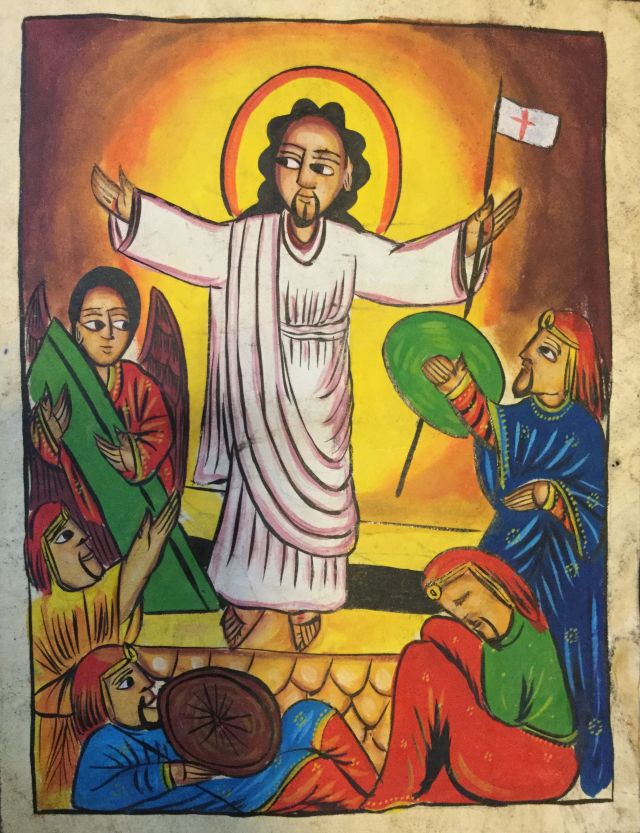
Ethiopian Jesus 2
Ethiopian Orthodox depiction of Jesus teaching

Then Jesus rejoiced in the Holy Spirit and said, “I praise you, Father, Lord of heaven and earth, because you have hidden these things from the people who are wise and smart. But you have shown them to those who are like little children. Yes, Father, this is what you really wanted.

“My Father has given me all things. No one knows who the Son is, except the Father. And no one knows who the Father is, except the Son and those whom the Son chooses to tell.”

Then Jesus turned to his followers and said privately, “You are blessed to see what you now see. I tell you, many prophets and kings wanted to see what you now see, but they did not, and they wanted to hear what you now hear, but they did not.” (NCV)

A healthy view of Holy Scripture is to look at it as an unfolding drama of redemption. Ever since the fall of humanity, God has been on a rescue mission to reclaim, redeem, and restore people. This human project has obviously taken several millennia; and, it still has not reached its fulfillment.

The Christian tradition understands that the climax of victory and final restoration to our true state as humans will occur when Christ returns. By warning us that divine mysteries are hidden to some and revealed to others is Jesus’ way of cautioning us toward triumphalism and self-congratulation. Yes, redemption is a reality; and, it is also not a reality. It is both here and is coming. We are delivered from sin, death, and hell – and, we still labor against the evil machinations of systemic world problems, our own sinful nature, and a demonic realm which is looking for every opportunity to exploit sin’s residue upon the earth.

What this all means on a practical basis is that the good old days for some were the bad old days for others. History is always written by the winners and those in power. The hidden voices are typically squelched. The vision of Jesus is that all kinds of people, not just a certain segment of winners, should enjoy God’s favor.

There were ancient people who longed for spiritual and physical freedom. They looked forward into history and had the hope of Messiah and God’s promises being fulfilled. History is still unfolding. People yet remain locked in personal bondage and large swaths of humanity still experience oppression and a longing to enjoy blessings which others possess and take for granted.

On this Independence Day in the United States it is important that we recognize and hold together both the blessings of realized freedom along with the limits of others’ freedom. And, with this realization, we continue to actively work for all people and keep praying that God’s kingdom come and God’s will be done, here on earth, as it is always done in heaven.

Frederick Douglass
Frederick Douglass, circa 1852

So, today, I am lifting a voice from history which exemplifies the struggle of the black experience in America. The following is a small portion from a speech by the ex-slave Frederick Douglass orated on July 4, 1852, nine years before civil war, with President Millard Fillmore and many congressional politicians in attendance:

“The feeling of the nation must be quickened; the conscience of the nation must be roused; the propriety of the nation must be startled; the hypocrisy of the nation must be exposed; and its crimes against God and man must be proclaimed and denounced. What, to the American slave, is your 4th of July? I answer: a day that reveals to him, more than all other days in the year, the gross injustice and cruelty to which he is the constant victim. To him, your celebration is a sham; your boasted liberty, an unholy license; your national greatness, swelling vanity; your sounds of rejoicing are empty and heartless; your denunciations of tyrants, brass fronted impudence; your shouts of liberty and equality, hollow mockery; your prayers and hymns, your sermons and thanksgivings, with all your religious parade, and solemnity, are, to him, mere bombast, fraud, deception, impiety, and hypocrisy — a thin veil to cover up crimes which would disgrace a nation of savages. There is not a nation on the earth guilty of practices more shocking and bloodier than are the people of these United States, at this very hour.”

Because history is forever unfolding, freedom and blessing develop over time and come more powerfully to some than others. True spiritual discernment, with the awareness to labor on behalf of the common good, does not ultimately come through astute observation and superior intellect; it comes by divine revelation. God will both conceal and reveal according to divine purposes and not human agendas.

Christian spirituality cannot be reduced to praying a sinner’s prayer and then maintaining a holding pattern on earth until heaven. Rather, Jesus remains present in this world through the person of the Holy Spirit and is continually interceding on behalf of those who need freedom and blessing. As Christ’s Body, Christians are to be the hands and feet of Jesus, animated by the Spirit to bring God’s ethical and benevolent regime to those who need it most.

If we are blessed, we are to pass blessing on without prejudice. For the kingdom of God belongs to the poor in spirit.

Dear God, Creator of the universe and all that inhabit it, we come as your Church, and as individuals, in humble submission to your word and your way. God, you are the Alpha and Omega, The Almighty Judge and The Forgiver of All Sins, so we come with humility and contrition on behalf of generations past, present and those yet unborn. We ask that you forgive us and create in us a new spirit. Bind our hearts and send forth the healing power that you and you alone can give to us and this sin-sick world. Bring us into reconciliation with one another and restore us to your righteous and holy path. Amen.