Welcome, friends! Just as we need a strong physical spine for good health, equally necessary is a healthy spiritual spine with good strong theology holding us up. Click the video below and let’s worship the Lord…
And, here is Psalm 99 put to song and performed by the Sons of Korah…
Psalm 99 by the Sons of Korah
May you be strengthened with all power according to God’s glorious might so that you may have great endurance and patience. Amen.
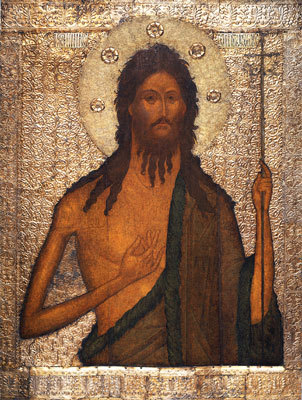
16th century Russian Orthodox icon of John the Baptist
At that time Herod the tetrarch heard the reports about Jesus, and he said to his attendants, “This is John the Baptist; he has risen from the dead! That is why miraculous powers are at work in him.”
Now Herod had arrested John and bound him and put him in prison because of Herodias, his brother Philip’s wife, for John had been saying to him: “It is not lawful for you to have her.” Herod wanted to kill John, but he was afraid of the people, because they considered John a prophet.
On Herod’s birthday the daughter of Herodias danced for the guests and pleased Herod so much that he promised with an oath to give her whatever she asked. Prompted by her mother, she said, “Give me here on a platter the head of John the Baptist.” The king was distressed, but because of his oaths and his dinner guests, he ordered that her request be granted and had John beheaded in the prison. His head was brought in on a platter and given to the girl, who carried it to her mother. John’s disciples came and took his body and buried it. Then they went and told Jesus. (NIV)
John’s murder is a story about our world – a world of power, sex, and intrigue. Times may change, but people across the ages do not change. Humanity is fundamentally the same in every century. And the world is still the world, no matter the historical time.
The contrast between Herod and John supply us with two types of people who exist throughout every age of humankind, offering us the choice of which way we will go with our lives. The story illustrates for us the reality of living in a fallen world as a devout person.
The Herod in today’s Gospel lesson was a son of Herod the Great, the one who killed all the male babies when Jesus was born in order to try and get rid of any rival king (Matthew 2:1-18). King Herod is displayed in the narrative as a tragic and pathetic figure who is ruled by his own lusts. He seems too proud and wimpy to admit he made a rash promise and killed a man just to save face with his guests at a party.
Talk about a Jerry Springer worthy family drama, here it is: The Herod family was rich, proud, and downright violent. They tended to marry within their own clan to hold their power and possessions for themselves. Herodias married her uncle Herod Philip; Salome was their daughter. Later, Salome married Philip the tetrarch, half-brother to Herod Philip. Through marriage, Salome became both aunt and sister-in-law to her mother. Then the Herod in our story married Herodias, who had been married to Herod’s half-brother, Herod Philip. Having fallen in love with Herod Antipas, Herodias divorced Herod Philip to marry Herod Antipas. Sheesh, nothing like complicated family drama.
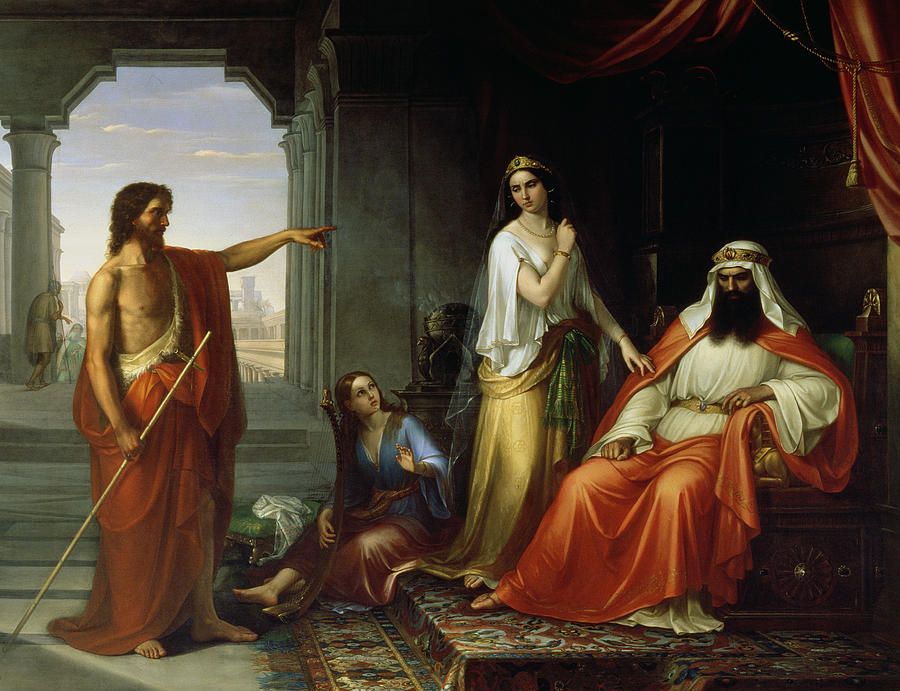
St. John the Baptist Rebuking Herod by Italian artist Giovanni Fattori (1825-1908)
Into this violation of Old Testament marriage laws (the Herod’s were Jewish) came John who made no bones about the fact this was not right (Leviticus 18:16, 20:21). Herodias nursed a grudge against John for speaking out against her and Herod’s choices. Hell, hath no fury like a woman’s scorn, and when Herodias found an opportunity to get rid of John, she coached her daughter into asking for John the Baptist’s head on a platter. Herod, too insecure to take back his ridiculous promise and look like a fool, consented to the execution of John.
In contrast to all this tragic theater is John the Baptist. John was a messenger of God and a preacher of repentance. As one who was preparing the way for Jesus, his message was simple and to the point: Repent, for the kingdom of God is near. John got into trouble and lost his life because he spoke truth to power by meddling in the life of King Herod and his family. The Herod’s were the political establishment of the day, and John did not temper his words when dealing with them.
There is a refreshing integrity about John. He was always the same no matter where he was, and no matter who the people were around him. In contrast to Herod, John was bold, courageous, confident, unafraid, and secure enough in his relationship with God to engage in ministry without thought to the consequences. He was unconcerned for what others might think of him if he proclaimed truth in the public square, and it did end up costing him his life.
The story of John the Baptist’s death speaks about the hostility of this world. And it prefigured and foreshadowed the death of Jesus. Like John, Jesus was executed by the civil authorities. Herod, like Pilate after him, hesitated to execute and was swayed by the crowd. Herodias, like the chief priests toward Jesus, finally got her way through scheming and manipulation. John’s disciples came and took his body and buried it, just like Joseph of Arimathea and Nicodemus did for Jesus.
These stories, on the surface of things, appear to be only gloom and doom. Yet, there is a message of hope and joy. The absurd is working out itself in deliverance from sin, death, and hell. Through death, Jesus conquered death. We now have no fear of death; its sting has been taken away. Without fear of death, we have no reason to fear life with its troubles and tribulations.
The fork in the road is between the way of John or Herod. It is a values-based decision. If worth is derived from what we do, what we have, and/or other’s opinion of us, we will likely identify more with Herod and his choices. If there is a preoccupation with hoarding power and control, this is the path of Herod.
Conversely, if the ultimate value is in knowing Christ crucified and the power of his resurrection, then we identify with John as our spiritual ancestor. If security and worth is derived from being in Christ, then there is boldness to speak truth to power and give grace to the powerless.
Herod saw no further than his immediate needs and safety; he failed to discern his own heart. Because of his spiritual blindness, Herod did not look away from himself and look to God. Faith in Jesus comes when persons look away from themselves and look to Christ who holds the power to free all from spiritual bondage.
Let us look to the example of John the Baptist who consistently sought to do the will of God as best as he understood it. Together with all God’s people past and present, we declare that God is with us, the kingdom of God is near, and the love of Christ brings faith and hope.
Almighty God, through your providence John the Baptist was wonderfully born and was sent to prepare the way of your Son, our Savior by the preaching of repentance. Lead us to repent according to his preaching and, after his example, constantly to speak the truth, boldly to rebuke vice, and patiently to suffer for truth’s sake; through Jesus Christ your Son, our Lord, who is alive and reigns with you, in the unity of the Holy Spirit, one God, now and forever. Amen.
To the elders among you, I appeal as a fellow elder and a witness of Christ’s sufferings who also will share in the glory to be revealed: Be shepherds of God’s flock that is under your care, watching over them—not because you must, but because you are willing, as God wants you to be; not pursuing dishonest gain, but eager to serve; not lording it over those entrusted to you, but being examples to the flock. And when the Chief Shepherd appears, you will receive the crown of glory that will never fade away.
In the same way, you who are younger, submit yourselves to your elders. All of you, clothe yourselves with humility toward one another, because “God opposes the proud but shows favor to the humble.”(NIV)
Today’s New Testament lesson addresses two groups of people: Leaders and followers, the older and the younger, shepherds and sheep. Both have their distinct roles and places, yet both are to share together in the virtue of humility. Whether pastor or parishioner, mentor or mentee, humble service is to characterize all.
I spent a good chunk of my ministerial life working with college students and twenty-somethings. One of the reasons I like being around young adults is that they have a very well attuned barometer to hogwash coming from older folks. Unlike children and more mature adults, this group of people live in a nexus between an emerging awareness of the world without having yet been crusted over with bitterness or disillusionment. They can spot a disingenuous person across the room like an eagle eyes the difference between a fish and a rock at five-thousand feet in the air.
All of us have likely had the experience of not being able to explain why, but a certain interaction with a person just seems off – it smacks of being a bit too contrived and manipulative. The other person might talk a good line, yet your instincts tell you different. So, for example, if a church pastor or leader seems to be just going through the motions as if the work is a necessary evil, then there might be something behind it. It is always a good idea to stop and listen to your gut speak.
Difficult for many people is that life is not so much about learning a certain skill set, as if we were in a trade school. The skills approach relies upon learning to say certain things, do certain things, and press certain buttons in others, and then get a solid expected outcome. That kind of approach is where the finely attuned baloney meter goes off in others. They sense that this person talking to them is not bringing anything of themselves to the discussion; they’re just talking without listening; they just go on without a sense of dialogue in which they learn from you or reveal anything of themselves to you.
I genuinely believe humility is the cornerstone of all virtues and the foundation to effective personal interactions and group dynamics. Without humility, there is no sense of the majesty and dignity of the other person – there is only competition and a twisted hierarchy of those with power and those without. If humility is absent, life is a trade school in learning to get what I want on the backs of others.
However, with humility, who we are as people matters. I bring my feelings, my thoughts, my beliefs, my experiences, and my questions into the conversation or situation and seek to, in turn, discover what you think and feel. Then, together, we come to a third way of seeing that honors our collective sharing and consulting of one another with fresh collaboration which blesses the world. This is less a skill set, and more of just being a good human being.
Humility is a posture, not a skill to leverage for what we want. A humble disposition pursues learning, growth, and development. It sits with uncertainty and mystery so that genuine relationship has a real go at happening. Humility sits on the floor at Jesus’ feet and discovers something about self, God, and the interaction between each.
The humble emptying of oneself is necessary in awakening to a new awareness of God’s presence. It may not mean that shepherds and leaders have clear assurances and certain plans, yet it will surely involve living in the awkward in-between of assurance and uncertainty, being loved but not knowing where that love will take you, and following Jesus without a pre-negotiated plan.
No one can malarkey their way through the Christian life; everyone needs the posture of humility. Jesus will be our Teacher, yet we will need to bring ourselves to the mix because Christianity is not dispassionately taking notes and then forensically regurgitating it all on an exam. Instead, Christianity is a dynamic spiritual encounter between God and self through the person of Jesus. It begins with humility. And the rewards of such living are permanent and eternal.
Jesus, the Good Shepherd of the sheep, give us the humility which realizes its ignorance, admits its mistakes, recognizes its need, welcomes advice, and accepts rebuke. Help us always to praise rather than to criticize, to sympathize rather than to discourage, to build rather than to destroy, and to think of people at their best rather than at their worst. This we ask for your name’s sake. Amen.
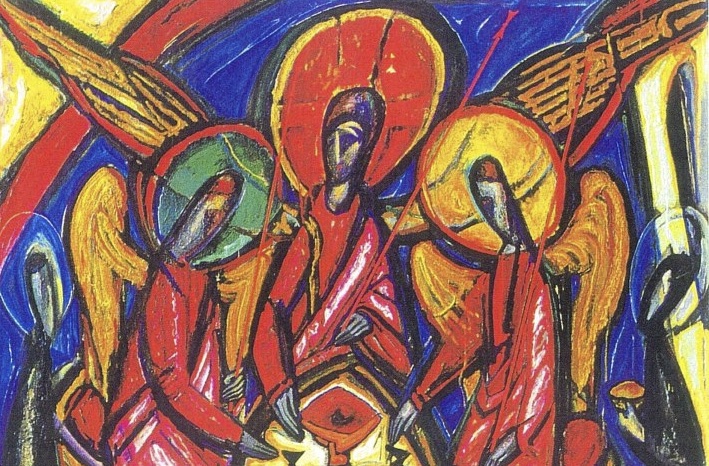
Trinity by Russian artist Alek Rapoport (1933-1997)
I wrote to the church, but Diotrephes, who loves to be first, will not welcome us. So, when I come, I will call attention to what he is doing, spreading malicious nonsense about us. Not satisfied with that, he even refuses to welcome other believers. He also stops those who want to do so and puts them out of the church.
Dear friends, do not imitate what is evil but what is good. Anyone who does what is good is from God. Anyone who does what is evil has not seen God. Demetrius is well spoken of by everyone—and even by the truth itself. We also speak well of him, and you know that our testimony is true. (NIV)
I believe in an egalitarian world. That is, humanity is meant to live, ideally, in equity with one another. Humility, meekness, and gentleness are to be the inner dispositions of a person’s life. These virtues work themselves out in being concerned for the common good of all, laboring toward just and righteous ways of living for everyone and sharing our lives as well as our resources with each other. In short, viewing one another as equals inevitably leads to gracious hospitality.
However, in a world of power disparities and privileged inequities are attitudes of seeking attention, a perceived need to always win and be first, and tight-fisted control of authority and money. The common good of all persons is scaled back to be the concern for the common good of some. There is a failure to regard the weak, poor, and vulnerable as legitimate members of the community.
The Apostle John wrote his short succinct letter in a concern that the church may be following a leader who was taking them down a bad path – a road leading to injustice where power and privilege remain with a few, and perhaps even one. John’s plainspoken exhortation was to judge rightly between what is good and bad, and then imitate the good while forsaking the bad.
Hospitality is the true litmus test between the good and the bad. An openness to the stranger, the immigrant, the migrant, the alien, the foreigner, the newcomer, and the outsider characterizes authentic fellowship. Being closed to such persons and having a xenophobic bent to others who are different is the mark of unwelcoming and inhospitable people. Hospitality serves others, whereas being inhospitable cajoles others to serve our needs.
Even Jesus, the Lord of all, did not come to this earth for people to serve him. He came to serve others and to give his life to save many people (Matthew 20:28; Mark 10:45; John 13:1-17). We are to imitate the loving service and radical hospitality of the Lord Jesus. He is our example. We are to imitate Christ.
We are to have both orthodoxy (right belief) and orthopraxy (right practice). Both go together like a hand in a glove. Good actions are to be the result of good and proper beliefs. The following are some thoughts about this nexus between belief and practice:
Hospitality (which literally means “love of the stranger”) is a way of life fundamental to orthodox Christianity, based in the person and work of Jesus.
God is hospitable and loves the outsider, welcoming them into the dance of the Trinity, and provides for them. Our human hospitality is to reflect this divine welcome.
Hospitality means extending to another a kindness typically reserved for family or friends.
The teaching of the New Testament emphasizes the practice of hospitality, i.e. Luke 14:12-14; Matthew 25:31-46.
The consistent witness of the Church in history is to lift and uphold Christian hospitality. For example, the Reformer John Calvin said, “Whatever person you meet who needs your aid, you have no reason to refuse to help them.” This was no mere theoretical advice for Calvin, whose ministry center of Geneva, Switzerland swelled with French Huguenot refugees fleeing persecution. Calvin, always the theologian, grounded his understanding of hospitality in the divine: “We should not regard what a person is and what they deserve but we should go higher – that it is God who has placed us in the world for such a purpose that we be united and joined together. God has impressed the divine image in us and has given us a common nature, which should incite us to provide one for the other.”
Hospitality is a practice which integrates both respect and care. St. John Chrysostom warned his congregation to show “excessive joy” when offering hospitality to avoid shaming the recipient of care.
Biblical hospitality does not need to know all the details of someone’s life before extending care. If Christ forgave and healed those who injured him, how could we neglect even a starving murderer?
True hospitality involves a face-to-face relationship of encouragement and respect – not just a distant giving of alms. Hospitable persons pay attention to others and share life with them.
The great twin concerns of hospitality are universalizing the neighbor and personalizing the stranger. One reason why many of the rich have little sympathy for the poor is because they seldom visit them. Hospitality depends on us recognizing our commonalities with strangers rather than our differences.
This is how we evaluate our hospitality: Did we see Christ in them? Did they see Christ in me?
Hospitable God:
Give us eyes to see the deepest needs of people.
Give us hearts full of love for our neighbors as well as for the strangers we meet.
Help us understand what it means to love others as we love ourselves.
Teach us to care in a way that strengthens those who are sick.
Fill us with generosity so we feed the hungry, clothe the naked, and give drink to the thirsty.
Let us be a healing balm to those who are weak and lonely and weary by offering our kindness to them.
May we remember to listen, smile, and offer a helping hand each time the opportunity presents itself. And may we conspire to create opportunities to do so.
Give us hearts of courage to risk loving our enemy.
Inspire us to go out of our way to include outsiders.
Help us to be welcoming and include all whom you send our way.