Hebrews 13:20-21 – Conflict and Peace

Pretty Place Chapel Blue Ridge Mountains
Pretty Place Chapel in the Blue Ridge Mountains

May the God of peace,
who brought back the great shepherd of the sheep,
our Lord Jesus,
from the dead by the blood of the eternal covenant,

        equip you with every good thing to do his will,
by developing in us what pleases him through Jesus Christ.
To him be the glory forever and always. Amen. (CEB)

These verses are the benediction, that is, the blessing given at the end of a long letter to a group of struggling Jewish Christians. In fact, things were so difficult for these believers that they were giving serious consideration to reneging on their commitment to Christ. So, the author of Hebrews sent them an exhortation and an encouragement to remain true and steadfast to the faith.

What is needed is not a shrinking back from faith but instead an enduring faith which is sustainable for the long haul of a person’s life.

The believers had both inner and outer conflict. They were experiencing hardship and persecution in the form of confiscation of their property and public insults. The Christians had started out well, facing such trouble with confidence through standing side-by-side with others who were suffering as well as holding on to their vibrant faith.

Yet, over time, their resolve began to break down. A slow drift occurred. Eventually, they started to retreat from the helping of others. They emotionally and spiritually inched their way to becoming despondent to the point of questioning whether all this Christianity stuff was worth it. The outer conflict worked its way inside their souls and damaged their spirits. By the time the writer of Hebrews comes along, a group of Christians are stuck in discouragement.

It’s one thing to deal with trouble and hardship on one day, even two. It’s quite another thing when that difficulty does not let up – when days turn into weeks, weeks into months, even months into years.

There are times when peace seems to have about as much chance of being realized as winning the lottery.

Yet, God is the God of peace, real lasting harmonious spiritually restful peace. It was achieved through the life and death of Jesus. The peace Jesus has brought is so much more than the absence of conflict. God’s peace is freedom from fear and anxiety. It is a settled confidence deep down inside that God will ultimately make good on all his promises and that things will not always be this way.

Until that day comes, God is not sitting in some divine Lazy-Boy recliner watching old reruns of the Angels playing baseball. Rather, God is active through carefully, deliberately, and, to our occasional consternation, slowly equipping us and developing us into spiritually fortified people who do the will of God and please Jesus in everything they do and say. Jesus is the Great Shepherd of the sheep who will not lead us astray but will settle us in green pastures.

The word translated “equip” is a rich word (Greek καταρτίσαι, pronounced “cot-ar-tids-ay”) which means to set something straight. Picture a bone which has been broken and needs to be reset and have time to heal. That is what God is doing in his people – repairing broken spirits. This divine healing is equipping believers for a lifetime of handling adversity with faith, confidence, and endurance. The process, frankly, hurts and requires patience before healing and health come.

If God can raise the dead, he can most certainly handle any earthly trouble we are going through.

God is in the transformation business. Extreme makeovers are his specialty. He uses hard circumstances, troubles, and torments of our lives and bends them into divine tools to form and shape his people to both survive and thrive in the world.

Complaining spirits, blaming and shaming others, and impatience borne of unrealistic expectations are the evidence of damaged emotions, wounded souls, and weak faith. This is the antithesis of God. He’s not overlooking humanity with a divine *sigh* in exasperation. That’s because he is the God of peace who is bringing all things to a conclusion in Christ. Jesus will come to judge the living and the dead. The Holy Spirit is now and very presently active to heal damaged emotions, repair wounded souls, and strengthen faith.

In those times when God seems absent and prayers seem to bounce off the ceiling are the times that God is establishing peace and expanding our capacity for faith and patience.

Benediction, blessing, and doxology come through the dark night of the soul and not by avoiding it.

Soli Deo Gloria. To God be the Glory.

Almighty God,
all thoughts of truth and peace
proceed from you.
Kindle in the hearts of all people
the true love of peace.
Guide with your pure and peaceable wisdom
those who take counsel
for the nations of the earth;
that in tranquility your kingdom
may go forward,
till the earth is filled
with the knowledge of your love;
through Jesus Christ our Lord. Amen.

–From the Book of Common Order of the Church of Scotland, St. Andrew Press.

Click It Is Well with My Soul by TenTwoSix Music and arranged by David Wise.

Psalm 100 – Knowing God

scenic photo of castle during dawn
Photo by Felix Mittermeier on Pexels.com

Shout for joy to the Lord, all the earth.
     Worship the Lord with gladness;
come before him with joyful songs.
Know that the Lord is God.
It is he who made us, and we are his;
we are his people, the sheep of his pasture.

Enter his gates with thanksgiving
and his courts with praise;
give thanks to him and praise his name.
For the Lord is good and his love endures forever;
his faithfulness continues through all generations. (NIV)

The original use of this psalm was for the ancient Israelites approaching the temple to worship God.  Before worshipers ever came into the presence of the Lord, they were preparing themselves to encounter God through giving him thanks, using this very psalm.

When David and other Hebrew writers penned their poetic songs, they would center what they most wanted to draw attention to in the middle, so that what came before it and after it pointed to that central message. The center of Psalm 100 is verse 3: Know that the LORD is God.

There are three imperatives (commands) that come before this phrase; and, three imperatives that come after it.  All six imperatives are meant to help us know God better. “Shout” for joy to the LORD. “Worship” the LORD with gladness. “Come” before him with joyful songs are the three that lead us up to knowing the LORD.  “Enter” his gates with thanksgiving; “give thanks” to him; and, “praise” his name all come after the central command to “know that the LORD is God.” We belong to God. As God’s people we celebrate this tremendous knowledge with actions meant to impress God’s gracious inclusiveness firmly into us.

There perhaps is no better biblical way to experience God than through these six words: shout; worship; come; enter; give thanks; and praise. Declaring loudly of God’s character and works; kneeling and prostrating before God; approaching God’s throne with boldness; immersing oneself into the presence of God; voicing aloud gratitude to God; and, praising God’s holy name are all heartfelt actions of the faithful. These pious activities are to happen here on earth as they are always done in heaven. It’s what folks with a settled sense of belonging do.

To “know” God is to experience him through close relationship. It means we have a place and a purpose. It is a knowing and belonging which exists deep down in our gut. We get to know God by how he has worked in people’s lives, as well as our own. So, gatherings of believers (whether physical or virtual) are an opportunity to engage in the six imperatives of today’s psalm. Faithful worshipers deeply desire to focus on who God is and what he has done, remembering and rehearsing his qualities and deeds. Through this activity, we help one another know the Lord.  And knowing God is what real life is all about.  He is worthy of all the praise, adoration, and worship we can give to him.  So, let us praise God with heartfelt thanksgiving.

One of my favorite verses in the Bible has to do with knowing God. The Apostle Paul said, “I want to know (to experience with his entire being and not just with his mind) Christ and the power of his resurrection and the fellowship of sharing in his sufferings, becoming like him in his death.” (Philippians 3:10, NIV)

Everything in our lives, whether good or bad, is designed to help us know God better.  Shared experiences with each other encourage us to keep living for Jesus.  So, let us express gratitude today for all the gracious ways God has revealed himself and reached out to save such ones as us.

Almighty God, who works on my behalf, give me grace to put away the rootless existence of one who has no place; and, help me to experience and know your radical acceptance and inclusion into the dance of the Trinity – Father, Son, and Spirit, one God, now and forever. Amen.

Click Psalm 100 (Enter In) for a time of praise and thanksgiving to God.

Acts 2:42-47 – The Community of the Redeemed

Welcome, friends! I hope you sense the great communion of all the saints past and present during this unique time. Simply click the video below, and let us worship God together with glad and sincere hearts.

You can also view this video at TimEhrhardtYouTube

Click Filipino Choir for an 8,600 community voice expressing their praise to God.

Be safe. Be strong. Be spiritual. We’re all in this together.

Luke 15:1-7 – One Lost Sheep

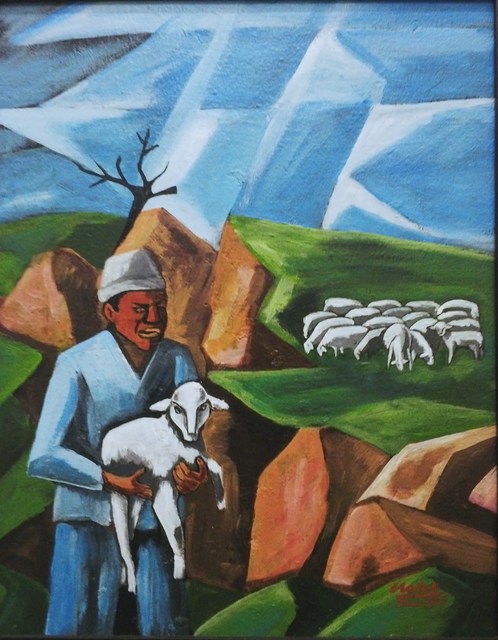
The Shepherd and the Lost Sheep
“The Shepherd and the Lost Sheep.” By Peter Clarke, 1969

A lot of men and women of doubtful reputation were hanging around Jesus, listening intently. The Pharisees and religion scholars were not pleased, not at all pleased. They grumbled, “He takes in sinners and eats meals with them, treating them like old friends.” Their complaining triggered this story:

“Suppose one of you had a hundred sheep and lost one. Wouldn’t you leave the ninety-nine in the wilderness and go after the lost one until you found it? When found, you can be sure you would put it across your shoulders, rejoicing, and when you got home call in your friends and neighbors, saying, ‘Celebrate with me! I’ve found my lost sheep!’ Count on it—there’s more joy in heaven over one sinner’s rescued life than over ninety-nine good people in no need of rescue. (MSG)

Lost people matter to God.  They matter so much to him that one lost soul found is the grounds for a big celestial party.  Please note this simple observation of today’s Gospel reading: If there is rejoicing in the presence of angels in heaven over one sinner who repents, then who is doing the rejoicing?  God!  God himself is crazy giddy with joy over one lost person being found.

Celebration is an important activity for the Christian. God throws the best parties, filled with plenty of joy and recognition of persons restored to fellowship. As people created in the image and likeness of God, we are hardwired for celebration. If God can go uncorked with joy and celebration, I’m going to say with confidence that open unabashed blowouts rejoicing over people’s transformation and new life is welcome and expected. Folks baptized in pickle juice can join the grumbling of all the high mucky-muck dudes who smugly look down on the marginal persons among us. Hopefully, the party-poopers won’t be heard because of all the noise at God’s party.

This parable of Jesus is meant to give us a glimpse of God’s own heart.  He would do anything to find a lost person, to restore and reconcile a person back to himself.  God would go dumpster diving and wade through the stinky nasty garbage to find that one lost valuable person.

Why should reaching out to marginal people with the grace and love of Jesus Christ be a high priority?  Because restoring lost people is a high priority for God.  God has placed the highest of priorities on recovering those who are spiritually lost and wandering around life without a purpose or a place to call home. Such people matter so much to him that God sent his Son, the Lord Jesus, to this earth.  Jesus went to the greatest lengths possible through enduring a cruel death on a cross in order to reconcile a broken lost relationship between people and God.

I can still remember what it felt like to be separated from God and estranged from the church – it was lonely and sad, like being in a deep black hole with no way of getting out and no one around to help.  But God, in his great mercy, sent spiritual commandos to extract me from my captivity of the soul. So, my greatest desire is to live my life basking in the grace shown to me, grateful for new mercies which come every day, and giving that same grace to others – especially those considered as the lost, the least, and the lonely in society.

In leaving the ninety-nine and going after the one sheep, God gave preferential attention to the lost. So, because of this, I ask a sincere and probing question which I believe needs to be asked:  Can you live with that?  My own answer is: “I sure can, because I was once that lone lost sheep!”

Jesus, you are the Good Shepherd.  Thank you for going after me when I was lost.  Help me to remember that you will often leave my pasture to go after others. I’ll be willing and happy to go with you when you do. Let’s also take the Spirit with us.  Amen.

Click Compassion Hymn by Keith and Kristyn Getty to remember the lengths of love God went to in restoring us.