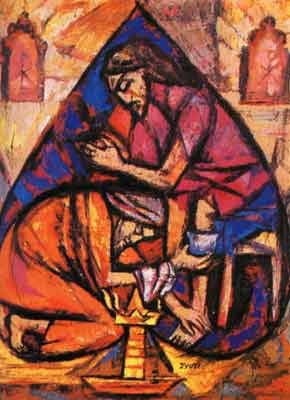
Psalm 31:9-16 – Lord, Have Mercy

Christ in Gethsemane by Michael O’Brien

Have mercy on me, Lord, for I am in distress.
    Tears blur my eyes.
    My body and soul are withering away.
I am dying from grief;
    my years are shortened by sadness.
Sin has drained my strength;
    I am wasting away from within.
I am scorned by all my enemies
    and despised by my neighbors—
    even my friends are afraid to come near me.
When they see me on the street,
    they run the other way.
I am ignored as if I were dead,
    as if I were a broken pot.
I have heard the many rumors about me,
    and I am surrounded by terror.
My enemies conspire against me,
    plotting to take my life.

But I am trusting you, O Lord,
    saying, “You are my God!”
My future is in your hands.
    Rescue me from those who hunt me down relentlessly.
Let your favor shine on your servant.
    In your unfailing love, rescue me. (New Living Translation)

One of my parishioners from years ago had seen hard combat in Italy during World War II. He saw his best friend killed, right next to him. I still remember his story and what he said in conclusion to it, in his own sage way: “In my experience, war is a very poor way of dealing with problems.”

And yet, we sometimes find ourselves embedded in circumstances we neither wanted nor asked for. Just ask the Ukrainians. No one puts their name on a sign-up sheet for suffering. Yet not a one of us can avoid it. 

Pain comes in all kinds of forms. Maybe the worst kind of suffering is the wound inflicted from others looking down at you when you’re already experiencing trouble and damaged emotions. 

Whether it is an ethnic or racial group of people facing ridicule, anger, and even beatings or death; or whether it is refugees trying to survive the ravages of war, the physical effects of pain can oftentimes be secondary to the primary hurt experienced within the spirit. 

“Suffering is part of the human condition, and it comes to us all. The key is how we react to it, either turning away from God in anger and bitterness or growing closer to Him in trust and confidence.”

Billy Graham

The Old Testament character, David, knew first-hand about suffering through hard circumstances. There were times when he felt completely overwhelmed by the evil machinations of people trying to take his life. If we could put ourselves in David’s sandals, we can understand why he was worn-out to the point of not sleeping, not eating well, even with a hint of paranoia. 

David responded to his seemingly impossible situation by entrusting himself to God. He truly believed he was in the Lord’s hands – and that fact was David’s go-to truth. 

Crossing over into the New Testament Gospels, Jesus uttered his last words on the cruel cross from this today’s psalm: “Father, into your hands I commit my spirit” (Luke 23:46). 

The cross was an obvious place of extreme bodily pain. That wretched pain, however, was dwarfed by the great spiritual pain of holding the entire world’s hurts and their curse of separation. The stress of both body and soul must have been crushing for Jesus. 

Yet, there was a strength of assurance, for Jesus, in the eye of that pain – the confidence of knowing he was in good hands, just like David’s confidence a millennium before.

There are times in life when we all struggle with why particular afflictions happen to us, in whatever form they might take in us. 

It is in the situation of being forgotten by others that we are most remembered by God.

It is within the crucible of trouble that God is the expert in deliverance.

It is when others revile us, say terrible things about us, and talk behind our backs that God comes alongside and whispers words of grace and steadfast love to us. 

It is whenever life is downright hard that we see a soft-hearted God standing to help us and hold us. 

While we are feeling our awful suffering, God is carefully crafting within us resilience through the rejection, empathy in our loneliness, purpose because of the trauma, forgiveness out of the shame, courage from having been failed, and self-awareness in the wake of emotional devastation. 

The biblical psalms are the consummate place to go when we are most in need. They provide the means to lift heartfelt prayers whenever our own words fail us. 

The psalms give us structure and meaning when the world around us makes no sense. 

The psalms do not always give us answers to our most vexing questions; they do, however, point us to the God who is attentive to the least, the lost, and the lonely.

Together, as people sharing the human condition of suffering, we cry out, “Lord, have mercy. Christ, have mercy. Lord, have mercy on us and grant us your peace. Amen.” 

Hebrews 2:1-9 – Pay Attention

We must pay the most careful attention, therefore, to what we have heard, so that we do not drift away. For since the message spoken through angels was binding, and every violation and disobedience received its just punishment, how shall we escape if we ignore so great a salvation? This salvation, which was first announced by the Lord, was confirmed to us by those who heard him. God also testified to it by signs, wonders and various miracles, and by gifts of the Holy Spirit distributed according to his will.

It is not to angels that he has subjected the world to come, about which we are speaking. But there is a place where someone has testified:

“What is mankind that you are mindful of them,
    a son of man that you care for him?
You made them a little lower than the angels;
    you crowned them with glory and honor
    and put everything under their feet.”

In putting everything under them, God left nothing that is not subject to them. Yet at present we do not see everything subject to them. But we do see Jesus, who was made lower than the angels for a little while, now crowned with glory and honor because he suffered death, so that by the grace of God he might taste death for everyone. (New International Version)

In my line of work as a hospital chaplain on a behavioral health unit, I frequently deal with patients who have brain disorders. Many of them, including many in my own family, have Attention Deficit Disorder (A.D.D.). Many people believe this to be a disadvantage.

Yet, I have noticed that since their brain chemistry doesn’t have a good filter for sifting all the stimuli they hear each day, many A.D.D. folks are quite intentional about picking out the voice they want to hear and engaging with it. Whereas others might take this for granted, the patients in my life know the value of creating the skills to pay attention.

The ability to pay attention and listen is necessary for a successful and sustainable Christian life.

The consequence of not developing such competency is that we will drift away – our minds will wander and allow other competing voices to overwhelm the singular voice of Jesus. Taking salvation for granted may subversively set us up for spiritual failure.

Whenever we think we already know about Christ’s person and work, we neglect to really pay attention. Bad idea.

Assuming we are paying attention is not the same thing as actually doing it. Assumptions create a slow drift away from truth. Therefore, we need continual reminders of Christ’s redemptive events. 

We must avoid the precarious position of being lost in a sea of competing voices.

We need an intentional plan for paying attention – without assuming we will be focused. Here are a few ways of daily mindfulness so that we will not become S.A.D.D. (Spiritual Attention Deficit Disorder):

  • Read Holy Scripture each day with a combination of standing and sitting, reading silently and out loud.
  • Hold a cross or other Christian reminder in your hand and feel free to fidget with it.
  • Journal your thoughts in a notebook.
  • Set a consistent time and place for spiritual reading and prayer.
  • Use different translations and versions of the Bible to read.
  • Go outside occasionally and pray while walking.
  • Focus on your breathing, and consider using breath prayers (i.e., Breathe out: “Speak Lord.” Breathe in: “I am listening.”)
  • Drink some coffee, tea, or something soothing, and picture the comfort of Christ coming into your life.
  • Be aware of distractions and acknowledge them without judging yourself.
  • Observe the Christian Year and the Daily Lectionary.

While some might argue that observing Lectionaries, the Church Calendar, Christian seasons, and worship liturgies are vain repetition, I insist otherwise: We are in grave danger of not paying attention to what we have heard, lest we drift away from it. 

Like a beach-goer on the lake drifting on her flotation device far out from shore, we can be unaware of how far we have strayed from our spiritual moorings.  If the passion and death of Jesus can only get a shoulder shrug and a “meh” out of us, there is a real problem.

Forming habits of worship, fellowship, service, and piety are essential to deliberately maintaining attention to Jesus. Perhaps if we all felt S.A.D.D. we would be more intentional about grafting reminders and practices into our lives.

Ignorance does not come from a lack of education; it comes from a failure to pay attention to the most important things in life.

God pays attention to us in a special way, different from all other creation. As the only creatures for whom the image and likeness of God resides, we have an innate sense of connection with the divine. Paying attention to things, especially to what Christ has secured for us through the cross, reflects the God who is continually observing humanity.

May your contemplation of Christ and his redemptive events of incarnation, holy life, teaching, death, resurrection, and ascension be always fresh and continually meaningful.

God, as You speak through scriptures, whispers, dreams, circumstances, nature, and people in our lives, help us to pay attention to Your voice. May we hear You in the many ways You communicate. May we pay attention to the important and the urgent and may we choose wisely. May we live attentively today.

Habakkuk 3:2-15 – Coming to Grips with Injustice

Statue of the Prophet Habakkuk, by Donatello c.1425 in Florence, Italy

I know your reputation, Lord,
and I am amazed
    at what you have done.
Please turn from your anger
    and be merciful;
do for us what you did
    for our ancestors.

You are the same Holy God
who came from Teman
    and Paran to help us.
The brightness of your glory
    covered the heavens,
and your praises were heard
    everywhere on earth.
Your glory shone like the sun,
and light flashed from your hands,
    hiding your mighty power.
Dreadful diseases and plagues
marched in front
    and followed behind.
When you stopped,
    the earth shook;
when you stared,
    nations trembled;
when you walked
    along your ancient paths,
eternal mountains and hills
    crumbled and collapsed.
The tents of desert tribes
in Cushan and Midian
    were ripped apart.

Our Lord, were you angry
with the monsters
    of the deep?
You attacked in your chariot
    and wiped them out.
Your arrows were ready
    and obeyed your commands.

You split the earth apart
    with rivers and streams;
mountains trembled
    at the sight of you;
rain poured from the clouds;
    ocean waves roared and rose.
The sun and moon stood still,
while your arrows and spears
    flashed like lightning.

In your furious anger,
    you trampled on nations
to rescue your people
    and save your chosen one.
You crushed a nation’s ruler
and stripped his evil kingdom
    of its power.
His troops had come like a storm,
hoping to scatter us
    and glad to gobble us down.
To them we were refugees
    in hiding—
but you smashed their heads
    with their own weapons.
Then your chariots churned
    the waters of the sea. (Contemporary English Version)

“Willfulness must give way to willingness and surrender. Mastery must yield to mystery.”

Gerald G. May

Tucked away in the Old Testament is the little prophecy of Habakkuk. Yet it packs a punch of a message. 

The prophet was distressed over the corruption of his people, Israel. So, he complained to God about it. God responded by informing Habakkuk that judgment was coming to sinful Israel through the pagan Babylonians.

This was not what Habakkuk expected. The prophet grumbled even more about the fact that the Babylonians were much more evil than the Israelites. The Babylonians needed judgment, too! (Habakkuk 1:2-17)

Today’s Old Testament lesson is Habakkuk’s struggle to come to terms with what God was doing. He remembered the Lord’s mighty deeds and miraculous actions from the past. God brought justice to Israel and judged the powerful Egyptians.

It seems that Habakkuk wanted God to make right the corruption of Israel, but not to do it in the same way that pagan nations are handled.

“The most difficult thing I have ever had to do is follow the guidance I prayed for.”

Albert Schweitzer

We all must come to grips with the cost of justice, of truly making things right and turning corruption and oppression around. Sometimes, maybe most times, implementing justice will impact everyone in an adverse way. For there is no realistic scenario in which someone gets to call for justice, then doesn’t have to live with the consequences – even if that someone isn’t culpable for the unjust actions.

You see, we are all inextricably connected to one another. We are of the same human family. We truly are our brother’s and sister’s keeper. We don’t get to shout or throw rocks from a distance and have everything magically change with no cost to us, personally.

It took the prophet Habakkuk awhile, but he finally resolved to live without having any closure. Instead, he took the stance of faith that he had always taken. Because when all is said and done, whether we like a particular outcome, or not, we must all live by faith, trusting in the sovereign God who always does what is right.

And here is the conclusion the prophet settled upon:

Though the fig tree does not bud
    and there are no grapes on the vines,
though the olive crop fails
    and the fields produce no food,
though there are no sheep in the pen
    and no cattle in the stalls,
yet I will rejoice in the Lord,
    I will be joyful in God my Savior.

The Sovereign Lord is my strength;
    he makes my feet like the feet of a deer,
    he enables me to tread on the heights. (Habakkuk 3:17-19, NIV)

Even though the circumstances were bad, and got worse, even dire, yet the prophet chose to rejoice in the Lord. He took the path of radical trust through suffering and hardship.

One of the most significant faith experiences we can ever have is to come to the point of complete trust in God so that our happiness is not dependent upon good circumstances. 

The truth is that the believer’s joy and spiritual security is independent of what is going on around them. Even though situations might be difficult, even evil, the faithful can still rejoice because they do not need everything to go their way in order to experience happiness.

Joy is neither cheap, nor easy. Total trust in God can only really come through a serious and open engagement, even argument, with God. And the place of contentment comes from a consistent, persevering, and constant interaction with God – just like Habakkuk did.

O Lord, we are at the limits of our power to effect any sort of change, help, or service. For what we have left undone, forgive us. For what you have helped us to do, we thank you. For what must be done by others, lend your strength. Now shelter us in your peace which passes our understanding. Amen.

1 John 2:18-28 – Who Is the Real Enemy?

Dear children, this is the last hour; and as you have heard that the antichrist is coming, even now many antichrists have come. This is how we know it is the last hour. They went out from us, but they did not really belong to us. For if they had belonged to us, they would have remained with us; but their going showed that none of them belonged to us.

But you have an anointing from the Holy One, and all of you know the truth.I do not write to you because you do not know the truth, but because you do know it and because no lie comes from the truth. Who is the liar? It is whoever denies that Jesus is the Christ. Such a person is the antichrist—denying the Father and the Son. No one who denies the Son has the Father; whoever acknowledges the Son has the Father also.

As for you, see that what you have heard from the beginning remains in you. If it does, you also will remain in the Son and in the Father. And this is what he promised us—eternal life.

I am writing these things to you about those who are trying to lead you astray. As for you, the anointing you received from him remains in you, and you do not need anyone to teach you. But as his anointing teaches you about all things and as that anointing is real, not counterfeit—just as it has taught you, remain in him. (New International Version)

Identifying the Antichrist is almost a spectator sport amongst some Christians. They seem to enjoy advancing particular persons as the archenemy of Christ and the Church.

Throughout Christian history, bloodthirsty kings and ruthless dictators have typically received the moniker of Antichrist. When the Protestant Reformation came along, five-hundred years ago, the Catholic Church often got labeled as the great enemy of Christianity.

The mudslinging that has gone on between different Christian traditions throughout the centuries can make any contemporary political war look like a powder puff football game.

Although some Christian groups tend to view the antichrist as a single enemy, setting-off a bomb of world-ending trauma, the earliest Church, following the teaching of the Apostle John, understood antichrist not as an individual, but as a class of people who deny Jesus is the Christ. 

It has become much too vogue in some circles of Christianity to identify and label enemies outside their small groups, leading to a xenophobic attitude of distrust and finger-pointing toward all kinds of people.


The fingers, however, must first be directed within our own house. It behooves us all to take up the instruction of John to let what we have heard from the beginning abide in us. If what you heard from the beginning abides in you, then you too will abide in the Son and in the Father. 

We are to embrace basic core cardinal truth given us. Then we will not be deceived by some supposed enlightened teacher who detracts from Trinitarian theology.

It is the last hour – but not because of some politician, tyrant, or religious figure. It is the end-times because Jesus has accomplished redemption for us, and the only event left is the return of Jesus to judge the living and the dead. 

Therefore, we must all live with the possibility and tension that it could be today. We are to be prepared. Proper preparation comes through proclaiming Jesus in all we say and do – not by obnoxiously ginning up fearmongering through pointing fingers at those we don’t like. Rather, we emulate our Lord in the way of loving God and neighbor.

When a person or group gets labeled by us as “enemy” or “antichrist” then our hate for them seems divinely justified and sanctioned. God, however, is the judge; not us. We are to follow the ethical instruction of Jesus to love our enemies, not curse them through declaring certain persons a “monster,” “devil,” “animal,” or some other non-human label.

Weaponizing words in a verbal war, which supposedly defends Christianity, only shifts the focus off Jesus and onto how horrible another is.

One of the great problems in our world, including many corners of Christianity, is that we assume we already know what another believes. So, we fail to listen. We cannot care as we ought because we’ve already formed our judgment.

“The moment someone attaches you to a philosophy or a movement, then they assign all the baggage and all the rest of the philosophy that goes with it to you. And when you want to have a conversation, they will assert that they already know everything important there is to know about you because of that association. And that’s not the way to have a conversation.”

Neil deGrasse Tyson

Within Christianity, there is more we have in common across the various traditions, than that which is different. Yes, spiritual charlatans exist. Let’s just make sure we have done our due diligence in listening to another and being curious before we form our opinions.

Despite the differences, the exchange of ideas and debate among various Christian groups in the early centuries of the church helped to clarify and form a sound Christology. While it may be difficult to avoid labeling individuals in an increasingly complex society, we must act in good faith and make the effort.

Perhaps we have already met the real enemy… us.

Gracious God, you are the Divine Gardener who cares for us with love. You call us to see the beauty of each branch united to the vine, the beauty of each person united to you in Christ through the Holy Spirit.

And yet, too often the differences in others make us afraid. We withdraw into ourselves. Our trust in you is forsaken. Enmity develops between us. Come and direct our hearts. Help us to live from your forgiveness so that we may be together and praise your name.

Lord Jesus, Prince of Peace, light the fire of your love in us so that suspicions, contempt and misunderstanding cease in the church. May the walls that separate us fall. Amen.