Get a Different Perspective (Isaiah 29:1-12)

Woe to you, Ariel, Ariel,
    the city where David settled!
Add year to year
    and let your cycle of festivals go on.
Yet I will besiege Ariel;
    she will mourn and lament,
    she will be to me like an altar hearth.
I will encamp against you on all sides;
    I will encircle you with towers
    and set up my siege works against you.
Brought low, you will speak from the ground;
    your speech will mumble out of the dust.
Your voice will come ghostlike from the earth;
    out of the dust your speech will whisper.

But your many enemies will become like fine dust,
    the ruthless hordes like blown chaff.
Suddenly, in an instant,
    the Lord Almighty will come
with thunder and earthquake and great noise,
    with windstorm and tempest and flames of a devouring fire.
Then the hordes of all the nations that fight against Ariel,
    that attack her and her fortress and besiege her,
will be as it is with a dream,
    with a vision in the night—
as when a hungry person dreams of eating,
    but awakens hungry still;
as when a thirsty person dreams of drinking,
    but awakens faint and thirsty still.
So will it be with the hordes of all the nations
    that fight against Mount Zion.

Be stunned and amazed,
    blind yourselves and be sightless;
be drunk, but not from wine,
    stagger, but not from beer.
The Lord has brought over you a deep sleep:
    He has sealed your eyes (the prophets);
    he has covered your heads (the seers).

For you this whole vision is nothing but words sealed in a scroll. And if you give the scroll to someone who can read, and say, “Read this, please,” they will answer, “I can’t; it is sealed.” Or if you give the scroll to someone who cannot read, and say, “Read this, please,” they will answer, “I don’t know how to read.” (New International Version)

Reading the Bible may sometimes feel like a weird Catch-22. We’re supposed to read, observe, and obey the contents of Holy Scripture; yet there is so much within it that we often just plain don’t understand – and even are not going to understand, at least on this side of heaven.

For many people, this is maddening. It may even cause them to throw up their hands and say that God is some mad scientist who merely tinkers and experiments with people like mice in laboratory.

I understand how some could think that way. The Lord comes along and does a mysterious dance of proclaiming judgment, then pivoting quickly around to assure deliverance. Reading through any prophetic book of the Old Testament is likely to make our heads spin with questions and our hearts to reel. No matter how you slice it, there are a lot of difficult passages in Holy Scripture.

So, I invite you to take a few differing perspectives.

First, if God is a Being who is infinitely higher and greater – the Creator who has made all things – then we are the creatures who are neither privy to all God’s reasonings nor even able to understand such a Being who is other than us.

Second, it seems we rarely even attempt to try and see things from God’s angle. We see our own situations, many of them confusing, and we wonder why the Lord doesn’t just step in and fix all the crud. However, none of us has the full picture, as God does – which is why we are continually invited to pray for wisdom, to see our life, relationships, and circumstances from a divine perspective. (James 1:2-5)

The prophet Isaiah, along with the other prophets, proclaims a double message of judgment and deliverance. Indeed, it appears there is a continual rhythm of identifying guilt and giving grace throughout a large chunk of the Old Testament.

And that is perhaps where we need to pay attention. People have a great predilection for saying and doing things (or failing to say and do things) which bring guilt. Our guilty actions and inactions are not okay; they cannot simply be dismissed as stuff that people do, as if we were just silly folks who don’t know any better.

Maybe we would like to view God as some geriatric grandfather who lets everyone do what they want, but that’s not the God we get in the Bible.

No, our words and actions have real impact and consequences for others. And the Lord is a real force to contend with, for whom we cannot escape nor ignore for long.

In Isaiah’s day, the people were called to account for their abject callousness toward their fellow humanity. God’s commands all have to do with living in harmony with creation. Chaos, disorder, and systemic evil result whenever the creature rebels against the Creator by trying to be a little god of their own making – taking the perspective of using people rather than serving them.

The Lord will have none of it; God will intervene. Hence, the judgment portions of Scripture. Yet, because God is gracious and loving, the judgment doesn’t last forever; mercy takes hold and overwhelms the guilty sinner.

If we could understand everything God does or doesn’t do, then God wouldn’t be God. But the very fact that God is mysterious, and in some ways unknowable, tells us that there is indeed a God.

Our task is not to take over God’s job because the Lord isn’t doing what we want. Our mandate is to reflect the image of God placed within us by loving the Lord and loving our neighbor as ourselves.

Yes, we are all guilty of a great many things. Yet, grace always has the last word, and not judgment. This, then, gives way to a life of gratitude that has learned to sync one’s heart with the heart of God.

Catch-22’s are certainly maddening… if we are truly in one to begin with. It could be that we just haven’t yet gained a different perspective on our situation, learned to accept it, and made the choice to live in harmony with the world as it is, rather than the world as we think it ought to be.

Most merciful God, we confess that we have sinned against you in thought, word, and deed, by what we have done, and by what we have left undone. We have not loved you with our whole heart; we have not loved our neighbors as ourselves. We are truly sorry and we humbly repent. For the sake of your Son Jesus Christ, have mercy on us and forgive us; that we may delight in your will, and walk in your ways, to the glory of your Name. Amen.

How To Live Well (Psalm 112:1-9)

By Stushie Art

Praise the Lord!
    Those who honor the Lord,
    who adore God’s commandments, are truly happy!
Their descendants will be strong throughout the land.
    The offspring of those who do right will be blessed;
    wealth and riches will be in their houses.
    Their righteousness stands forever.
They shine in the dark for others who do right.
    They are merciful, compassionate, and righteous.
Those who lend generously are good people—
    as are those who conduct their affairs with justice.
Yes, these sorts of people will never be shaken;
    the righteous will be remembered forever!
They won’t be frightened at bad news.
    Their hearts are steady, trusting in the Lord.
Their hearts are firm; they aren’t afraid.
    In the end, they will witness their enemies’ defeat.
They give freely to those in need.
    Their righteousness stands forever.
    Their strength increases gloriously. (Common English Bible)

To live well is to obey well. Well, that’s a thought! And a deep subject it is.

It’s a matter of whether we’ll take our cues for living from S. Hiney Wells or his brother, Russ T. Wells.

S. Hiney tells us this:

“Listen, my friends, the Lord’s commands are not made for drudgery. They’re how to be happy in this here life. Obeying what God says leads to blessings of family, security, contentment, and peace. God’s never failed to keep bacon in my frying pan, folks to help me out in a pinch, and a heap of hope for when I’m lower than a snake’s belly in a wagon rut.”

Russ T. tells us:

“Well, the world ain’t shiny at all. It’s all dark and covered in rust so thick you’d think nuthin’ good’s been used fer a coon’s age.”

S. Hiney responds: “Well, Russ T., there’s certainly a powerful lot of darkness everywhere; but that don’t mean there’s no light! Even a few little lightnin’ bugs helps us to see where we are in the night.”

Russ T. retorts: “Well, S. Hiney, them little bugs don’t help none when I’m brinin’ away in pickle barrel so full of vinegar that I don’t know whether I’m in the field or the henhouse.”

S. Hiney: “Well, now, fortunately we’ve got more than a few matches in our pockets. God’s own light shines so bright that it lights up the whole earth, a world-illuminating light that keeps every old fox away from the barn.”


Russ T.: “Well, that’d be mighty nice. But if that light’s so all-powerful, I ought to be able to see my hand in front of my face! All’s I see is a bunch o’ nasty weasels lurkin’ about, givin’ me a headache bigger than the Ozark Mountain Daredevils singin’ and playin’ on my tin roof while I’m tryin’ to sleep.”

S. Hiney: “Well, Russ T., I see it every time I lend money without any expectation of interest or return. I see it in my neighbor’s generous hand and sharing her prize winnin’ tomatoes and blue ribbon apple pies. And I mostly saw it with our dear mama’s teaching to “give until it’s gone, boys, not until it hurts,” rest her soul.

Russ T.: “I obeyed mama, bless her heart; she was one of the good ones. And I certainly didn’t wanna be on her bad side!”

S. Hiney: “Me, too. Her words of affirmation felt a lot better than those times when I was disobedient and found a willow switch on my behind! So, Russ T., were you happy listening to mama and doing what she said?”

Russ T.: “Well, now, I reckon I was. Things was a lot simpler and a lot less complicated when I listened to her. Whenever I didn’t, I felt like I was a polecat in the chicken house, like I didn’t much belong.”

S. Hiney: “My heart’s calculatin’ that your true love, the Lord God, is presently waitin’ on you to shake all that rust off so that he can give you a good shine on that soul of yours. But yer goin’ to have to listen, to obey what you hear, brother.”

Maybe because we tend to be all or nothing people, we often get hung up on either being perfect or being a failure. In reality, we are neither. We’re just simple folk trying to do our best in loving and serving the Lord with an obedient heart.

Christianity takes its cues in reading the psalms from Christ’s illumination. Jesus embodied the ideals of humanity, having neither material wealth nor actual physical descendants; yet he distributed gifts more generously than anyone ever did; and he has more spiritual progeny than anybody else.

Following in the way of Christ, we live in such a way that it is possible to be:

  • Poor and rich
  • Compassionate and competent
  • Gentle and shrewd
  • Gracious and tough
  • Giving and receiving
  • Faithful and doubting
  • Light and dark
  • Happy and sad
  • Vulnerable and powerful
  • Confident and scared
  • Brave and hesitant
  • Generous and just
  • Consistent and unpredictable
  • Mindful and forgetful
  • Weak and strong
  • Loving and questioning
  • Open to change and immovable

Living well means obeying well enough to see the best in others, seek the common good of everyone, and be resilient to deal with our personal foibles and the unforeseen pitfalls we sometimes experience.

What will you do when you’re in a pickle?

O God, whose blessed Son came into the world that he might destroy the works of the devil and make us children of God and heirs of eternal life: Grant that, having this hope, we may purify ourselves as he is pure; that, when he comes again with power and great glory, we may be made like him in his eternal and glorious kingdom; where he lives and reigns with you and the Holy Spirit, one God, for ever and ever. Amen.

Receiving Blessings or Woes? (Luke 6:17-26)

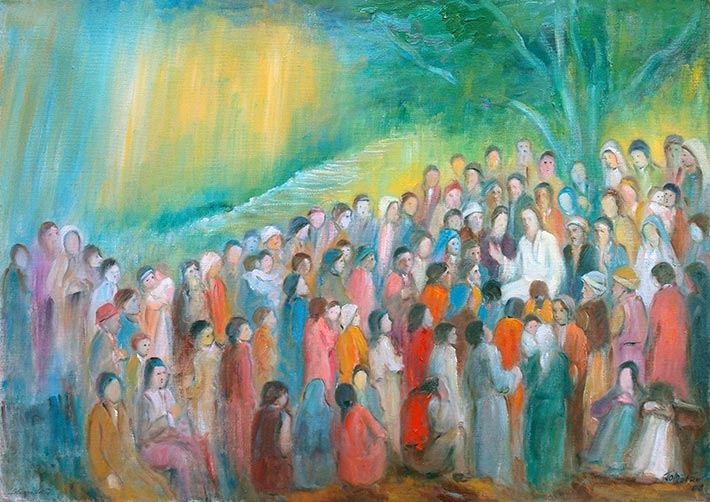
Ethiopian artist depiction of Jesus teaching

He went down with them and stood on a level place. A large crowd of his disciples was there and a great number of people from all over Judea, from Jerusalem, and from the coastal region around Tyre and Sidon, who had come to hear him and to be healed of their diseases. Those troubled by impure spirits were cured, and the people all tried to touch him, because power was coming from him and healing them all.

Looking at his disciples, he said:

“Blessed are you who are poor,
    for yours is the kingdom of God.
Blessed are you who hunger now,
    for you will be satisfied.
Blessed are you who weep now,
    for you will laugh.
Blessed are you when people hate you,
    when they exclude you and insult you
    and reject your name as evil,
        because of the Son of Man.

“Rejoice in that day and leap for joy, because great is your reward in heaven. For that is how their ancestors treated the prophets.

“But woe to you who are rich,
    for you have already received your comfort.
Woe to you who are well fed now,
    for you will go hungry.
Woe to you who laugh now,
    for you will mourn and weep.
Woe to you when everyone speaks well of you,
    for that is how their ancestors treated the false prophets. (New International Version)

There are double meanings throughout these words of Christ for us today; the expressions used by Jesus are specifically meant to be understood in two ways.

In order to speak to the people, Jesus went down with them and stood on a level place. In other words, the actual act of doing this is also to be understood as a means of identifying with others and getting on their level. The Lord intends not to speak down to people but to relate with folks alongside them.

The blessing of God is provided, up close and personal, not from afar. The word “blessed” is much more than a reference to physical health and wealth; it also refers to enjoying God’s stamp of approval on the whole of your life – body, mind, emotions, and spirit. And that is also what healing does for us; it effects the entirety of our being and not just one dimension of it.

To be “blessed” does not mean an absence of struggle. Indeed, blessings can and do rest upon us, even though we may be on the unfortunate end of someone’s hatred, exclusion, and defamation. It is to live through opposition, aware that our struggles are temporary and that our reward is great in heaven.

To have a “woe” pronounced means the opposite of blessing – to have God’s disapproval. It is to experience a curse – body, mind, emotions, and spirit – in the holistic sense.

The woeful may not experience apparent discomfort during this life. They mistake their wealth, their stuff, and their high connections as approval from God. However, they will find a fiery existence awaiting them. Apart from repentance and faith in becoming poor in spirit, their end is sure.

We are being led and guided to choose the way of blessing – and to avoid the path of woe.

Poverty, hunger, and weeping, on one level, are broad social categories. At another level, they are spiritual categories which describe the true follower of Jesus.

Christ’s church includes people who are poor, hungry, and weeping – in the full sense of the term. They, therefore, rely upon the community of the redeemed sharing all things in common as their means of provision. (Acts 2:44-45; 4:34)

We really need to avoid the temptation to make complex situations simple. To look upon those who now have wealth, eat well, laugh, and enjoy high standing, as under a curse from God, makes us simpletons who likely don’t understand what’s going on.

Others may make direct associations with wealth as blessing, which it may or may not be. And the same can be said for poverty and hunger – the presence of it doesn’t necessarily mean either blessing or woe.

The watershed issue is what we do with the life we have been given. Do the rich rely upon wealth or on God? Do the poor seek the Lord or just try to look for patrons who will help them? And do we all accept where we are right now and look to use whatever we have, and whoever we are, to benefit the benevolent and gracious kingdom of God?

We all may come from different places, have differing experiences, and be at various points along the continuum of poverty and wealth. Yet, we are all human and we are all in this life together.

So, we need to make the best of it with each other – instead of continually being at cross purposes with one another through simple stereotypes and hackneyed approaches based in little research or rational thought.

Jesus is leading us to a place of abundance, peace, and blessing – if we have ears to hear and minds receptive to his leading. It’s a place of healing; and not a place of woe. It is the realm of God, in which morality, ethics, kindness, and joy abound forever and ever.

Help us, O God, to heal those who are broken in body or spirit, and to turn their sorrow into joy. Grant this, Father, for the love of your Son, who for our sake became poor, Jesus Christ our Lord, who with you and the Holy Spirit are one God, now and forever. Amen.

Some Well-Ordered Wisdom (Psalm 37:1-17)

Don’t be worried on account of the wicked;
    don’t be jealous of those who do wrong.
They will soon disappear like grass that dries up;
    they will die like plants that wither.

Trust in the Lord and do good;
    live in the land and be safe.
Seek your happiness in the Lord,
    and he will give you your heart’s desire.

Give yourself to the Lord;
    trust in him, and he will help you;
he will make your righteousness shine like the noonday sun.

Be patient and wait for the Lord to act;
    don’t be worried about those who prosper
    or those who succeed in their evil plans.

Don’t give in to worry or anger;
    it only leads to trouble.
Those who trust in the Lord will possess the land,
    but the wicked will be driven out.

Soon the wicked will disappear;
    you may look for them, but you won’t find them;
but the humble will possess the land
    and enjoy prosperity and peace.

The wicked plot against good people
    and glare at them with hate.
But the Lord laughs at wicked people,
    because he knows they will soon be destroyed.

The wicked draw their swords and bend their bows
    to kill the poor and needy,
    to slaughter those who do what is right;
but they will be killed by their own swords,
    and their bows will be smashed.

The little that a good person owns
    is worth more than the wealth of all the wicked,
because the Lord will take away the strength of the wicked,
    but protect those who are good. (Good News Translation)

Today’s Psalm feels as if it could be in the book of Proverbs; it’s chocked full of wisdom sayings. And wisdom is most definitely something you, me, and the entire world needs. Indeed, we have enough fools around us running their mouths with a bunch of gobbledygook that’s nonsensical and meaningless.

We need helpful language and well-ordered words which reflect our ordered creation.

The underlying assumption of all biblical wisdom literature is that our world has been created by God with a material and moral order built into it.

That means that to buck this order is stupid and foolish. Somebody who walks off the roof of their house because they don’t believe in gravity will experience the harsh reality of that belief. Likewise, anyone who walks any old way they want in this world, without regard to the divine force operating within it, is going to experience a broken spirit.

Our human well-being depends on knowing the ordered creation we inhabit. There are social expectations which need to be realized in order to conform and be in sync with the natural (and supernatural!) universal rhythms all around us. Those expectations are framed for us as wisdom sayings.

Our actions and inactions have consequences. It’s our task to gain experiential knowledge as we move about this earth and interact with others. Notice I did not say we need to be perfect. No, instead, we are continually in a mode of improvement – seeking and learning to be better and do better.

And one of the things we all must discover is that our own personal actions and attitudes effects the entire surrounding community.

Biblical wisdom literature communicates how we receive blessing and how we hold onto it. True wisdom is to live in a responsible awareness of both Creator and creation – and then to make appropriate choices which will bless God and others.

So, in our Psalm for today, we have some wise choices to make that put us in the groove of how things are ordered and established:

  • Don’t worry about the evil simpletons around you. Why? Because in the Lord’s well-ordered world, the wicked cannot and will not survive; their end is certain, just as sure as death and taxes.

Those who are evil—
they are like straw
    blown by the wind.
Sinners won’t have an excuse
    on the day of judgment,
and they won’t have a place
    with the people of God.
The Lord protects everyone
    who follows him,
but the wicked follow a road
    that leads to ruin. (Psalm 1:4-6, CEV)

  • Trust the Lord. Everything changes. Everyone is fickle. Why trust? Because God, unlike everything and everyone else, is consistent, stable, and always true to character.

Trust God from the bottom of your heart;
    don’t try to figure out everything on your own.
Listen for God’s voice in everything you do, everywhere you go;
    he’s the one who will keep you on track. (Proverbs 3:5-6, MSG)

  • Be patient and wait on the Lord. Why? Because God is good, all the time, and has only good plans in mind for you and me. We short circuit what God is doing whenever we fail to have patience.

Be patient, then, brothers and sisters, until the Lord’s coming. See how the farmer waits for the land to yield its valuable crop, patiently waiting for the autumn and spring rains. You too, be patient and stand firm, because the Lord’s coming is near. (James 5:7-8, NIV)

The best things in life are internal, not external. One’s inner well-being, peace of mind, emotional awareness, and spiritual health are worth infinitely more than any title, position, wealth, or delusions of control.

A well-ordered life comes from tapping into the divine resources available to us.

Grant us patience, O Lord, to follow the road you have taken. Let our confidence not rest in our own understanding but in your guiding hand; let our desires not be for our own comfort, but for the joy of your kingdom; for your cross is our hope and our joy now and unto the day of eternity. Amen.

– A Prayer of St. Augustine