Rebellion In the Community (Numbers 16:1-19)

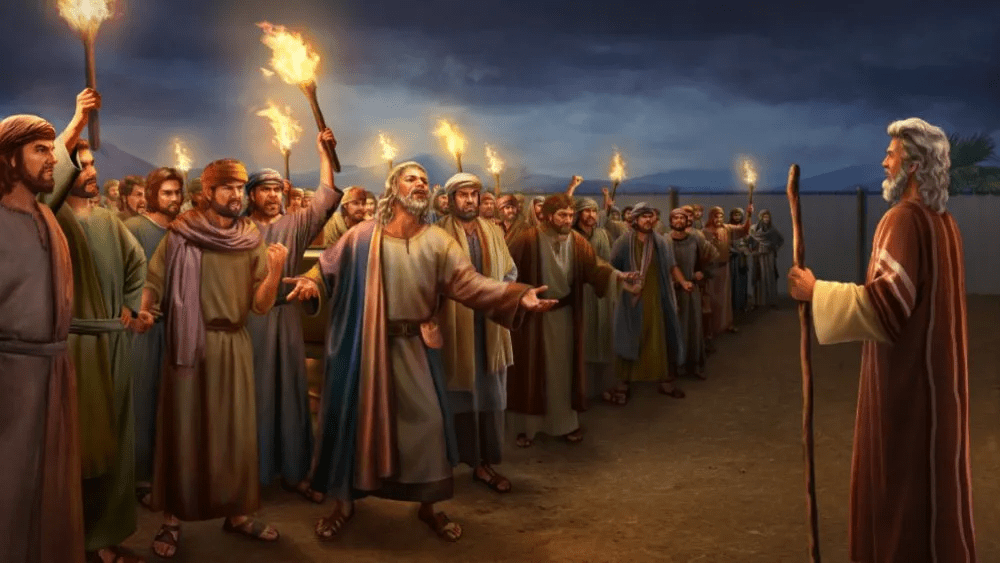
Korah and His Company Refuse to Obey Moses, by Wheatfield Media

Korah son of Izhar, the son of Kohath, the son of Levi, and certain Reubenites—Dathan and Abiram, sons of Eliab, and On son of Peleth—became insolent,and rose up against Moses. With them were 250 Israelite men, well-known community leaders who had been appointed members of the council. 

They came as a group to oppose Moses and Aaron and said to them, “You have gone too far! The whole community is holy, every one of them, and the Lord is with them. Why then do you set yourselves above the Lord’s assembly?”

When Moses heard this, he fell facedown. Then he said to Korah and all his followers: “In the morning the Lord will show who belongs to him and who is holy, and he will have that person come near him. The man he chooses he will cause to come near him. You, Korah, and all your followers are to do this: Take censers and tomorrow put burning coals and incense in them before the Lord. The man the Lord chooses will be the one who is holy. You Levites have gone too far!”

Moses also said to Korah, “Now listen, you Levites! Isn’t it enough for you that the God of Israel has separated you from the rest of the Israelite community and brought you near himself to do the work at the Lord’s tabernacle and to stand before the community and minister to them? He has brought you and all your fellow Levites near himself, but now you are trying to get the priesthood too. It is against the Lord that you and all your followers have banded together. Who is Aaron that you should grumble against him?”

Then Moses summoned Dathan and Abiram, the sons of Eliab. But they said, “We will not come! Isn’t it enough that you have brought us up out of a land flowing with milk and honey to kill us in the wilderness? And now you also want to lord it over us! Moreover, you haven’t brought us into a land flowing with milk and honey or given us an inheritance of fields and vineyards. Do you want to treat these men like slaves? No, we will not come!”

Then Moses became very angry and said to the Lord, “Do not accept their offering. I have not taken so much as a donkey from them, nor have I wronged any of them.”

Moses said to Korah, “You and all your followers are to appear before the Lord tomorrow—you and they and Aaron. Each man is to take his censer and put incense in it—250 censers in all—and present it before the Lord. You and Aaron are to present your censers also.” 

So each of them took his censer, put burning coals and incense in it, and stood with Moses and Aaron at the entrance to the tent of meeting. When Korah had gathered all his followers in opposition to them at the entrance to the tent of meeting, the glory of the Lord appeared to the entire assembly. (New International Version)

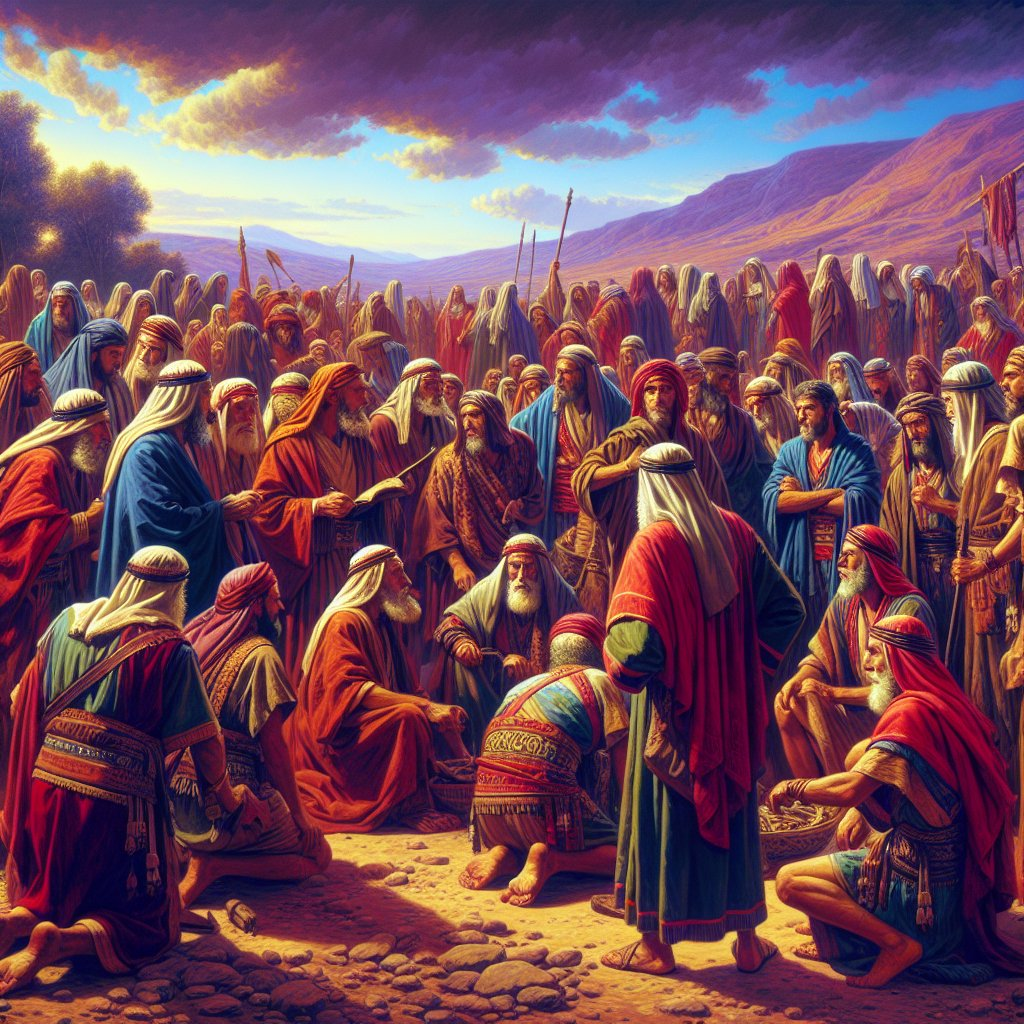
By Bible Art

I must admit that, having been a church pastor for decades, today’s story sounds eerily like several parishioners I’ve known over the years. They, along with the story’s antagonist Korah, strike me as ungrateful and continually concerned about angling for more power and authority within the community.

Rebellions are nothing new. They happen everywhere, from faith communities to neighborhood associations, from local politics to national governments.

The Book of Numbers is a rather depressing part of the Bible, largely because of the nature of the Israelite grumblings, without much gratitude happening.

The murmurings turned to complaints, and then to outright rebellion. It seems to have been a pattern with the Israelites in the desert. The animosities were directed against God or Moses, and sometimes both.

In each one of the various stories of rebellion in the desert, the rebellious people died in various ways by means of a plague, a fire, or in a battle. We get the sense with today’s story that a whopper of a divine judgment is going to happen.

The punishments mentioned in the Old Testament are meant to highlight, with rather strong illustrations, that the political and religious systems set up through the covenant code were divinely originated and sanctioned. In other words, don’t mess with God’s authority.

So then, a rebellion against Moses and Aaron was, in reality, a rebellion against God. And it would bring divine wrath on the rebels.

Having been in various leadership capacities in my life, to me the most insidious kind of rebellion is the subtle sort. Authority is challenged indirectly, in passive-aggressive forms through gossip, back-biting, and building a coalition from false information.

I also think that those subtle forms of rebellion really upset God. Which is why the Lord extended divine wrath on such rebels.

Korah was a Levite, like Moses. But that is about all he had in common with Israel’s leader. Korah’s rebellion was precisely directed against the leadership of Moses (and Aaron).

Similar to many arguments I’ve encountered throughout my ministerial life, Korah framed his argument with pious sounding language – as if Moses was the problem the one opposed to holiness.

Lord, have mercy. I really do despise religious gaslighting.

Korah implied that Moses was raising himself above the others, that the entire Israelite community was holy, therefore, there’s no need for a leader like Moses. The people’s holiness is enough. That’s all anybody needs, right?

Apparently, no.

Neither Moses nor Aaron dealt with the argument. Rather, Moses was satisfied to leave the matter with God as to what to do with the rebels.

It’s always good to let God reaffirm God’s own way of doing things. It was God who raised up Moses, and it would be God to whom Korah would have to answer.

The reason these sorts of situations keep popping up in every generation of history is that they deal with a problem which all humans encounter. Every person, group, faith community, and nation must contend with the tension between authority and freedom.

Like so many arrogant demagogues, Korah believed he was the guardian of freedom – and that the people ought to follow him. Yet, even though many did, the most important person in the room, God, did not.

Give peace in our time, O good and gracious God, a peace which the world cannot give. To those who have taken up arms in anger or revenge, or even in the cause of justice, grant the grace of conversion to the path of peaceful dialogue and constructive collaboration. And to those who are victims of human cruelty, open wide your arms and enfold them in the embrace of your compassion, healing, and life. Amen.

Third Sunday of Advent – The Ministry of John the Baptist (Luke 3:7-18)

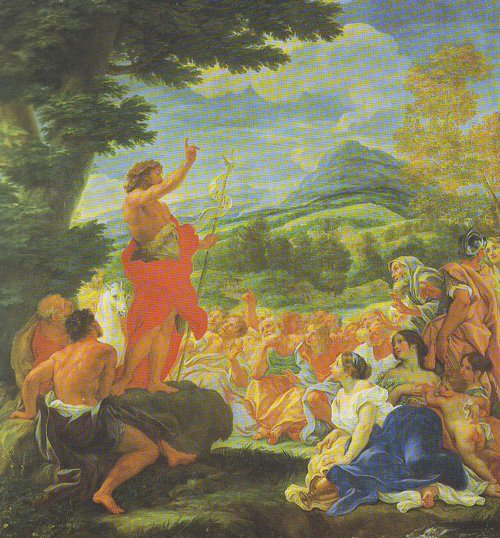
St. John the Baptist Preaching, by Giovanni Battista Gaulli (1639-1709)

John said to the crowds coming out to be baptized by him, “You brood of vipers! Who warned you to flee from the coming wrath? Therefore, bear fruits worthy of repentance, and do not begin to say to yourselves, ‘We have Abraham as our ancestor,’ for I tell you, God is able from these stones to raise up children to Abraham. Even now the ax is lying at the root of the trees; therefore every tree that does not bear good fruit will be cut down and thrown into the fire.”

And the crowds asked him, “What, then, should we do?” In reply he said to them, “Whoever has two coats must share with anyone who has none, and whoever has food must do likewise.” Even tax collectors came to be baptized, and they asked him, “Teacher, what should we do?” He said to them, “Collect no more than the amount prescribed for you.” Soldiers also asked him, “And we, what should we do?” He said to them, “Do not extort money from anyone by threats or false accusation, and be satisfied with your wages.”

As the people were filled with expectation and all were questioning in their hearts concerning John, whether he might be the Messiah, John answered all of them by saying, “I baptize you with water, but one who is more powerful than I is coming; I am not worthy to untie the strap of his sandals. He will baptize you with the Holy Spirit and fire. His winnowing fork is in his hand to clear his threshing floor and to gather the wheat into his granary, but the chaff he will burn with unquenchable fire.”

So with many other exhortations he proclaimed the good news to the people. (New Revised Standard Version)

John’s ministry was meant to be one of preparing people for the Lord’s coming. His understanding of that preparation may seem odd, even harsh, to us.

Yet, John believed that the coming of the Lord meant that Judgment Day was at hand. So, his words are consistent with that sort of theological understanding.

What John did not see at the time – nor anyone else, for that matter – was that the coming of the Lord was happening in two advents, and not just one.

The first advent, or coming, was the incarnation and earthly life of Jesus. This first coming is not yet the time for judgment. The second advent, however, will be all about judgment for both the living and the dead.

That reality, however, doesn’t mean John’s feisty words have no meaning for us. In fact, they have more meaning than ever, because the judgment he foresaw is still yet to come.

We need to hear John’s words, and have the ears to receive those words, because we are in a world that seems ripe for divine judgment.

Repentance – a change of mind and heart that leads to a new life of active justice (not judgment) – is the appropriate preparation for us in this current Advent season.

Amongst the crowds who gathered around John, some recognized how they had fallen short of loving God and neighbor. Some had a profound sense of failing to live faithfully. Others were overwhelmed and came to see and hear the Baptist preach.

Above all, however, John had a warning to the people about relying on their privilege as Jews. It isn’t pedigree that gets anyone anywhere in God’s kingdom.

Instead of putting faith in something like ethnicity or religious beliefs, people ought to be putting their efforts into living a good, right, and just life.

For us today, nobody can rely on special privileges either. It has always been humanity’s responsibility and obligation to love, not hate; serve, not always looking to be served; and showing mercy, not revenge.

The axe comes in many forms, yet it consistently exists to cut off something. Far too many persons, during this time of year, and especially in this season, feel cut off from family or friends. Many sense they are cut off from light, or sanity, as if the world is a surreal place filled with clowns and oligarchs who care nothing for others.

There’s a lot of suffering going on. And any threats of axes and separation are already a reality for too many persons. So, what are we to do with all these icky and unwanted thoughts, feelings, and situations?

John said to the crowd that they were to bear fruit that is worthy of repentance. That is a very biblically language-based way of saying that, for God’s sake, we had better start practicing forgiveness, and see one another from a different angle.

We need a changed viewpoint that leads to a changed heart and life.

There must be a new, or renewed, relationship with God.

If there is doubt about what to do, the answer lies within the problem:

  • For the money-hungry, don’t be greedy, but learn to give away resources
  • For those in authority, don’t abuse power through extortion, but learn to give it away, along with your wages
  • For those who talk a good line, don’t manipulate others, but learn to give your hands and feet to working for a better world, and for your neighbor next door

Learning how to change and be different in this season of Advent is the very best way of preparing to receive the Christ child at Christmas.

One greater than John is coming, with something better than anyone can imagine. It is the gift of a different baptism – fire and spirit – that breathes the power of God into everything it touches.

The axe may be at the root of the tree. There may already be plenty of separation and disconnection. But this year doesn’t have to end in disaster or destruction or disappointment.

You and I, along with everyone who calls on the name of the Lord, can experience deliverance from evil, and freedom to be the people we were always meant to be.

O God of the lost and the displaced, you promise restoration and wholeness through the power of Jesus Christ. Give us faith to live joyfully, sustained by your promises, as we eagerly await the day when they will be fulfilled for all the world to see; through the coming of your Son, Jesus Christ. Amen.

I Want To Know Christ (Philippians 3:7-11)

Jesus Christ and the Apostles, by Nikolas Martínez Ortiz de Zarate (1907-1990)

But whatever were gains to me I now consider loss for the sake of Christ. What is more, I consider everything a loss because of the surpassing worth of knowing Christ Jesus my Lord, for whose sake I have lost all things. I consider them garbage, that I may gain Christ and be found in him, not having a righteousness of my own that comes from the law, but that which is through faith in Christ—the righteousness that comes from God on the basis of faith. 

I want to know Christ—yes, to know the power of his resurrection and participation in his sufferings, becoming like him in his death, and so, somehow, attaining to the resurrection from the dead. (New International Version)

Whenever someone asks me what my favorite portion of Holy Scripture is, I reflexively turn to these verses in our New Testament lesson for today.

I resonate with these words from the Apostle Paul to the Church at Philippi, because they match what I truly believe, and how I really feel about Jesus.

We go through a lot of loss in this earthly life. We experience hardship and adversity. We grieve and lament.

Some of the losses in this life, we are okay with, or at least, we come around to being okay with them after a bit of time. Yet, there are other losses that are heartrending.

On the flipside, there are many gains we experience in this life. Some of them we worked very hard for, and others came to us as gifts.

Oftentimes, our gains and our losses are inextricably bound with each other. Something we consider precious is lost. We may even choose to set aside or give up something we have – we allow it become lost – so that we can gain something even better.

At other times, the process of gaining, losing, then gaining something good was not purposed by us, but by God.

And, to me, that’s probably the best sort of good there is.

Another way of putting the matter is: We must let go and accept how something or someone is, before we can experience what a truly good life really is.

Jesus, by Ghanshyam Gupta

Allow me, or please indulge me, as I frame the Apostle’s words in my own sort of language:

Anything in this life that I have achieved; anything I have come to possess; any sort of position or title I hold or have held; any kind of identification I have, or prestige  I have gained, is of no value. In reality, it’s all rather worthless.

If you will let me take it even further, compared to having an authentic, real, and experiential relationship with Jesus as my Savior, my Lord, and my Friend, everything else is like a bunch of garbage. That’s how much I value Jesus. There’s no other thing, no other relationship, that comes remotely close to knowing Christ.

It isn’t so much that I found Jesus, but that he found me. So, I have a faith that’s got nothing to do with keeping up appearances or rule-keeping, or keeping ahold of anything. I have the life that is truly life.

But, oh my, there is so much more to experience and to know with Jesus! I want to experientially know the power of Christ’s mighty resurrection. I  want to be like him, and participate with him, as if Jesus were living his life through me.

And, I must tell you, I know that this sort of life means suffering. But I also know that this suffering puts me in solidarity with my Lord – which is exactly where I want to be.

I only want to live up to who I’m supposed to be in Christ, to be my true self, and not some faux Christian living according to mere rules and regulations. The only thing that counts to me is faith expressing itself through love.

I understand that I took a lot of liberties with the text, and elaborated on it in order to make it my own. But, truth be told, we all need to find ways to make scripture as our own.

We all must let go of some old ways and unlearn a lot of things, in order to discover new life and be united with Christ. Everyone needs to learn from the past, so that we can live a new life here in the present.

If you don’t like my words, that’s fine. You aren’t under any obligation to read them. Yet, I do believe we have an obligation to Holy Scripture, and specifically, to ingest it as if it were the best meal you’ve ever eaten.

Indeed, we end up experiencing a lot of losses in this life. Yet, with Jesus, we will never lose him, because he will never forsake us. Christ is our eternal gain. He’s alive, always living, so that we need never be concerned about him not existing anymore.

That’s my faith. That’s what I trust in, or rather whom I put my faith in, and my trust upon. It’s all about Jesus. Anything less will not stand the test of time, nor of satisfaction in life.

What will you do with Jesus?

Christ isn’t going to strongarm you into the kingdom of God. But he will doggedly go after you, and be a pester pup in your ears and an ever-present sense in your heart.

You might as well go ahead and consider him, or perhaps reconsider him, like you’ve never done before.

After all, you’ve really got nothing to lose.

We believe in one Lord, Jesus Christ,

the only Son of God,
eternally begotten of the Father,
God from God, Light from Light,
true God from true God,
begotten, not made,
of one being with the Father;
through him all things were made.
For us and for our salvation
he came down from heaven:
was incarnate of the Holy Spirit and the Virgin Mary,
and became truly human.
For our sake he was crucified under Pontius Pilate;
he suffered death and was buried.
On the third day he rose again
in accordance with the Scriptures;
he ascended into heaven
and is seated at the right hand of the Father.
He will come again in glory to judge the living and the dead,
and his kingdom will have no end. – The Nicene Creed, on Jesus Christ

Be Prepared, For the Lord Is Coming (Luke 1:5-17)

The Angel Appearing to Zechariah, by William Blake, 1800

In the days of King Herod of Judea, there was a priest named Zechariah, who belonged to the priestly order of Abijah. His wife was descended from the daughters of Aaron, and her name was Elizabeth. Both of them were righteous before God, living blamelessly according to all the commandments and regulations of the Lord. But they had no children because Elizabeth was barren, and both were getting on in years.

Once when he was serving as priest before God during his section’s turn of duty, he was chosen by lot, according to the custom of the priesthood, to enter the sanctuary of the Lord to offer incense. Now at the time of the incense offering, the whole assembly of the people was praying outside. 

Then there appeared to him an angel of the Lord, standing at the right side of the altar of incense. When Zechariah saw him, he was terrified, and fear overwhelmed him. 

But the angel said to him, “Do not be afraid, Zechariah, for your prayer has been heard. Your wife Elizabeth will bear you a son, and you will name him John. You will have joy and gladness, and many will rejoice at his birth, for he will be great in the sight of the Lord. He must never drink wine or strong drink; even before his birth he will be filled with the Holy Spirit. He will turn many of the people of Israel to the Lord their God. With the spirit and power of Elijah he will go before him, to turn the hearts of parents to their children and the disobedient to the wisdom of the righteous, to make ready a people prepared for the Lord.” (New Revised Standard Version)

We have the story of John the Baptist in the New Testament Gospels. In today’s Gospel lesson, we have the events surrounding his conception.

John’s birth story and life’s narrative are deeply rooted in Old Testament promises of deliverance and divine connection.

John’s ministry was one of preparing people for the Lord. John was, in many ways, the prophet Elijah who was to come, as Jesus said about him:

As they were coming down the mountain [of Transfiguration], Jesus ordered them, “Tell no one about the vision until after the Son of Man has been raised from the dead.” And the disciples asked him, “Why, then, do the scribes say that Elijah must come first?” He replied, “Elijah is indeed coming and will restore all things, but I tell you that Elijah has already come, and they did not recognize him, but they did to him whatever they pleased. So also the Son of Man is about to suffer at their hands.” Then the disciples understood that he was speaking to them about John the Baptist. (Matthew 17:9-13, NRSV)

Just as John’s story only has meaning because of Israel’s history, so the story of Jesus is deeply connected to the Old Testament, as well. Jesus is very much related to Israel’s God.

Furthermore, the coming salvation that the Gospel writer Luke wrote about is not only for the glory of Israel; it will also be a revelation of light available to Gentiles.

So it ought to be no surprise to the reader that the angelic birth announcement of John is reminiscent of similar messages in the Old Testament about the coming of a special child. (Genesis 16:7-13; 17:1-22; Judges 13:3-20)

John’s parents, Zechariah and Elizabeth, appear in the narrative as solid citizens of Israel, reminiscent of ancient heroes like Abraham and Sarah. And much like their faithful ancestors, Zechariah and Elizabeth are told they will have a child in their old age.

Elizabeth having been barren all her life is no problem or issue for God. The Lord had done it before; and would do it again.

And the child to come, John, will resemble Old Testament heroes, especially the prophet Elijah. (Malachi 4:5-6)

The visitation to the old couple was a message designed to be lifted up for the entire world: The Lord is coming! Be prepared!

All of us find ourselves getting on in years. Certainly, I do, as a father and grandfather. Yet, at any age, even younger persons feel this. We grow as people. We move on from being a baby to a toddler to an adolescent, a teenager, a young adult, middle-aged, older, geriatric.

We continually age. Hopefully, with the aging process comes a bit of wisdom.

I’d like to think that old Zechariah and Elizabeth had learned enough wisdom over their life’s journey to embrace both the meaning and mystery of that life.

I believe they had a sense of what is, and had an acceptance of it. Yet, at the same time, they had a sense of hope and of what could be. And that’s because they knew something of God’s promises.

Not everything will remain as it presently is. All will change. Acceptance entails knowing this, that all things will be different. And this helps open us to all the possibilities of prayers rooted in ancient promises.

The angel told Zechariah that his prayer had been heard. We aren’t told exactly what Zechariah had prayed. But it seems it was a rather “pregnant” prayer, full of asking for a child of his own, as well as a Messiah to come, and an Elijah to come.

In that sense, Zechariah’s very full prayer was answered magnanimously.

Now, in the spirit of old Zechariah and Elizabeth, we have our own opportunity to offer an advent prayer. We have the privilege of hearing the message.

The Lord is coming. Be prepared.

“Surely I am coming soon.”

Amen. Come, Lord Jesus!

The grace of the Lord Jesus be with all the saints. Amen. (Revelation 22:20-21, NRSV)

Gracious God, guard our hearts and minds by the power of Christ Jesus. Speak to our anxieties with the peace that passes understanding and let our gentleness and joy be a sign of Christ’s gracious presence.

Through Christ, with Christ, in Christ, in the unity of the Holy Spirit, all glory and honor are yours, almighty God, now and forever. Amen.