Get Rid of Grumbling (Numbers 11:1-9)

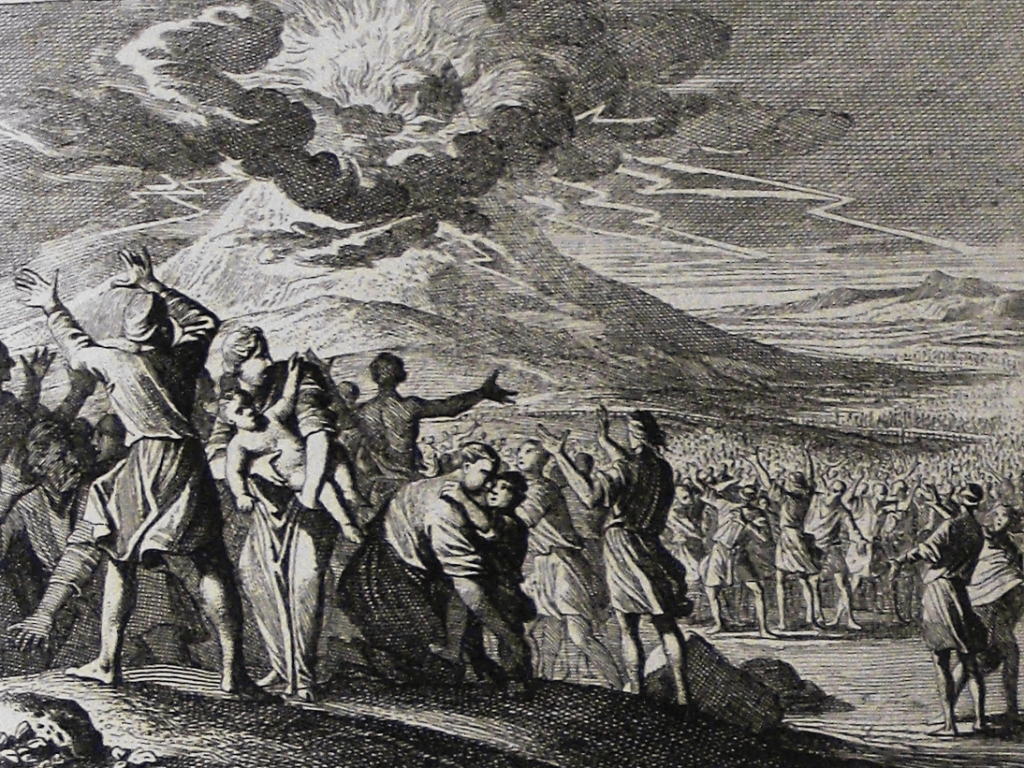
Now the people complained about their hardships in the hearing of the Lord, and when he heard them his anger was aroused. Then fire from the Lord burned among them and consumed some of the outskirts of the camp. When the people cried out to Moses, he prayed to the Lord and the fire died down. So that place was called Taberah because fire from the Lord had burned among them.

The rabble with them began to crave other food, and again the Israelites started wailing and said, “If only we had meat to eat! We remember the fish we ate in Egypt at no cost—also the cucumbers, melons, leeks, onions and garlic. But now we have lost our appetite; we never see anything but this manna!”

The manna was like coriander seed and looked like resin. The people went around gathering it, and then ground it in a hand mill or crushed it in a mortar. They cooked it in a pot or made it into loaves. And it tasted like something made with olive oil. When the dew settled on the camp at night, the manna also came down. (New International Version)

Some complaints are a form of lamenting a significant loss and expressing grief. That’s normal, even healthy, and to be expected. Many other complaints come in the form of grumbling, murmuring, and just plain old selfish bellyaching.

The latter type of complaining is clearly what was happening with the ancient Israelites. They were delivered from Egyptian slavery and now free. The people ought to be celebrating. But instead, the minute things are hard, they grumble. When the God-given food became commonplace and too plain for their pallets, the people whined and complained.

And it was the rabble rousers among them who got the whole community up in arms and grumbling.

The Apostle Paul understood that negative people only create more negative people – which is why he offered the church leader Titus some counsel about how to handle such persons: 

After a first and second warning, have nothing more to do with a person who causes conflict, because you know that someone like this is twisted and sinful—so they condemn themselves. (Titus 3:10-11, CEB)

Whenever a passion for power and control prevails over a desire for the common good of all people, then we have an issue of character. Stirring up antagonism against biblically-oriented, Spirit-directed change is demonic – and the real test of it is a constant stream of negativism which is secretive, remains in the shadows, relies on gossip and slander for its fuel, and hates being in the light.

Jesus said to be as shrewd as snakes and as innocent as doves because there are wolves among the sheep (Matthew 10:16). You will know them by their fruit. We are called not to participate in negative influences!  Individuals must be called-out for their chronic negative spirits. So, how do we do it?  How do we shut-out the negative?

Refuse it

Name it. Call it what it is: fighting against the Holy Spirit and attributing evil to the work of God (Matthew 12:30-32). When someone comes to you and wants to dish up a little “sumthin’-sumthin’” on somebody or something, refuse to take the bait. Refuse it and reject it.

Keep a group of friends who are positive, encouraging, helpful, and steer clear of antagonistic attitudes. It is extremely beneficial to both physical and spiritual health. In a study at Stanford University, a pair of researchers reviewed over 200 studies on group therapy and concluded that group members “develop close bonds with the other members and are deeply influenced by their positive acceptance and feedback.” In other words, negative thinking keeps people in bondage, whereas positive encouragement of others brings freedom and life.

Rebuke it

Someone might be speaking to you, start talking around some issue slowly, but eventually comes around to carving up another person like a Thanksgiving turkey. What do you do? Rebuke it. We can say something like, “When you continue to speak with such negativity about ______ I feel upset because I need to be in a place which helps me to spiritually grow. Will you please stop being so negative?”

I once had a person come to me not knowing how to deal with a negative person. I walked him through some biblical ways about confronting the negativity when it comes. He simply hung his head and said he could not do that. But he was miserable, which is why he came and talked to me. And he walked away with that same misery because he was not willing to call out a person on their destructive negativity.

You and I are in control of our own happiness. If another person causes us anger; if some politician drives us nuts; if a television program or radio show is upsetting me; then, it is our responsibility to keep away.

If we have a chronic negative person in our life, and have tried to deal with that person, and they refuse to listen, we can say something like this when they start their rant: “I don’t want to hear it. And if you keep bringing it up and being negative, I will walk out of the room.” The principle here is that we control our own behavior, not somebody else’s.

Redirect it

Satan is the author of negative antagonism. He talked trash about God in the garden to Adam and Eve. So, avoid getting caught up in trying to dialogue with a negative person. Redirect the negativity by calling the person to change their ways, because truth be told, the negativity is really rebellion against God.

If you are wondering, “I could never do that” then you likely have been telling yourself a lot of negative thoughts. God calls us to stamp-out the negativity before it can get started, even within our own brains. In some cases, we need to re-train our minds to focus on the positive, and not the negative.

It takes two to tango. Negativity cannot survive if there is no one to listen to it. We must stop being negative and stop listening to negative people; constant complaining creates divisions and scandals.

If there are people who chronically have negative speech and can never seem to say anything good about someone or something, then stay away from them. Have nothing to do with them. Do not participate in the divisive speech. Refuse it. Rebuke it. Redirect it.

God wants us righteous and robust, holy, and happy – not walking around like a grump who was baptized in pickle juice.

We can choose to fill our minds with gracious good news; pray positively about everything; and find the positive in all things. We can continually choose to cultivate unity, purity, peace, and love. That’s how we enjoy life together.

May it be so, to the glory of God.

Why Not Women? (Romans 16:1-16)

I commend to you our sister Phoebe, a deacon of the church in Cenchreae. I ask you to receive her in the Lord in a way worthy of his people and to give her any help she may need from you, for she has been the benefactor of many people, including me.

Greet Priscilla and Aquila, my co-workers in Christ Jesus. They risked their lives for me. Not only I but all the churches of the Gentiles are grateful to them.

Greet, also, the church that meets at their house.

Greet my dear friend Epenetus, who was the first convert to Christ in the province of Asia.

Greet Mary, who worked very hard for you.

Greet Andronicus and Junia, my fellow Jews who have been in prison with me. They are outstanding among the apostles, and they were in Christ before I was.

Greet Ampliatus, my dear friend in the Lord.

Greet Urbanus, our co-worker in Christ, and my dear friend Stachys.

Greet Apelles, whose fidelity to Christ has stood the test.

Greet those who belong to the household of Aristobulus.

Greet Herodion, my fellow Jew.

Greet those in the household of Narcissus who are in the Lord.

Greet Tryphena and Tryphosa, those women who work hard in the Lord.

Greet my dear friend Persis, another woman who has worked very hard in the Lord.

Greet Rufus, chosen in the Lord, and his mother, who has been a mother to me, too.

Greet Asyncritus, Phlegon, Hermes, Patrobas, Hermas and the other brothers and sisters with them.

Greet Philologus, Julia, Nereus and his sister, and Olympas and all the Lord’s people who are with them.

Greet one another with a holy kiss.

All the churches of Christ send greetings. (Romans 16:1-16, NIV)

The reason we have the “Captain Obvious” people in our lives, is that they simply point out something that is right under our noses we might miss. I’m playing the role of Captain Obvious. In today’s New Testament lesson are a group of women. Paul names, greets, thanks, and encourages several church leaders, and they are not all men:

  1. Phoebe is a deacon. She’s actually the representative who was sent to take Paul’s letter to the church at Rome and read it to the congregation.
  2. Priscilla is co-equal with her husband Aquila. Together they co-pastored a house church. She helped teach and mentor Apollos in Corinth.
  3. Mary
  4. Junia is an apostle. Paul states that she’s outstanding amongst them, of which also he is one.
  5. Tryphena and Tryphosa
  6. Persis is a dear friend of Paul.
  7. Julia

In the earliest church, within the New Testament Scriptures, women are mentioned as serving in every sort of capacity. And yet, women are the greatest and largest untapped resource in the church today.  

You might wonder why I would say such a thing, being that more women attend church than men. However, still in this day and age – removed 2,000 years from the biblical text – the reality for many churches around the world is that only men can hold positions of authority.  

The reasoning goes something like this: “The Bible says women can’t serve over men, so women can’t hold those positions.” Really?

So, a woman can serve as a CEO of a Fortune 500 company, can be elected as governor of a state, and can manage men on a factory floor, but that same woman cannot serve as an elder in many churches? I once asked a pastor that very question, and he answered with “Yes, because the Bible says so.”

I guess he never read Romans 16.

If you are of the belief that a church office is based on gender instead of the calling and gifting of the Spirit, then, methinks, it behooves us to ask these questions of the biblical text:

  • If women are not to exercise authority over men in the church, how do we account for actual women leaders in the Bible, such as Deborah, Huldah, Philip’s daughters, Priscilla’s role in Apollos’ life, not to mention the list of women leaders in Romans 16?  If our impulse is to say that these are exceptions because there were no men to “step up,” then what does that say about our theology? Is God not big enough to find a man to put into a position of leadership?
  • If we insist that women ought not to teach and be silent based on Paul’s letter to Timothy (1 Timothy 3:11-15) then why do we ignore Paul’s instruction that women are to publicly prophecy and pray? (1 Corinthians 11:5; Acts 21:9)
  • Doesn’t the prominence of women in the ministry of Jesus and Paul suggest something different than just having women tag along to teach children?
  • Just when does a boy become too old for a woman to legitimately teach him?  If women can’t teach men, why in the world would we ever think that they are the best teachers for boys?
  • How can we apply Galatians 3:26-28 (there is no male or female in Christ)? Are women the exception?
  • Does the Reformation doctrine of the priesthood of all believers only apply to men?  Doesn’t the absence of women in church leadership go against this?
  • Isn’t it weird and confusing that women have an equal vote in congregational decisions, even when a male leader is being elected and/or disciplined, when they aren’t supposed to exercise authority?

I could go on, but I think you get the picture; the absence of women in leadership is problematic, at best. It’s a problem because there are actually women leaders in the Bible. So, here is my unabashed, dogmatic, and biblical belief:  

All individuals are equally created in God’s image, and, therefore, have equal worth, privilege, and opportunity in Christ’s Church without any limitation, including gender.

In some churches and Christian denominations today, there are far too many wonderful Christian women who are exhausted and depressed because they are trying to live up to a certain expectation of being someone they are not. They suppress their gifts and calling because they believe they must prop-up the fragile male egos around them.  

They aren’t free to serve in leadership positions; and it’s eating them from the inside-out. These women think there is something wrong with them, but the reality is that there is something wrong with the whole system of male-only authority. And, what’s more, we are missing out on the blessing of God. It is high time we value all women, even those with gifts of leadership, by allowing them to serve without limitation.

I have a wife and three daughters. All of them are more intelligent, more gifted, and better leaders than me, the lone family male. To have them using their superior talents in the church by leading and serving is the least threatening thing to me on this earth. I love it that they can outdo me; it is my joy!  

Even more than that, I believe it is Christ’s joy, as well. We must be proactive in cultivating and nurturing the gifts and calling we see in women. They don’t need to be put in their place; instead, the good-old-boy system of the church needs to be put in its place so that men are practicing a leadership that sacrifices on behalf of making women’s leadership a priority.

Lord God, bless all women who daily strive to bring peace to their communities, their homes and their hearts. Give them strength to continue to turn swords into ploughshares. We pray for all women who face prejudice, inequality and gender disparities. Help us to see and to face the discrimination against women in all the many forms it may take.

Forgive all women and men who let differences breed hate and discrimination. Let your example of valuing all of creation help us to see that we are equal partners in the stewardship of your world. Help us to see the strength and goodness in all women and men. Amen.

The Parable of the Vineyard Workers (Matthew 20:1-16)

The Workers in the Vineyard, by Rembrandt, 1637

“For the kingdom of heaven is like a landowner who went out early in the morning to hire workers for his vineyard. He agreed to pay them a denarius for the day and sent them into his vineyard.

“About nine in the morning he went out and saw others standing in the marketplace doing nothing. He told them, ‘You also go and work in my vineyard, and I will pay you whatever is right.’So they went.

“He went out again about noon and about three in the afternoon and did the same thing. About five in the afternoon he went out and found still others standing around. He asked them, ‘Why have you been standing here all day long doing nothing?’

“‘Because no one has hired us,’ they answered.

“He said to them, ‘You also go and work in my vineyard.’

“When evening came, the owner of the vineyard said to his foreman, ‘Call the workers and pay them their wages, beginning with the last ones hired and going on to the first.’

“The workers who were hired about five in the afternoon came and each received a denarius. So when those came who were hired first, they expected to receive more. But each one of them also received a denarius.When they received it, they began to grumble against the landowner. ‘These who were hired last worked only one hour,’ they said, ‘and you have made them equal to us who have borne the burden of the work and the heat of the day.’

“But he answered one of them, ‘I am not being unfair to you, friend. Didn’t you agree to work for a denarius? Take your pay and go. I want to give the one who was hired last the same as I gave you. Don’t I have the right to do what I want with my own money? Or are you envious because I am generous?’

“So the last will be first, and the first will be last.” (New International Version)

Fairness

We humans have an innate sense of right and wrong, justice and injustice. We want life to be fair. It disturbs us when there is favoritism, discrimination, and preferential treatment. When things seem off, and others seem more privileged, envy can easily creep in and settle in our bones.

The envy can go even deeper. For example, is it fair that any child should struggle with health issues like cancer, epilepsy, and mental disorders? Is it fair to have healthcare disparities? Is it fair to have a spouse taken from you before their time? Is it fair to lose your job through no fault of your own? Is it ever fair to be treated like a second-class citizen?

Pat answers to people’s genuine struggles will not do, such as “You just need to work hard and hope for the best;” “We have to take what is given us and accept these things;” “Think of all those starving children in India;” or the more crass, “Suck it up buttercup; life was never meant to be a rose garden.”  Those statements are simply unhelpful.      

At the heart of envy is the belief that others are getting something that I deserve. “It isn’t fair!” we cry. Yet, God does not always operate according to our standards of fairness. God’s very nature is to be generous and full of grace. The parable which Jesus told about the vineyard workers is a story not of unfairness, but a story of generosity and grace. It’s all in how you look at it.

A normal workday in the ancient world was ten hours, not counting breaks. The workday began at 6:00am. A denarius was a typical day’s wage for laborers. The landowner went out at the third hour, 9:00am; the sixth hour, noon, etc. He kept returning to hire more workers even up to the last hour of the workday. Laborers were always paid at the end of the day.

In this parable, the last workers were paid first, which prompted the first workers hired to think they would be getting more, even though they had been promised a denarius. So, they grumbled about not getting more. They thought the landowner was not being fair.

Parable of the Workers in the Vineyard, by Johann Christian Brand, 1769

Complaining

Grumbling. Complaining. Murmuring. It is the bane of our existence. Decades ago, when gas station attendants still filled tanks for customers, I was working at a station and had a lady go berserk on me for not checking her oil and cleaning her windshield, because I did it for the car in front of her. Even though there was a sign right in front of her that said checking oil and cleaning windshields is only done upon request, the lady thought she was getting gypped. 

In truth, the landowner did not cheat nor defraud the workers in any way. He paid the agreed upon wage, just like he promised. Should he want to pay everyone the same even though the amount of work was different was his own business.

The problem was not with the owner, it was with the worker’s envy of the owner’s generosity toward the others. God distributes gifts because God is gracious, not because we have earned anything. Our standard of fairness is not the rule of the kingdom of God – grace is.

Grace

Deep down many believe we control our destiny, and that we save ourselves by what we do. We discern that if we serve God all our lives, in the end, God will reward us. We believe that our pious activities, our acts of service and our work for the Lord, will bring us salvation, or, at least a leg up in the kingdom of God over others who have not worked as hard or as long as we have. After all, we do the right thing.

So, what about those who have not figured out Christianity… those who do not have the correct or proper beliefs… or those who have not straightened out their lives? According to a worldview of human fairness, they are out of luck. They should be in church. They should work harder, faster, and better. Then, they could get their lives in order. If they would only understand fairness, we reason, then all would be well.

But there is a problem, because the parable of the workers told by Jesus seems to be saying that is not how it works at all.  Jesus seems to be saying that grace and grace alone saves, that God’s amazingly naïve and irresponsible grace is available to anyone and everybody. And that troubles the workers to no end. 

Parable of the Workers in the Vineyard, by Solomon Koninck, c.1648

What’s in it for me?

Whenever we run headlong into God’s unfair grace and see that God’s way of doing things is so far removed from our way, there is bound to be grumbling. After all, if God is going to run a vineyard like the one in the gospel lesson and give everybody the same pay regardless of their actual work hours, then what’s the use of getting up early in the morning to work? 

What is the good of sitting in church, listening to sermons from a crazy preacher who is no better than us, if these outsiders, these Johnny-and Jane-come-lately’s can waltz in at the last minute and receive the same treatment as the rest of us? For many church folks who diligently serve, it’s not fair to pay so much attention to outsiders and build ministry around people who aren’t even here, who don’t yet know Jesus.

The conclusion and point of the parable: The last will be first, and the first will be last. In Luke’s prodigal story, the elder brother grumbles and gripes: “All these years I’ve been slaving for you and never disobeyed your orders.  But when this son of yours who has squandered your property with prostitutes comes home, you kill the fatted calf!”  It is the firstborn son that complains. (Luke 15:11-32)

In both the parable of the prodigal son and the parable in today’s lesson, “good” people are the ones who fail to see the heart of the Father and of the landowner. The “firsts” got off track because, over time, they forgot the kingdom hinges on grace, not effort, on not simply doing the right things over a long period of time.

Who’s in control?

God controls the flow of mercy, not us. 

We might be surprised in heaven with those already sitting at God’s banquet table, and equally surprised with who is not there. Resentment can move us away from the table of mercy God is preparing. The problem comes whenever we think we are above other people.  We might be sinners, but we are not as bad as some other people are!  We commit ordinary sins, not mass murder!

Here is the unvarnished truth: God does not owe you nor I a thing, and God cares about all kinds of people, not just us and people who think and live like we do. Our hearts need to be big enough to center ministry around other people who are different than us.

If our hearts are small, we easily get jealous when God pays attention to prodigals and profligates. Grace becomes too repugnant a doctrine for us.

The gospel of Jesus Christ is about grace. Life is not all about being decent or even moral; and it is certainly not about our own goodness. The gospel is about being steeped in and surrounded by the grace of God in Christ, so that we, in turn, can show others grace. Grace is the way God deals with us beyond what we deserve or feel we have earned. 

Grace is unfair; we get what we do not deserve. 

May we allow God’s grace to so permeate our hearts and lives so that we will give it to others as freely as we have received.

Praise be to you, almighty and everlasting Father of our Lord Jesus Christ. In Christ, you have given us every spiritual blessing in heaven – you chose us before the world was made, and in love, to be your holy people. It pleased you to make us your own children through Jesus Christ. 

So we praise you because of your wonderful grace, given to us freely, in Christ, the one you love. We have forgiveness of sins because of this lavishly rich grace. Amen.

Jesus Intervenes (Matthew 19:23-30)

Orthodox depiction of Jesus and the rich young ruler

Then Jesus said to his disciples, “I assure you that it will be very hard for a rich person to enter the kingdom of heaven. In fact, it’s easier for a camel to squeeze through the eye of a needle than for a rich person to enter God’s kingdom.”

When his disciples heard this, they were stunned. “Then who can be saved?” they asked.

Jesus looked at them carefully and said, “It’s impossible for human beings. But all things are possible for God.”

Then Peter replied, “Look, we’ve left everything and followed you. What will we have?”

Jesus said to them, “I assure you who have followed me that, when everything is made new, when the Human One sits on his magnificent throne, you also will sit on twelve thrones overseeing the twelve tribes of Israel. And all who have left houses, brothers, sisters, father, mother, children, or farms because of my name will receive one hundred times more and will inherit eternal life. But many who are first will be last. And many who are last will be first. (Common English Bible)

We all have a chronic struggle and relapse with some besetting shortcomings. And we compulsively do them even though they harm us.

Whether it’s an addiction (alcohol, illicit drugs, etc.) or things we don’t readily notice as addictive (gossip, food, shopping) we need to be weaned off our damaging obsessions. In Holy Scripture, the most pervasive and compulsive vice is the addiction to wealth and money.

Everyone has their own unique tussle with money. If our initial knee-jerk reactions to money issues is to think of someone else (“I don’t have as much money as…” or, “So-and-so really has a problem with this…”) then this is what we call denial. Truth be told, all of us offer some disclaimer about how our trust is not in paychecks, bank accounts, and material stuff. For me, money buys books, of which my voracious appetite is never satiated.

Even people who truly have little money and scant resources can have an addiction to money. They think about money and wish for it to an unhealthy degree, as if wealth is the thing that will make them happy. Folks in denial rarely have any idea how much they harm others, themselves, and even God. In fact, the consistent witness of the early church fathers is that the sheer accumulation of stuff is the same as stealing from the poor.

Sometimes, because of denial, people need an intervention – and to be jolted back to their senses. Intervention is a gift. Someone cares enough to intervene. Yet, many interventions don’t work because the person can walk away and refuse to change.

Jesus performed an intervention with a rich young man (literally, a twenty-something). The young man was obsessed with wealth and money, but didn’t see it. He thought of himself as godly and spiritual. It’s really a sad story because the rich man walked away unchanged by his encounter with Jesus. He failed to see himself as desperately needing to change. He held to his denial. (Matthew 19:16-22)

Jesus and the Rich Young Man by Chinese artist, 1879

Jesus exposed the rich young man’s divided loyalties of trying to serve both God and money. He would have to choose between the two masters. And this is our choice, as well.

God wants an undivided heart and loyal allegiance. Jesus is looking for those who are poor in spirit and recognize their great need for God, rather than believing they are okay and just need to add a little Jesus to their lives. God wants spiritual beggars who understand their desperate situation and do not practice denial by sugar-coating their actual spiritual state.

Just like an addict who either cannot or will not give up the addiction, the rich young man would not give up his disordered love for money and possessions. So, Jesus intervened. Christ doesn’t ask everybody to do exactly as he called the rich young man to do. For example, Jesus asked neither the wealthy Zacchaeus to do it, nor the disciple Peter to sell his fishing business.

However, Jesus does ask all of us to do what seems impossible and let God meet our needs.

Christ had the original come-to-Jesus-meeting with his disciples in debriefing about his conversation with the rich man. If it is so impossible and so difficult for a rich person to be saved because his wealth gets in the way, who then can be saved, the disciples wondered? We cannot save or redeem ourselves. We need grace. We need help.

So serious is Jesus about this business of genuine discipleship, about what it really takes to follow God, that he repeated himself using a colorful illustration: It’s easier for a camel to go through the eye of a needle than for a rich man to enter the kingdom of God. 

Jesus wants us, who have lots of stuff, bank accounts, and money to see ourselves in the illustration. Only the discouraged, the hopeless, and the helpless will see their absolute need for grace and will seek the miracle of salvation Jesus offers.

Peter, always the big mouthpiece for the disciples, blurts out that they have left everything to follow Jesus. So, what then will there be for the disciples? What’s in it for me?

We may avoid the idol of money only to find ourselves with the idol of pride. Twentieth-century theologian, Reinhold Niebuhr, once said that a person had to achieve a great deal of good to be able to commit the sin of pride.

Yet, grace always has the last word. Jesus gives grace and assures us of reward even when we are stinkers by asking prideful questions. 

“The promise of a hundredfold recompense does not seem to square with experience. Usually those who for the testimony of Christ are deprived of parents or children and other relatives, or their marriage partners, or have lost all their money, do not recover but struggle out their life in lonely and deserted exile and in poverty. But I reply that if anyone rightly assesses God’s grace by which he alleviates the miseries of His children he will confess that is to be preferred to all the riches of this world.”

John Calvin

The first step in facing any harmful compulsion is to be honest about it – without telling our story in a way that makes us look surprisingly good so that others are pleased with us.

Life is about following Jesus. To follow Jesus, we must not be in denial. Perhaps the best way to express our faith is to tell someone about our obsessions to compulsively work in order to feel better and pad our savings; or that we are afraid to charitably give because we worry about the future; or that we love to buy things we don’t really need, so that we’ll feel better.

An honest awareness of our compulsions sometimes causes us to feel awful about ourselves. We may disparage ourselves for always screwing up, never saying “no” to others, or feeling unable to stop the anxiety.

Yet, grace abundantly overwhelms any and all addictions, shortcomings, and pride when it comes money or anything else. God has unlimited patience with people; Jesus never tires of inviting us to follow him. God’s love and acceptance is not based on our screw-ups, but on Christ’s forgiveness through the cross.

Allow the words of Jesus to sink deep into your life so that you ooze the grace of God in your life.

Camels cannot pass through the needle’s eye by means of dieting, positive thoughts, or luck. It happens not because the camel can squeeze through the narrowness of the needle’s eye but because there is a wideness in God’s mercy.

God’s grace will pull you through. Unlike the rich young man, once you hear and understand that piece of delightful news, you do not walk away sad but with boundless joy.

God of wisdom, help me in the mess of my finances; in my fear of taking charge of the resources entrusted to my care; in my preference for ignorance  over honest acknowledgment of the ways I use and fail to use my wealth; in my anxiety over debt, and in all the pressures of my financial life.  

Help me to take one step at a time toward honoring you through my use of money and honoring others from whom I buy and borrow. Make me humble to seek counsel, grateful for my abundance, prudent with my limited means, and patient with myself as I seek to be a better steward of all you have given me. Amen.