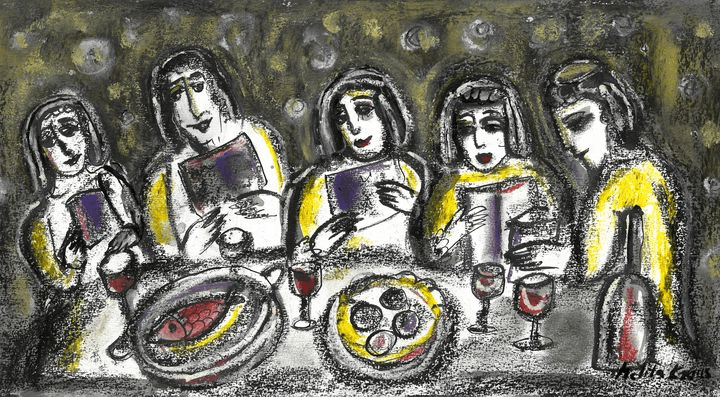
Justice Remembered (Exodus 12:1-13, 21-28)

Passover Seder, by Melita Kraus

The Lord said to Moses and Aaron in the land of Egypt, “This month shall mark for you the beginning of months; it shall be the first month of the year for you. Tell the whole congregation of Israel that on the tenth of this month they are to take a lamb for each family, a lamb for each household. If a household is too small for a whole lamb, it shall join its closest neighbor in obtaining one; the lamb shall be divided in proportion to the number of people who eat of it. 

Your lamb shall be without blemish, a year-old male; you may take it from the sheep or from the goats. You shall keep it until the fourteenth day of this month; then the whole assembled congregation of Israel shall slaughter it at twilight. They shall take some of the blood and put it on the two doorposts and the lintel of the houses in which they eat it. 

They shall eat the lamb that same night; they shall eat it roasted over the fire with unleavened bread and bitter herbs. Do not eat any of it raw or boiled in water but roasted over the fire, with its head, legs, and inner organs. You shall let none of it remain until the morning; anything that remains until the morning you shall burn with fire. 

This is how you shall eat it: your loins girded, your sandals on your feet, and your staff in your hand, and you shall eat it hurriedly. It is the Passover of the Lord. I will pass through the land of Egypt that night, and I will strike down every firstborn in the land of Egypt, from human to animal, and on all the gods of Egypt I will execute judgments: I am the Lord. The blood shall be a sign for you on the houses where you live: when I see the blood, I will pass over you, and no plague shall destroy you when I strike the land of Egypt….

Then Moses called all the elders of Israel and said to them, “Go, select lambs for your families, and slaughter the Passover lamb. Take a bunch of hyssop, dip it in the blood that is in the basin, and touch the lintel and the two doorposts with the blood in the basin.

None of you shall go outside the door of your house until morning. For the Lord will pass through to strike down the Egyptians; when he sees the blood on the lintel and on the two doorposts, the Lord will pass over that door and will not allow the destroyer to enter your houses to strike you down. 

You shall observe this as a perpetual ordinance for you and your children. When you come to the land that the Lord will give you, as he has promised, you shall keep this observance. And when your children ask you, ‘What does this observance mean to you?’ you shall say, ‘It is the Passover sacrifice to the Lord, for he passed over the houses of the Israelites in Egypt when he struck down the Egyptians but spared our houses.’ ” And the people bowed down and worshiped.

The Israelites went and did just as the Lord had commanded Moses and Aaron; so they did. (New Revised Standard Version)

The Exodus, by Yoram Raanan

Today’s story of Passover is the highlight of Jewish history concerning both God’s judgment and God’s justice. It is a continual reminder that God is concerned with the divine Name; with his people; and with providing them what they need.

The Lord’s tenth and final plague against the Egyptians was the ultimate judgment of taking their firstborn children. At the same time, the Lord extended great justice to the Israelites by removing the oppressive obstacles which hindered them from having their basic human needs met.

Both God’s judgment and God’s justice were to be annually remembered through rituals established by God. These remembrance rituals of Passover are meant to be brought perpetually to Jewish minds, so that they will maintain a high view of Gods’ Name, and also never be a nation who acts like the Egyptians.

Passover and Exodus constituted a new beginning and new life for Israel. Slaughtering the Passover lamb was the start of liberation for the people; along with the eating of unleavened bread. Both the blood of the lamb, and the absence of leaven, together communicated freedom to the Israelites from God.

Even today, nearly four millennia later, Passover is still celebrated amongst the Jewish community as a great festival of freedom. The primary ritual in this celebration is the seder, an evening meal which involves eating several symbolic foods.

The purpose of coming together to eat special foods is to relive the experience of the Exodus from Egypt. It is a time of passing down the people’s communal memory, as well as reflecting upon God’s divine redemption for them.

The Passover rituals are the root of Christianity’s celebration of communion at the Table. For Christians, the final seder meal of Jesus and his disciples at the Last Supper in the Upper Room is remembered and relived, so that believers may contemplate the Cross of Christ as the ultimate divine redemption.

Table fellowship for both religions – Judaism and Christianity – has a central place in ritual remembrance. God is acknowledged and praised as the great Liberator from oppression. Justice is memorialized. Past events are remembered in order to live justly and rightly in the present.

Deliverance of people from both physical and spiritual slavery is a grand theme throughout all of Holy Scripture. People of freedom are never to let themselves again be placed in bondage. The New Testament puts the matter this way:

For freedom Christ has set us free. Stand firm, therefore, and do not submit again to a yoke of slavery. (Galatians 5:1, NRSV)

The yearning for freedom from oppression and injustice lies within the breast of every human on this earth. It’s why people will go out of their way to use whatever means they have of standing against abusive powers.

It is more than ironic that there are people today who espouse themselves as Christian, yet are hell-bent on using whatever means they have to oppress and abuse others into submission. Such persons are not demonstrating care for the Name of God, especially not the Name of Jesus Christ. Instead, they have another agenda – one that has nothing to do with liberation and freedom.

This is one big reason why we need rituals. Rituals keep us remembering the things we need to remember, and help us forget the things we need to forget.

Earthly power is not the summum bonum of life. Rather, real power is Love. Again, quoting the Apostle Paul from the Book of Galatians:

For you were called to freedom, brothers and sisters, only do not use your freedom as an opportunity for self-indulgence, but through love become enslaved to one another. For the whole law is summed up in a single commandment, “You shall love your neighbor as yourself.” If, however, you bite and devour one another, take care that you are not consumed by one another. (Galatians 5:13-15, NRSV)

Indeed, all that really counts for us in this life is “faith expressing itself through love.” (Galatians 5:6)

Remembering true freedom, and it’s real cost, through established rituals, is perhaps the best way of ensuring that the oppression and injustice of empires like Egypt and Rome do not happen in our present day.

Therefore, if we lose connection with important and seminal events of the past without ritual remembrance, we are setting ourselves up for terrible injustice to occur.

We are better than that. Redemption and remembrance can help show us the way.

Great God of all justice, righteousness, and redemption: Continue to break the yoke of Pharaoh in our time, and forever shatter the bonds of human oppression.. Hasten the Day when we shall all be free, at the coming of your Son, our Lord, Jesus Christ, who with you and the Holy Spirit are one God, now and forever. Amen.

The Lord Will Grant Me Justice (Isaiah 49:1-7)

From the final of scene of “The Count of Monte Cristo,” 2002 film from Touchstone Pictures

Listen to me, coastlands;
    pay attention, peoples far away.
The Lord called me before my birth,
    called my name when I was in my mother’s womb.
He made my mouth like a sharp sword,
    and hid me in the shadow of God’s own hand.
He made me a sharpened arrow,
        and concealed me in God’s quiver,
    saying to me, “You are my servant,
        Israel, in whom I show my glory.”
But I said, “I have wearied myself in vain.
    I have used up my strength for nothing.”
Nevertheless, the Lord will grant me justice;
    my reward is with my God.
And now the Lord has decided—
    the one who formed me from the womb as his servant—
    to restore Jacob to God,
    so that Israel might return to him.
    Moreover, I’m honored in the Lord’s eyes;
    my God has become my strength.
He said: It is not enough, since you are my servant,
    to raise up the tribes of Jacob
    and to bring back the survivors of Israel.
    Hence, I will also appoint you as light to the nations
    so that my salvation may reach to the end of the earth.

The Lord, redeemer of Israel and its holy one,
    says to one despised,
    rejected by nations,
    to the slave of rulers:
    Kings will see and stand up;
    commanders will bow down
    on account of the Lord, who is faithful,
    the holy one of Israel,
    who has chosen you. (Common English Bible)

The Servant in today’s Old Testament lesson is referred to as Israel. Israel’s role is identified as being the covenant people of God. And Israel’s purpose is to be a light to the nations. It was the Lord’s intention that through this covenant community God’s glory would be revealed.

But in much of Israel’s history, this purpose and mission from God did not shake-out very well among the people. The prophets were sent to Israel’s leadership in order to point out the incongruence between Israel’s call from God from their actual lived experience.

Among the prophets, like Isaiah, was modeled for the people what they should have been doing all along: Persevering in faithful suffering for the sake of the surrounding nations. Yet, instead of embracing this difficult commission, Israel largely appropriated worship practices and dubious morality from the nations.

Whereas light was supposed to shine in the darkness, the light was hidden and the darkness overwhelmed it.

However, light cannot stay hidden for long. Servant Israel nonetheless discovered what it meant to suffer for righteousness sake. The Servant confessed having fallen short of God’s glory while also speaking confidently about God’s abiding faithfulness.

There is here a recognition by the Servant that Israel’s purpose and mission has not yet been fulfilled. A big task still awaits to bring forth justice to the nations.

Oftentimes, whenever we think of justice, we may tend toward believing that it refers to divine judgment, as if the task is to make sure the bad guys get it in the  end. But that’s a Western movie understanding in which the Sheriff puts some lead in the bandits bellies.

“Justice” in Holy Scripture refers to the good guys – that they receive what they need to live and flourish on this earth. Whenever food, clothing, housing, or basic human rights are withheld or ignored by those in power, that’s injustice. And God is most concerned that everyone receives proper justice, that is, having everything they need for life and godliness in this present evil age.

So, what God cares about, the Servant is to care about. Since God cares about justice, so the Servant is to work toward ensuring there is justice for all.

God has provided. It is the Servant’s task to use that provision and live into the vocation given by God. In other words, the Servant has been equipped to do the work. There’s no excuse for injustice.

Wrapped-up in this call for justice is making sure that the faithful in Israel bring back the unfaithful, so that everyone together might fully engage in God’s purposes for humanity and reach the nations with deliverance from all that stands in the way of justice.

God is continually on a mission of bringing back wayward people. It is the role of God’s people to honor and glorify God by fulfilling their divine call to the nations. The Lord desires restoration, and wants to work with people in a divine/human cooperative which establishes just practices for the common good of everyone on planet earth.

Real strength comes from the Lord. There’s empowerment for God’s people to return to their sense of vocation, to be a light to the nations, and to realize deliverance from injustice so that people may thrive and enjoy creation and the Creator forever.

No matter what the circumstances one faces in this life, everyone has the capacity to trust in God in the middle of their suffering and/or discouragement. It’s in this context that the light of God is best shown among the nations.

Others rarely take note of believers’ faith when things are going well. It’s easy to show faith when life is good. But when life is precipitous, when situations are dire, and the believer nonetheless has a genuine and confident trust that God’s justice will prevail, then the world takes notice of that kind of faith.

Right now many people are facing hardship and feeling powerless due to governmental interventions that they don’t want and didn’t ask for. It’s easy to become discouraged and to be fearful of what will happen.

I definitely feel it. I have a 36-year-old daughter who is a white Christian mother of three living in Minneapolis. Sound familiar? It’s people like my sweet girl who are getting oppressed, abused, even killed. It’s unjust and unrighteous.

God is looking for justice in the public square. God does not forget the downtrodden, the immigrant, the weak, and the powerless. And God holds those in power to account – whether they are using their resources for justice or injustice.

What I need to hear, and maybe you do too, is that ultimately God is still on the throne – and not any earthly ruler or president or national leader of any kind. God still cares about the needs of everyone. The Lord has a heart and a passion for justice for all, and not just some.

The Lord will grant me and you justice.

Grant, O God, that your holy and life-giving Spirit may so move every human heart, that barriers which divide us may crumble, suspicions disappear, and hatreds cease; that our divisions being healed, we may live in justice and peace; through Jesus Christ our Lord. Amen.

Waiting Patiently For God (Psalm 40:1-11)

I waited patiently for the Lord;
    he inclined to me and heard my cry.
He drew me up from the desolate pit,
    out of the miry bog,
and set my feet upon a rock,
    making my steps secure.
He put a new song in my mouth,
    a song of praise to our God.
Many will see and fear
    and put their trust in the Lord.

Happy are those who make
    the Lord their trust,
who do not turn to the proud,
    to those who go astray after false gods.
You have multiplied, O Lord my God,
    your wondrous deeds and your thoughts toward us;
    none can compare with you.
Were I to proclaim and tell of them,
    they would be more than can be counted.

Sacrifice and offering you do not desire,
    but you have given me an open ear.
Burnt offering and sin offering
    you have not required.
Then I said, “Here I am;
    in the scroll of the book it is written of me.
I delight to do your will, O my God;
    your law is within my heart.”

I have told the glad news of deliverance
    in the great congregation;
see, I have not restrained my lips,
    as you know, O Lord.
I have not hidden your saving help within my heart;
    I have spoken of your faithfulness and your salvation;
I have not concealed your steadfast love and your faithfulness
    from the great congregation.

Do not, O Lord, withhold
    your mercy from me;
let your steadfast love and your faithfulness
    keep me safe forever. (New Revised Standard Version)

Some of the greatest gifts any of us could ever receive are God’s steadfast love, faithfulness, and mercy. These are no problem for the Lord to bestow, because they are all a part of God’s very character.

Since, according to Holy Scripture, people are created in the image and likeness of God, every single one of us contains a divine reflection of faith, love, and mercy inside our very souls.

So, why aren’t these gifts and character virtues more evident in humanity?

Why does it seem to so many that love, faith, and mercy are in short supply today?

I believe today’s psalm gives us a clue to the answer. Virtuous character only really arises out of us through the practices of patience and gratitude. Another way of looking at this is: Our waiting and our thanksgiving help us become aware and in-touch with love, faith, and mercy.

Waiting Patiently

The Psalter is replete with encouragements to wait. The ability to be patient is connected to our character’s integrity.

May integrity and uprightness preserve me,
    for I wait for you. (Psalm 25:21, NRSV)

Our patience is an expression of our trust and reliance upon God.

Wait for the Lord;
    be strong, and let your heart take courage;
    wait for the Lord! (Psalm 27:14, NRSV)

Throughout the psalms, faithful and patient waiting leads to God’s deliverance.

Wait for the Lord and keep to his way,
    and he will exalt you to inherit the land;
    you will look on the destruction of the wicked. (Psalm 37:34, NRSV)

We can wait because we have the hope that God is good for promises given.

And now, O Lord, what do I wait for?
    My hope is in you. (Psalm 39:7, NRSV)

It would be great if love and mercy were always right there, embedded clearly within every human community, family, group of people, and nation. But, as you well know, virtuous character is not always there for us.

This is why there are times in life in which we must wait for others’ love and faithfulness. We can do that through active patience, that is, by purposely loving others and being committed to them despite their unloving and uncommitted behaviors.

I’m not saying this is easy. In fact, it is downright hard. Yet, our persevering patience, expressed in mercy, will eventually win the day. What’s more, the Lord Jesus made it plain that we are to love others whether they are nice to us, or mean to us. (Matthew 5:43-48)

Giving Praise and Thanks

When God gives us deliverance from whatever or whomever is oppressing us, a new song arises in our hearts. The song declares and testifies to God’s goodness toward us. A song provides witness to our experience of God’s steadfast love, faithfulness, and divine mercy. Through singing, we show others the path toward deliverance.

O sing to the Lord a new song;
    sing to the Lord, all the earth.
Sing to the Lord; bless his name;
    tell of his salvation from day to day.
Declare his glory among the nations,
    his marvelous works among all the peoples. (Psalm 96:1-3, NRSV)

I admit that there are many times I don’t feel like singing. Yet, even using my voice to sing a lament is a way of expressing thanks to God for being present with me in my grief, and for what God will do in my life.

For he will hide me in his shelter
    in the day of trouble;
he will conceal me under the cover of his tent;
    he will set me high on a rock.

Now my head is lifted up
    above my enemies all around me,
and I will offer in his tent
    sacrifices with shouts of joy;
I will sing and make melody to the Lord.

Hear, O Lord, when I cry aloud;
    be gracious to me and answer me! (Psalm 27:5-7, NRSV)

Monetary sacrificial giving and offering is needed, yet this is not so much what God truly desires from us. God delights in our delight to do God’s will. So then, our sacrifice can look more like the exhortation of the Apostle Paul in the New Testament:

Therefore, I urge you, brothers and sisters, in view of God’s mercy, to offer your bodies as a living sacrifice, holy and pleasing to God—this is your true and proper worship. 

Do not conform to the pattern of this world, but be transformed by the renewing of your mind. Then you will be able to test and approve what God’s will is—his good, pleasing and perfect will. (Romans 12:1-2, NIV)

Petitioning God For Mercy

In today’s psalm, the psalmist makes a shift from offering thanks to asking God for mercy. Mercy in the form of God’s steadfast love and faithfulness is what the psalmist needed. And it is likely what you and I need, as well.

Any sort of deliverance we experience in this mortal life seems to have a temporary element to it. There is really no final deliverance until Jesus returns to judge the living and the dead. In the meantime, we need a lot of mercy.

I don’t know if you have ever had that feeling of deliverance from a slimy pit, and having your feet set on firm solid ground. Thankfully, I have.

My own deliverance(s) were never experienced because of any superior character on my part. No, deliverance is realized through asking. And asking requires some humility which admits need, and knows how much we cannot simply save ourselves from trouble.

But we must brace ourselves for the reality that we might do a lot asking over a seemingly long period of time. It’s one thing to ask; it’s another to keep asking day in and day out, week after week, month after month, even year after year, or decade after decade.

Yet this is the nature of patient waiting. There is no deliverance apart from perseverance in prayer. I’m not talking about a vain repetition of trying to get God’s attention – that’s because you and I already have it. I’m talking about the reality that we ourselves are not in control of anything except ourselves. And even our own self-control doesn’t often go so well.

A song of thanksgiving to God always understands that there will be ongoing trouble in this old world; and a continual need for deliverance.

I humbly ask that you join me in getting on your knees every day and asking for deliverance from the injustice and unrighteousness of our current world and national troubles. They are legion.

It isn’t easy watching friends live in fear, and neighbors becoming victims of oppression and abuse. But here we are, all of us in need of seeing God’s kingdom come to earth and God’s will be done on this planet, as it is always done in God’s heaven.

Soli Deo Gloria

May it be so, to the glory of God.

It’s All About Grace (Acts 1:1-5)

Jesus and the Apostles, by Bible Art

Theophilus, I first wrote to you about all that Jesus did and taught from the very first until he was taken up to heaven. But before he was taken up, he gave orders to the apostles he had chosen with the help of the Holy Spirit.

For 40 days after Jesus had suffered and died, he proved in many ways that he had been raised from death. He appeared to his apostles and spoke to them about God’s kingdom. While he was still with them, he said:

Don’t leave Jerusalem yet. Wait here for the Father to give you the Holy Spirit, just as I told you he has promised to do. John baptized with water, but in a few days you will be baptized with the Holy Spirit. (Contemporary English Version)

One of the unshakable and foundational convictions I have is that the earth revolves on an axis of grace. Apart from grace, we wouldn’t even exist.

If God’s grace in Christ was only an undeserved gift, that would be incredibly wonderful and more than enough for us. Yet, it is even more.

The word “grace” doesn’t need to be in every verse of the Bible for the reality of grace to be embedded within every verse of the Bible.

Grace is the answer to every question that humankind can ask. Grace not only forgives and loves unconditionally, but it also infuses us with freedom and power within our souls.

Grace is the ultimate game-changer. And grace is evident everywhere in Holy Scripture, powering its message and mission. It’s evident in today’s New Testament lesson…

The Grace of God Choosing People

In this biblical passage of Christ’s imminent ascension to heaven, Jesus intentionally made gracious provision so that his apostles could carry on without his bodily presence.

First of all, and priority above the ability to be and to do anything, is the gracious reality that Jesus chose his apostles; they did not choose him. In fact, every disciple of Christ was chosen by God before we made our choice. That, my friend, is grace.

Christ deliberately chose twelve Jewish men to be his intimate followers on this earth during his ministry. No follower and disciple of Christ is ever self-appointed to anything, nor are they really appointed by any committee or by some human means.

What’s more, every church pastor, elder, deacon, and leader of any sort is providentially chosen and appointed by Christ himself well before being chosen by a body of believers in a church, synod, or board.

The Lord’s intentions in choosing people for a specific purpose (and especially for salvation) is first of all a tremendous act of divine grace. This ought to be of great encouragement to us, that Christ who builds the Church, sees us and chooses us.

The Grace of Seeing Jesus

Second, God showed his infinite grace by having Jesus shown to his apostles after his resurrection. The twelve, along with many other disciples, were eyewitnesses to the bodily resurrection of Christ.

After his sufferings, the risen Lord revealed his presence to his apostles. He gave them many convincing and decisive proofs that he was truly alive. And if that wasn’t enough, Jesus kept it up for 40 days until his ascension.

Jesus talked to them about the kingdom of God, about God’s gracious rule and reign upon this earth. He prepared them for the ascension, and helped them make sense of all the nonsensical things happening in their lives. Jesus showed them that he was no ghost, but could be touched, hugged, and enjoy a meal with.

The entire post-resurrection experience was a time of amazing grace in getting to see, feel, and listen to Jesus.

The Grace of Christ’s Commissioning

Third, Jesus not only spoke with his apostles, but he also commissioned them by giving them instructions to proclaim gracious good news of forgiveness and new life with God.

The word “apostle” means to be a herald, an envoy or messenger; being an ambassador sent out with the authority to boldly proclaim good news for the nations. Disciples  are to have a ministry of proclaiming peace and reconciliation between God and humanity, and between one another. Indeed, it is all about grace.

Therefore, if anyone is in Christ, the new creation has come: The old has gone, the new is here! All this is from God, who reconciled us to himself through Christ and gave us the ministry of reconciliation: that God was reconciling the world to himself in Christ, not counting people’s sins against them. And he has committed to us the message of reconciliation. 

We are therefore Christ’s ambassadors, as though God were making his appeal through us. We implore you on Christ’s behalf: Be reconciled to God. God made him who had no sin to be sin for us, so that in him we might become the righteousness of God. (2 Corinthians 5:17-21, NIV)

The Grace of Having the Holy Spirit

Finally and ultimately, Jesus promised his apostles the greatest grace gift of all: the very Holy Spirit of God. The Advocate, the Spirit of Truth, would remind them and teach them of all things concerning God’s gracious and benevolent kingdom. (John 16:12ff)

The Holy Spirit is the battery, the power source, of the Christian life. Apart from the Spirit we can do nothing.

The Need For Grace Today

It is imperative that we continually remember grace, and keep grace in the forefront of our minds and our hearts. It’s especially needed in this day and age.

We live in a time in which ungracious and unjust words and actions are in front of our faces continually. The biblical witness is adamant that life is not about having earthly power and wielding it for our own earthly purposes.

Grace is what gives and sustains life. Grace is the real power operative in the world. And if we fail to realize this, and do not tap into grace, then we are truly doomed and are to be pitied above all persons.

So, let us keep bearing in mind that:

  • God’s grace is why we have Jesus and the Holy Spirit
  • The purpose of Jesus is to alert people the presence and eventual fulfillment of God’s gracious realm and reign
  • The Spirit’s presence among us equips us to be Salt to ICE by melting injustice and a lack of mercy; and Light to those blinded by greed by showing the world how to live a different way.

Lord, we pray that your grace may always precede and follow us, so that we may continually be given to good works; through Jesus Christ our Lord, who lives and reigns with you and the Holy Spirit, one God, now and forever. Amen.