What Pentecost Means for Us

Pentecost

The Holy Spirit is the distinguishing mark of the believer in Jesus Christ. Christians are given the Spirit.  Therefore, our main responsibility as Christians is to receive. Christianity is distinctive in this sense – it is primarily a religion of receiving. The Christian life is lived by the power of the Holy Spirit, and not in our own strength. The function of faith is to receive what grace offers. We are saved and sanctified by grace alone through faith. God lives in and through us by means of the Spirit. The miraculous and the supernatural cannot be done by any human person. It can, however, be accomplished through the power of the Holy Spirit.

We may put a lot of pressure on ourselves to be a certain way and to do certain things. The result is that we are tired. Every time we catch our breath, someone else needs something else. Yet, what if Christianity is not chiefly about giving, but about receiving? What if the Christian life was about putting ourselves in a position to receive through prayer and humility? The opposite of receiving is not giving – it is pride.

Maybe this kind of talk causes some uncomfortable feelings with you. This is no adventure into passivity or laziness. This is about receiving grace from God by means of the Holy Spirit and allowing God the Spirit to work in and through us to the glory of Christ. Jesus said we would do greater works than even he himself with the advent of the Spirit! (John 14:12-14). The question then becomes: Will we let God be God? Will we participate with God, and allow the Spirit to work? Will we petition God and let him do whatever he wants to do in and through us?

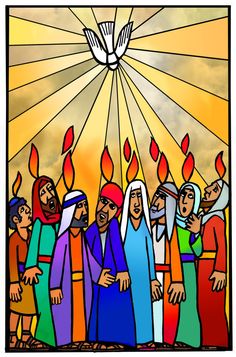
The Spirit is elsewhere in Scripture described as a gentle and encouraging presence, a counselor and comforter. Yet, not at Pentecost – the Spirit is portrayed like wind and fire (Acts 2:1-21). Neither a gentle breeze, nor a warm campfire – instead, a violent presence! The Holy Spirit on the Day of Pentecost was not some gentleman caller entering politely when invited. Rather, the Spirit appears more like a drunken sailor who bursts into the room and causes and big ruckus. There is nothing subtle about the Spirit at Pentecost. The Spirit is electric and volcanic, causing a huge upheaval. This is a big God with a big Word looking to expand out into a big world.

Pentecost

Because of Pentecost, believers are marked by God’s Spirit. The life of God within them is the life of the Spirit. God wants to pour out the Spirit on all kinds of people. He wants to fill people to overflowing so that what comes out of them is “prophecy.” That is, inspired speech and words coming from a spiritual heart full of the Spirit. Just as an inebriated person says and does things he/she would not typically say or do because they are filled with alcohol, so the person filled with God’s Spirit says things and does things that they would not typically say or do because their inspiration and courage do not come from themselves but is a result of God within them.

God transformed the little band of Christ followers from learners, to practitioners sent out with a mission.  Being on a mission from God is not so much about ability; it is about being filled and sent.  First time parents may read and learn all they can about parenting before their child is born. Yet, when that little bundle comes into the world and the hospital puts this kid in your arms and sends you out, you feel inadequate for the task.  Parenting becomes a kind of supernatural affair where you pray and learn on the fly, finding out that you need something beyond yourself to get anywhere in raising this screaming, pooping, sleeping person who depends completely on you for everything.

God has sent us into the world to make disciples and we may feel largely inadequate for the task. However, this has more to do with receiving the Spirit. The Spirit comes looking to turn our lives upside-down with new life in Jesus Christ.

Pentecost means the Spirit has come to shake things up and accomplish among God’s people what they could never do on their own. The church in the New Testament was not a country club for people to simply enjoy the perks of membership. The church in Acts 2 is more like a place where the people seem drunk because they are all talking with inspired speech from the Holy Spirit.

Everyone who calls on the name of the Lord will be saved. Maybe we do not need to be saved in the sense that we have already called on the name of the Lord concerning forgiveness of sins in Christ. Yet, maybe we need to call on the name of the Lord to be delivered from our misguided attempts to see the Christian life as a pleasant affair. Perhaps we need deliverance from disordered priorities and misguided loves. We may need to be saved from ourselves so that we are open to the Holy Spirit with palms up receiving from him whatever it is he wants to do in and through us, rather than telling God what we think he needs to do. Prayer, then, is more about receiving the Spirit and God’s purposes for us rather than giving God an earful and expecting him to buy into our plans.

Pentecost is the launching pad of the church’s mission – it was explosive because the Spirit is a kind of wild man who fills people up to overflowing with himself so that what comes out of them is inspired speech and missional actions.  If a language barrier cannot stop the Spirit from operating, then how much more can God transform us and use us in the lives of those around us?

0bab4-pentecost

How we interpret events is important. Peter interpreted the believers of Jesus speaking different languages as the outpouring of the Spirit. This outpouring of the Spirit is a sign that the end is near. This giving of the Spirit will be inclusive – there is room for all kinds of people. And, through the Spirit, God will save all who call on his name.  The way we interpret events is based upon what kind of relationships we have. Peter had a relationship with God that caused him to go constantly to prayer so that when the Spirit showed up, he interpreted that God was up to something.

Next week my wife and I will celebrate 35 years of marriage. How I interpret my anniversary is based upon what kind of relationship I have with my wife. A good relationship means that it will be a day of celebration and joy with the anticipation of more years together. A bad relationship would bring an interpretation of the day with anger or regret. If there is a bland relationship in which two people are married but just live under the same roof, then it is just another anniversary and there is no regret, but also no celebration or any anticipation of the future – it just is another day.

This is not just another day. It is Pentecost! Just as marriages occasionally need a spark and a fire and a fresh wind, so we need the Holy Spirit to breathe on us because God wants to do something within us that results in the church becoming afire with mission! How we interpret this day of Pentecost says a lot about our relationship to Jesus Christ. How we spend our day today says a lot about how we interpret the Holy Spirit in our lives. Let us be filled with the Spirit and with joy as we anticipate what our God will do now, and in the years to come.

Matthew 5:1-12 – The Beatitudes of Jesus

Sermon-on-the-Mount
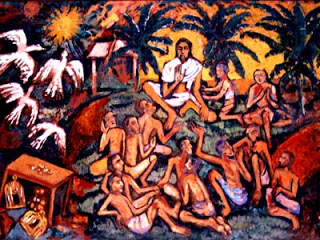
A Bengali depiction of Christ’s Sermon on the Mount

Now when Jesus saw the crowds, he went up on a mountainside and sat down. His disciples came to him, and he began to teach them. He said: 

“Blessed are the poor in spirit, 
    for theirs is the kingdom of heaven. 
Blessed are those who mourn, 
    for they will be comforted. 
Blessed are the meek, 
    for they will inherit the earth. 
Blessed are those who hunger and thirst for righteousness, 
    for they will be filled. 
Blessed are the merciful, 
    for they will be shown mercy. 
Blessed are the pure in heart, 
    for they will see God. 
Blessed are the peacemakers, 
    for they will be called children of God. 
Blessed are those who are persecuted because of righteousness, 
    for theirs is the kingdom of heaven. 

“Blessed are you when people insult you, persecute you and falsely say all kinds of evil against you because of me. Rejoice and be glad, because great is your reward in heaven, for in the same way they persecuted the prophets who were before you. (NIV) 

Just as God’s Law was given on a mountain (The Ten Commandments) so the law was restated on a mountain by Jesus (Sermon on the Mount). I believe that arguably one of the most important and impacting portions of Holy Scripture are the Beatitudes of Jesus, which serve as the foundation to all of Christ’s teaching. These Beatitudes are not simply a random collection of pithy phrases from Jesus on what constitutes approval from God. They intentionally build upon each other and describe true righteousness.  

Blessed are the poor in spirit.   

This Beatitude is the spiritual base to the Christian life.  Most of the original crowd listening to Jesus thought they were on the outside of the kingdom, on the margins of true religion. Instead, Jesus told them they have a place as poor and pitiable people. To be “poor in spirit” means one is a spiritual beggar who recognizes they have nothing to offer God. It is seeing oneself, one’s sin, and one’s life as spiritually bankrupt apart from God. Beggars have no ability to strike deals; they have nothing to leverage with; and, realize they deserve nothing. Beggars do one thing continually: they beg. The proud person would never be caught begging for anything. Yet, the humble spiritual beggar constantly prays because they need God! They discern that without God there is no hope. The kingdom of heaven belongs to the penitent and not the proud. 

Blessed are those who mourn. 

This is the emotional response of acknowledging one’s spiritual poverty.  Grief and lament have a central place in Christian theology and life. To avoid it, work around it, or short-circuit its process is to refuse Christ because there is no righteousness apart from mourning over sin. Crying, weeping, and even intense tears are important and necessary. To experience personal grief over one’s sins and the sins of the church and the world is a Beatitude of Jesus. You neither need position, power, privilege, nor pedigree to be a mourner. All can mourn. This is the door by which we enter the kingdom of God. 

Blessed are the meek. 

A meek spirit is the result of realizing our poverty of spirit and practicing grief and lament. At the heart of what it means to be meek is a spirit of non-retaliation. When we are flat on our backs before God, there is no place to look but up. Thus, there is no ability to look down on others. To be meek is to be broken before God. A meek person takes personal responsibility for their attitudes and actions. The meek have no need to retaliate, even when egregiously wronged, because they fully entrust themselves to God alone who judges the living and the dead. Ironically, brokenness is the path to righteous wholeness. 

Blessed are those who hunger and thirst for righteousness. 

Only those who know their poverty of spirit, personally grieve over sin, and are truly humble/meek end up longing for righteousness. This is much more than just desire; this is the recognition that without God I will not make it. I cannot be righteous without Jesus. Simply put, righteousness is a right relationship with God and others. That is what happens when a person is meek. Such a person knows she cannot make things right by herself; she needs help, specifically, God’s help. If we ever have the thought that we can live most days of our lives without God, we do not yet know true righteousness. People who understand their great need for Jesus are easy to spot. They crave and devour God’s Word as their daily food; and they cannot stop blabbering on about Jesus. 

Sermon on the Mount
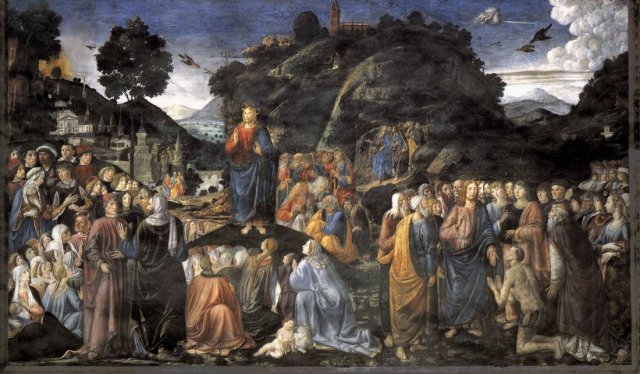
A fresco of the Sermon on the Mount on the northern wall of the Sistine Chapel.

There are three practices of living that arise from being filled with God’s righteousness.  They are the next three Beatitudes of mercy, purity, and peacemaking. These cannot be conjured up by our own will. They organically grow within us and are freely expressed because of what God is doing in our lives. You cannot force them any more than you can force a stalk of corn to grow on your terms. Instead, you work with the unforced rhythms of God’s grace and allow his righteousness to take root in you. Below the soil the activity of spiritual poverty, mourning, and humility takes place. Then, when the plant breaks the soil and flowers, it produces mercy, purity, and peace-making. 

Blessed are the merciful.  

Mercy begins with a disposition of the heart that seeks to be generous. Mercy is a loving response to someone or a group of people in misery. We accept them and help them because we ourselves have been there. Mercy looks for ways to come alongside others and help, rather than pile expectations and burdens on others without mentoring them in the ways of God. 

Blessed are the pure in heart. 

Purity also results from true righteousness. A stalk of corn might look good, but if you shuck it and it is filled with worms, it isn’t going to be worth much. Legalistic righteousness is concerned to look good, is obsessed with performance, perfection, and possessions. Conversely, the righteousness of God fills our hungry hearts and makes us pure and holy, set apart for his use. 

Blessed are the peacemakers.  

Peacemakers are people who find themselves caught in the middle and want to live righteously with the mercy and purity that God has provided for them. Peace is only realized through peacemakers. It seems we all desire peace, yet, peacemakers are hard to come by. It’s a tough gig. Peacemakers exist through being characterized by the earlier Beatitudes. To achieve peace, one must first be at peace with God and self – which is why we need the cross of Jesus Christ. 

Blessed are those who are persecuted because of righteousness.  

When a person lives in this righteousness as presented by Jesus, there will be persecution. Folks who are offended by even slight criticisms are usually the ones who are privileged and in power. They have not yet learned the ways of Jesus. Pettiness is nothing more than a sign of unrighteousness. Yoking up with Jesus, following him, and living into his words and ways has always been risky and dangerous. The Beatitudes of Jesus are not characteristics that lead to power, prestige, or possessions, but likely just the opposite. 

The former Pope Benedict XVI, explained Christ’s Beatitudes this way: “The Beatitudes, spoken with the community of Jesus’ disciples in view, are paradoxes – the standards of the world are turned upside down as soon as things are seen in their right perspective, which is to say, in terms of God’s values, so different from those of the world. It is precisely those who are poor in worldly terms, those thought of as lost souls, who are truly fortunate ones, the blessed, who have every reason to rejoice and exult in their suffering. The Beatitudes are promises resplendent with the new image of the world and humanity inaugurated by Jesus.” 

Those who are in Jesus Christ become living beatitudes, walking, talking blessings to the world.  Those who live with Jesus in his kingdom have a destiny to be witnesses to another subversive, yet wonderful, way of life, where the last are first and the greatest are the least. 

O Lamb of God, that takes away the sins of the world, have mercy upon me. 

O Lamb of God, that takes away the sins of the world, have mercy upon me. 

O Lamb of God, that takes away the sins of the world, grant me your peace. 

Exodus 19:16-25 – An Awesome God

Mount Sinai

On the morning of the third day, thunder roared, and lightning flashed, and a dense cloud came down on the mountain. There was a long, loud blast from a ram’s horn, and all the people trembled. Moses led them out from the camp to meet with God, and they stood at the foot of the mountain.  All of Mount Sinai was covered with smoke because the Lord had descended on it in the form of fire. The smoke billowed into the sky like smoke from a brick kiln, and the whole mountain shook violently. As the blast of the ram’s horn grew louder and louder, Moses spoke, and God thundered his reply. The Lord came down on the top of Mount Sinai and called Moses to the top of the mountain. So, Moses climbed the mountain.

Then the Lord told Moses, “Go back down and warn the people not to break through the boundaries to see the Lord, or they will die. Even the priests who regularly come near to the Lord must purify themselves so that the Lord does not break out and destroy them.”

“But Lord,” Moses protested, “the people cannot come up to Mount Sinai. You already warned us. You told me, ‘Mark off a boundary all around the mountain to set it apart as holy.’”

But the Lord said, “Go down and bring Aaron back up with you. In the meantime, do not let the priests or the people break through to approach the Lord, or he will break out and destroy them.”

So, Moses went down to the people and told them what the Lord had said. (NLT)

As Christians await the Day of Pentecost and the giving of the Spirit, the Revised Common Lectionary reminds us of another great anticipation from the Old Testament. The ancient Israelites were amazingly delivered from Egyptian slavery, miraculously walked through the Red Sea, and traveled with wondrous anticipation to Mount Sinai. Now, in today’s reading, they are about to meet with God!

The scene of this meeting is not exactly the romantic highland encounter of the Man from Snowy River (my wife’s all-time favorite movie). The landscape is much more akin to the dark and volcanic Mount Doom from The Lord of the Rings. The picture appears more foreboding than loving. The thing about mountain top experiences is that they are not all monolithic one-size-fits-all encounters with bright rainbows and happy skipping unicorns.

Holy Scripture is replete with mountain experiences. Mountains serve as symbols for significant encounters with a mighty God. Whether it is Christ’s transfiguration on a mountain; or, the giving of the law on a mountain; the awesome mountain serves as a tangible symbol of divine majesty, strength, and sovereignty. And, I might add, conversely, valleys in Scripture are symbolic of difficulty and suffering.  Our God is a God of both mountain and valley. That is, the God of the Bible is both transcendent and immanent; he rules with power and might high above us on his holy mountain; yet, he also comes near to us in the valley of the shadow of death.

Leading up to the giving of the Ten Words (Commandments) in Exodus 20, Exodus 19 portrays an awesome scene of God in his transcendent holiness and power. In fact, the experience was so otherworldly that the people were afraid to even come near the mountain. The Israelites needed limits placed on themselves because of God’s holy presence. Just like coming too near the immense power of the sun will destroy us, so getting near God can ruin us if we do not respect his holiness.

Respecting God’s power and transcendence brings the reality of his immanence into greater appreciation. God has gone to extreme lengths to reveal himself to his people. For the Christian, it all culminates through the incarnation of Christ, the sending of the Son. In Jesus, the transcendence and immanence of God meet perfectly to bridge the chasm between humanity and the divine.  Because of Jesus, the awesome sounds of thunder and trumpet do not lead to fear; they announce grace to those who approach God by faith.

You have not come to a mountain that can be touched and that is burning with fire; to darkness, gloom and storm; to a trumpet blast or to such a voice speaking words that those who heard it begged that no further word be spoken to them, because they could not bear what was commanded: “If even an animal touches the mountain, it must be stoned to death.” The sight was so terrifying that Moses said, “I am trembling with fear.” But you have come to Mount Zion, to the city of the living God, the heavenly Jerusalem. You have come to thousands upon thousands of angels in joyful assembly, to the church of the firstborn, whose names are written in heaven. You have come to God, the Judge of all, to the spirits of the righteous made perfect, to Jesus the mediator of a new covenant….

See to it that you do not refuse him who speaks. If they did not escape when they refused him who warned them on earth, how much less will we, if we turn away from him who warns us from heaven? At that time, his voice shook the earth, but now he has promised, “Once more I will shake not only the earth but also the heavens.” The words “once more” indicate the removing of what can be shaken—that is, created things—so that what cannot be shaken may remain.

Therefore, since we are receiving a kingdom that cannot be shaken, let us be thankful, and so worship God acceptably with reverence and awe, for our “God is a consuming fire.” (Hebrews 12:18-29, NIV)

Our God is an awesome God. As Christians anticipate Pentecost, we connect the consuming fire of Mount Sinai with the fire of the Spirit. The divine drama of both experiences has provided God’s people with spiritual power. Both the deliverance of the Israelites from Egyptian slavery by God and the deliverance secured on Mount Zion from spiritual slavery by Jesus are meant to free us to do the will of God. With God’s Word and God’s Spirit given to us, we are emancipated from an empty way of life to experience the fullness of Christ.

May the Spirit who hovered over the waters at creation breathe life into your spirit.

May the Spirit whose presence on the mountain was a consuming fire grant you a revived spirit.

May the Spirit who overshadowed the virgin Mary at the conception of our Lord overwhelm your spirit with joy.

May the Spirit who set the Church afire on Pentecost aflame every spirit on earth with the love of Christ.

And, may the Spirit who exhorts, encourages, helps, and comforts be your blessing and your life today and always. Amen.

Psalm 33:12-22 – God Is Watching

sunshine of love

Happy is the nation whose God is the Lord, 
    the people whom he has chosen as his heritage. 

The Lord looks down from heaven; 
    he sees all humankind. 
From where he sits enthroned he watches 
    all the inhabitants of the earth— 
he who fashions the hearts of them all, 
    and observes all their deeds. 
A king is not saved by his great army; 
    a warrior is not delivered by his great strength. 
The war horse is a vain hope for victory, 
    and by its great might it cannot save. 

Truly the eye of the Lord is on those who fear him, 
    on those who hope in his steadfast love, 
to deliver their soul from death, 
    and to keep them alive in famine. 

Our soul waits for the Lord; 
    he is our help and shield. 
Our heart is glad in him, 
    because we trust in his holy name. 
Let your steadfast love, O Lord, be upon us, 
    even as we hope in you. (NRSV) 

God is in control of the world, and I am not. Although the myth of self-sufficiency and self-reliance thoroughly permeates individualist societies, this in no way lessens the transcendence of a big God. In today’s psalm, the scene of God looking down from heaven portrays him as above all, firmly in control, yet, attentive to all that is happening on the earth. Individual human creatures subscribing to a narrative of personal independence will inevitably run into the Creator God. 

Our success may give us the illusion that our own strength, intelligence, and/or ingenuity has brought us the good things we possess – not God. “I worked hard for my money and I will do whatever I want with it,” and the even more crass, “It wasn’t God who put food on my table,” are just a few of the power delusions I have heard from others, as if personal accomplishments are unconnected to any other force in the universe. 

In addition, our lack of success may also cause us to pause and wonder if God is really observing all our deeds, or not. Perhaps he is reclining in his La-z-God chair and watching old baseball game replays of the Angels. More likely, we have become so expectant of satisfactory service and immediate results as consumers in a capitalist culture that we fail to discern the virtue of patience – that God is not slow in keeping his promises as some would understand it. 

The bald fact of the matter is that we need God. What’s more, God feels no compulsion from us to be hurried along in his purposes for humanity. Since God is the divine gravity in this world, the only way of realizing the good life is to conform ourselves to him, and not the other way around.  

When we learn to exercise the inherent gifts of hope and patience which a gracious God has fashioned in our hearts, then we begin to discover persevering trust, enduring happiness, a settled sense of gladness, and steadfast love. We awaken to the true passion of God for us. Rather than a capricious or indifferent deity, the Lord God looks upon us with endearing faithfulness. In short, God’s heart is forever drawn to us. Therefore, we need not attempt to take all matters into our own hands, as if we are alone in the world. If we can see a vision of God high and lifted-up, observing us with a gaze of delight, then our spirits open to mercy and we find grace to help us in our time of need. The prophet Zephaniah allows us a glimpse into God’s feelings for us:  

The Lord your God is in your midst—a warrior bringing victory. He will create calm with his love; he will rejoice over you with singing. (Zephaniah 3:17, CEB)

God labors on our behalf. God has our backs. God establishes a safe environment for us. And, we must never forget: God delights in you so much that – this very minute – he is singing songs of joy over you. For trust and hope cannot be coerced by another or willed into being by the mind; it can only be generated through the deep conviction of God’s broad love for you and me. 

The best self-help program I know of is not self-help at all – it is the self-care of opening to a loving God and allowing God’s joy and delight to fill us. God is watching us, and it is the gaze of adoration, not condemnation. 

Dear God, the One who watches all, love comes from you. Anyone who loves is your child and knows you. And anyone who does not love does not know you, for God is love. Thank you for showing me love by sending your one and only Son into the world so that I might have eternal life through him. Dear God, since you loved me that much, I surely ought to love others. May you live in me and may the love of Jesus be brought to full expression in me through the power of the Spirit. Amen.